Fluorouracil Cream
Product Images NDC 75907-169

View Photos of Packaging, Regulatory Labels, and Product Appearance

Product Visual Gallery

This gallery contains 4 technical images submitted to the FDA as part of the official labeling for Fluorouracil (NDC 75907-169). Unlike standard consumer photos, these assets often include clinical data figures, molecular chemical structures, and official manufacturer packaging layouts.

As provided by Dr. Reddy's Laboratories Inc., these visuals offer a comprehensive scientific overview of the product's physical and chemical identity, aiding pharmacists and researchers in product verification and study.

FDA Label Image

Carton (Carton)

Carton (Carton)
This is a description of Fluorouracil Cream 0.5% for topical use. The cream comes in a 30g net weight container manufactured by "Dr. Reddy's" company. It contains patented porous microspheres and is composed of ingredients like ethyl cellulose, dimethicone, and dimethyloctadecylsilane. The cream should be stored at 20-25°C (68-77°F).*
FDA Label Image

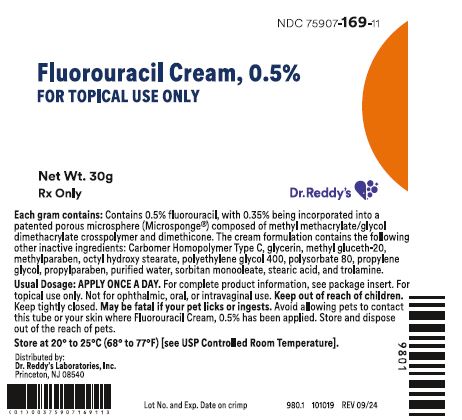
Container (Container)

Container (Container)
This is a description for a Fluorouracil Cream, 0.5% for topical use. The cream contains Fluorouracil integrated into patented porous microspheres, along with other inactive ingredients like Carbomer Copolymer Type C, Isopropyl Myristate, Polysorbate 60, Sorbitan Monostearate, and Cetyl Alcohol. It is recommended to apply once a day and should be kept out of reach of children. The cream should be stored between 20-25°C (68-77°F). For further details, refer to the package insert.*
FDA Label Image

Figures (Figures Fu 2)

Figures (Figures Fu 2)
This is a chart displaying the percentage of subjects with 100% clearance and at least 75% clearance over different periods of time (1 week, 2 weeks, and 4 weeks) compared to a vehicle control group. The data shows the clearance percentages increasing over time across the different groups.*
FDA Label Image

Chemical-structure (Chemical Structure Fu 1)

* These product label images have been analyzed using experimental machine learning. Please verify findings with the primary label text.