Important Limitations of Use:
KRYSTEXXA is not recommended for the treatment of asymptomatic hyperuricemia.
Monitoring Therapy: The risk of anaphylaxis and infusion reactions is higher in patients who have lost therapeutic response. Monitor serum uric acid levels prior to infusions and consider discontinuing treatment if levels increase to above 6 mg/dL, particularly when 2 consecutive levels above 6 mg/dL are observed [see Warnings and Precautions (5.1, 5.2)].
The KRYSTEXXA admixture should only be administered by intravenous infusion over no less than 120 minutes via gravity feed, syringe-type pump, or infusion pump.
Patients should receive pre-infusion medications (e.g., antihistamines, corticosteroids), to minimize the risk of anaphylaxis and infusion reactions. Administer KRYSTEXXA in a healthcare setting and by healthcare providers prepared to manage anaphylaxis and infusion reactions, and observe patients for an appropriate period of time after administration [see Warnings and Precautions (5.1, 5.2)].
If an infusion reaction occurs during the administration of KRYSTEXXA, the infusion may be slowed, or stopped and restarted at a slower rate, at the discretion of the physician. Since infusion reactions can occur after completion of infusion, observation of patients for approximately an hour post-infusion should be considered [see Warnings and Precautions (5.2), Adverse Reactions (6.1)].
Risk Summary
There are no adequate and well-controlled studies of KRYSTEXXA in pregnant women.
Based on animal reproduction studies, no structural abnormalities were observed when pegloticase was administered by subcutaneous injection to pregnant rats and rabbits during the period of organogenesis at doses up to 50 and 75 times, respectively, the maximum recommended human dose (MRHD). Decreases in mean fetal and pup body weights were observed at approximately 50 and 75 times the MRHD, respectively [see Data].
All pregnancies have a background risk of birth defect, loss or other adverse outcomes. In the US general population, the estimated background risk of major birth defects and miscarriage in clinical recognized pregnancies is 2% to 4% and 15% to 20%, respectively.
Data
Animal Data
In 2 separate embryo-fetal developmental studies, pregnant rats and rabbits received pegloticase during the period of organogenesis at doses up to approximately 50 and 75 times the maximum recommended human dose (MRHD), respectively (on a mg/m2 basis at maternal doses up to 40 and 30 mg/kg twice weekly, in rats and rabbits, respectively). No evidence of structural abnormalities was observed in rats or rabbits. However, decreases in mean fetal and pup body weights were observed at approximately 50 and 75 times the MRHD in rats and rabbits, respectively (on a mg/m2 basis at maternal doses up to 40 and 30 mg/kg every other day, in rats and rabbits, respectively). No effects on mean fetal body weights were observed at approximately 10 and 25 times the MRHD in rats and rabbits, respectively (on a mg/m2 basis at maternal doses up to 10 mg/kg twice weekly in both species).
Risk Summary
It is not known whether this drug is excreted in human milk. Therefore, KRYSTEXXA should not be used when breastfeeding unless the clear benefit to the mother can overcome the unknown risk to the newborn/infant.
Absorption
Following single intravenous infusions of 0.5 mg to 12 mg pegloticase in 23 patients with symptomatic gout, maximum serum concentrations of pegloticase increased in proportion to the dose administered. The population pharmacokinetic analysis showed that age, sex, weight, and creatinine clearance did not influence the pharmacokinetics of pegloticase.
Distribution
Significant covariates included in the model for determining clearance and volume of distribution were found to be body surface area and anti-pegloticase antibodies.
Special Populations
Pediatric Populations
The pharmacokinetics of pegloticase has not been studied in children and adolescents.
Patients with Renal or Hepatic Impairment
No formal studies were conducted to examine the effects of either renal or hepatic impairment on pegloticase pharmacokinetics.
How Supplied
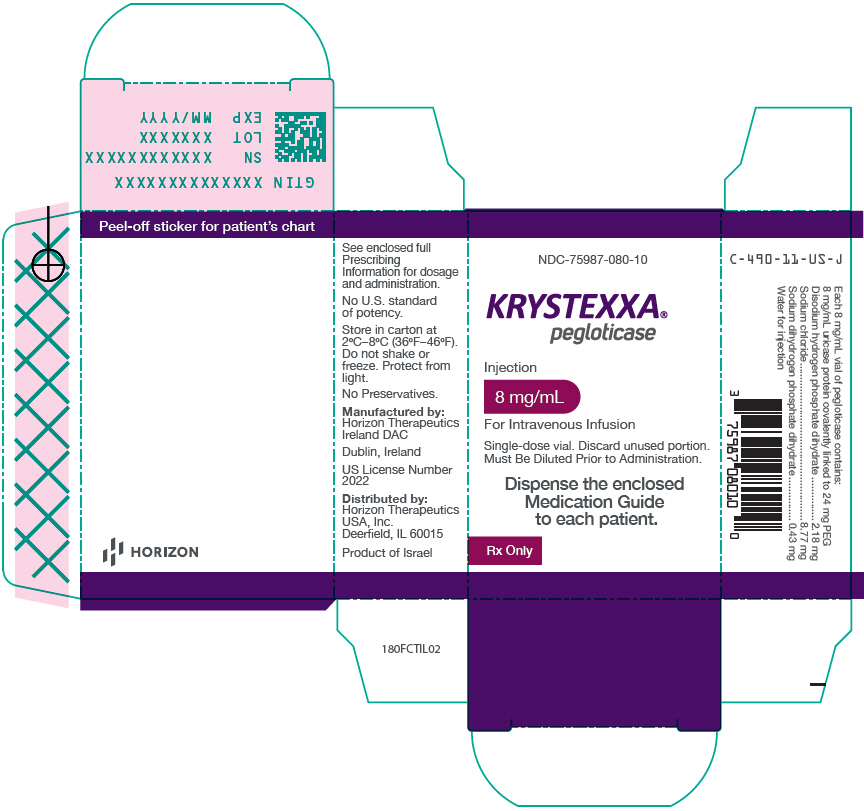
KRYSTEXXA is supplied as a clear, colorless, sterile solution in phosphate buffered saline intended for intravenous infusion after dilution. KRYSTEXXA is supplied in a single-dose 2 mL glass vial with a Teflon® coated (latex-free) rubber injection stopper to deliver KRYSTEXXA as 8 mg of uricase protein in 1 mL volume.
General Information
Provide and instruct patients to read the accompanying Medication Guide before starting treatment and before each subsequent treatment.
Anaphylaxis and Infusion Reactions
- Anaphylaxis and infusion reactions can occur at any infusion while on therapy. Counsel patients on the importance of adhering to any prescribed medications to help prevent or lessen the severity of these reactions.
- Educate patients on the signs and symptoms of anaphylaxis, including wheezing, peri-oral or lingual edema, hemodynamic instability, and rash or urticaria.
- Educate patients on the most common signs and symptoms of an infusion reaction, including urticaria (skin rash), erythema (redness of the skin), dyspnea (difficulty breathing), flushing, chest discomfort, chest pain, and rash.
- Advise patients to seek medical care immediately if they experience any symptoms of an allergic reaction during or at any time after the infusion of KRYSTEXXA [see Warnings and Precautions (5.1, 5.2), Adverse Reactions (6.1)].
- Advise patients to discontinue any oral urate-lowering agents before starting on KRYSTEXXA and not to take any oral urate-lowering agents while on KRYSTEXXA.
Glucose-6-phosphate dehydrogenase (G6PD) Deficiency
Inform patients not to take KRYSTEXXA if they have a condition known as G6PD deficiency. Explain to patients that G6PD deficiency is more frequently found in individuals of African, Mediterranean, or Southern Asian ancestry and that they may be tested to determine if they have G6PD deficiency, unless already known [see Warnings and Precautions (5.3), Contraindications (4)].
Gout Flares
Explain to patients that gout flares may initially increase when starting treatment with KRYSTEXXA, and that medications to help reduce flares may need to be taken regularly for the first few months after KRYSTEXXA is started [see Warnings and Precautions (5.4), Adverse Reactions (6.1)]. Advise patients that they should not stop KRYSTEXXA therapy if they have a flare.
Manufactured by:
Horizon Therapeutics Ireland DAC
Dublin, Ireland
US License Number 2022
Distributed by:
Horizon Therapeutics USA, Inc.
Deerfield, IL 60015
KRY-US-PI-002