Pharmacokinetics in Adults
General
Darunavir is primarily metabolized by CYP3A. Ritonavir inhibits CYP3A, thereby increasing the plasma concentrations of darunavir. When a single dose of darunavir 600 mg was given orally in combination with 100 mg ritonavir twice daily, there was an approximate 14-fold increase in the systemic exposure of darunavir. Therefore, darunavir should only be used in combination with 100 mg of ritonavir to achieve sufficient exposures of darunavir.
The pharmacokinetics of darunavir, co-administered with low dose ritonavir (100 mg), has been evaluated in healthy adult volunteers and in HIV-1-infected subjects. Table 11 displays the population pharmacokinetic estimates of darunavir after oral administration of darunavir/ritonavir 600/100 mg twice daily (based on sparse sampling in 285 patients in trial TMC114-C214, 278 patients in trial TMC114-C229 and 119 patients [integrated data] from trials TMC114-C202 and TMC114-C213) and darunavir/ritonavir 800/100 mg once daily (based on sparse sampling in 335 patients in trial TMC114-C211 and 280 patients in trial TMC114-C229) to HIV-1-infected patients.
Table 11: Population Pharmacokinetic Estimates of Darunavir at Darunavir/ritonavir 800/100 mg Once Daily (Trial TMC114-C211, 48-Week Analysis and Trial TMC114-C229, 48-Week Analysis) and Darunavir/ritonavir 600/100 mg Twice Daily (Trial TMC114-C214, 48-Week Analysis, Trial TMC114-C229, 48-Week Analysis and Integrated Data from Trials TMC114-C213 and TMC114-C202, Primary 24-Week Analysis)
| Parameter | Darunavir/ritonavir 800/100 mg once daily | Darunavir/ritonavir 600/100 mg twice daily |
|---|
| TMC114-C211 N=335 | TMC114-C229 N=280 | TMC114-C214 N=285 | TMC114-C229 N=278 | TMC114-C213 + TMC114-C202 (integrated data) N=119 |
AUC24h (ng∙h/mL)a |
Mean ± Standard Deviation | 93026 ± 27050 | 93334 ± 28626 | 116796 ± 33594 | 114302 ± 32681 | 124698 ± 32286 |
Median (Range) | 87854 (45000-219240) | 87788 (45456-236920) | 111632 (64874-355360) | 109401 (48934-323820) | 123336 (67714-212980) |
C0h (ng/mL) |
Mean ± Standard Deviation | 2282 ± 1168 | 2160 ± 1201 | 3490 ± 1401 | 3386 ± 1372 | 3578 ± 1151 |
Median (Range) | 2041 (368-7242) | 1896 (184-7881) | 3307 (1517-13198) | 3197 (250-11865) | 3539 (1255-7368) |
N=number of subjects with data
a AUC24h is calculated as AUC12h*2.
Absorption and Bioavailability
Darunavir, co-administered with 100 mg ritonavir twice daily, was absorbed following oral administration with a Tmax of approximately 2.5-4 hours. The absolute oral bioavailability of a single 600 mg dose of darunavir alone and after co-administration with 100 mg ritonavir twice daily was 37% and 82%, respectively. In vivo data suggest that darunavir/ritonavir is an inhibitor of the P-glycoprotein (P-gp) transporters.
Effects of Food on Oral Absorption
When darunavir tablets were administered with food, the Cmax and AUC of darunavir, co-administered with ritonavir, is approximately 40% higher relative to the fasting state. Within the range of meals studied, darunavir exposure is similar. The total caloric content of the various meals evaluated ranged from 240 Kcal (12 gms fat) to 928 Kcal (56 gms fat).
Distribution
Darunavir is approximately 95% bound to plasma proteins. Darunavir binds primarily to plasma alpha 1-acid glycoprotein (AAG).
Metabolism
In vitro experiments with human liver microsomes (HLMs) indicate that darunavir primarily undergoes oxidative metabolism. Darunavir is extensively metabolized by CYP enzymes, primarily by CYP3A. A mass balance study in healthy volunteers showed that after a single dose administration of 400 mg 14C-darunavir, co-administered with 100 mg ritonavir, the majority of the radioactivity in the plasma was due to darunavir. At least 3 oxidative metabolites of darunavir have been identified in humans; all showed activity that was at least 90% less than the activity of darunavir against wild-type HIV-1.
Elimination
A mass balance study in healthy volunteers showed that after single dose administration of 400 mg 14C-darunavir, co-administered with 100 mg ritonavir, approximately 79.5% and 13.9% of the administered dose of 14C-darunavir was recovered in the feces and urine, respectively. Unchanged darunavir accounted for approximately 41.2% and 7.7% of the administered dose in feces and urine, respectively. The terminal elimination half-life of darunavir was approximately 15 hours when co-administered with ritonavir. After intravenous administration, the clearance of darunavir, administered alone and co-administered with 100 mg twice daily ritonavir, was 32.8 L/h and 5.9 L/h, respectively.
Special Populations
Hepatic Impairment
Darunavir is primarily metabolized by the liver. The steady-state pharmacokinetic parameters of darunavir were similar after multiple dose co-administration of darunavir/ritonavir 600/100 mg twice daily to subjects with normal hepatic function (n=16), mild hepatic impairment (Child-Pugh Class A, n=8), and moderate hepatic impairment (Child-Pugh Class B, n=8). The effect of severe hepatic impairment on the pharmacokinetics of darunavir has not been evaluated [see Dosage and Administration (2.6) and Use in Specific Populations (8.6)].
Hepatitis B or Hepatitis C Virus Co-infection
The 48-week analysis of the data from Studies TMC114-C211 and TMC114-C214 in HIV-1-infected subjects indicated that hepatitis B and/or hepatitis C virus co-infection status had no apparent effect on the exposure of darunavir.
Renal Impairment
Results from a mass balance study with 14C-darunavir/ritonavir showed that approximately 7.7% of the administered dose of darunavir is excreted in the urine as unchanged drug. As darunavir and ritonavir are highly bound to plasma proteins, it is unlikely that they will be significantly removed by hemodialysis or peritoneal dialysis. Population pharmacokinetic analysis showed that the pharmacokinetics of darunavir were not significantly affected in HIV-1-infected subjects with moderate renal impairment (CrCL between 30-60 mL/min, n=20). There are no pharmacokinetic data available in HIV-1-infected patients with severe renal impairment or end stage renal disease [see Use in Specific Populations (8.7)].
Gender
Population pharmacokinetic analysis showed higher mean darunavir exposure in HIV-1-infected females compared to males. This difference is not clinically relevant.
Race
Population pharmacokinetic analysis of darunavir in HIV-1-infected subjects indicated that race had no apparent effect on the exposure to darunavir.
Geriatric Patients
Population pharmacokinetic analysis in HIV-1-infected subjects showed that darunavir pharmacokinetics are not considerably different in the age range (18 to 75 years) evaluated in HIV-1-infected subjects (n=12, age greater than or equal to 65) [see Use in Specific Populations (8.5)].
Pediatric Patients
Darunavir/ritonavir administered twice daily
The pharmacokinetics of darunavir in combination with ritonavir in 93 antiretroviral treatment-experienced HIV-1-infected pediatric subjects 3 to less than 18 years of age and weighing at least 10 kg showed that the administered weight-based dosages resulted in similar darunavir exposure when compared to the darunavir exposure achieved in treatment-experienced adults receiving darunavir/ritonavir 600/100 mg twice daily [see Dosage and Administration (2.5)].
Darunavir/ritonavir administered once daily
The pharmacokinetics of darunavir in combination with ritonavir in 12 antiretroviral treatment‑naïve HIV-1-infected pediatric subjects 12 to less than 18 years of age and weighing at least 40 kg receiving darunavir/ritonavir 800/100 mg once daily resulted in similar darunavir exposures when compared to the darunavir exposure achieved in treatment-naïve adults receiving darunavir/ritonavir 800/100 mg once daily [see Dosage and Administration (2.5)].
Based on population pharmacokinetic modeling and simulation, the proposed darunavir/ritonavir once daily dosing regimens for pediatric patients 3 to less than 12 years of age is predicted to result in similar darunavir exposures when compared to the darunavir exposures achieved in treatment-naïve adults receiving darunavir/ritonavir 800/100 mg once daily [see Dosage and Administration (2.5)].
The population pharmacokinetic parameters in pediatric subjects with darunavir/ritonavir administered once or twice daily are summarized in the table below:
Table 12: Population Pharmacokinetic Estimates of Darunavir Exposure (Trials TMC114‑C230, TMC114-C212 and TMC114-C228) Following Administration of Doses in Tables 2 and 3
| Parameter | Darunavir/ ritonavir once daily | Darunavir/ritonavir twice daily |
|---|
| TMC114-C230aN=12 | TMC114-C212N=74 | TMC114-C228c |
|---|
| 10 to less than 15 kgbN=10 | 15 to less than 20 kgdN=13 |
|---|
AUC24h (ng∙h/mL)e) |
Mean ± Standard Deviation | 84390 ± 23587 | 126377 ± 34356 | 137896 ± 51420 | 157760 ± 54080 |
Median (Range) | 86741 (35527-123325) | 127340 (67054-230720) | 124044 (89688-261090) | 132698 (112310- 294840) |
C0h (ng/mL) |
Mean ± Standard Deviation | 2141 ± 865 | 3948 ± 1363 | 4510 ± 2031 | 4848 ± 2143 |
Median (Range) | 2234 (542-3776) | 3888 (1836-7821) | 4126 (2456-9361) | 3927 (3046-10292) |
N=number of subjects with data.
a Summary statistics for population pharmacokinetic parameter estimates for DRV after administration of DRV/rtv at 800/100 mg once daily in treatment-naïve HIV-1 infected subjects from 12 to <18 years of age – Week-48 Analyses.
b Calculated from individual pharmacokinetic parameters estimated for Week 2 and Week 4, based on the Week 48 analysis that evaluated a darunavir dose of 20 mg/kg twice daily with ritonavir 3 mg/kg twice daily.
c Subjects may have contributed pharmacokinetic data to both the 10 kg to less than 15 kg weight group and the 15 kg to less than 20 kg weight group.
d The 15 kg to less than 20 kg weight group received 380 mg (3.8 mL) darunavir oral suspension twice daily with 48 mg (0.6 mL) ritonavir oral solution twice daily in TMC114-C228. Calculated from individual pharmacokinetic parameters estimated for Week 2 post-dose adjustment visit; Week 24 and Week 48 based on the – Week 48 analysis that evaluated a darunavir dose of 380 mg twice daily.
e AUC24h is calculated as AUC12h*2.
Pregnancy and Postpartum
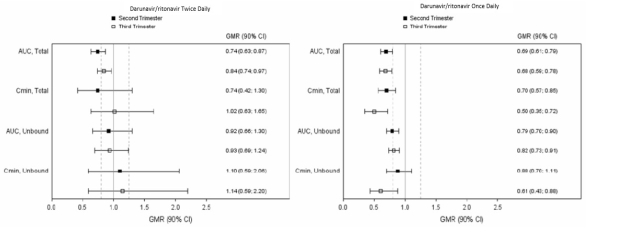
The exposure to total darunavir and ritonavir after intake of darunavir/ritonavir 600/100 mg twice daily and darunavir/ritonavir 800/100 mg once daily as part of an antiretroviral regimen was generally lower during pregnancy compared with postpartum (see Table 13, Table 14 and Figure 1).
Table 13: Pharmacokinetic Results of Total Darunavir After Administration of Darunavir /ritonavir at 600/100 mg Twice Daily as Part of an Antiretroviral Regimen, During the 2nd Trimester of Pregnancy, the 3rd Trimester of Pregnancy and Postpartum
Pharmacokinetics of total darunavir
(mean ± standard deviation) | 2nd Trimester of pregnancy
(n=12)a | 3rd Trimester of pregnancy
(n=12) | Postpartum (6–12 Weeks)
(n=12) |
Cmax, ng/mL | 4668 ± 1097 | 5328 ± 1631 | 6659 ± 2364 |
AUC24h, ng.h/mLb | 78740 ± 19194 | 91760 ± 34720 | 113780 ± 52680 |
Cmin, ng/mL | 1922 ± 825 | 2661 ± 1269 | 2851 ± 2216 |
a n=11 for AUC24h
b AUC24h is calculated as AUC12h*2
Table 14: Pharmacokinetic Results of Total Darunavir After Administration of Darunavir /ritonavir at 800/100 mg Once Daily as Part of an Antiretroviral Regimen, During the 2nd Trimester of Pregnancy, the 3rd Trimester of Pregnancy and PostpartumPharmacokinetics of total darunavir
(mean ± standard deviation) | 2nd Trimester of pregnancy
(n=17) | 3rd Trimester of pregnancy
(n=15) | Postpartum (6–12 Weeks)
(n=16) |
Cmax, ng/mL | 4964 ± 1505 | 5132 ± 1198 | 7310 ± 1704 |
AUC24h, ng.h/mL | 62289 ± 16234 | 61112 ± 13790 | 92116 ± 29241 |
Cmin, ng/mL | 1248 ± 542 | 1075 ± 594 | 1473 ± 1141 |
Due to an increase in the unbound fraction of darunavir during pregnancy compared to postpartum, unbound darunavir exposures were less reduced during pregnancy as compared to postpartum. Exposure reductions during pregnancy were greater for the once daily regimen as compared to the twice daily regimen (see Figure 1).
Figure 1: Pharmacokinetic Results (Within-Subject Comparison) of Total and Unbound Darunavir After Administration of Darunavir/ritonavir at 600/100 mg Twice Daily or 800/100 mg Once Daily as Part of an Antiretroviral Regimen, During the 2nd and 3rd Trimester of Pregnancy Compared to Postpartum
Legend: 90% CI: 90% confidence interval; GMR: geometric mean ratio. Solid vertical line: ratio of 1.0; dotted vertical lines: reference lines of 0.8 and 1.25.
Drug Interactions
[See also Contraindications (4), Warnings and Precautions (5.5) and Drug Interactions (7).]
Darunavir co-administered with ritonavir is an inhibitor of CYP3A, CYP2D6, and P-gp. Co-administration of darunavir and ritonavir with drugs primarily metabolized by CYP3A and CYP2D6, or are transported by P-gp, may result in increased plasma concentrations of such drugs, which could increase or prolong their therapeutic effect and adverse events.
Darunavir and ritonavir are metabolized by CYP3A. In vitro data indicate that darunavir may be a P-gp substrate. Drugs that induce CYP3A activity would be expected to increase the clearance of darunavir and ritonavir, resulting in lowered plasma concentrations of darunavir and ritonavir. Co-administration of darunavir and ritonavir and other drugs that inhibit CYP3A or P-gp may decrease the clearance of darunavir and ritonavir and may result in increased plasma concentrations of darunavir and ritonavir.
Drug interaction studies were performed with darunavir and other drugs likely to be co-administered and some drugs commonly used as probes for pharmacokinetic interactions. The effects of co-administration of darunavir on the AUC, Cmax, and Cmin values are summarized in Table 15 (effect of other drugs on darunavir) and Table 16 (effect of darunavir on other drugs). For information regarding clinical recommendations, see Drug Interactions (7).
Several interaction studies have been performed with a dose other than the recommended dose of the co-administered drug or darunavir; however, the results are applicable to the recommended dose of the co-administered drug and/or darunavir.
Table 15: Drug Interactions: Pharmacokinetic Parameters for Darunavir in the Presence of Co-Administered Drugs
| Co-administered drug | Dose/Schedule | N | PK | LS Mean ratio (90% CI) of darunavirPharmacokinetic parameters with/without co-administered drugno effect =1.00 |
|---|
| Co-administered Drug | Darunavir/ ritonavir | | | Cmax | AUC | Cmin |
Co-administration with other HIV protease inhibitors |
Atazanavir | 300 mg q.d.a | 400/100 mg b.i.d.b | 13 | ↔ | 1.02 (0.96-1.09) | 1.03 (0.94-1.12) | 1.01 (0.88-1.16) |
Indinavir | 800 mg b.i.d. | 400/100 mg b.i.d. | 9 | ↑ | 1.11 (0.98-1.26) | 1.24 (1.09-1.42) | 1.44 (1.13-1.82) |
Lopinavir/ ritonavir | 400/100 mg b.i.d. 533/133.3 mg b.i.d. | 1200/100 mg b.i.d.c 1200 mg b.i.d.c | 14 15 | ↓ ↓ | 0.79 (0.67-0.92) 0.79 (0.64-0.97) | 0.62 (0.53-0.73) 0.59 (0.50-0.70) | 0.49 (0.39-0.63) 0.45 (0.38-0.52) |
Saquinavir hard gel capsule | 1000 mg b.i.d. | 400/100 mg b.i.d. | 14 | ↓ | 0.83 (0.75-0.92) | 0.74 (0.63-0.86) | 0.58 (0.47-0.72) |
Co-administration with other HIV antiretrovirals |
Didanosine | 400 mg q.d. | 600/100 mg b.i.d. | 17 | ↔ | 0.93 (0.86-1.00) | 1.01 (0.95-1.07) | 1.07 (0.95-1.21) |
Efavirenz | 600 mg q.d. | 300/100 mg b.i.d. | 12 | ↓ | 0.85 (0.72-1.00) | 0.87 (0.75-1.01) | 0.69 (0.54-0.87) |
Etravirine | 200 mg b.i.d. | 600/100 mg b.i.d. | 15 | ↔ | 1.11 (1.01-1.22) | 1.15 (1.05-1.26) | 1.02 (0.90-1.17) |
Nevirapine | 200 mg b.i.d. | 400/100 mg b.i.d. | 8 | ↑ | 1.40 d (1.14-1.73) | 1.24 d (0.97-1.57) | 1.02 d (0.79-1.32) |
Rilpivirine | 150 mg q.d. | 800/100 mg q.d. | 15 | ↔ | 0.90 (0.81-1.00) | 0.89 (0.81-0.99) | 0.89 (0.68-1.16) |
Tenofovir disoproxil fumarate | 300 mg q.d. | 300/100 mg b.i.d. | 12 | ↑ | 1.16 (0.94-1.42) | 1.21 (0.95-1.54) | 1.24 (0.90-1.69) |
Co-administration with other drugs |
Artemether/ lumefantrine | 80/480 mg (6 doses at 0, 8, 24, 36, 48, and 60 hours) | 600/100 mg b.i.d. | 14 | ↔ | 1.00 (0.93-1.07) | 0.96 (0.90-1.03) | 0.87 (0.77-0.98) |
Carbamazepine | 200 mg b.i.d. | 600/100 mg b.i.d. | 16 | ↔ | 1.04 (0.93-1.16) | 0.99 (0.90-1.08) | 0.85 (0.73-1.00) |
Clarithromycin | 500 mg b.i.d. | 400/100 mg b.i.d. | 17 | ↔ | 0.83 (0.72-0.96) | 0.87 (0.75-1.01) | 1.01 (0.81-1.26) |
Ketoconazole | 200 mg b.i.d. | 400/100 mg b.i.d. | 14 | ↑ | 1.21 (1.04-1.40) | 1.42 (1.23-1.65) | 1.73 (1.39-2.14) |
Omeprazole | 20 mg q.d. | 400/100 mg b.i.d. | 16 | ↔ | 1.02 (0.95-1.09) | 1.04 (0.96-1.13) | 1.08 (0.93-1.25) |
Paroxetine | 20 mg q.d. | 400/100 mg b.i.d. | 16 | ↔ | 0.97 (0.92-1.02) | 1.02 (0.95-1.10) | 1.07 (0.96-1.19) |
Pitavastatin | 4 mg q.d. | 800/100 mg q.d. | 27 | ↔ | 1.06 (1.00-1.12) | 1.03 (0.95-1.12) | NA |
Ranitidine | 150 mg b.i.d. | 400/100 mg b.i.d. | 16 | ↔ | 0.96 (0.89-1.05) | 0.95 (0.90-1.01) | 0.94 (0.90-0.99) |
Rifabutin | 150 mg q.o.d.e | 600/100 mg b.i.d. | 11 | ↑ | 1.42 (1.21-1.67) | 1.57 (1.28-1.93) | 1.75 (1.28-2.37) |
Sertraline | 50 mg q.d. | 400/100 mg b.i.d. | 13 | ↔ | 1.01 (0.89-1.14) | 0.98 (0.84-1.14) | 0.94 (0.76-1.16) |
N = number of subjects with data
a q.d. = once daily
b b.i.d. = twice daily
c The pharmacokinetic parameters of darunavir in this study were compared with the pharmacokinetic parameters following administration of darunavir/ritonavir 600/100 mg twice daily.
d Ratio based on between-study comparison.
e q.o.d. = every other day
Table 16: Drug Interactions: Pharmacokinetic Parameters for Co-Administered Drugs in the Presence of Darunavir/ritonavir| Co-administered drug | Dose/Schedule | N | PK | LS Mean ratio (90% CI) of co-administered drugpharmacokinetic parameters with/without darunavirno effect =1.00 |
|---|
| Co-administered drug | Darunavir/ ritonavir | | | Cmax | AUC | Cmin |
Co-administration with other HIV protease inhibitors |
Atazanavir | 300 mg q.d.a /100 mg ritonavir q.d. when administered alone 300 mg q.d. when administered with darunavir/ ritonavir | 400/100 mg b.i.d.b | 13 | ↔ | 0.89 (0.78-1.01) | 1.08 (0.94-1.24) | 1.52 (0.99-2.34) |
Indinavir | 800 mg b.i.d. /100 mg ritonavir b.i.d. when administered alone 800 mg b.i.d. when administered with darunavir/ ritonavir | 400/100 mg b.i.d. | 9 | ↑ | 1.08 (0.95-1.22) | 1.23 (1.06-1.42) | 2.25 (1.63-3.10) |
Lopinavir/ritonavir | 400/100 mg b.i.d.c 533/133.3 mg b.i.d.c | 1200/100 mg b.i.d. 1200 mg b.i.d. | 14 15 | ↔ ↔ | 0.98 (0.78-1.22) 1.11 (0.96-1.30) | 1.09 (0.86-1.37) 1.09 (0.96-1.24) | 1.23 (0.90-1.69) 1.13 (0.90-1.42) |
Saquinavir hard gel capsule | 1000 mg b.i.d. /100 mg ritonavir b.i.d. when administered alone 1000 mg b.i.d. when administered with darunavir/ ritonavir | 400/100 mg b.i.d. | 12 | ↔ | 0.94 (0.78-1.13) | 0.94 (0.76-1.17) | 0.82 (0.52-1.30) |
Co-administration with other HIV antiretrovirals |
Didanosine | 400 mg q.d. | 600/100 mg b.i.d. | 17 | ↔ | 0.84 (0.59-1.20) | 0.91 (0.75-1.10) | - |
Dolutegravir | 30 mg q.d. | 600/100 mg b.i.d. | 15 | ↓ | 0.89 (0.83-0.97) | 0.78 (0.72-0.85) | 0.62d (0.56-0.69) |
Dolutegravir | 50 mg q.d. | 600/100 mg b.i.d. with 200 mg b.i.d. etravirine | 9 | ↓ | 0.88 (0.78-1.00) | 0.75 (0.69-0.81) | 0.63d (0.52-0.76) |
Efavirenz | 600 mg q.d. | 300/100 mg b.i.d. | 12 | ↑ | 1.15 (0.97-1.35) | 1.21 (1.08-1.36) | 1.17 (1.01-1.36) |
Etravirine | 100 mg b.i.d. | 600/100 mg b.i.d. | 14 | ↓ | 0.68 (0.57-0.82) | 0.63 (0.54-0.73) | 0.51 (0.44-0.61) |
Nevirapine | 200 mg b.i.d. | 400/100 mg b.i.d. | 8 | ↑ | 1.18 (1.02-1.37) | 1.27 (1.12-1.44) | 1.47 (1.20-1.82) |
Rilpivirine | 150 mg q.d. | 800/100 mg q.d. | 14 | ↑ | 1.79 (1.56-2.06) | 2.30 (1.98-2.67) | 2.78 (2.39-3.24) |
Tenofovir disoproxil fumarate | 300 mg q.d. | 300/100 mg b.i.d. | 12 | ↑ | 1.24 (1.08-1.42) | 1.22 (1.10-1.35) | 1.37 (1.19-1.57) |
Maraviroc | 150 mg b.i.d. | 600/100 mg b.i.d. | 12 | ↑ | 2.29 (1.46-3.59) | 4.05 (2.94-5.59) | 8.00 (6.35-10.1) |
600/100 mg b.i.d. with 200 mg b.i.d. etravirine | 10 | ↑ | 1.77 (1.20-2.60) | 3.10 (2.57-3.74) | 5.27 (4.51-6.15) |
Co-administration with other drugs |
Atorvastatin | 40 mg q.d. when administered alone 10 mg q.d. when administered with darunavir/ ritonavir | 300/100 mg b.i.d. | 15 | ↑ | 0.56 (0.48-0.67) | 0.85 (0.76-0.97) | 1.81 (1.37-2.40) |
Artemether | 80 mg single dose | 600/100 mg b.i.d. | 15 | ↓ | 0.85 (0.68-1.05) | 0.91 (0.78-1.06) | - |
Dihydroartemisinin | | | 15 | ↑ | 1.06 (0.82-1.39) | 1.12 (0.96-1.30) | - |
Artemether | artemether/ lumefantrine 80/480 mg (6 doses at 0, 8, 24, 36, 48, and 60 hours) | 600/100 mg b.i.d. | 15 | ↓ | 0.82 (0.61-1.11) | 0.84 (0.69-1.02) | 0.97 (0.90-1.05) |
Dihydroartemisinin | | | 15 | ↓ | 0.82 (0.66-1.01) | 0.82 (0.74-0.91) | 1.00 (0.82-1.22) |
Lumefantrine | | | 15 | ↑ | 1.65 (1.49-1.83) | 2.75 (2.46-3.08) | 2.26 (1.92-2.67) |
Buprenorphine/ Naloxone | 8/2 mg to 16/4 mg q.d. | 600/100 mg b.i.d. | 17 | ↔ | 0.92 e (0.79-1.08) | 0.89 e (0.78-1.02) | 0.98 e (0.82-1.16) |
Norbuprenorphine | | | 17 | ↑ | 1.36 (1.06-1.74) | 1.46 (1.15-1.85) | 1.71 (1.29-2.27 |
Carbamazepine | 200 mg b.i.d. | 600/100 mg b.i.d. | 16 | ↑ | 1.43 (1.34-1.53) | 1.45 (1.35-1.57) | 1.54 (1.41-1.68) |
Carbamazepine epoxide | | | 16 | ↓ | 0.46 (0.43-0.49) | 0.46 (0.44-0.49) | 0.48 (0.45-0.51) |
Clarithromycin | 500 mg b.i.d. | 400/100 mg b.i.d. | 17 | ↑ | 1.26 (1.03-1.54) | 1.57 (1.35-1.84) | 2.74 (2.30-3.26) |
Dabigatran etexilate | 150 mg | 800/100 mg single dose 800/100 mg q.d.f | 14 13 | ↑ ↑ | 1.64 (1.212.23) 1.22 (0.891.67) | 1.72 (1.332.23) 1.18 (0.901.53) | - - |
Dextromethorphan | 30 mg | 600/100 mg b.i.d. | 12 | ↑ | 2.27 (1.59-3.26) | 2.70 (1.80-4.05) | - |
Dextrorphan | | | | ↓ | 0.87 (0.77-0.98) | 0.96 (0.90-1.03) | - |
Digoxin | 0.4 mg | 600/100 mg b.i.d. | 8 | ↑ | 1.15 (0.89-1.48) | 1.36 (0.81-2.27) | - |
Ethinyl estradiol (EE) | Ortho-Novum 1/35 (35 μg EE /1 mg NE) | 600/100 mg b.i.d. | 11 | ↓ | 0.68 (0.61-0.74) | 0.56 (0.50-0.63) | 0.38 (0.27-0.54) |
Norethindrone (NE) | | | 11 | ↓ | 0.90 (0.83-0.97) | 0.86 (0.75-0.98) | 0.70 (0.51-0.97) |
Ketoconazole | 200 mg b.i.d. | 400/100 mg b.i.d. | 15 | ↑ | 2.11 (1.81-2.44) | 3.12 (2.65-3.68) | 9.68 (6.44-14.55) |
R-Methadone | 55-150 mg q.d. | 600/100 mg b.i.d. | 16 | ↓ | 0.76 (0.71-0.81) | 0.84 (0.78-0.91) | 0.85 (0.77-0.94) |
Omeprazole | 40 mg single dose | 600/100 mg b.i.d. | 12 | ↓ | 0.66 (0.48-0.90) | 0.58 (0.50-0.66) | - |
5-hydroxy omeprazole | | | | ↓ | 0.93 (0.71-1.21) | 0.84 (0.77-0.92) | - |
Paroxetine | 20 mg q.d. | 400/100 mg b.i.d. | 16 | ↓ | 0.64 (0.59-0.71) | 0.61 (0.56-0.66) | 0.63 (0.55-0.73) |
Pitavastatin | 4 mg q.d. | 800/100 mg q.d. | 27 | ↓ | 0.96 (0.84-1.09) | 0.74 (0.69-0.80) | NA |
Pravastatin | 40 mg single dose | 600/100 mg b.i.d. | 14 | ↑ | 1.63 (0.95-2.82) | 1.81 (1.23-2.66) | - |
Rifabutin | 150 mg q.o.d. g when administered with darunavir/ritonavir | 600/100 mg b.i.d. h | 11 | ↑ | 0.72 (0.55-0.93) | 0.93 (0.80-1.09) | 1.64 (1.48-1.81) |
25-O-desacetyl-rifabutin | 300 mg q.d. when administered alone | | 11 | ↑ | 4.77 (4.04-5.63) | 9.81 (8.09-11.9) | 27.1 (22.2-33.2) |
Sertraline | 50 mg q.d. | 400/100 mg b.i.d. | 13 | ↓ | 0.56 (0.49-0.63) | 0.51 (0.46-0.58) | 0.51 (0.45-0.57) |
Sildenafil | 100 mg (single dose) administered alone 25 mg (single dose) when administered with darunavir/ ritonavir | 400/100 mg b.i.d. | 16 | ↑ | 0.62 (0.55-0.70) | 0.97 (0.86-1.09) | - |
S-warfarin | 10 mg single dose | 600/100 mg b.i.d. | 12 | ↓ | 0.92 (0.86-0.97) | 0.79 (0.73-0.85) | -- |
7-OH-S-warfarin | | | 12 | ↑ | 1.42 (1.24-1.63) | 1.23 (0.97-1.57) | |
N = number of subjects with data;- = no information available
a q.d. = once daily
b b.i.d. = twice daily
c The pharmacokinetic parameters of lopinavir in this study were compared with the pharmacokinetic parameters following administration of lopinavir/ritonavir 400/100 mg twice daily.
d Noted as Cτ or C24 in the dolutegravir U.S. prescribing information
e Ratio is for buprenorphine; mean Cmax and AUC24 for naloxone were comparable when buprenorphine/naloxone was administered with or without darunavir/ritonavir
f 800/100 mg q.d. for 14 days before co-administered with dabigatran etexilate.
g q.o.d. = every other day
h In comparison to rifabutin 300 mg once daily.