Other
Nicardipine hydrochloride capsules for oral administration each contain 20 mg or 30 mg of nicardipine hydrochloride. Nicardipine hydrochloride capsules are a calcium ion influx inhibitor (slow channel blocker or calcium channel blocker).
Nicardipine hydrochloride is a dihydropyridine structure with the IUPAC (International Union of Pure and Applied Chemistry) chemical name 2-(benzyl-methyl amino)ethyl methyl 1,4-dihydro-2,6-dimethyl-4-(m-nitrophenyl)-3,5-pyridinedicarboxylate monohydrochloride, and it has the following structure:
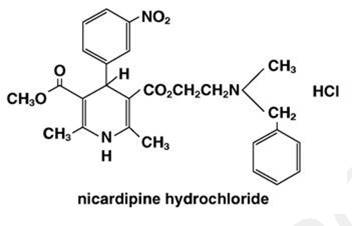
Image (A32a7f2d E45c 4545 Ad2c Dce5665262ae 01)
Nicardipine hydrochloride is a greenish-yellow, odorless, crystalline powder that melts at about 169°C. It is freely soluble in chloroform, methanol and glacial acetic acid, sparingly soluble in anhydrous ethanol, slightly soluble in n-butanol, water, 0.01 M potassium dihydrogen phosphate, acetone and dioxane, very slightly soluble in ethyl acetate, and practically insoluble in benzene, ether and hexane. It has a molecular weight of 515.99.
Nicardipine hydrochloride capsules are available in hard gelatin capsules containing 20 mg or 30 mg nicardipine hydrochloride with pregelatinized starch NF, Lactose Monohydrate NF, Sodium Starch Glycolate NF, Colloidal Silicon Dioxide NF and Magnesium Stearate NF as the inactive ingredients. The 20-mg strength is provided in white opaque body and light blue opaque cap, hard gelatin capsules imprinted "S087" in black ink on cap and body, filled with yellow color granular powder, while the 30-mg capsules are light blue opaque body and blue opaque cap, hard gelatin capsules imprinted "S088" in black ink on cap and body, filled with yellow color granular powder. The colorants used in capsules are Gelatin USP, FD&C Blue #1, and Titanium Dioxide USP.
The responses are shown as differences from the concurrent placebo control group. The large changes between peak and trough effects were not accompanied by observed side effects at peak response times. In a study using 24-hour intra-arterial blood pressure monitoring, the circadian variation in blood pressure remained unaltered, but the systolic and diastolic blood pressures were reduced throughout the whole 24 hours.
When added to beta-blocker therapy, nicardipine hydrochloride capsules further lower both systolic and diastolic blood pressure.
Nicardipine hydrochloride capsules are contraindicated in patients with hypersensitivity to the drug.
Because part of the effect of nicardipine hydrochloride capsules are secondary to reduced afterload, the drug is also contraindicated in patients with advanced aortic stenosis. Reduction of diastolic pressure in these patients may worsen rather than improve myocardial oxygen balance.
In multiple-dose US and foreign controlled short-term (up to 3 months) studies 1910 patients received nicardipine hydrochloride capsules alone or in combination with other drugs. In these studies adverse events were reported spontaneously; adverse experiences were generally not serious but occasionally required dosage adjustment and about 10% of patients left the studies prematurely because of them. Peak responses were not observed to be associated with adverse effects during clinical trials, but physicians should be aware that adverse effects associated with decreases in blood pressure (tachycardia, hypotension, etc.) could occur around the time of the peak effect. Most adverse effects were expected consequences of the vasodilator effects of nicardipine hydrochloride capsules.
In addition, adverse events were observed that are not readily distinguishable from the natural history of the atherosclerotic vascular disease in these patients. Adverse events in this category each occurred in <0.4% of patients receiving nicardipine hydrochloride capsules and included myocardial infarction, atrial fibrillation, exertional hypotension, pericarditis, heart block, cerebral ischemia, and ventricular tachycardia. It is possible that some of these events were drug-related.
Overdosage with a 600-mg single dose (15 to 30 times normal clinical dose) has been reported. Marked hypotension (blood pressure unobtainable) and bradycardia (heart rate 20 bpm in normal sinus rhythm) occurred, along with drowsiness, confusion and slurred speech. Supportive treatment with a vasopressor resulted in gradual improvement with normal vital signs approximately 9 hours posttreatment.
Based on results obtained in laboratory animals, overdosage may cause systemic hypotension, bradycardia (following initial tachycardia) and progressive atrioventricular conduction block. Reversible hepatic function abnormalities and sporadic focal hepatic necrosis were noted in some animal species receiving very large doses of nicardipine.
For treatment of overdose standard measures (for example, evacuation of gastric contents, elevation of extremities, attention to circulating fluid volume, and urine output) including monitoring of cardiac and respiratory functions should be implemented. The patient should be positioned so as to avoid cerebral anoxia. Frequent blood pressure determinations are essential. Vasopressors are clinically indicated for patients exhibiting profound hypotension. Intravenous calcium gluconate may help reverse the effects of calcium entry blockade.
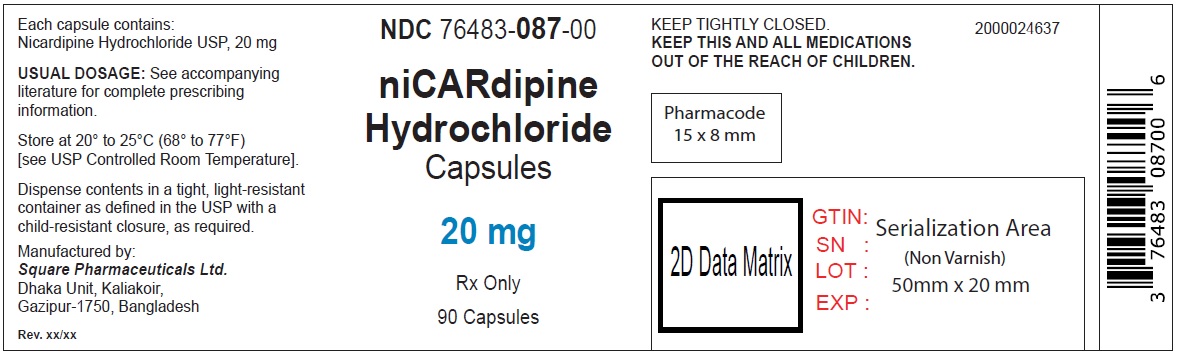
Nicardipine hydrochloride capsules, 20 mg are available in white opaque body and light blue opaque cap, hard gelatin capsules imprinted "S087" in black ink on cap and body, filled with yellow color granular powder.
These are supplied in bottles of 90 (NDC 76483-087-00).
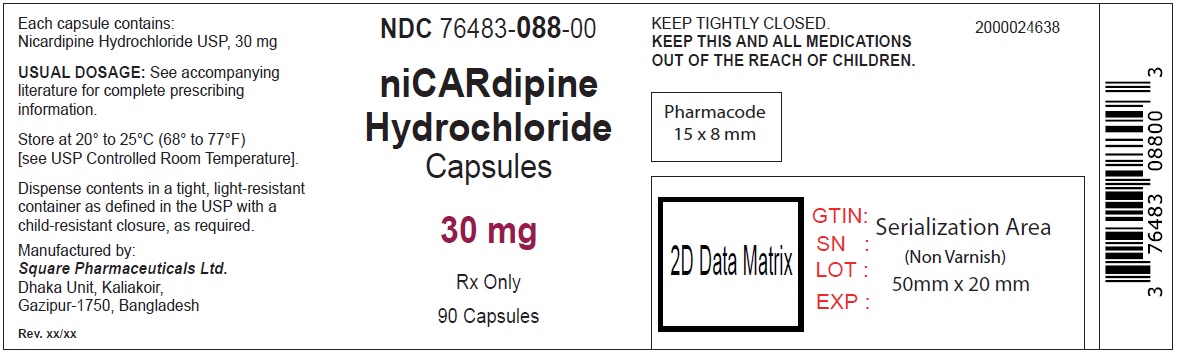
Nicardipine hydrochloride capsules, 30 mg are available in light blue opaque body and blue opaque cap, hard gelatin capsules imprinted "S088" in black ink on cap and body, filled with yellow color granular powder.
These are supplied in bottles of 90 (NDC 76483-088-00)
Store at 20° to 25°C (68° to 77° F) [see USP Controlled Room Temperature]. Dispense contents in a tight, light-resistant container as defined in the USP with a child-resistant closure.
The brands listed are trademarks of their respective owners.
Manufactured by:
Square Pharmaceuticals Ltd.
Dhaka Unit,
Kaliakoir, Gazipur-1750,
Bangladesh
Revised: 11/2022