Limitations of Use
TRUDHESA is not indicated for the preventive treatment of migraine.
TRUDHESA is not indicated for the management of hemiplegic or basilar migraine.
Adverse Reactions in Placebo-Controlled Trials with Dihydroergotamine (DHE) Mesylate Nasal Spray [see Clinical Studies (14)]
Of the 1,796 patients and subjects treated with DHE nasal spray doses 2 mg or less in U.S. and foreign clinical studies, 26 (1.4%) discontinued because of adverse events. The adverse events associated with discontinuation were, in decreasing order of frequency: rhinitis (13), dizziness (2), facial edema (2), and one patient each due to cold sweats, accidental trauma, depression, elective surgery, somnolence, allergy, vomiting, hypotension, and paraesthesia.
Table 1 summarizes the incidence rates of adverse reactions reported by at least 1% of patients who received DHE nasal spray for the treatment of migraine during placebo-controlled, double-blind clinical studies and were more frequent than in those patients receiving placebo. The most commonly reported adverse reactions (greater than 1% of patients who received DHE nasal spray) were rhinitis, nausea, altered sense of taste, application site reactions, dizziness, vomiting, somnolence, pharyngitis, and diarrhea. In most instances these events were transient and self-limited and did not result in patient discontinuation from a study.
Table 1 Adverse Reactions Reported by at Least 1% of the DHE Nasal Spray Treated Patients and Occurred more Frequently than in the Placebo-Group in the Migraine Placebo-Controlled Trials | DHE Nasal Spray
N=597
% | Placebo
N=631
% |
|---|
| Respiratory System |
| Rhinitis | 26 | 7 |
| Pharyngitis | 3 | 1 |
| Gastrointestinal System |
| Nausea | 10 | 4 |
| Vomiting | 4 | 1 |
| Diarrhea | 2 | <1 |
| Special Senses, Other |
| Altered Sense of Taste | 8 | 1 |
| Application Site |
| Application Site Reaction | 6 | 2 |
| Central and Peripheral Nervous System |
| Dizziness | 4 | 2 |
| Somnolence | 3 | 2 |
| Body as a Whole, General |
| Hot Flashes | 1 | <1 |
| Asthenia | 1 | 0 |
| Musculoskeletal System |
| Stiffness | 1 | <1 |
Adverse Reactions in Studies with TRUDHESA
An open-label study in adults (18 to 66 years of age) was conducted to evaluate the safety and tolerability of TRUDHESA, repeated use of TRUDHESA was allowed over the course of 6 to 12 months. A total of 354 patients with migraine received at least one dose of TRUDHESA. One hundred and eighty-five patients treated on average at least two migraines per month for 6 months, and 55 patients treated on average at least two migraines per month for 12 months. Of the patients who received at least one dose of TRUDHESA, 185 (52.3%) patients experienced local irritative symptoms. Of these, the most common local irritative symptoms were nasopharyngitis, rhinitis, nasal discomfort, product taste abnormal/dysgeusia, sinusitis, sinus discomfort, olfactory test abnormal, epistaxis, pharyngitis, nasal mucosal disorder, change in smell, ear discomfort, and rhinorrhea [see Warnings and Precautions (5.9)].
Risk Summary
Available data from published literature indicate an increased risk of preterm delivery with TRUDHESA use during pregnancy. Avoid use of TRUDHESA during pregnancy [see Warnings and Precautions (5.7)]. Data collected over decades have shown no increased risk of major birth defects or miscarriage with use of dihydroergotamine mesylate during pregnancy.
In animal studies, adverse effects on embryofetal development were observed following administration of dihydroergotamine mesylate during pregnancy (decreased fetal body weight and/or skeletal ossification) in rats and rabbits or during pregnancy and lactation in rats (decreased body weight and impaired reproductive function in the offspring) in rats at doses less than those used clinically and which were not associated with maternal toxicity (see Data).
The estimated rate of major birth defects (2.2% to 2.9%) and miscarriage (17%) among deliveries to women with migraine are similar to rates reported in women without migraine. All pregnancies have a background risk of birth defect, loss, or other adverse outcomes. In the U.S. general population, the estimated background risk of major birth defects and miscarriages in clinically recognized pregnancies is 2% to 4% and 15% to 20%, respectively.
Data
Animal Data
Intranasal administration of dihydroergotamine mesylate to pregnant rats throughout the period of organogenesis resulted in decreased fetal body weight and/or skeletal ossification at doses of 0.16 mg/day (associated with plasma exposures [AUC] less than that in humans at the maximum recommended human dose [MRHD] of 2.9 mg) or greater. A no-effect level for embryofetal toxicity was not identified in rats. Intranasal administration of dihydroergotamine mesylate to pregnant rabbits throughout organogenesis resulted in decreased skeletal ossification at 3.6 mg/day. At the no-effect dose (1.2 mg/day) for adverse effects on embryofetal development in rabbits, plasma exposures (AUC) were less than that in humans at the MRHD.
Intranasal administration of dihydroergotamine mesylate to female rats throughout pregnancy and lactation resulted in decreased body weight and impaired reproductive function (decreased mating indices) were observed in the offspring at doses of 0.16 mg/day or greater. A no-effect dose for adverse developmental effects in rats was not established.
Effects on development occurred at doses below those that produced evidence of significant maternal toxicity in these studies.
Dihydroergotamine-induced intrauterine growth retardation has been attributed to reduced uteroplacental blood flow resulting from prolonged vasoconstriction of the uterine vessels and/or increased myometrial tone.
Risk Summary
There are no data on the presence of dihydroergotamine in human milk; however, ergotamine, a related drug, is present in human milk. There are reports of diarrhea, vomiting, weak pulse, and unstable blood pressure in breastfed infants exposed to ergotamine. TRUDHESA may reduce milk supply because it may decrease prolactin levels. Because of the potential for reduced milk supply and serious adverse events in the breastfed infant, including diarrhea, vomiting, weak pulse, and unstable blood pressure, advise patients not to breastfeed during treatment with TRUDHESA and for 3 days after the last dose. Breast milk supply during this time should be pumped and discarded.
Absorption
The mean time from dosing to maximum plasma concentration following TRUDHESA administration was approximately 0.5 hours.
Distribution
Dihydroergotamine mesylate is 93% plasma protein bound. The apparent steady-state volume of distribution is approximately 800 liters.
Elimination
Metabolism
Four dihydroergotamine mesylate metabolites have been identified in human plasma following oral administration. The major metabolite, 8'-β-hydroxy dihydroergotamine, exhibits affinity equivalent to its parent for adrenergic and 5-HT receptors and demonstrates equivalent potency in several venoconstrictor activity models, in vivo and in vitro. The other metabolites, i.e., dihydrolysergic acid, dihydrolysergic amide, and a metabolite formed by oxidative opening of the proline ring, are of minor importance. Following nasal administration, total metabolites represent only 20% to 30% of plasma AUC. The systemic clearance of dihydroergotamine mesylate following intravenous and intramuscular administration is 1.5 L/min. Quantitative pharmacokinetic characterization of the four metabolites has not been performed.
Excretion
The major excretory route of dihydroergotamine is via the bile in the feces. The total body clearance is 1.5 L/min, which reflects mainly hepatic clearance. Only 6% to 7% of unchanged dihydroergotamine is excreted in the urine after intramuscular injection. The renal clearance (0.1 L/min) is unaffected by the route of dihydroergotamine administration.
The mean apparent half-life of TRUDHESA nasal administration in healthy subjects is approximately 12 hours.
Specific Populations
No studies have been conducted on the effect of renal or hepatic impairment, gender, race, ethnicity, or pregnancy on dihydroergotamine pharmacokinetics [see Contraindications (4), Use in Specific Populations (8.1)].
Drug Interaction Studies
CYP3A4 Inhibitors
Rare reports of ergotism have been obtained from patients treated with dihydroergotamine and macrolide antibiotics (e.g., clarithromycin, erythromycin) and from patients treated with dihydroergotamine and protease inhibitors (e.g., ritonavir), presumably due to inhibition of CYP3A metabolism of ergotamine [see Contraindications (4)].
Other Drugs
The pharmacokinetics of dihydroergotamine did not appear to be significantly affected by the concomitant use of a local vasoconstrictor.
Multiple oral doses of the β-adrenoceptor antagonist propranolol, used for migraine prophylaxis, had no significant influence on the Cmax, tmax, or AUC of dihydroergotamine doses up to 4 mg. However, propranolol may potentiate the vasoconstrictive action of ergotamine [see Drug Interactions (7.3)].
The effect of oral contraceptives on the pharmacokinetics of TRUDHESA has not been studied.
Carcinogenesis
Assessment of the carcinogenic potential of dihydroergotamine mesylate in mice and rats has not been assessed.
Mutagenesis
Dihydroergotamine mesylate was negative in an in vitro mutagenicity (Ames) assay and positive in in vitro chromosomal aberration (V79 Chinese hamster cell assay with metabolic activation, and human peripheral blood lymphocyte) assays. Dihydroergotamine was negative in in vivo micronucleus assays in mouse and hamster.
Impairment of Fertility
There was no evidence of impairment of fertility in rats given intranasal doses of dihydroergotamine mesylate up to 1.6 mg/day, which was associated with plasma exposures (AUC) approximately 3 times that in humans at the maximum recommended human dose of 2.9 mg/day.
Serious and/or Life-Threatening Reactions with Coadministration of CYP3A4 Inhibitors
Inform patients that serious and/or life-threatening peripheral ischemia (cerebral ischemia and/or ischemia of the extremities) has been associated with the coadministration of dihydroergotamine mesylate and strong CYP3A4 inhibitors, such as macrolide antibiotics and protease inhibitors [see Contraindications (4), Warnings and Precautions (5.1), and Drug Interactions (7.1)].
Myocardial Ischemia and/or Infarction, Other Cardiac Events, Cerebrovascular Events, and Fatalities
Inform patients of the risk for serious cardiac, cerebrovascular, and other vasospasm related events. Advise patients to notify their healthcare provider if they develop any risk factors or symptoms while taking TRUDHESA. Inform patients that nicotine may provoke vasoconstriction predisposing to a greater ischemic response [see Warnings and Precautions (5.2, 5.3, 5.4)].
Medication Overuse Headache
Inform patients that use of drugs to treat migraine attacks for 10 or more days per month may lead to an exacerbation of headache, and encourage patients to record headache frequency and drug use (e.g., by keeping a headache diary) [see Warnings and Precautions (5.6)].
Local Irritation
Advise patients to notify their healthcare provider if they have bothersome local irritation [see Warnings and Precautions (5.9)].
Drug Interactions
Advise patients to inform their healthcare providers if they are taking, or plan to take, any prescription or over-the-counter drugs, since there is a potential for interactions [see Drug Interactions (7)].
Pregnancy
Advise patients of the risk for preterm birth. Advise women to inform their healthcare provider if they are pregnant or intend to become pregnant [see Warnings and Precautions (5.7), Use in Specific Populations (8.1)].
Lactation
Advise patients not to breastfeed during treatment with TRUDHESA [see Use In Specific Populations (8.2)].
Important Administration Instructions
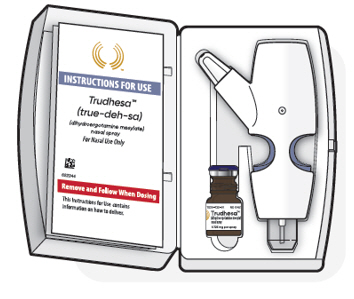
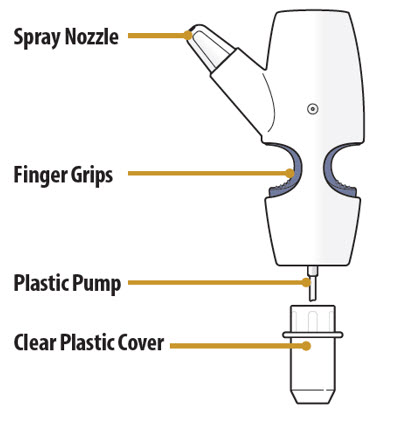
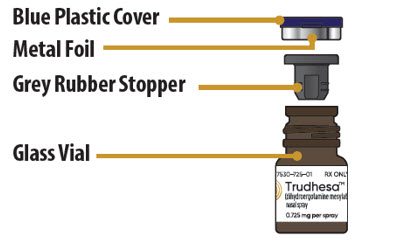
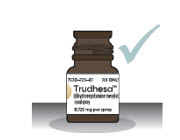
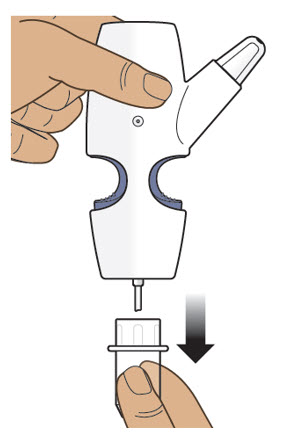
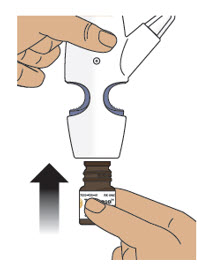
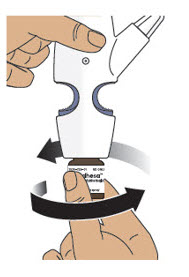
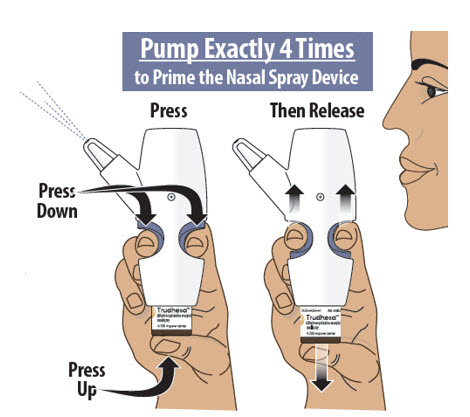
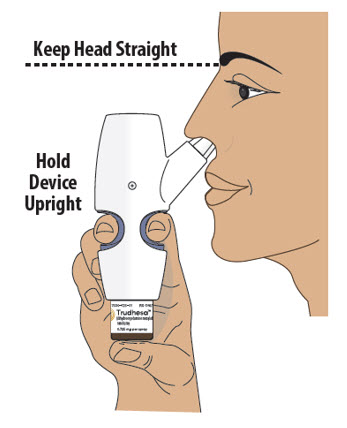
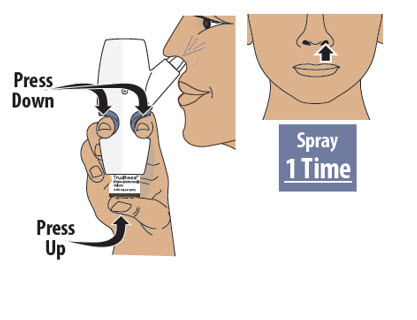
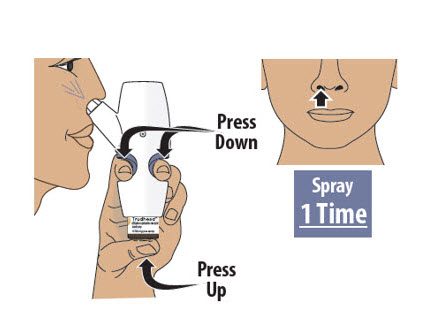
Advise patients that TRUDHESA must be assembled prior to use and that, prior to administration, the device must be primed (i.e., pumped 4 times). Instruct patients to use or discard TRUDHESA within 8 hours once the vial has been opened or the product has been assembled.
Manufactured by:
Mipharm, S.p.A.
Milano, Italy
Manufactured for:
Impel NeuroPharma Inc
201 Elliott Ave West, Suite 260
Seattle, WA 98119 USA