The dosage of thyroid hormones is determined by the indication and must in every case be
individualized according to patient response and laboratory findings.
Thyroid hormones are given orally. In acute, emergency conditions, injectable levothyroxine sodium
(T4) may be given intravenously when oral administration is not feasible or desirable, as in the
treatment of myxedema coma, or during total parenteral nutrition. Intramuscular administration is not
advisable because of reported poor absorption.
Hypothyroidism
Therapy is usually instituted using low doses, with increments which depend on the cardiovascular
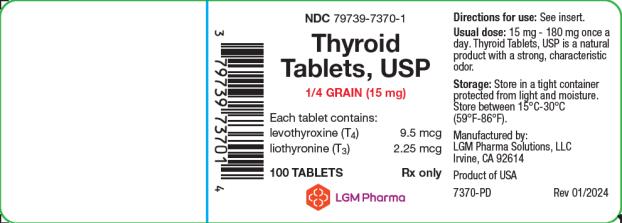
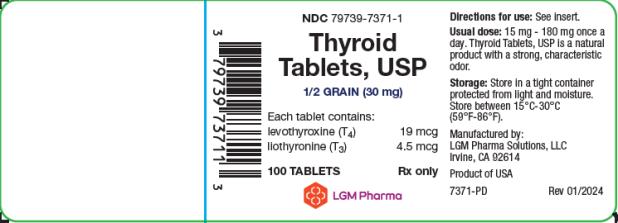
status of the patient. The usual starting dose is 30 mg Thyroid Tablets, USP, with increments of 15 mg
every 2 to 3 weeks. A lower starting dosage, 15 mg/day, is recommended in patients with
long-standing myxedema, particularly if cardiovascular impairment is suspected, in which case extreme caution is recommended. The appearance of angina is an indication for a reduction in
dosage. Most patients require 60 to 120 mg/day. Failure to respond to doses of 180 mg suggests lack
of compliance or malabsorption. Maintenance dosages 60 to 120 mg/day usually result in normal
serum T4 and T3 levels. Adequate therapy usually results in normal TSH and T4 levels after 2 to 3
weeks of therapy.
Readjustment of thyroid hormone dosage should be made within the first four weeks of therapy, after
proper clinical and laboratory evaluations, including serum levels of T4, bound and free, and TSH.
Liothyronine (T3) may be used in preference to levothyroxine (T4) during radio-isotope scanning
procedures, since induction of hypothyroidism in those cases is more abrupt and can be of shorter
duration. It may also be preferred when impairment of peripheral conversion of levothyroxine (T4) and
liothyronine (T3) is suspected.
Myxedema Coma
Myxedema coma is usually precipitated in the hypothyroid patient of long-standing by intercurrent
illness or drugs such as sedatives and anesthetics and should be considered a medical emergency.
Therapy should be directed at the correction of electrolyte disturbances and possible infection besides
the administration of thyroid hormones. Corticosteroids should be administered routinely.
Levothyroxine (T4) and liothyronine (T3) may be administered via a nasogastric tube but the preferred
route of administration of both hormones is intravenous. Levothyroxine sodium (T4) is given at a
starting dose of 400 mcg (100 mcg/mL) given rapidly, and is usually well tolerated, even in the elderly.
This initial dose is followed by daily supplements of 100 to 200 mcg given IV. Normal T4 levels are
achieved in 24 hours followed in 3 days by threefold elevation of T3. Oral therapy with thyroid
hormone would be resumed as soon as the clinical situation has been stabilized and the patient is
able to take oral medication.
Thyroid Cancer
Exogenous thyroid hormone may produce regression of metastases from follicular and papillary
carcinoma of the thyroid and is used as ancillary therapy of these conditions with radioactive iodine.
TSH should be suppressed to low or undetectable levels. Therefore, larger amounts of thyroid
hormone than those used for replacement therapy are required. Medullary carcinoma of the thyroid is
usually unresponsive to this therapy.
Thyroid Suppression Therapy
Administration of thyroid hormone in doses higher than those produced physiologically by the gland
results in suppression of the production of endogenous hormone. This is the basis for the thyroid
suppression test and is used as an aid in the diagnosis of patients with signs of mild hyperthyroidism
in whom base line laboratory tests appear normal, or to demonstrate thyroid gland autonomy in
patients with Grave’s ophthalmopathy. 131I uptake is determined before and after the administration
of the exogenous hormone. A 50% or greater suppression of uptake indicates a normal
thyroid-pituitary axis and thus rules out thyroid gland autonomy.
For adults, the usual suppressive dose of levothyroxine (T4) is 1.56 mcg/kg of body weight per day
given for 7 to 10 days. These doses usually yield normal serum T4 and T3 levels and lack of response
to TSH.
Thyroid hormones should be administered cautiously to patients in whom there is strong suspicion of
thyroid gland autonomy, in view of the fact that the exogenous hormone effects will be additive to the
endogenous source.
Pediatric Dosage
Pediatric dosage should follow the recommendations summarized in Table 1. In infants with
congenital hypothyroidism, therapy with full doses should be instituted as soon as the diagnosis has
been made.
| Age | Thyroid Tablets, USP |
| Dose per day | Daily dose per kg of body weight |
| 0- 6 months | 15-30 mg | 4.8-6 mg |
| 6- 12 months | 30-45 mg | 3.6-4.8 mg |
| 1 – 5 years | 45-60 mg | 3-3.6 mg |
| 6- 12 years | 60-90 mg | 2.4-3 mg |
| Over 12 years | Over 90 mg | 1.2-1.8 mg |