Gabapentin Capsule
Product Images NDC 80425-0032

9 FDA label images from Advanced Rx Of Tennessee, Llc · Packaging, Regulatory Labels, and Product Appearance

Product Visual Gallery

This gallery contains 9 technical images submitted to the FDA as part of the official labeling for Gabapentin (NDC 80425-0032). Unlike standard consumer photos, these assets often include clinical data figures, molecular chemical structures, and official manufacturer packaging layouts.

As provided by Advanced Rx Of Tennessee, Llc, these visuals offer a comprehensive scientific overview of the product's physical and chemical identity, aiding pharmacists and researchers in product verification and study.

FDA Label Image

Imprint (Imprint)

Imprint (Imprint)
Gabapentin 300 mg oral capsules packaging label from Advanced Rx of Tennessee, LLC. The white capsules are contained in a clear plastic bottle with a white child-resistant cap. The label includes product name, strength, dosage form, and usage instructions.*
FDA Label Image

Struc. (Struc)

Struc. (Struc)
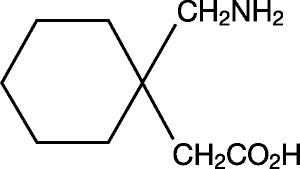
Chemical structure of Gabapentin, displaying a cyclohexane ring bonded to an aminomethyl group (CH2NH2) and an acetic acid moiety (CH2CO2H).*
FDA Label Image

Fig. 1 (Fig 1)

Fig. 1 (Fig 1)
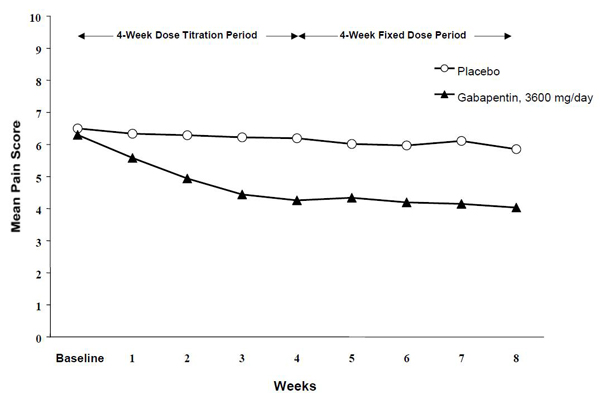
A line graph comparing mean pain scores over eight weeks for Gabapentin 3600 mg/day versus placebo. The x-axis represents weeks from baseline to 8; the y-axis shows mean pain scores from 0 to 10. Two periods are marked: a 4-week dose titration period and a 4-week fixed dose period. Gabapentin shows a steady decrease in pain scores, while placebo remains relatively constant.*
FDA Label Image

Fig. 2 (Fig 2)

Fig. 2 (Fig 2)
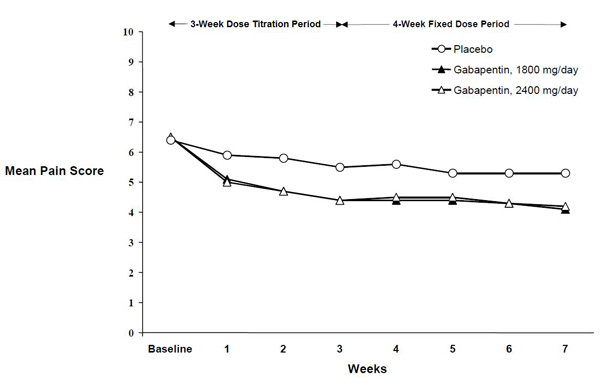
A line graph depicting mean pain scores over a 7-week period comparing placebo, gabapentin 1800 mg/day, and gabapentin 2400 mg/day. The x-axis represents weeks from baseline to week 7, and the y-axis shows mean pain score from 0 to 10. The graph illustrates a 3-week dose titration period followed by a 4-week fixed dose period, showing decreasing pain scores for gabapentin groups compared to placebo.*
FDA Label Image

Fig. 3 (Fig 3)

Fig. 3 (Fig 3)
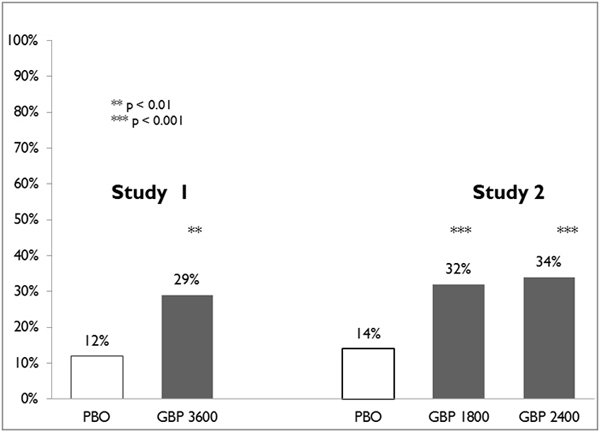
A bar graph comparing percentage outcomes between placebo (PBO) and gabapentin (GBP) at different dosages in two separate studies. Study 1 shows PBO at 12% and GBP 3600 mg at 29%. Study 2 shows PBO at 14%, GBP 1800 mg at 32%, and GBP 2400 mg at 34%. Statistical significance is noted with p-values less than 0.01 and 0.001.*
FDA Label Image

Fig. 4 (Fig 4)

Fig. 4 (Fig 4)
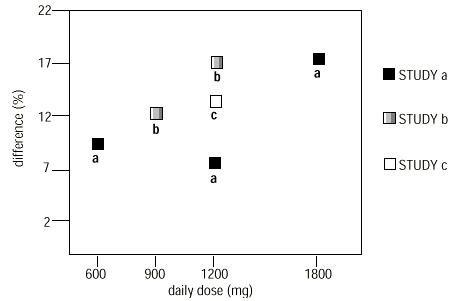
A scatter plot chart depicting the percentage difference versus daily dose (mg) for three studies labeled a, b, and c. Data points for study a are marked with black squares, study b with gray squares, and study c with white squares, showing varying differences at doses of approximately 600, 900, 1200, and 1800 mg.*
FDA Label Image

Label 1 (Lable 1)

Label 1 (Lable 1)
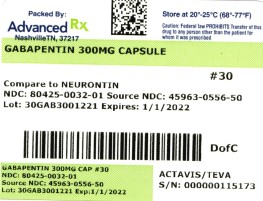
Gabapentin 300 mg capsule packaging label from Advanced Rx of Tennessee, LLC. The label includes storage instructions at 20-25°C (68-77°F) and a caution about federal law restricting transfer. It references the product comparison to Neurontin and displays lot number and expiration date information. The product NDC is 80425-0032.*
FDA Label Image

Label 2 (Lable 2)

Label 2 (Lable 2)
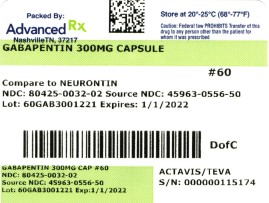
Gabapentin 300 mg capsule label from Advanced Rx of Tennessee, LLC. The label includes the product name, strength (300 mg), dosage form (capsule), NDC number (80425-0032-02), lot number, expiration date (1/1/2022), and a barcode. The label also references comparison to Neurotonin and includes storage instructions (20°-25°C).*
FDA Label Image

Label 3 (Label 3)

Label 3 (Label 3)
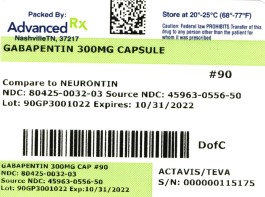
Gabapentin 300 mg capsule bottle label by Advanced Rx of Tennessee, LLC. The label includes storage instructions, lot number 90GP3001022, and expiration date 10/31/2022. It compares to Neurontin and shows NDC 80425-0032-03 along with barcode and manufacturer information.*

* About these descriptions: Image descriptions on this page are generated by automated AI analysis of the product label images from the manufacturer's FDA label submission (SPL). They are provided for reference only and may contain errors or omissions. Always rely on the printed label itself and the official FDA labeling, and consult a pharmacist or healthcare professional with any questions about this product.