Pregabalin Capsule
Product Images NDC 80425-0152

View Photos of Packaging, Regulatory Labels, and Product Appearance

Product Visual Gallery

This gallery contains 15 technical images submitted to the FDA as part of the official labeling for Pregabalin (NDC 80425-0152). Unlike standard consumer photos, these assets often include clinical data figures, molecular chemical structures, and official manufacturer packaging layouts.

As provided by Advanced Rx Pharmacy Of Tennessee, Llc, these visuals offer a comprehensive scientific overview of the product's physical and chemical identity, aiding pharmacists and researchers in product verification and study.

FDA Label Image

Figure 1

Figure 1
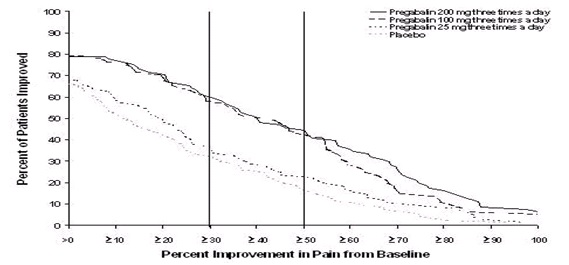
A line graph depicting the percent of patients improved relative to percent improvement in pain from baseline for different doses of Pregabalin (25 mg, 100 mg, 200 mg three times a day) compared to placebo. The x-axis represents percent improvement in pain from baseline, and the y-axis shows the percent of patients improved.*
FDA Label Image

Figure 10

Figure 10
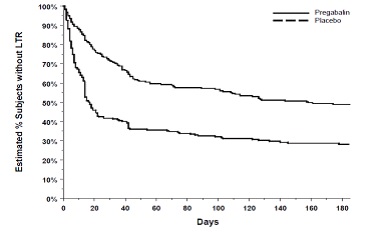
A line graph comparing the estimated percentage of subjects without LTR over 180 days for Pregabalin versus Placebo. The x-axis represents days, the y-axis the estimated percentage without LTR, showing a decline over time for both groups, with Pregabalin maintaining a higher percentage than Placebo.*
FDA Label Image

Figure 11

Figure 11
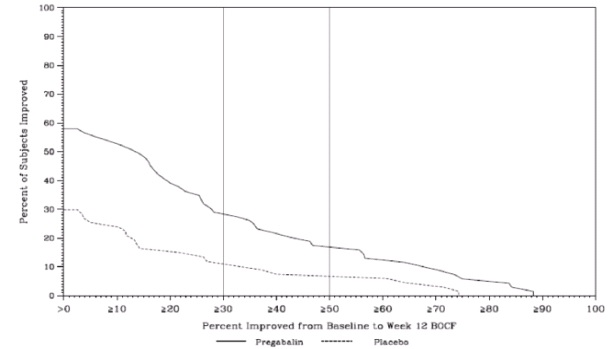
A line graph showing the percent of subjects improved over time, comparing Pregabalin and Placebo groups. The x-axis represents the percent improvement from baseline to week 12 BOCF, ranging from 0 to 100, and the y-axis shows the percent of subjects improved, ranging from 0 to 100. Two lines illustrate the difference in improvement between Pregabalin and Placebo across the percent improved scale.*
FDA Label Image

Figure 12

Figure 12
A line graph showing Percent of Subjects Improved over Percent Improved from Baseline to Week 16 BOCF. It compares two groups labeled Pregabalin and Placebo, with Pregabalin represented by a solid line and Placebo by a dotted line, illustrating different improvement trajectories across the study period.*
FDA Label Image

Figure 2

Figure 2
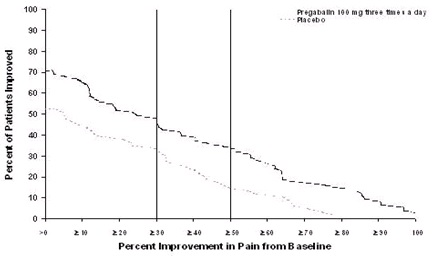
A line graph comparing the percent of patients improved with Pregabalin 100 mg three times a day versus placebo. The x-axis represents percent improvement in pain from baseline, and the y-axis represents the percent of patients improved. The graph shows two lines, one for Pregabalin and one for placebo, illustrating treatment effect over varying levels of pain improvement.*
FDA Label Image

Figure 3

Figure 3
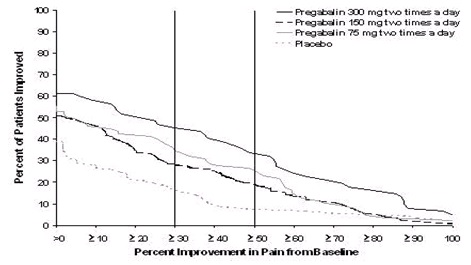
A line graph showing the percent improvement in pain from baseline versus the percent of patients improved. The graph compares Pregabalin doses of 75 mg, 150 mg, and 300 mg taken two times a day against a placebo, with the highest dose showing the greatest patient improvement.*
FDA Label Image

Figure 4

Figure 4
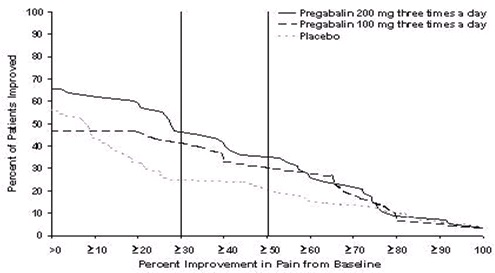
A line chart comparing the percent of patients improved versus percent improvement in pain from baseline for pregabalin 200 mg three times a day, pregabalin 100 mg three times a day, and placebo. The graph shows three lines representing these groups, illustrating their effectiveness over a range of pain improvements from 0 to 100 percent.*
FDA Label Image

Figure 5

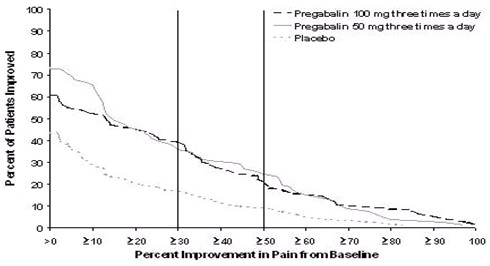
Figure 5
A line graph depicting the percent of patients improved on the y-axis against percent improvement in pain from baseline on the x-axis for three groups: Pregabalin 100 mg three times a day, Pregabalin 50 mg three times a day, and placebo. The graph compares the efficacy of these treatments in reducing pain.*
FDA Label Image

Figure 6

Figure 6
Bar graph comparing responder rates (%) across different treatment groups in two studies labeled E1 and E3. The x-axis lists treatment groups including placebo and varying doses, and the y-axis represents responder rate percentage. Statistical significance versus placebo is indicated.*
FDA Label Image

Figure 7

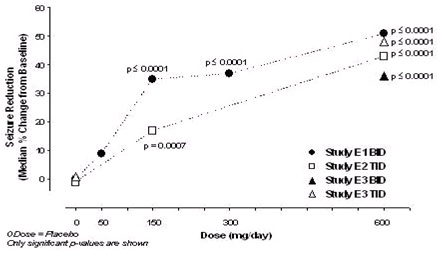
Figure 7
A dose-response graph showing median percentage seizure reduction from baseline on the y-axis and dose in mg/day on the x-axis. The graph compares seizure reduction results across four studies with different dosing regimens labeled as Study E1 BID, Study E2 TID, Study E3 BID, and Study E3 TID, with p-values annotated for statistical significance.*
FDA Label Image

Figure 9

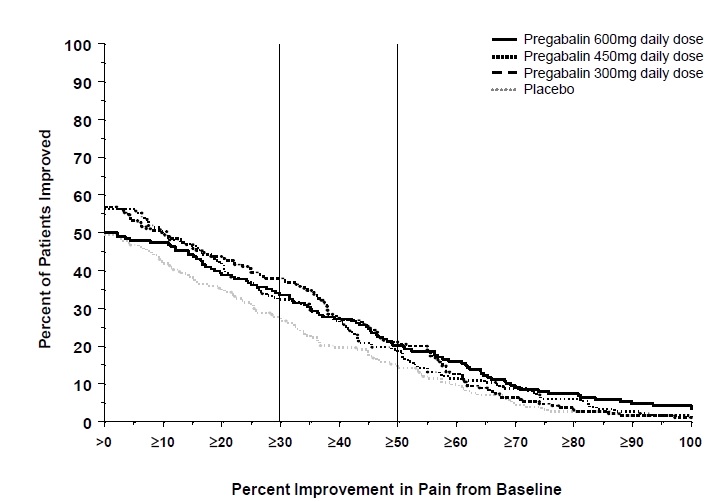
Figure 9
A line chart depicting the percent of patients improved versus percent improvement in pain from baseline for Pregabalin and placebo groups. Four curves represent Pregabalin daily doses of 600 mg, 450 mg, 300 mg, and placebo, showing their respective patient improvement percentages across pain improvement levels from 0 to 100%.*
FDA Label Image

Pregabalin 50 mg Cap Qty 30 80425 0152

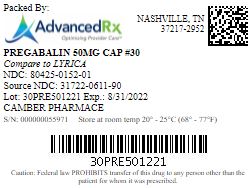
Pregabalin 50 mg Cap Qty 30 80425 0152
Label for Pregabalin 50 mg capsules, 30 count, manufactured by Advanced Rx Pharmacy of Tennessee, LLC in Nashville, TN. The label includes the NDC 80425-0152-01, lot number 30PRE501221, and expiration date 8/31/2022. Storage instructions specify room temperature between 20°C and 25°C (68°F to 77°F).*
FDA Label Image

Pregabalin 50 mg Cap Qty 60 80425 0152

Pregabalin 50 mg Cap Qty 60 80425 0152
Packaging label for Pregabalin 50 mg oral capsules, package size 60, labeled by Advanced Rx Pharmacy of Tennessee, LLC. The label includes National Drug Code 80425-0152, storage instructions for 20 to 25°C, lot and source NDC numbers, and a comparison reference to LYRICA. It also contains a caution regarding federal law on dispensing.*
FDA Label Image

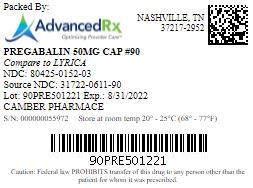
Pregabalin 50 mg Cap Qty 90 80425 0152

Pregabalin 50 mg Cap Qty 90 80425 0152
Label for Pregabalin 50 mg capsules, bottle of 90, labeled by Advanced Rx Pharmacy of Tennessee, LLC. It shows the NDC number 80425-0152 and includes storage instructions to keep at room temperature 20°-25°C. The label also specifies the lot number 90PRES01221 and expiration date 8/31/2022, with a comparison to Lyrica and a caution against unauthorized use.*
FDA Label Image

Structure

Structure
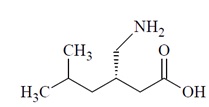
Chemical structure of pregabalin, showing its molecular framework including an amino group, carboxyl group, and hydrocarbon side chains.*

* About these descriptions: Image descriptions on this page are generated by automated AI analysis of the product label images from the manufacturer's FDA label submission (SPL). They are provided for reference only and may contain errors or omissions. Always rely on the printed label itself and the official FDA labeling, and consult a pharmacist or healthcare professional with any questions about this product.