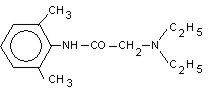
Lidocaine is a topical anesthetic and stabilizes the neuronal membrane by inhibiting the ionic fluxes required for the initiation and conduction of impulses, thereby effecting local anesthetic action.
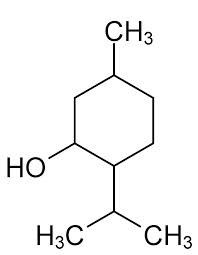
Menthol has local anesthetic and counterirritant qualities. It also acts as a weak kappa (ĸ) opioid receptor agonist. Menthol chemically triggers the cold-‐sensitive TRPM-‐8 receptors in the skin, which are responsible for the well-‐documented cooling sensation that occurs when applied to the skin. Menthol’s analgesic properties are not fully understood; however, they are mediated through a selective activation of ĸ-‐opioid receptors. Menthol also blocks voltage-‐sensitive sodium channels, reducing neural activity that may stimulate muscle tissue.
Pharmacodynamics
Menthol works by targeting the k-‐opiod receptor on the TRPM8 neuron. The TRPM8 neuron is normally activated at temperatures between (8° -‐ 28° C). Menthol causes the neuron to fire at temperatures above normal activation, which triggers the characteristic cooling sensation. Also because of Menthol's specific targeting of the k-‐opioid receptor, it is endowed with analgesic properties.
Lidocaine is an amide-‐type local anesthetic agent and is suggested to stabilize neuronal membranes by inhibiting the ionic fluxes required for the initiation and conduction of impulses.
The penetration of Lidocaine into intact skin after application of patch is sufficient to produce an analgesic effect, but less than the amount necessary to produce a complete sensory block.
Pharmacokinetics
Absorption:
The amount of Lidocaine and Menthol systemically absorbed is directly related to both the duration of application and the surface area over which it is applied.
In a pharmacokinetic study, three Lidocaine 5% patches were applied over an area of 420 cm2 of intact skin on the back of
normal volunteers for 12 hours. Blood samples were withdrawn for a determination of Lidocaine concentration during the application and for 12 hours after removal of patches. The results are summarized in table 1.
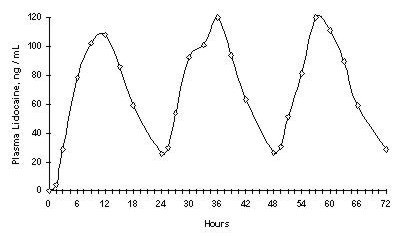
Repeated application of three days indicated that the Lidocaine concentration does not increase with daily use. The mean plasma pharmacokinetic profile for the 15 healthy volunteers is shown in Figure 1.When Lidocaine 5% patch is used according to the recommended dosing instructions, only 3 ± 2% of the dose applied is expected to be absorbed. At least 95% (665 mg) of Lidocaine will remain in a used patch. Mean peak blood concentration of Lidocaine is about 0.13 µg/mL (about 1/10 of the therapeutic concentration required to treat cardiac arrhythmias).
Figure 1
Mean Lidocaine blood concentrations after three consecutive daily applications of three Lidocaine 5% patches simultaneously for 12 hours per day in healthy volunteers (n = 15).
Distribution:
When Lidocaine is administered intravenously to healthy volunteers, the volume of distribution is 0.7 to 2.7 L/kg (mean 1.5
± 0.6 SD, n = 15). At concentrations produced by application of Lidocaine Patch 5%, Lidocaine is approximately 70% bound to plasma proteins, primarily alpha-‐1-‐acid glycoprotein. At much higher plasma concentrations (1 to 4 µg/mL of free base), the plasma protein binding of Lidocaine is concentration dependent. Lidocaine crosses the placental and blood brain barriers, presumably by passive diffusion.
Metabolism:
It is not known if Lidocaine is metabolized in the skin. Lidocaine is metabolized rapidly by the liver to a number of metabolites, including menoethylglycinexylidie (MEGX) and glycinexylidide (GX), both of which have pharmacologic activity similar to, but less potent than that of Lidocaine. A minor metabolite, 2,6-‐xylidine, has unknown pharmacologic activity but is carcinogenic in rats. The blood concentration of this metabolite is negligible following application of Lidocaine Patch 5%.
Following intravenous administration, MEGX and GX concentrations in serum range from 11% to 36% and from 5% to 11% of Lidocaine concentrations, respectively.
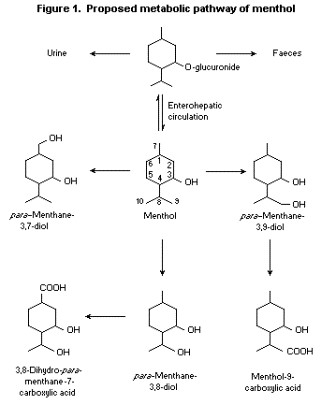
Humans rapidly metabolize Menthols primarily in the liver by the microsomes, using the enzyme CYP2A6. Cytochrome P450-‐mediated oxidation occurs in humans, yielding various alcohol and hydroxy acid derivatives. These are eliminated in the urine unchanged or conjugated with glucuronic acid.
Excretion:
Lidocaine and its metabolites are excreted by the kidneys. Less than 10% of Lidocaine is excreted unchanged. The half-‐life of Lidocaine elimination from plasma following IV administration is 81 to 149 minutes (mean 107 ± 22 SD, n=15). The systemic clearance is 0.33 to 0.90 L/min (mean 0.64 ± 0.18 SD, n=15).
Menthols are largely eliminated as glucuronides. In an experiment, 79% of a 1g (Quick, 1928) and 78% of a 10-‐20mg (Atzl et al., 1972) oral dose of Menthol was eliminated as the glucuronic acid conjugate within 6 h after administration to volunteers. Of a dose of 47 mg/kg bw [3-‐3H]-‐(-‐)-‐Menthol, 82% was eliminated in the urine 17 hours after administration.
Smaller amounts were distributed in the feces and ileum; only 1% of the activity remained in the liver (Clegg et al., 1982).