Non-Small Cell Lung Cancer
The safety of adagrasib was evaluated in patients with KRAS G12C-mutated, locally advanced or metastatic NSCLC in KRYSTAL-1 [see Clinical Studies (14)]. Patients received adagrasib 600 mg orally twice daily (n = 116). Among patients who received adagrasib, 45% were exposed for 6 months or longer and 4% were exposed for greater than one year.
The median age of patients who received adagrasib was 64 years (range 25 to 89), 56% female, 84% White, 8% Black or African American, and 4.3% Asian.
Serious adverse reactions occurred in 57% of patients who received adagrasib. Serious adverse reactions in ≥ 2% of patients were pneumonia (17%), dyspnea (9%), renal impairment (8%), sepsis (5%), hypoxia (4.3%), pleural effusion (4.3%), respiratory failure (4.3%), anemia (3.4%), cardiac failure (3.4%), hyponatremia (3.4%), hypotension (3.4%), muscular weakness (3.4%), pyrexia (3.4%), dehydration (2.6%), diarrhea (2.6%), mental status changes (2.6%), pulmonary embolism (2.6%), and pulmonary hemorrhage (2.6%). Fatal adverse reactions occurred in 11% of patients who received adagrasib due to pneumonia (3.4%), respiratory failure (1.7%), sudden death (1.7%), cardiac failure (0.9%), cerebrovascular accident (0.9%), mental status change (0.9%), pulmonary embolism (0.9%), and pulmonary hemorrhage (0.9%).
Permanent discontinuation of adagrasib due to an adverse reaction occurred in 13% of patients. Adverse reactions which resulted in permanent discontinuation of adagrasib occurring in two patients each (1.7%) were pneumonia and pneumonitis and occurring in one patient each (0.9%) were cerebrovascular accident, dyspnea, decreased ejection fraction, encephalitis, gastrointestinal obstruction, hemorrhage, hepatotoxicity, hypotension, muscular weakness, pulmonary embolism, pyrexia, respiratory failure and sepsis.
Dose interruptions of adagrasib due to an adverse reaction occurred in 77% of patients. Adverse reactions requiring dosage interruption in ≥ 2% of patients who received adagrasib included nausea, hepatotoxicity, fatigue, vomiting, pneumonia, renal impairment, diarrhea, QTc interval prolongation, anemia, dyspnea, increased lipase, decreased appetite, dizziness, hyponatremia, muscular weakness, increased amylase, pneumonitis, sepsis and decreased weight.
Dose reductions of adagrasib due to an adverse reaction occurred in 28% of patients. Adverse reactions which required dose reductions in ≥ 2% of patients who received adagrasib included hepatotoxicity, fatigue, nausea, diarrhea, vomiting, and renal impairment.
The most common adverse reactions (≥ 20%) were diarrhea, nausea, fatigue, vomiting, musculoskeletal pain, hepatotoxicity, renal impairment, dyspnea, edema, decreased appetite, cough, pneumonia, dizziness, constipation, abdominal pain, and QTc interval prolongation. The most common laboratory abnormalities (≥ 25%) were decreased lymphocytes, increased aspartate aminotransferase, decreased sodium, decreased hemoglobin, increased creatinine, decreased albumin, increased alanine aminotransferase, increased lipase, decreased platelets, decreased magnesium, and decreased potassium.
Table 3 summarizes the adverse reactions in KRYSTAL-1.
Table 3: Adverse Reactions (≥ 20%) in Patients with KRAS G12C-mutated NSCLC Who Received Adagrasib in KRYSTAL-1| Adverse Reaction | Adagrasib
N = 116 |
|---|
| All Grades
(%) | Grade 3 or 4
(%) |
|---|
| Gastrointestinal Disorders |
| Diarrhea Grouped term. | 70 | 0.9 |
| Nausea | 69 | 4.3 |
| Vomiting | 56 | 0.9 |
| Constipation | 22 | 0 |
| Abdominal pain | 21 | 0 |
| General Disorders and Administration Site Conditions |
| Fatigue | 59 | 7 |
| Edema | 32 | 0 |
| Musculoskeletal and Connective Tissue Disorders |
| Musculoskeletal pain | 41 | 7 |
| Hepatobiliary Disorders |
| Hepatotoxicity, Hepatotoxicity includes mixed liver injury, blood alkaline phosphatase increased, alanine aminotransferase increased, aspartate aminotransferase increased, liver function test increased, blood bilirubin increased, and bilirubin conjugated increased. | 37 | 10 |
| Renal and Urinary Disorders |
| Renal impairment, Renal impairment includes acute kidney injury and increased blood creatinine. | 36 | 6 |
| Respiratory |
| Dyspnea | 35 | 10 |
| Cough | 24 | 0.9 |
| Metabolism and Nutrition Disorders | | |
| Decreased appetite | 30 | 4.3 |
| Infections and Infestations | | |
| Pneumonia | 24 | 17 |
| Nervous System Disorders |
| Dizziness | 23 | 0.9 |
| Cardiac Disorders |
| Electrocardiogram QT prolonged | 20 | 6 |
Table 4 summarizes the laboratory abnormalities in KRYSTAL-1.
Table 4: Select Laboratory Abnormalities Occurring (≥ 25%) That Worsened from Baseline in Patients with KRAS G12C-mutated NSCLC Who Received Adagrasib in KRYSTAL-1| Laboratory Abnormality | Adagrasib Denominator used to calculate the rate varied from 106 to 113 based on the number of patients with a baseline value and at least one post-treatment value. |
|---|
All Grades
(%) | Grade 3 or 4
(%) |
|---|
| Hematology |
| Decreased lymphocytes | 64 | 25 |
| Decreased hemoglobin | 51 | 8 |
| Decreased platelets | 27 | 0 |
| Chemistry |
| Increased aspartate aminotransferase | 52 | 6 |
| Decreased sodium | 52 | 8 |
| Increased creatinine | 50 | 0 |
| Decreased albumin | 50 | 0.9 |
| Increased alanine aminotransferase | 46 | 5 |
| Increased lipase | 35 | 1.8 |
| Decreased magnesium | 26 | 0 |
| Decreased potassium | 26 | 3.5 |
Strong CYP3A4 Inducers
Avoid concomitant use of KRAZATI with strong CYP3A inducers.
Adagrasib is a CYP3A4 substrate. Concomitant use of KRAZATI with a strong CYP3A inducer reduces adagrasib exposure [see Clinical Pharmacology (12.3)], which may reduce the effectiveness of KRAZATI.
Strong CYP3A4 Inhibitors
Avoid concomitant use of KRAZATI with strong CYP3A inhibitors until adagrasib concentrations have reached steady state (after approximately 8 days).
Adagrasib is a CYP3A4 substrate. If adagrasib concentrations have not reached steady state, concomitant use of a strong CYP3A inhibitor will increase adagrasib concentrations, [see Clinical Pharmacology (12.3)], which may increase the risk of KRAZATI adverse reactions.
Sensitive CYP3A Substrates
Avoid concomitant use of KRAZATI with sensitive CYP3A substrates unless otherwise recommended in the Prescribing Information for these substrates.
Adagrasib is a CYP3A inhibitor. Concomitant use with KRAZATI increases exposure of CYP3A substrates [see Clinical Pharmacology (12.3)], which may increase the risk of adverse reactions related to these substrates.
Sensitive CYP2C9 Substrates
Avoid concomitant use of KRAZATI with sensitive CYP2C9 substrates where minimal concentration changes may lead to serious adverse reactions unless otherwise recommended in the Prescribing Information for these substrates.
Adagrasib is a CYP2C9 inhibitor. Concomitant use with KRAZATI increases exposure of CYP2C9 substrates [see Clinical Pharmacology (12.3)], which may increase the risk of adverse reactions related to these substrates.
Sensitive CYP2D6 Substrates
Avoid concomitant use of KRAZATI with sensitive CYP2D6 substrates where minimal concentration changes may lead to serious adverse reactions unless otherwise recommended in the Prescribing Information for these substrates.
Adagrasib is a CYP2D6 inhibitor. Concomitant use with KRAZATI increases exposure of CYP2D6 substrates [see Clinical Pharmacology (12.3)], which may increase the risk of adverse reactions related to these substrates.
P-gp Substrates
Avoid concomitant use of KRAZATI with P-gp substrates where minimal concentration changes may lead to serious adverse reactions unless otherwise recommended in the Prescribing Information for these substrates.
Adagrasib is a P-gp inhibitor. Concomitant use with KRAZATI increases exposure of P-gp substrates [see Clinical Pharmacology (12.3)], which may increase the risk of adverse reactions related to these substrates.
Risk Summary
There are no available data on the use of KRAZATI in pregnant women. In animal reproduction studies, oral administration of adagrasib to pregnant rats and rabbits during the period of organogenesis did not cause adverse development effects or embryo-fetal lethality at exposures below the human exposure at the recommended dose of 600 mg twice daily (see Data).
In the U.S. general population, the estimated background risk of major birth defects and miscarriage in clinically recognized pregnancies is 2% to 4% and 15% to 20%, respectively.
Data
Animal Data
In a rat embryo-fetal development study, once daily oral administration of adagrasib to pregnant rats during the period of organogenesis resulted in maternal toxicity (reduced body weight and food intake, and adverse clinical signs leading to moribund condition and early termination) and lower fetal body weight at 270 mg/kg dose level (approximately 2 times the recommended dose of 600 mg twice daily based on body surface area [BSA]). Adagrasib induced skeletal malformations, such as bent limbs, and skeletal variations, such as bent scapula, wavy ribs, and supernumerary short cervical ribs at 270 mg/kg, which were secondary to maternal toxicity and reduced fetal body weight.
In a rabbit embryo-fetal development study, once daily oral administration of adagrasib during the period of organogenesis resulted in lower fetal body weight and increased litter frequency of unossified sternebra at 30 mg/kg (approximately 0.11 times the human exposure based on area under the curve [AUC] at the clinical dose of 600 mg twice daily). This skeletal variation was associated with maternal toxicities, including reduced mean body weight and decreased food consumption. Adagrasib exposure did not cause adverse developmental effects and did not affect embryo-fetal survival in rabbits at doses up to 30 mg/kg once daily.
Risk Summary
There are no data on the presence of adagrasib or its metabolites in human milk, the effects on the breastfed child, or on milk production. Because of the potential for serious adverse reactions in breastfed children, advise women not to breastfeed during treatment with KRAZATI and for 1 week after the last dose.
Infertility
Based on findings from animal studies, KRAZATI may impair fertility in females and males of reproductive potential [see Nonclinical Toxicology (13.1)].
Cardiac Electrophysiology
Adagrasib increased QTc in a concentration-dependent manner. Based on the concentration-QTcF relationship, the mean (90% CI) QTcF change from baseline (ΔQTcF) was 18 (15, 21) ms at the mean steady-state maximum concentration (Cmax,ss) in patients after administration of adagrasib 600 mg twice daily [see Warnings and Precautions (5.2)].
Absorption
The median (min, max) Tmax of adagrasib is approximately 6 (6, 12) hours.
Effect of Food
No clinically significant differences in the pharmacokinetics of adagrasib were observed following administration of a high-fat and high-calorie meal (containing approximately 900 to 1000 calories, 50% from fat).
Distribution
The apparent volume of distribution of adagrasib is 942 L (57%). Human plasma protein binding of adagrasib is approximately 98% in vitro.
Elimination
The adagrasib terminal elimination half-life is 23 hours (16%) and the apparent oral clearance (CL/F) is 37 L/h (54%) in patients.
Metabolism
Adagrasib is metabolized primarily by CYP3A4 following single dose administration. Adagrasib inhibits its own CYP3A4 metabolism following multiple dosing to steady-state which permits CYP2C8, CYP1A2, CYP2B6, CYP2C9, and CYP2D6 to contribute to its metabolism at steady-state.
Excretion
Following a single oral dose of radiolabeled adagrasib, approximately 75% of the dose was recovered in feces (14% as unchanged) and 4.5% recovered in urine (2% as unchanged).
Specific Populations
No clinically significant differences in the pharmacokinetics of adagrasib based on age (19 to 89 years), sex, race (White, Black or African American, or Asian), body weight (36 to 139 kg), ECOG PS (0, 1), or tumor burden. No clinically significant differences in the pharmacokinetics of adagrasib are expected in patients with mild to severe renal impairment (CLcr 15 to < 90 mL/min estimated by Cockcroft-Gault equation) or in patients with mild to severe hepatic impairment (Child-Pugh classes A to C).
Drug Interaction Studies
Clinical Studies and Model-Informed Approaches
The following table describes the effect of other drugs on the pharmacokinetics of adagrasib.
Table 5: Effect of Other Drugs on Adagrasib| Concomitant Drug | Adagrasib Dosage | Changes in Cmax or AUC of Adagrasib |
|---|
Cmax
% Decrease | AUC
% Decrease |
|---|
| Cmax = maximum plasma concentration; AUC = area under the plasma concentration-time curve |
Rifampin
(a strong CYP3A inducer) | 600 mg single dose | 88% | 95% |
| 600 mg multiple doses | > 61% Predicted changes in Cmax or AUC of adagrasib | > 66% |
Strong CYP3A Inhibitors: Adagrasib Cmax increased by 2.4-fold and AUC increased by 4-fold following concomitant use of a single dose of 200 mg (0.33 times the approved recommended dose) with itraconazole (a strong CYP3A inhibitor). No clinically significant differences in the pharmacokinetics of adagrasib at steady state were predicted when used concomitantly with itraconazole.
No clinically significant differences in the pharmacokinetics of adagrasib were predicted or observed when used concomitantly with efavirenz (a moderate CYP3A inducer), pantoprazole (a proton pump inhibitor), or rosuvastatin (a BCRP/OATP substrate).
The following table describes the effect of adagrasib on the pharmacokinetics of other drugs.
Table 6: Effect of Adagrasib on Other Drugs| Concomitant Drug | Adagrasib Dosage | Fold Increase of Concomitant Drug |
|---|
| Cmax | AUC |
|---|
| Cmax = maximum plasma concentration; AUC = area under the plasma concentration-time curve |
Midazolam
(a sensitive CYP3A substrate) | 400 mg 0.66 times the approved recommended dosage twice daily | 4.8-fold | 21-fold |
| 600 mg twice daily | 3.1-fold Predicted changes in Cmax or AUC of concomitant drug | 31-fold |
Warfarin
(a sensitive CYP2C9 substrate) | 600 mg twice daily | 1.1-fold | 2.9-fold |
Dextromethorphan
(a sensitive CYP2D6 substrate) | 400 mgtwice daily | 1.9-fold | 1.8-fold |
| 600 mg twice daily | 1.7-fold | 2.4-fold |
Digoxin
(a P-gp substrate) | 600 mg twice daily | 1.9-fold | 1.5-fold |
In Vitro Studies
Cytochrome P450 (CYP) Enzymes: Adagrasib may inhibit CYP2B6.
Transporter Systems: Adagrasib may be a substrate of BCRP and may inhibit MATE-1/MATE-2K.
How Supplied
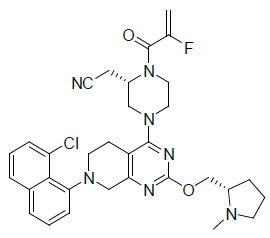
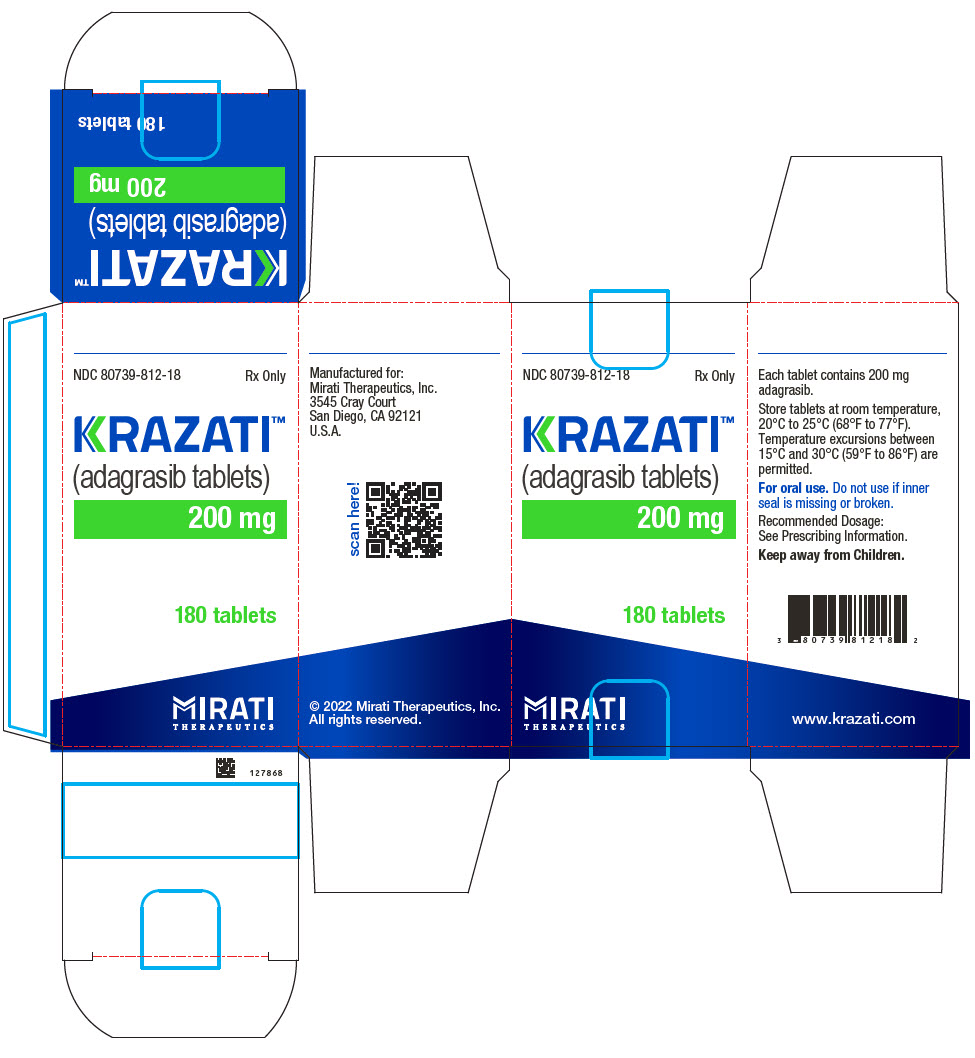
KRAZATI (adagrasib) tablets, 200 mg, oval shaped, white to off-white, immediate release, film coated tablets with "200" on one side and stylized "M" on the other side.
KRAZATI (adagrasib) tablets are packaged in high-density polyethylene, white opaque, square bottles with desiccant and polypropylene, white, child resistant closures with a tamper-proof heat induction seal.
- NDC 80739-812-12: 200 mg, bottle containing 120 tablets.
- NDC 80739-812-18: 200 mg, bottle containing 180 tablets.
Gastrointestinal Adverse Reactions
Advise patients that KRAZATI can cause severe gastrointestinal adverse reactions and to contact their healthcare provider for signs or symptoms of severe or persistent gastrointestinal adverse reactions [see Warnings and Precautions (5.1)].
QTc Interval Prolongation
Advise patients that KRAZATI can cause QTc interval prolongation and to contact their healthcare provider for signs or symptoms of arrhythmias [see Warnings and Precautions (5.2)].
Hepatotoxicity
Advise patients that KRAZATI can cause hepatotoxicity and to immediately contact their healthcare provider for signs or symptoms of liver dysfunction [see Warnings and Precautions (5.3)].
Interstitial Lung Disease (ILD)/Pneumonitis
Advise patients that KRAZATI can cause ILD / pneumonitis and to contact their healthcare provider immediately for new or worsening respiratory symptoms [see Warnings and Precautions (5.4)].
Drug Interactions
Advise patients to inform their healthcare providers of all concomitant medications, including prescription medicines, over-the-counter drugs, vitamins, and herbal products [see Drug Interactions (7.1)].
Missed Dose
If a dose of KRAZATI is missed by greater than 4 hours, resume dosing at the next scheduled time [see Dosage and Administration (2.2)].
Lactation
Advise women not to breastfeed during treatment with KRAZATI and for 1 week after the last dose [see Use in Specific Populations (8.2)].
Infertility
Inform patients that KRAZATI may cause infertility [see Use in Specific Populations (8.3)]
KRAZATI (adagrasib)
Manufactured for:
Mirati Therapeutics, Inc.
3545 Cray Court
San Diego, CA 92121, U.S.A.
© 2022 Mirati Therapeutics, Inc. All Rights Reserved