Mflusiva Injection, Suspension
FDA Label NDC 80777-500

Full FDA labeling including Indications, Dosage, Usage, and Precautions

Structured Product Label

The following Structured Product Label (SPL) was submitted to the FDA by Moderna Us, Inc. for the product Mflusiva (NDC 80777-500). This document serves as the official prescribing information, containing essential scientific data and clinical materials required for healthcare providers and patients.

This specific version of the label includes detailed information regarding 1 indications and usage, 2 dosage and administration, 2.1 dose and schedule, 2.2 preparation for administration, 2.3 administration, 3 dosage forms and strengths, 4 contraindications, 5.1 management of acute allergic reactions, and other regulatory disclosures. Use the navigation below to review specific sections of the FDA submission.

1 Indications And Usage

MFLUSIVA is a vaccine indicated for active immunization for the prevention of influenza disease caused by influenza virus subtypes A and type B represented in the vaccine. MFLUSIVA is approved for use in persons 50 years of age and older.

The indication for persons 65 years of age and older is approved under accelerated approval based on immune responses [see Clinical Studies (14.3)]. Continued approval for this indication may be contingent upon verification and description of clinical benefit in a confirmatory trial.

2 Dosage And Administration

For intramuscular use.

2.1 Dose And Schedule

Administer MFLUSIVA as a single 0.38 mL dose.

2.2 Preparation For Administration

  • Verify that the label on the pre-filled syringe states 2026-2027 formula.
  • Parenteral drug products should be inspected visually for particulate matter and discoloration prior to administration, whenever solution and container permit.
  • MFLUSIVA is a white to off-white suspension that may contain visible white or translucent product-related particulates. Do not administer if the vaccine is discolored or contains other particulate matter.
  • Do not shake.
  • With tip cap upright, remove tip cap by twisting counterclockwise until tip cap releases. Remove tip cap in a slow, steady motion. Avoid pulling tip cap while twisting.
  • Attach the needle by twisting in a clockwise direction until the needle fits securely on the pre-filled syringe.
  • Discard after single use.

2.3 Administration

Administer MFLUSIVA intramuscularly.

3 Dosage Forms And Strengths

MFLUSIVA is an injectable suspension. A single dose is 0.38 mL.

4 Contraindications

Do not administer MFLUSIVA to individuals with a history of a severe allergic reaction (e.g., anaphylaxis) to MFLUSIVA or any of its components [see Description (11)].

5.1 Management Of Acute Allergic Reactions

Appropriate medical treatment must be immediately available to manage potential anaphylactic reactions following administration of MFLUSIVA.

5.2 Guillain-Barré Syndrome

If Guillain-Barré syndrome (GBS) has occurred within 6 weeks following previous influenza vaccination, the decision to give MFLUSIVA should be based on careful consideration of the potential benefits and risks. 

The 1976 swine influenza vaccine was associated with an increased frequency of GBS. Evidence for a causal relation of GBS with other influenza vaccines is inconclusive; if an excess risk exists, it is probably slightly more than one additional case per 1 million persons vaccinated1.

5.3 Syncope

Syncope (fainting) may occur in association with administration of injectable vaccines including MFLUSIVA. Procedures should be in place to avoid injury from fainting.

5.4 Altered Immunocompetence

Immunocompromised individuals, including those receiving immunosuppressive therapy, may have a diminished immune response to MFLUSIVA.

5.5 Limitations Of Vaccine Effectiveness

MFLUSIVA may not protect all vaccine recipients.

6 Adverse Reactions

In adults 50 through 64 years of age who received MFLUSIVA, the most commonly reported (≥10%) adverse reactions were injection site pain (68.7%), fatigue (48.1%), headache (41.9%), myalgia (40.6%), arthralgia (31.5%), chills (27.5%), and axillary (underarm) swelling or tenderness (20.3%).

In adults 65 years of age and older who received MFLUSIVA, the most commonly reported (≥10%) adverse reactions were injection site pain (62.9%), fatigue (42.1%), headache (33.7%), myalgia (30.2%), arthralgia (24.1%), chills (18.1%), and axillary (underarm) swelling or tenderness (14.2%).

6.1 Clinical Trials Experience

Because clinical trials are conducted under widely varying conditions, adverse reaction rates observed in the clinical trials of a vaccine cannot be directly compared with rates in the clinical trials of another vaccine and may not reflect the rates observed in practice.

MFLUSIVA in Participants 50 Years of Age and Older

The safety of MFLUSIVA was evaluated in Study 1 (NCT06602024), a Phase 3, randomized, double-blind, active-control clinical trial conducted during the 2024-2025 influenza season in participants 50 years of age and older. Participants in the trial received either MFLUSIVA (N=20,350) or a U.S.-licensed standard dose (SD) inactivated influenza vaccine comparator (Fluarix® Quadrivalent, marketed outside the U.S. under other trade names, or Fluarix®, both manufactured by GlaxoSmithKline Biologicals [referred to as SD comparator hereafter]; N=20,353). The trial was conducted in 11 countries: Belgium, Bulgaria, Canada, Estonia, Finland, Georgia, Germany, South Korea, Taiwan, United Kingdom, and United States.

In this trial, 56.9% of participants were female, 82.6% were White, 13.2% were Black or African American, and 10.4% were Hispanic or Latino. The median age was 64 years; 52.2% were 50 through 64 years of age, 36.2% were 65 through 74 years of age, and 11.6% were 75 years of age and older. The baseline demographics and characteristics were comparable across MFLUSIVA and SD comparator groups.

Solicited Adverse Reactions

Local and systemic adverse reactions were solicited in an electronic diary for 7 days following injection (i.e., the day of injection and 6 subsequent days) among a subset of 3,015 participants receiving MFLUSIVA and 2,997 participants receiving SD comparator.

The number and percentage of participants who reported solicited local and systemic adverse reactions are presented in Table 1 and Table 2, respectively. Solicited adverse reactions (any grade, including Grade 3) were reported more frequently in the MFLUSIVA group compared with the SD comparator group. In the MFLUSIVA group, both local and systemic solicited adverse reactions had a median time of onset of 2 days after vaccination and a median duration of 2 days. Most reactions were Grade 1 or Grade 2 in severity.

Table 1: Number and Percentage of Participants in Study 1 (≥50 Years of Age) with Solicited Local Adverse Reactions (Any Grade and Grade 3) Within 7 Days of Vaccination*, by Age Subgroup
50 through 64 years of age65 years of age and older
Local Adverse ReactionsaMFLUSIVA
N=1,510
n (%)
SD Comparatorb
N=1,502
n (%)
MFLUSIVA
N=1,505
n (%)
SD Comparatorb
N=1,495
n (%)
SD=standard dose.
* 7 days included day of vaccination and the subsequent 6 days. Events were collected in the electronic diary (e‑diary).
a No Grade 4 solicited local adverse reactions were reported.
b Fluarix® Quadrivalent, marketed outside the U.S. under other trade names, or Fluarix®, both manufactured by GlaxoSmithKline Biologicals.
c Pain and axillary (underarm) swelling or tenderness grading scale: no interference with activity (Grade 1); some interference with activity (Grade 2); prevents daily activity (Grade 3).
d Swelling (hardness) and erythema (redness) grading scale: 25‑50 mm / 2.5‑5 cm (Grade 1); 51‑100 mm / 5.1‑10 cm (Grade 2); >100 mm / >10 cm (Grade 3).

Injection site pain, Any Gradec

1,038 (68.7)

517 (34.4)

947 (62.9)

377 (25.2)

Injection site pain, Grade 3c

17 (1.1)

1 (<0.1)

10 (0.7)

0

Axillary (underarm) swelling or tenderness, Any Gradec

306 (20.3)

104 (6.9)

214 (14.2)

80 (5.4)

Axillary (underarm) swelling or tenderness, Grade 3c

4 (0.3)

1 (<0.1)

6 (0.4)

0

Swelling (hardness), Any Graded

96 (6.4)

18 (1.2)

76 (5.0)

27 (1.8)

Swelling (hardness), Grade 3d

4 (0.3)

2 (0.1)

5 (0.3)

2 (0.1)

Erythema (redness), Any Graded

66 (4.4)

19 (1.3)

51 (3.4)

19 (1.3)

Erythema (redness), Grade 3d

4 (0.3)

1 (<0.1)

6 (0.4)

1 (<0.1)

Table 2: Number and Percentage of Participants in Study 1 (≥50 Years of Age) with Solicited Systemic Adverse Reactions (Any Grade and Grade 3) Within 7 Days of Vaccination*, by Age Subgroup
50 through 64 years of age65 years of age and older
Systemic Adverse ReactionsaMFLUSIVA
N=1,510#
n (%)
SD Comparatorb
N=1,502#
n (%)
MFLUSIVA
N=1,505#
n (%)
SD Comparatorb
N=1,495#
n (%)
SD=standard dose.
* 7 days included day of vaccination and the subsequent 6 days. Events were collected in the electronic diary (e‑diary).
# Except for fever, which had N=1,505 (MFLUSIVA 50 through 64 years), N=1,501 (SD Comparator 50 through 64 years), N=1,496 (MFLUSIVA ≥65 years), N=1,491 (SD Comparator ≥65 years).
a No Grade 4 solicited systemic adverse reactions were reported.
b Fluarix® Quadrivalent, marketed outside the U.S. under other trade names, or Fluarix®, both manufactured by GlaxoSmithKline Biologicals.
c Fatigue, headache, myalgia, arthralgia, and chills grading scale: no interference with activity (Grade 1); some interference with activity (Grade 2); prevents daily activity (Grade 3).
d Nausea/vomiting grading scale: no interference with activity or 1-2 episodes/24 hours (Grade 1); some interference with activity or >2 episodes/24 hours (Grade 2); prevents daily activity or requires outpatient intravenous hydration (Grade 3).
e Fever grading scale: ≥38.0°C – ≤38.4°C / ≥100.4°F – ≤101.1°F (Grade 1); ≥38.5°C – ≤38.9°C / ≥101.2°F – ≤102.0°F (Grade 2); ≥39.0°C – ≤40.0°C / ≥102.1°F – ≤104.0°F (Grade 3).

Fatigue, Any Gradec

727 (48.1)

309 (20.6)

633 (42.1)

300 (20.1)

Fatigue, Grade 3c

59 (3.9)

9 (0.6)

38 (2.5)

4 (0.3)

Headache, Any Gradec

633 (41.9)

302 (20.1)

507 (33.7)

236 (15.8)

Headache, Grade 3c

33 (2.2)

6 (0.4)

26 (1.7)

4 (0.3)

Myalgia, Any Gradec

613 (40.6)

196 (13.0)

454 (30.2)

152 (10.2)

Myalgia, Grade 3c

44 (2.9)

4 (0.3)

32 (2.1)

3 (0.2)

Arthralgia, Any Gradec

476 (31.5)

167 (11.1)

363 (24.1)

150 (10.0)

Arthralgia, Grade 3c

34 (2.3)

3 (0.2)

23 (1.5)

3 (0.2)

Chills, Any Gradec

415 (27.5)

71 (4.7)

273 (18.1)

58 (3.9)

Chills, Grade 3c

42 (2.8)

3 (0.2)

20 (1.3)

1 (<0.1)

Nausea/vomiting, Any Graded

147 (9.7)

61 (4.1)

112 (7.4)

41 (2.7)

Nausea/vomiting, Grade 3d

3 (0.2)

1 (<0.1)

2 (0.1)

1 (<0.1)

Fever, Any Gradee

90 (6.0)

13 (0.9)

84 (5.6)

13 (0.9)

Fever, Grade 3e

11 (0.7)

2 (0.1)

6 (0.4)

1 (<0.1)

Unsolicited Adverse Events

In Study 1, unsolicited adverse events within 28 days of study vaccination were reported in 5.9% (1,204/20,350) of participants in the MFLUSIVA group and 5.7% (1,167/20,353) of participants in the SD comparator group. There were no notable patterns or numerical imbalances between treatment groups for specific categories of adverse events that would suggest a causal relationship to MFLUSIVA.

Serious Adverse Events

Serious adverse events were collected for 6 months postvaccination. In Study 1, with a median duration of safety follow-up of 184 days (range 1 to 254 days), serious adverse events were reported in 2.2% (455/20,350) of participants in the MFLUSIVA group and 1.9% (392/20,353) of participants in the SD comparator group.

In the MFLUSIVA group, one serious adverse event was assessed as related to study vaccine: syncope on Study Day 2, accompanied by fever and possible dehydration, in a 62‑year‑old participant. There were no other notable patterns or numerical imbalances between treatment groups for specific categories of serious adverse events that would suggest a causal relationship to MFLUSIVA.

Moderna mRNA Quadrivalent Influenza Vaccine in Participants 65 Years of Age and Older

Study 2 (NCT05827978) was a randomized, double-blind, active-controlled trial conducted in the United States to evaluate the immunogenicity and safety of Moderna mRNA quadrivalent influenza vaccine in adults 65 years of age and older during the 2023-2024 influenza season. The study included 2,991 participants 65 years of age and older to receive either an unlicensed Moderna mRNA quadrivalent influenza vaccine (N=1,502) or high-dose (HD) inactivated influenza vaccine comparator (Fluzone® High-Dose Quadrivalent, U.S.‑licensed, manufactured by Sanofi Pasteur Inc. [referred to as HD comparator hereafter]; N=1,489). The safety experience with Moderna mRNA quadrivalent influenza vaccine is relevant to MFLUSIVA. The Moderna mRNA quadrivalent influenza vaccine (containing 50 micrograms [mcg] of total RNA, with equal amounts [12.5 mcg] of each of the four RNAs encoding the hemagglutinin [HA] glycoproteins of A/Wisconsin/67/2022 pdm09-like virus [H1N1], A/Darwin/6/2021-like virus [H3N2], B/Austria/1359417/2021-like virus [B/Victoria], and B/Phuket/3073/2013-like virus [B/Yamagata]) is manufactured using the same process as MFLUSIVA and differs only in the addition of the RNA encoding the B/Yamagata antigen [see Description (11)].

In Study 2, 57.8% of participants were female, 82.7% were White, 15.3% were Black or African American, and 30.2% were Hispanic or Latino. The median age was 70 years; 77.9% were 65 through 74 years of age, and 22.1% were 75 years of age and older. The baseline demographics and characteristics were comparable across the Moderna mRNA quadrivalent influenza vaccine and the HD comparator groups.

Solicited Adverse Reactions

Local and systemic adverse reactions were solicited in an electronic diary for 7 days following injection (i.e., the day of injection and 6 subsequent days) among participants receiving Moderna mRNA quadrivalent influenza vaccine and participants receiving HD comparator.

The number and percentage of participants who reported solicited local and systemic adverse reactions are presented in Table 3 and Table 4, respectively. Solicited adverse reactions (any grade, including Grade 3 or 4) were reported more frequently in the Moderna mRNA quadrivalent influenza vaccine group compared with the HD comparator group. The median time of onset for solicited local adverse reactions after vaccination was Day 2 and Day 1 in the Moderna mRNA quadrivalent influenza vaccine group and the HD comparator group, respectively, and with a median duration of 2 days in both groups. The median time of onset for solicited systemic adverse reactions after vaccination was Day 2 with a median duration of 2 days in both groups. Most reactions were Grade 1 or Grade 2 in severity.

Table 3: Number and Percentage of Participants in Study 2 (≥65 Years of Age) with Solicited Local Adverse Reactions (Any Grade and Grade 3) Within 7 Days of Vaccination*
Local Adverse ReactionsamRNA QIVb
N=1,502
n (%)
HD Comparatorc
N=1,488-1,489d
n (%)
HD=high-dose; mRNA=messenger ribonucleic acid; QIV=quadrivalent influenza vaccine.
* 7 days included day of vaccination and the subsequent 6 days. Events were collected in the electronic diary (e‑diary).
a No Grade 4 solicited local adverse reactions were reported.
b An unlicensed Moderna mRNA quadrivalent influenza vaccine manufactured using the same process as MFLUSIVA and differs only in the addition of the RNA encoding the B/Yamagata antigen.
c Fluzone® High‑Dose Quadrivalent, U.S.‑licensed, manufactured by Sanofi Pasteur Inc.
d N is the number of vaccinated participants with available data for the adverse reactions listed.
e Pain and axillary (underarm) swelling or tenderness grading scale: no interference with activity (Grade 1); some interference with activity (Grade 2); prevents daily activity (Grade 3).
f Swelling (hardness) and erythema (redness) grading scale: 25‑50 mm / 2.5‑5 cm (Grade 1); 51‑100 mm / 5.1‑10 cm (Grade 2); >100 mm / >10 cm (Grade 3).

Injection site pain, Any Gradee

971 (64.6)

546 (36.7)

Injection site pain, Grade 3e

23 (1.5)

6 (0.4)

Axillary (underarm) swelling or tenderness, Any Gradee

252 (16.8)

128 (8.6)

Axillary (underarm) swelling or tenderness, Grade 3e

8 (0.5)

6 (0.4)

Swelling (hardness), Any Gradef

67 (4.5)

25 (1.7)

Swelling (hardness), Grade 3f

6 (0.4)

2 (0.1)

Erythema (redness), Any Gradef

42 (2.8)

20 (1.3)

Erythema (redness), Grade 3f

6 (0.4)

3 (0.2)

Table 4: Number and Percentage of Participants in Study 2 (≥65 Years of Age) with Solicited Systemic Adverse Reactions (Any Grade and ≥Grade 3) Within 7 Days of Vaccination*
Systemic Adverse ReactionsamRNA QIVb
N=1,502
n (%)
HD Comparatorc
N=1,487-1,488d
n (%)
HD=high-dose; mRNA=messenger ribonucleic acid; QIV=quadrivalent influenza vaccine.
* 7 days included day of vaccination and the subsequent 6 days. Events were collected in the electronic diary (e‑diary).
a No Grade 4 solicited systemic adverse reactions were reported except fever.
b An unlicensed Moderna mRNA quadrivalent influenza vaccine.
c Fluzone® High‑Dose Quadrivalent, U.S.‑licensed, manufactured by Sanofi Pasteur Inc.
d N is the number of vaccinated participants with available data for the adverse reactions listed.
e Fatigue, myalgia, headache, and arthralgia grading scale: no interference with activity (Grade 1); some interference with activity (Grade 2); prevents daily activity (Grade 3).
f Chills grading scale: no interference with activity (Grade 1); some interference with activity not requiring medical intervention (Grade 2); prevents daily activity and requires medical intervention (Grade 3).
g Nausea/vomiting grading scale: no interference with activity or 1-2 episodes/24 hours (Grade 1); some interference with activity or >2 episodes/24 hours (Grade 2); prevents daily activity or requires outpatient intravenous hydration (Grade 3).
h Fever grading scale: ≥38.0°C – ≤38.4°C / ≥100.4°F – ≤101.1°F (Grade 1); ≥38.5°C – ≤38.9°C / ≥101.2°F – ≤102.0°F (Grade 2); ≥39.0°C – ≤40.0°C / ≥102.1°F – ≤104.0°F (Grade 3); ≥ 40.1°C or ≥ 104.1°F (Grade 4).

Fatigue, Any Gradee

669 (44.5)

293 (19.7)

Fatigue, Grade 3e

52 (3.5)

12 (0.8)

Myalgia, Any Gradee

626 (41.7)

239 (16.1)

Myalgia, Grade 3e

48 (3.2)

11 (0.7)

Headache, Any Gradee

592 (39.4)

258 (17.3)

Headache, Grade 3e

35 (2.3)

10 (0.7)

Arthralgia, Any Gradee

529 (35.2)

210 (14.1)

Arthralgia, Grade 3e

35 (2.3)

11 (0.7)

Chills, Any Gradef

443 (29.5)

115 (7.7)

Chills, Grade 3f

18 (1.2)

5 (0.3)

Nausea/vomiting, Any Gradeg

192 (12.8)

63 (4.2)

Nausea/vomiting, Grade 3g

4 (0.3)

3 (0.2)

Fever, Any Gradeh

127 (8.5)

21 (1.4)

Fever, Grade 3h

9 (0.6)

1 (<0.1)

Fever, Grade 4h

2 (0.1)

0

Unsolicited Adverse Events

In Study 2, unsolicited adverse events within 28 days of study vaccination were reported in 10.3% (155/1,502) of participants in the Moderna mRNA quadrivalent influenza vaccine group and 9.2% (137/1,489) of participants in the HD comparator group. There were no notable patterns or numerical imbalances between treatment groups for specific categories of adverse events that would suggest a causal relationship to Moderna mRNA quadrivalent influenza vaccine.
Serious Adverse Events

Serious adverse events were collected for 6 months postvaccination. In Study 2, with a median duration of safety follow-up of 171 days (range 1 to 207 days), serious adverse events were reported in 2.7% (41/1,502) of participants in the Moderna mRNA quadrivalent influenza vaccine group and 2.6% (38/1,489) of participants in the HD comparator group. There were no serious adverse events considered causally related to Moderna mRNA quadrivalent influenza vaccine. There were no notable patterns or numerical imbalances between treatment groups for specific categories of serious adverse events that would suggest a causal relationship to Moderna mRNA quadrivalent influenza vaccine.

8.1 Pregnancy

Risk Summary

All pregnancies have a risk of birth defect, loss, or other adverse outcomes. In the U.S. general population, the estimated background risk of major birth defects and miscarriage in clinically recognized pregnancies is 2% to 4% and 15% to 20%, respectively.

MFLUSIVA is not approved for use in persons younger than 50 years of age. Available data on MFLUSIVA administered to pregnant women are insufficient to inform vaccine-associated risks in pregnancy.

A developmental toxicity study was performed in female rats administered a vaccine containing 100 mcg of nucleoside-modified messenger ribonucleic acid (mRNA; 2.7 times the amount of nucleoside-modified mRNA in a full human dose of MFLUSIVA) twice prior to mating and twice during gestation. The study revealed no evidence of harm to the fetus due to the vaccine (see Data).

Data

Animal Data

In a developmental toxicity study, a vaccine formulation containing 100 mcg of nucleoside-modified mRNA (which is 2.7 times the amount of nucleoside-modified mRNA in a full human dose of MFLUSIVA) along with all other ingredients present in a 0.38 mL single human dose of MFLUSIVA was administered to female rats by intramuscular injection during the premating period (28 and 14 days prior to mating) and on gestation days (GDs) 1 and 13.

No vaccine-related fetal malformations or variations and no adverse effect on postnatal development were observed in the study. The study revealed no evidence of impaired female fertility.

8.2 Lactation

Risk Summary

MFLUSIVA is not approved for use in persons younger than 50 years of age. It is not known whether MFLUSIVA is excreted in human milk. No human or animal data are available to assess the effects of MFLUSIVA on the breastfed infant or on milk production/excretion.

The developmental and health benefits of breastfeeding should be considered along with the mother’s clinical need for MFLUSIVA and any potential adverse effects on the breastfed infant from MFLUSIVA or from the underlying maternal condition. For preventive vaccines, the underlying maternal condition is susceptibility to disease prevented by the vaccine.

8.4 Pediatric Use

Safety and effectiveness of MFLUSIVA have not been established in persons younger than 18 years of age.

8.5 Geriatric Use

Of the 20,350 participants 50 years of age and older who received MFLUSIVA in Study 1, 9,726 (47.8%) were 65 years of age and older and 2,354 (11.6%) were 75 years of age and older. Of the 1,502 participants 65 years of age and older who received Moderna mRNA quadrivalent influenza vaccine in Study 2, 326 (21.7%) were 75 years of age and older [see Adverse Reactions (6.1) and Clinical Studies (14)].

11 Description

MFLUSIVA (Influenza Vaccine, mRNA) is a sterile white to off-white suspension for intramuscular use supplied in a single-dose pre-filled syringe. Cells are not used in the manufacturing process for MFLUSIVA. The mRNA is synthesized by in vitro transcription.

Each 0.38 mL dose contains three RNAs (12.5 micrograms of each RNA, for a total of 37.5 micrograms of RNA) encapsulated in lipid nanoparticles, each encoding one of the following seasonal influenza strain hemagglutinin (HA) glycoproteins:

  • A/Missouri/11/2025 (H1N1) pdm09-like virus;
  • A/Michigan/105/2025, an A/Darwin/1415/2025 (H3N2)-like virus; and
  • B/Pennsylvania/19/2025, a B/Pennsylvania/14/2025-like virus.
  • These three influenza virus strains are recommended by FDA for the 2026-2027 influenza season.

    Each 0.38 mL dose of MFLUSIVA also contains the following ingredients: a total lipid content of 0.759 mg (SM-102 (heptadecan-9-yl 8-{(2-hydroxyethyl) [6-oxo-6-(undecyloxy) hexyl] amino}octanoate), polyethylene glycol [PEG] 2000 dimyristoyl glycerol [DMG], cholesterol, and 1,2-distearoyl-sn-glycero-3-phosphocholine [DSPC]), 0.189 mg tromethamine, 0.934 mg tromethamine hydrochloride, 32.6 mg sucrose, and water for injection.

    MFLUSIVA does not contain egg protein, antibiotics, or preservatives.

    The rubber tip cap and plunger used for the pre-filled syringes are not made with natural rubber latex.

12.1 Mechanism Of Action

MFLUSIVA encodes for the full-length HA glycoproteins of the 3 influenza virus strains represented in the vaccine. After delivery into cells, the mRNA serves as a template for the synthesis of the intended proteins. The expressed, membrane-bound HA glycoproteins of the encoded influenza strains are recognized by immune cells as a foreign antigen, eliciting immune responses, which contribute to protection against influenza.

Antibody against one influenza virus type or subtype confers limited or no protection against another. Furthermore, antibody to one antigenic variant of influenza virus might not protect against a new antigenic variant of the same type or subtype. Frequent development of antigenic variants through antigenic drift is the virologic basis for seasonal epidemics and the reason for the usual change of one or more new strains in each year's influenza vaccine.

13.1 Carcinogenesis, Mutagenesis, Impairment Of Fertility

MFLUSIVA has not been evaluated for the potential to cause carcinogenicity, genotoxicity, or impairment of male fertility in animals [see Use in Specific Populations (8.1)].

14.1 Efficacy Against Influenza

Effectiveness in adults 50 through 64 years of age is based on relative efficacy data from Study 1. Effectiveness in adults 65 years of age and older is based on immunogenicity data from Study 2, which compared MFLUSIVA with a HD influenza comparator vaccine [see Clinical Studies (14.3)], and supported by relative efficacy data from Study 1, which compared MFLUSIVA with a SD influenza comparator vaccine. At the time of the study, the HD influenza comparator vaccine, but not the SD comparator, was one of the preferentially recommended influenza vaccines by the Centers for Disease Control and Prevention (CDC) in adults 65 years of age and older [see Clinical Studies (14.3)].

Study 1 (NCT06602024) was a Phase 3, randomized, double-blind, active-control trial conducted during a single influenza season (2024-2025) in participants 50 years of age and older. Participants were randomized to receive MFLUSIVA, containing A/Wisconsin/67/2022 (H1N1), A/Massachusetts/18/2022 (H3N2), and B/Austria/1359417/2021 (Victoria lineage), or a U.S.‑licensed standard dose (SD) inactivated influenza vaccine comparator (Fluarix® Quadrivalent marketed outside the U.S. under other trade names or Fluarix®, both manufactured by GlaxoSmithKline Biologicals [referred to as SD comparator hereafter]). Randomization was stratified by age (50 through 64 years of age or 65 years of age and older) and by influenza vaccination status in the previous influenza season.

The per-protocol (PP) analysis set for efficacy assessments included 20,179 participants who received MFLUSIVA and 20,124 participants who received an SD comparator influenza vaccine. The study excluded immunocompromised individuals or those on immunosuppressive medications.

Among all participants, the median age was 64 years (range 50 through 97 years), 52.2% of participants were 50 through 64 years, 47.8% were 65 years and older, 36.2% were 65 through 74 years, and 11.6% were 75 years and older. Overall, 56.8% participants were female, 82.7% were White, 13.2% were Black or African American, 2.4% were Asian, and 10.4% were Latino/Hispanic ethnicity.

A total of 46.8% of participants received seasonal influenza vaccine in the prior influenza season, and 56.9% had at least one protocol-defined baseline high-risk factor for severe influenza (body mass index ≥30 kg/m2 or a medical history of autoimmune/immune-mediated disease, blood disorders, cardiac disorders, diabetes mellitus, hepatic disorders, mental impairment disorders, nervous system disorders, pulmonary disorders, or renal disorders). The Edmonton Frail Scale was administered to participants 65 years of age and older, among whom 8.5% had a score ≥6, and 0.3% had a score ≥10 (scoring range 0 to 17).

There were no notable differences in the baseline demographics, characteristics, prior influenza vaccination status, or protocol-defined high-risk factors between the MFLUSIVA and SD comparator groups.

The primary efficacy endpoint was real-time reverse transcription polymerase chain reaction (RT‑PCR)‑confirmed protocol-defined influenza-like illness (ILI) caused by any influenza A or B strains beginning at least 14 days postvaccination through the end of the influenza season. Protocol-defined ILI included at least 1 systemic symptom (temperature >37.2°C [>99.0°F], chills, feverish, tiredness, headaches, or myalgia) and at least 1 respiratory symptom (sore throat, cough, sputum production, wheezing, or difficulty breathing).

The 3 pre-specified success criteria (sequentially tested) for the primary efficacy endpoint were met. The lower limit of the 2-sided 95% CI of the relative vaccine efficacy (rVE) of MFLUSIVA relative to the licensed SD comparator vaccine for noninferiority was >-10%; the lower limits for the more stringent pre-specified success criteria were >0% and >9.1%.

Table 5 presents the rVE results for Study 1 based on median duration of follow-up of 181 days (range 1 to 227 days).

Table 5: Relative Vaccine Efficacy of MFLUSIVA Versus SD Comparator Against RTPCR-Confirmed ILI* in Participants ≥50 Years of Age (Study 1; Per-Protocol Analysis Set)
MFLUSIVA
N=20,179
nb (%)
SD Comparatora
N=20,124
nb (%)
rVE
% (95% CI)c
CI=confidence interval; ILI=influenza-like illness; RT-PCR=reverse transcription polymerase chain reaction; rVE=relative vaccine efficacy; SD=standard dose.
* Protocol-defined ILI included at least 1 systemic symptom (temperature >37.2°C [>99.0°F], chills, feverish, tiredness, headaches, or myalgia) and at least 1 respiratory symptom (sore throat, cough, sputum production, wheezing, or difficulty breathing).
a Fluarix® Quadrivalent marketed outside the U.S. under other trade names or Fluarix®, both manufactured by GlaxoSmithKline Biologicals.
b The event is the first RT-PCR-confirmed protocol-defined ILI that begins at least 14 days after study vaccination through the end of influenza season.
c The rVE and the 95% CI are based on a stratified Cox proportional hazards model.
d Primary endpoint.
e The 3 pre-specified success criteria (sequentially tested) were met. The lower limit of the 2-sided 95% CI of the relative vaccine efficacy of MFLUSIVA relative to the licensed SD comparator vaccine for noninferiority was >‑10%; the lower limits for more stringent pre-specified success criteria were >0% and >9.1%.
f The influenza subtype data were descriptive analyses.
g Cases of influenza B were not distinguished by lineage. The rVE cannot be precisely estimated due to low number of cases accrued.

Any Type / Subtyped

411 (2.0)

557 (2.8)

26.6 (16.7, 35.4)e

   Influenza Af

386 (1.9)

522 (2.6)

26.5 (16.1, 35.5)

           A (H1N1)

223 (1.1)

315 (1.6)

29.6 (16.4, 40.7)

           A (H3N2)

158 (0.8)

202 (1.0)

22.2 (4.3, 36.9)

   Influenza Bf, g

25 (0.1)

35 (0.2)

29.1 (-18.5, 57.5)

14.2 Efficacy In Participants 50 Through 64 Years Of Age

The descriptive subgroup analysis in Study 1 for relative vaccine efficacy of MFLUSIVA relative to a SD influenza comparator vaccine in participants 50 through 64 years of age [see Clinical Studies (14.1)] is presented in Table 6.

Table 6: Descriptive Relative Vaccine Efficacy of MFLUSIVA Versus SD Comparator Against RT-PCR-Confirmed ILI in Participants 50 Through 64 Years of Age (Study 1; Per-Protocol Analysis Set)
CI=confidence interval; ILI=influenza-like illness; RT-PCR=reverse transcription polymerase chain reaction; rVE=relative vaccine efficacy; SD=standard dose.
a Fluarix® Quadrivalent marketed outside the U.S. under other trade names or Fluarix®, both manufactured by GlaxoSmithKline Biologicals.
b Based on the number of participants in each subgroup. The event is the first RT-PCR-confirmed, protocol-defined ILI with onset at least 14 days after study vaccination through the end of the influenza season, regardless of vaccine match.
c The rVE and 95% CI are based on a stratified Cox proportional hazards model.

Subgroup

MFLUSIVA
n/Nb (%)

SD Comparatora
n/Nb (%)

rVE
% (95% CI)c

Age group

   50 through 64 years

229/10,542 (2.2)

307/10,501 (2.9)

26.1 (12.3, 37.7)

14.3 Effectiveness In Participants 65 Years Of Age And Older

The clinical experience with Moderna mRNA quadrivalent influenza vaccine is relevant to MFLUSIVA. The Moderna mRNA quadrivalent influenza vaccine (containing 50 micrograms [mcg] of total RNA, with equal amounts [12.5 mcg] of each of the four RNAs encoding the hemagglutinin [HA] glycoproteins of A/Wisconsin/67/2022 pdm09-like virus [H1N1], A/Darwin/6/2021-like virus [H3N2], B/Austria/1359417/2021-like virus [B/Victoria], and B/Phuket/3073/2013-like virus [B/Yamagata]) is manufactured using the same process as MFLUSIVA and differs only in the addition of the RNA encoding the B/Yamagata antigen [see Description (11)].

Study 2 (NCT05827978) was a randomized, double-blind, active-controlled study conducted in the United States to evaluate the immunogenicity and safety of Moderna mRNA quadrivalent influenza vaccine in adults 65 years of age and older during the 2023-2024 influenza season. The per-protocol immunogenicity set (PPIS) for the primary analysis included 1,425 participants who received Moderna mRNA quadrivalent influenza vaccine and 1,409 participants who received a high-dose (HD) inactivated influenza vaccine comparator (Fluzone® High-Dose Quadrivalent, U.S.‑licensed, manufactured by Sanofi Pasteur Inc. [referred to as HD comparator hereafter]). Randomization was stratified by influenza vaccination status in the previous influenza season.

In the overall population, the median age was 70 years (range 65 through 93 years), 57.9% were female, 82.7% were White, 15.3% were Black or African American, 0.7% were Asian, and 30.8% were Latino/Hispanic ethnicity. There were no notable differences in the baseline demographics and characteristics between MFLUSIVA and HD comparator groups.

Immunogenicity against vaccine-matched influenza strains was evaluated at Day 29 after administration of Moderna mRNA quadrivalent influenza vaccine or an HD comparator vaccine. The co-primary endpoints were hemagglutination inhibition (HAI) Geometric Mean Titer (GMT) and the seroconversion rates at Day 29. Pre-specified criteria (sequentially tested) required that first, the lower bound of the 95% CI of the GMT ratio was >0.667 and the lower bound of the 95% of the seroconversion rate difference was >-10% for noninferiority for each strain, followed by more stringent pre-specified success criteria, i.e., lower bound of the 97.5% CI of the GMT ratio >1.0 and the lower bound of the 97.5% CI of the seroconversion rate difference of >0% for each strain. As shown in Table 7, Moderna mRNA quadrivalent influenza vaccine met all co-primary immunogenicity endpoints for all vaccine-matched influenza strains.

Table 7: Postvaccination HAI Antibody GMTs and Seroconversion Rates of Moderna mRNA Quadrivalent Influenza Vaccine Relative to HD Comparator at Day 29 in Participants ≥65 Years of Age (Study 2; Per Protocol Immunogenicity Set)
GMTaGMT RatiobSeroconversioncSeroconversion Differenced
mRNA QIVe
N=1,425
(95% CI)
HD Comparatorf
N=1,409
(95% CI)
mRNA QIV over HD Comparator
(95% CI)g
mRNA QIVe
N=1,425
% (95% CI)
HD Comparatorf
N=1,409
% (95% CI)
mRNA QIV minus HD Comparator (95% CI)g
ANCOVA=analysis of covariance; CI=confidence interval; GMT=geometric mean titer; HAI=hemagglutination inhibition; HD=high-dose; mRNA=messenger ribonucleic acid; QIV=quadrivalent.
a GMT and 95% CI are calculated based on the t-distribution of the log‑transformed HAI antibody titer, then back transformed to the original scale.
b The model‑based GMT ratio and 95% CI are obtained from an ANCOVA analysis of the log‑transformed HAI antibody titer, then back transformed to the original scale.
c The rate of seroconversion is defined as the percentage of participants with a baseline HAI titer <1:10 and a post‑baseline titer ≥1:40 or a baseline HAI titer ≥1:10 and a minimum 4‑fold rise in post‑baseline HAI antibody titer. The 95% CI is calculated using the Clopper‑Pearson method.
d The 95% CIs are calculated using the Miettinen‑Nurminen (score) method.
e An unlicensed Moderna mRNA quadrivalent influenza vaccine manufactured using the same process as MFLUSIVA and differs only in the addition of the RNA encoding the B/Yamagata antigen.
f Fluzone® High‑Dose Quadrivalent, U.S.‑licensed, manufactured by Sanofi Pasteur Inc.
g The pre-specified success criteria (sequentially tested) required that first, the lower bound of the 95% CI of the GMT ratio was >0.667 and the lower bound of the 95% CI of the seroconversion rate difference was >-10% for noninferiority for each strain, followed by more stringent pre-specified success criteria, i.e., the 97.5% CI of the GMT ratio >1.0 and the lower bound of the 97.5% CI of the seroconversion rate difference of >0% for each strain.
h In Study 1, a statistically significant correlation was observed between HAI titers and RT-PCR-confirmed, protocol-defined influenza-like illness (ILI) for Influenza A/H1N1 and A/H3N2. For Influenza B/Victoria, the correlation between strain-specific HAI titers and RT-PCR-confirmed, protocol-defined ILI was not statistically significant; therefore, effectiveness against this strain cannot be reliably inferred based on HAI titers.

A/H1N1

174.81

(165.15, 185.04)

130.09

(122.86, 137.74)

1.34

(1.25, 1.43)

49.7

(47.06, 52.31)

36.3

(33.75, 38.84)

13.42

(9.79, 17.01)

A/H3N2

141.62

(133.29, 150.46)

116.24

(109.47, 123.44)

1.21

(1.13, 1.30)

56.4

(53.80, 59.02)

47.8

(45.20, 50.48)

8.59

(4.91, 12.24)

B/Victoriah

248.03

(237.34, 259.21)

195.97

(187.44, 204.89)

1.25

(1.19, 1.32)

29.8

(27.46, 32.27)

20.2

(18.09, 22.35)

9.67

(6.50, 12.83)

B/Yamagata

104.82

(100.70, 109.11)

91.94

(88.33, 95.71)

1.14

(1.09, 1.20)

26.0

(23.77, 28.40)

20.2

(18.09, 22.35)

5.88

(2.78, 8.97)

The effectiveness of MFLUSIVA in adults 65 years of age and older is also supported by the descriptive analysis of relative vaccine efficacy of MFLUSIVA by age group in Study 1 [see Clinical Studies (14.1)]. Table 8 presents the relative vaccine efficacy of MFLUSIVA relative to a SD influenza comparator vaccine in participants 65 years of age and older in Study 1. At the time of conduct of Study 1, the HD influenza comparator vaccine, but not the SD influenza comparator vaccine, was one of the preferentially recommended influenza vaccines by the CDC for this age group.

Table 8: Descriptive Relative Vaccine Efficacy of MFLUSIVA Versus SD Comparator Against RT-PCR-Confirmed ILI in Participants ≥65 Years of Age (Study 1; Per-Protocol Analysis Set)
CI=confidence interval; ILI=influenza-like illness; RT-PCR=reverse transcription polymerase chain reaction; rVE=relative vaccine efficacy; SD=standard dose.
a Fluarix® Quadrivalent marketed outside the U.S. under other trade names or Fluarix®, both manufactured by GlaxoSmithKline Biologicals.
b Based on the number of participants in each subgroup. The event is the first RT-PCR-confirmed, protocol-defined ILI with onset at least 14 days after study vaccination through the end of the influenza season, regardless of vaccine match.
c The rVE and 95% CI are based on a stratified Cox proportional hazards model.
d The rVE cannot be precisely estimated due to the low number of cases accrued.

Subgroup

MFLUSIVA
n/Nb (%)

SD Comparatora
n/Nb (%)

rVE
% (95% CI)c

Age group

   ≥65 years

182/9,637 (1.9)

250/9,623 (2.6)

27.4 (12.1, 40.0)

      65 through 74 years

138/7,307 (1.9)

191/7,289 (2.6)

28.0 (10.4, 42.2)

      ≥75 yearsd

44/2,330 (1.9)

59/2,334 (2.5)

25.3 (-10.4, 49.5)

15 References

1 Lasky T, Terracciano GJ, Magder L, et al. The Guillain-Barré syndrome and the 1992-1993 and 1993-1994 influenza vaccines. N Engl J Med 1998; 339(25): 1797-1802.

16 How Supplied/Storage And Handling

MFLUSIVA (2026-2027 Formula) is supplied as follows:

NDC 80777-500-20             Carton of 10 single-dose pre-filled syringes, each syringe containing 1 dose of 0.38 mL (NDC 80777-500-18).

Storage

Store refrigerated between 2°C to 8°C (36°F to 46°F). Do not freeze.

During storage, minimize exposure to room light, and avoid exposure to direct sunlight and ultraviolet light.

MFLUSIVA may be stored between 8°C to 25°C (46°F to 77°F) for up to 12 hours after removal from refrigerated conditions. Discard the pre-filled syringe if not used within this time. Syringes should not be returned to refrigerated conditions after being stored at room temperature.

17 Patient Counseling Information

Advise the vaccine recipient or caregiver to read the FDA-approved patient labeling.

Prior to administration of MFLUSIVA:

  • Inform vaccine recipient or caregiver of the potential benefits and risks of vaccination with MFLUSIVA.
  • Educate vaccine recipient that (1) MFLUSIVA contains mRNA that encodes proteins that cannot cause influenza and (2) MFLUSIVA stimulates the immune system to produce antibodies that help protect against the influenza viruses carrying the proteins contained in the vaccine but does not prevent other respiratory infections.
  • Inform vaccine recipient or caregiver about the potential for adverse reactions [see Adverse Reactions (6.1)].
  • Instruct vaccine recipient or caregiver to report any adverse events to their healthcare provider or to the Vaccine Adverse Event Reporting System at 1-800-822-7967 or www.vaers.hhs.gov.
  • Inform the vaccine recipient that annual vaccination is recommended.
  • Manufactured for:

    Moderna US, Inc.
    Princeton, NJ 08540

    ©2026 ModernaTX, Inc. All rights reserved.

    MFLUSIVA is a trademark of ModernaTX, Inc.
    Patent(s): www.modernatx.com/patents

    US Govt. License No. 2256

    Revised: 8/2026

Package/Label Principal Display Panel

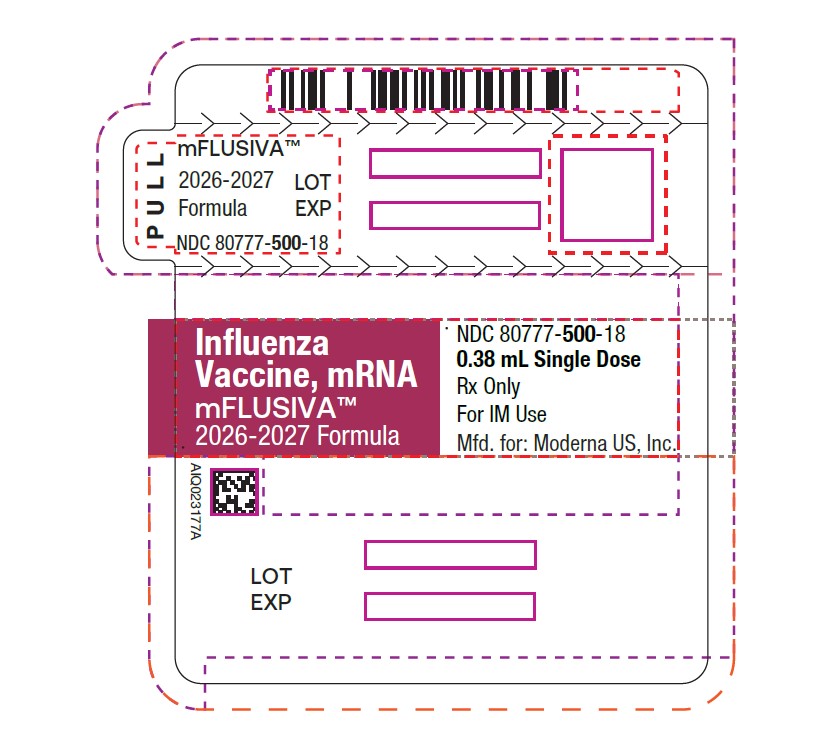
Mflusiva (influenza Vaccine, Mrna) 2026-2027 Formula Injectable Suspension For Intramuscular Use Single-dose Pre-filled Syringe 0.38 mL (Image 01)

Mflusiva (influenza Vaccine, Mrna) 2026-2027 Formula Injectable Suspension For Intramuscular Use Single-dose Pre-filled Syringe 0.38 mL (Image 01)

Influenza Vaccine, mRNA

mFLUSIVA

2026-2027 Formula

NDC 80777-500-18

0.38 mL Single Dose

Rx Only

For IM Use

Mfd. for: Moderna, US Inc.

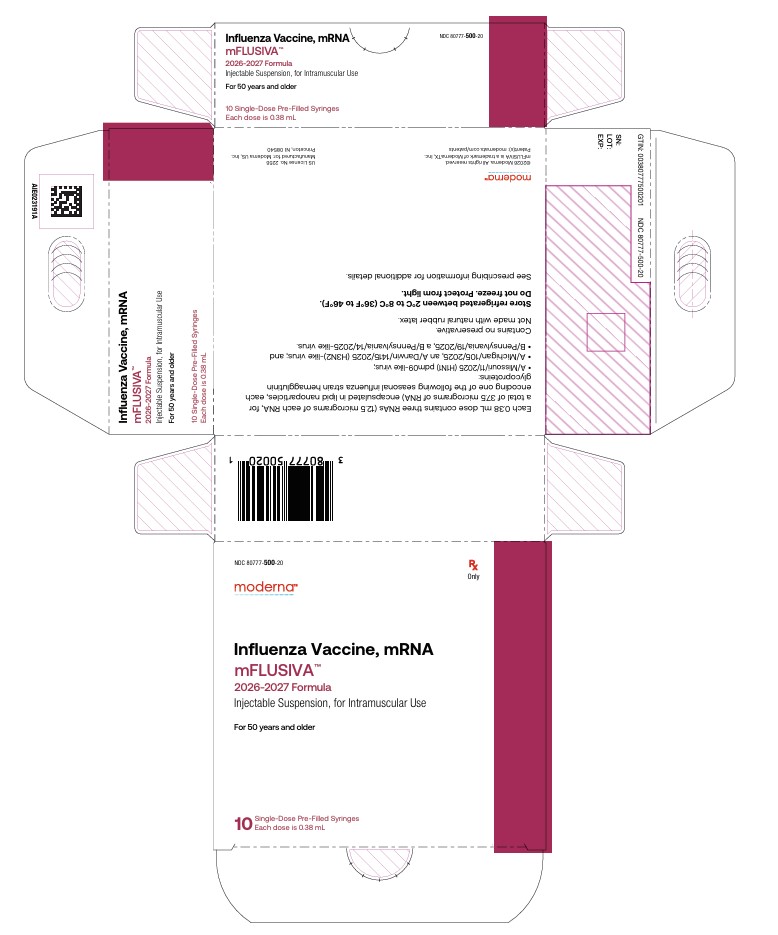
Mflusiva (influenza Vaccine, Mrna) 2026-2027 Formula Injectable Suspension For Intramuscular Use Single-dose Pre-filled Syringe Carton 0.38 mL (Image 02)

Mflusiva (influenza Vaccine, Mrna) 2026-2027 Formula Injectable Suspension For Intramuscular Use Single-dose Pre-filled Syringe Carton 0.38 mL (Image 02)

NDC 80777-500-20

Moderna

Rx Only

Influenza Vaccine, mRNA

mFLUSIVA

2026-2027 Formula

Injectable Suspension, for Intramuscular Use

For 50 years and older

10 Single-Dose Pre-Filled Syringes

Each dose is 0.38 mL

* Please review the disclaimer below.