1.1 Treatment Of Clinically Significant Metabolic Acidosis
Sodium bicarbonate injection is indicated to raise plasma pH in adults and pediatric patients with clinically significant metabolic acidosis.
The following Structured Product Label (SPL) was submitted to the FDA by Amneal Pharmaceuticals Private Limited for the product Sodium Bicarbonate (NDC 80830-2613). This document serves as the official prescribing information, containing essential scientific data and clinical materials required for healthcare providers and patients.
This specific version of the label includes detailed information regarding 1.1 treatment of clinically significant metabolic acidosis, 1.2 urinary alkalization in drug poisoning, 2.1 general administration instructions, 2.2 recommended dosage, 3 dosage forms and strengths, 4 contraindications, 5.1 edema with sodium retention, 5.2 electrolyte imbalances, and other regulatory disclosures. Use the navigation below to review specific sections of the FDA submission.
Sodium bicarbonate injection is indicated to raise plasma pH in adults and pediatric patients with clinically significant metabolic acidosis.
Sodium bicarbonate injection is indicated to alkalinize the urine in drug poisoning in adult and pediatric patients in cases in which urinary drug elimination is enhanced by urinary alkalinaztion.
Limitation of Use
Do not use sodium bicarbonate injection in settings where rapid administration of sodium bicarbonate is required, such as cardiac arrest. In such situations use a more concentrated solution.
Inspect parenteral drug products for particulate matter and discoloration prior to administration. Do not use if the solution is colored or cloudy or if it contains particulate matter. Discard any unused portion.
Sodium bicarbonate injection is a ready to administer product that requires no further dilution prior to infusion. Administer sodium bicarbonate injection by intravenous infusion, via a dedicated line.
Individualize dosage depending on the severity of the acidosis.
Treatment of metabolic acidosis with sodium bicarbonate should be superimposed on measures designed to address the underlying cause of metabolic acidosis.
Recommended Dosage in Adults and Pediatric Patients 2 Years of Age and Older
Administer 2 mEq/kg to 5 mEq/kg of sodium bicarbonate injection over a four- to eight-hour period, depending upon the severity of metabolic acidosis as assessed by serum bicarbonate concentration, total CO2, blood pH and the clinical condition of the patient.
Recommended Dosage in Pediatric Patients Less Than 2 Years of Age, including Neonates
Administer 1 mEq/kg to 2 mEq/kg of sodium bicarbonate injection over a four- to eight-hour period. Avoid rapid or bolus administration [see Warnings and Precautions (5.2), Use in Specific Populations (8.4)].
Sodium bicarbonate injection, USP is a sterile, nonpyrogenic, clear, colorless solution available as:
Injection: 150 mEq/1,000 mL (0.15 mEq/mL) in a ready-to-use single-dose infusion bag.
Sodium bicarbonate injection is contraindicated in patients who are losing chloride by vomiting or from continuous gastrointestinal suction and in patients receiving diuretics known to produce a hypochloremic alkalosis.
Sodium bicarbonate injection can cause sodium retention and volume overload. Monitor patients who are sensitive to sodium intake (heart failure, hypertension, kidney disease, anuria, edema) for signs of fluid overload and adjust sources of sodium as appropriate.
Sodium bicarbonate injection may cause electrolyte imbalances. Overly aggressive therapy with sodium bicarbonate injection can result in metabolic alkalosis (associated with muscular twitchings, irritability and tetany) and hypernatremia. Monitor electrolytes periodically during administration and treat abnormalities appropriately.
Dosing with sodium bicarbonate injection results in a large volume of administration in younger and lighter weight pediatric patients. Consider use of more concentrated sodium bicarbonate formulations in these pediatric populations [see Dosing and Administration (2)].
Inadvertent extravasation of intravenously administered hypertonic solutions of sodium bicarbonate have been reported to cause chemical cellulitis because of their alkalinity, with tissue necrosis, ulceration or sloughing at the site of infiltration. Prompt elevation of the area, warmth, and local injection of lidocaine or hyaluronidase are recommended to reduce the likelihood of tissue sloughing at the site of intravenous solution extravasation.
The following clinically significant adverse reactions are described elsewhere in labeling:
Risk Summary
Available data from published literature over decades of use have not identified a drug associated risk of major birth defects, miscarriage or other adverse maternal or fetal outcomes. Physiological replacement of sodium bicarbonate is not expected to lead to increased risk of adverse fetal or maternal outcomes. Animal reproduction studies have not been conducted with sodium bicarbonate.
The background risk of major birth defects and miscarriage for the indicated population is unknown. All pregnancies have a background risk of birth defect, loss, or other adverse outcomes. In the U.S. general population, the estimated background risk of major birth defects and miscarriage in clinically recognized pregnancies is 2% to 4% and 15% to 20%, respectively.
Risk Summary
There are no data on the presence of sodium bicarbonate in either human or animal milk, the effects on the breast-fed infant or the effects on milk production following administration of sodium bicarbonate injection.
The developmental and health benefits of breastfeeding should be considered along with the mother's clinical need for sodium bicarbonate and any potential adverse effects on the breast-fed child from sodium bicarbonate or from the underlying maternal condition.
Sodium bicarbonate injection is indicated in pediatric patients:
Rapid injection of sodium bicarbonate injection may result in complications of the central nervous system related to electrolyte imbalances in pediatric patients less than two years of age [see Dosing and Administration (2) and Warnings and Precautions (5.2)].
Clinical studies of sodium bicarbonate injection did not include sufficient numbers of subjects aged 65 and over to determine whether they respond differently from younger subjects. Other reported clinical experience has not identified differences in responses between the elderly and younger patients.
If alkalosis results, discontinue the sodium bicarbonate injection and manage the patient according to the degree of alkalosis present. Administer potassium chloride if hypokalemia is present. Treat severe alkalosis accompanied by hyperirritability or tetany with calcium gluconate. In severe alkalosis, consider use of acidifying agent such as ammonium chloride [see Warnings and Precautions (5.2)].
Sodium bicarbonate injection, USP is an alkalinizing agent, supplied as a sterile, nonpyrogenic, clear, colorless, ready-to-use solution of sodium bicarbonate (NaHCO3) in water for injection for administration by the intravenous infusion as an electrolyte replenisher and systemic alkalizer.
Sodium bicarbonate, 12.6 mg is equal to 0.15 milliequivalent each of Na+ and HCO3-.
Sodium bicarbonate, USP is chemically designated NaHCO3, molecular weight 84.01 g/mol, a white crystalline powder soluble in water and insoluble in ethanol.
Solution is offered in concentration of 1.26% [see How Supplied Storage and Handling (16.1)].
The solution contains no bacteriostat, antimicrobial agent or added buffer and is intended only for use as an intravenous infusion. Carbon dioxide is added to adjust pH between 7 to 8.5. When smaller doses are required, the unused portion should be discarded.
Intravenous sodium bicarbonate therapy increases plasma bicarbonate, buffers excess hydrogen ion concentration, raises blood pH.
Intravenous sodium bicarbonate therapy increases plasma bicarbonate, buffers excess hydrogen ion concentration, and raises blood pH.
Distribution
Sodium bicarbonate in water dissociates to provide sodium (Na+) and bicarbonate (HCO3-) ions. Sodium (Na+) is the principal cation of the extracellular fluid. Bicarbonate (HCO3-) is a normal constituent of body fluids.
Elimination
Plasma bicarbonate concentration is regulated by the kidney through acidification of the urine when there is a deficit or by alkalinization of the urine when there is an excess. Bicarbonate anion is considered "labile" since at a proper concentration of hydrogen ion (H+) it may be converted to carbonic acid (H2CO3) and then to its volatile form, carbon dioxide (CO2) excreted by the lung.
In a healthy adult with normal kidney function, practically all the glomerular filtered bicarbonate ion is reabsorbed; less than 1% is excreted in the urine.
Carcinogenesis, mutagenesis and impairment of fertility studies have not been conducted with sodium bicarbonate.
Sodium bicarbonate injection USP, 150 mEq/1,000 mL (0.15 mEq/mL) is supplied as a sterile, nonpyrogenic, clear, colorless solution available in a ready-to-use infusion bag in the following dosage form:
Unit of Sale | Unit of Use | Conc % | mg/mL (NaHCO3) | mEq/mL (Na+) | mEq/mL (HCO3-) | mEq/Container size (mL) | mOsmol |
NDC 80830-2613-2 Carton containing 6 Pouch | NDC 80830-2613-1 1,000 mL Single-dose Infusion Bag in a Pouch | 1.26 | 12.6 | 0.15 | 0.15 | 150/1,000 | 0.3/mL |
Store at 20°C to 25°C (68°F to 77°F); excursions permitted between 15°C to 30°C (59°F to 86°F) [See USP Controlled Room Temperature]. Avoid excessive heat. Protect from freezing. Keep covered in the pouch until time of use.
Each ready-to-use infusion bag contains no preservatives. Once the ready-to-use infusion bag has been removed from the pouch, the ready-to-use infusion bag should be used within 24 hours, with any unused portion discarded.
Advise patients to report signs and symptoms suggestive of fluid and/or solute overloading, electrolyte imbalances, overhydration, congested states or pulmonary edema [see Warnings and Precautions (5.1)].
Advise the patient, family or caregiver to report signs of extravasation [see Warnings and Precautions (5.3)].
Manufactured by:
Amneal Pharmaceuticals Pvt. Ltd.
Ahmedabad 382110, INDIA
Distributed by:
Amneal Pharmaceuticals LLC
Bridgewater, NJ 08807
Rev. 07-2026-04
NDC 80830-2613-1
Sodium Bicarbonate Injection, USP
150 mEq/1,000 mL (0.15 mEq/mL)
Rx only
Intravenous Bag Label
Amneal Pharmaceuticals LLC
1 (Sodium Bicarbonate Injection 505b2 1) 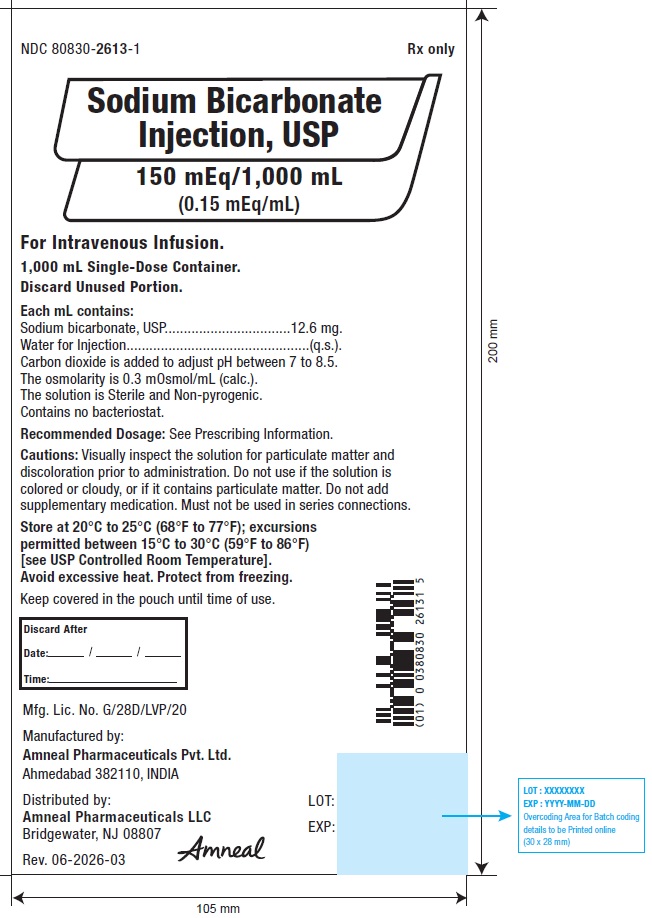
NDC 80830-2613-1
Sodium Bicarbonate Injection, USP
150 mEq/1,000 mL (0.15 mEq/mL)
Rx only
Pouch Label
Amneal Pharmaceuticals LLC
1 (Sodium Bicarbonate Injection 505b2 2) 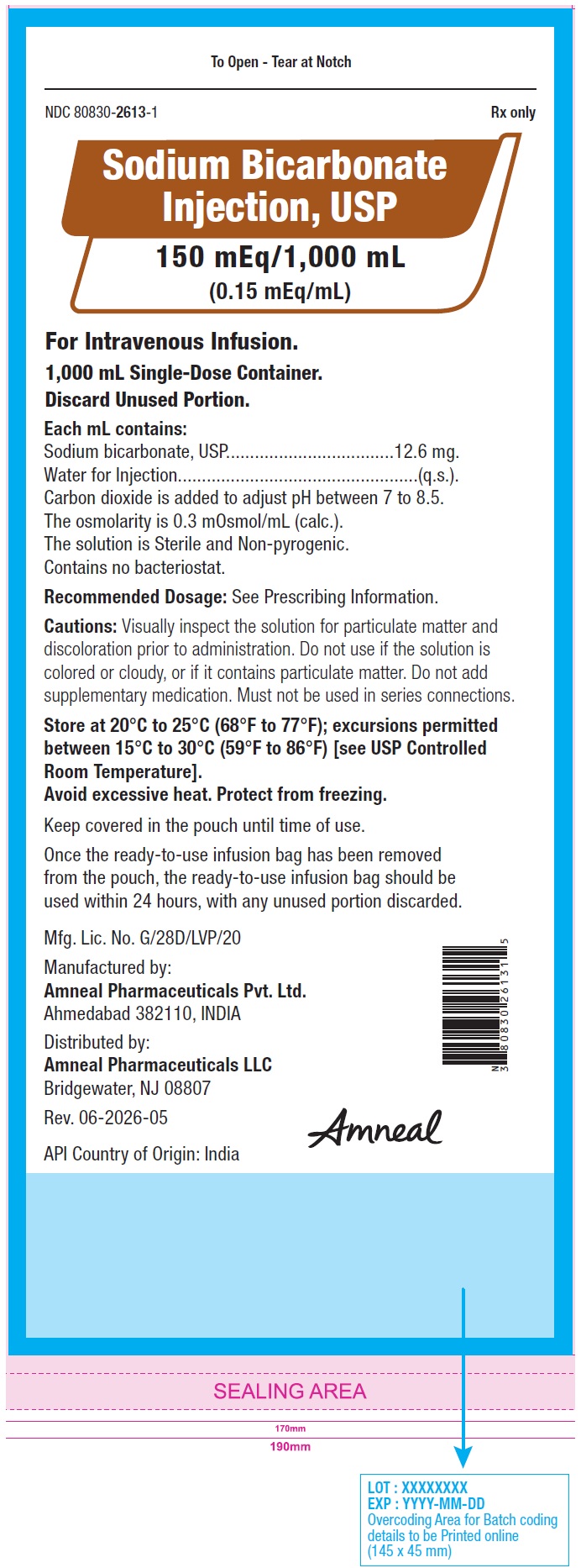
Sodium Bicarbonate Injection, USP
150 mEq/1,000 mL (0.15 mEq/mL)
Rx only
6 x 1,000 mL Single-Dose Containers
Carton Label
Amneal Pharmaceuticals LLC
1 (Sodium Bicarbonate Injection 505b2 3) 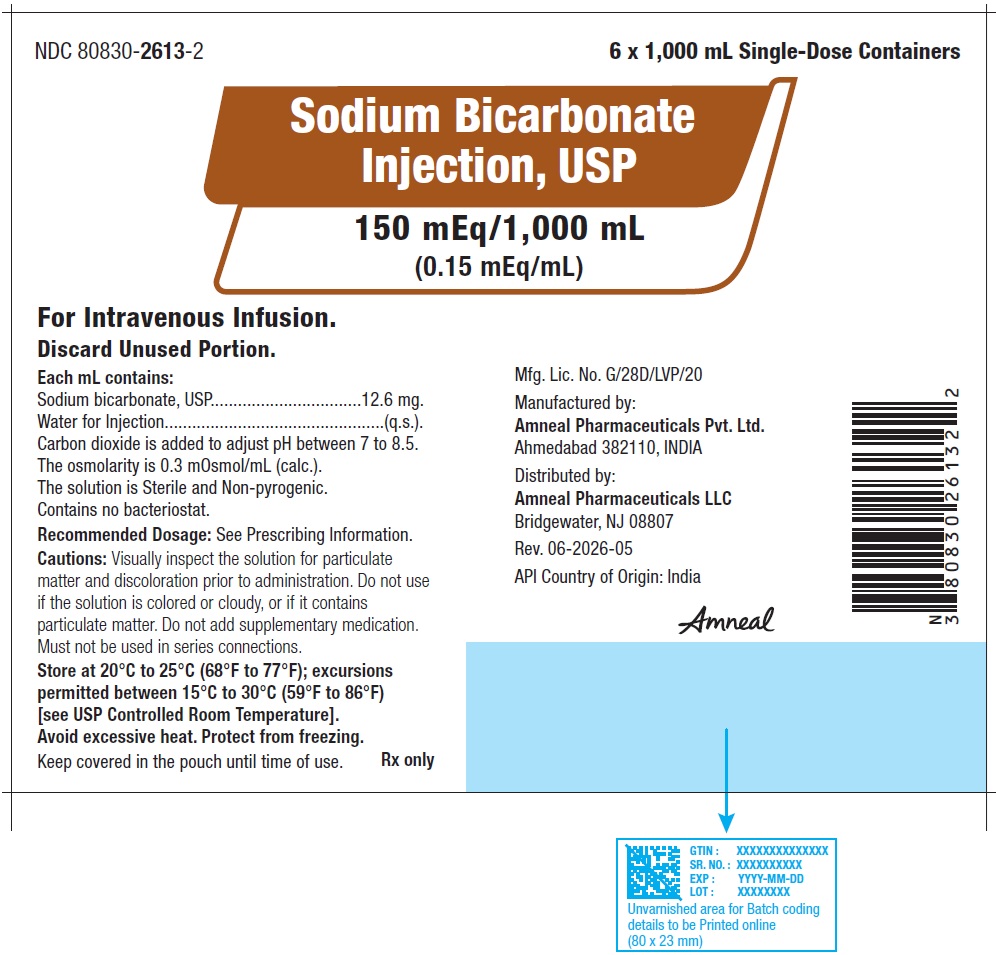
* Please review the disclaimer below.
