Atovaquone Oral Suspension
Product Images NDC 81033-105

View Photos of Packaging, Regulatory Labels, and Product Appearance

Product Visual Gallery

This gallery contains 13 technical images submitted to the FDA as part of the official labeling for Atovaquone Oral Suspension (NDC 81033-105). Unlike standard consumer photos, these assets often include clinical data figures, molecular chemical structures, and official manufacturer packaging layouts.

As provided by Kesin Pharma Corporation, these visuals offer a comprehensive scientific overview of the product's physical and chemical identity, aiding pharmacists and researchers in product verification and study.

FDA Label Image

20 Count Carton (Atovaquone Susp 5ml Carton 2x20)

20 Count Carton (Atovaquone Susp 5ml Carton 2x20)
This is a description of Atovaquone Oral Suspension, USP with a concentration of 750 mg per 5 mL, packaged as 20 x 5 mL Unit Dose Cups by Kesin Pharma Corporation in Oldsmar, FL. The product is intended for institutional use only and should be stored between 59°F to 77°F (15°C to 25°C). The expiration date is marked as 00-FEB-0000 with LOT number KO0O00000. The text also mentions information for internal use only and includes an NDC code for identification.*
FDA Label Image

42 Count Carton (Atovaquone Susp 5ml Carton 2x42)

42 Count Carton (Atovaquone Susp 5ml Carton 2x42)
This text provides information on Atovaquone Oral Suspension, USP, with a concentration of 750 mg per 5 mL. It is intended for institutional use only and comes packaged in 42 x 5 mL unit dose cups. The product is distributed by Kesin Pharma Corporation and should be stored between 59°F to 77°F (15°C to 25°C). The expiration date and lot number are also included. It is recommended to refer to the insert for further details.*
FDA Label Image
FDA Label Image

Chemical Structure (Figure 01)

FDA Label Image

Table 01 (Table 01)

Table 01 (Table 01)
This is a comparison table showing the percentage of subjects who experienced selected adverse reactions requiring discontinuation of treatment in the Dapsone Comparative PCP Prevention Trial. The adverse reactions are for Atovaquone Oral Suspension at 1,500 mg/day and Dapsone at 100 mg/day. The table indicates that 63% of subjects on Atovaquone and 41% of subjects on Dapsone experienced adverse reactions, leading to discontinuation of treatment.*
FDA Label Image

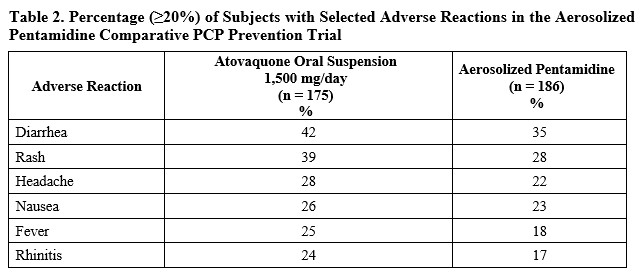
Table 02 (Table 02)

Table 02 (Table 02)
This is a table showing the percentage of subjects who experienced selected adverse reactions in the Aerosolized Pentamidine Comparative PCP Prevention Trial. The adverse reactions include diarrhea (35%), rash (28%), headache (2%), nausea (2%), fever (18%), and rhinitis (17%).*
FDA Label Image

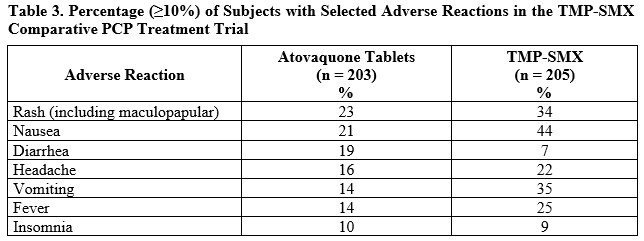
Table 03 (Table 03)

Table 03 (Table 03)
Table 3 displays the percentage (210%) of subjects with selected adverse reactions in a TMP-SMX comparative PCP treatment trial. The adverse reactions were compared between Atovaquone Tablets (n=203) and TMP-SMX (n=205). Some of the prominent adverse reactions reported include rash (including maculopapular) with 34%, nausea with 21%, diarrhea with 19%, headache with 16%, vomiting with 14%, fever with 14%, and insomnia with 10%.*
FDA Label Image

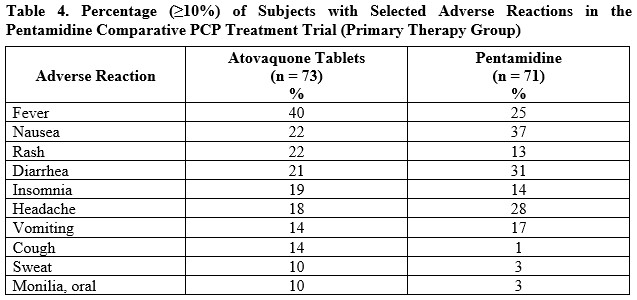
Table 04 (Table 04)

Table 04 (Table 04)
This is a table displaying the percentage of subjects experiencing selected adverse reactions in the Pentamidine Comparative PCP Treatment Trial's Primary Therapy Group. Adverse reactions and their corresponding percentages are listed for Atovaquone Tablets and Pentamidine. Adverse reactions include Fever, Nausea, Rash, Diarrhea, Insomnia, Headache, Vomiting, Cough, Sweat, and Oral Monilia.*
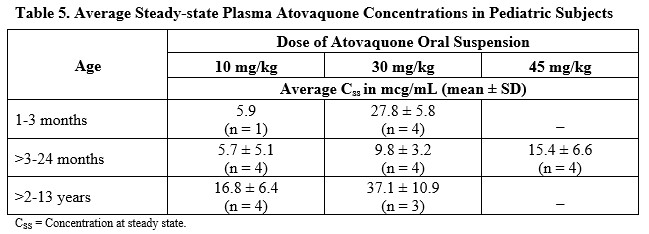
FDA Label Image

Table 05 (Table 05)

FDA Label Image

Table 06 (Table 06)

Table 06 (Table 06)
This text appears to show a table that illustrates the relationship between Atovaquone concentrations in plasma and the success of the treatment outcome. The table presents the number of successes and the number of individuals in each concentration group, along with the percentage of successful treatments in each group. The data suggests a potential correlation between higher Atovaquone concentrations in plasma and increased treatment success rates.*
FDA Label Image

Table 07 (Table 07)

FDA Label Image

Table 8 (Table 08)

FDA Label Image

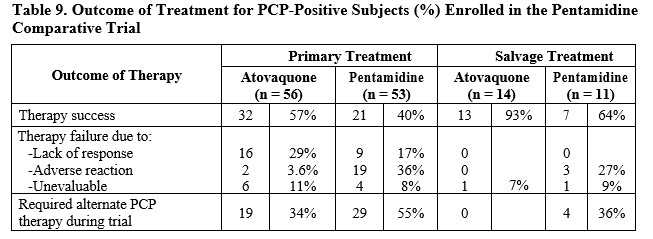
Table 9 (Table 09)

Table 9 (Table 09)
This text provides the outcomes of treatment for PCP-positive subjects enrolled in a comparative trial involving Atovaquone, Pentamidine, and Afovaquone as primary and salvage treatments. It includes the percentage of therapy success, therapy failure reasons such as lack of response and adverse reactions, as well as unevaluable cases. The data shows the effectiveness and challenges associated with each treatment option.*

* These product label images have been analyzed using experimental machine learning. Please verify findings with the primary label text.