Anticoagulant Sodium Citrate Solution
Product Images NDC 81839-782

View Photos of Packaging, Regulatory Labels, and Product Appearance

Product Visual Gallery

This gallery contains 2 technical images submitted to the FDA as part of the official labeling for Anticoagulant Sodium Citrate (NDC 81839-782). Unlike standard consumer photos, these assets often include clinical data figures, molecular chemical structures, and official manufacturer packaging layouts.

As provided by Csl Plasma Inc., these visuals offer a comprehensive scientific overview of the product's physical and chemical identity, aiding pharmacists and researchers in product verification and study.

FDA Label Image

Principal Display Panel (250 mL Bag Label)
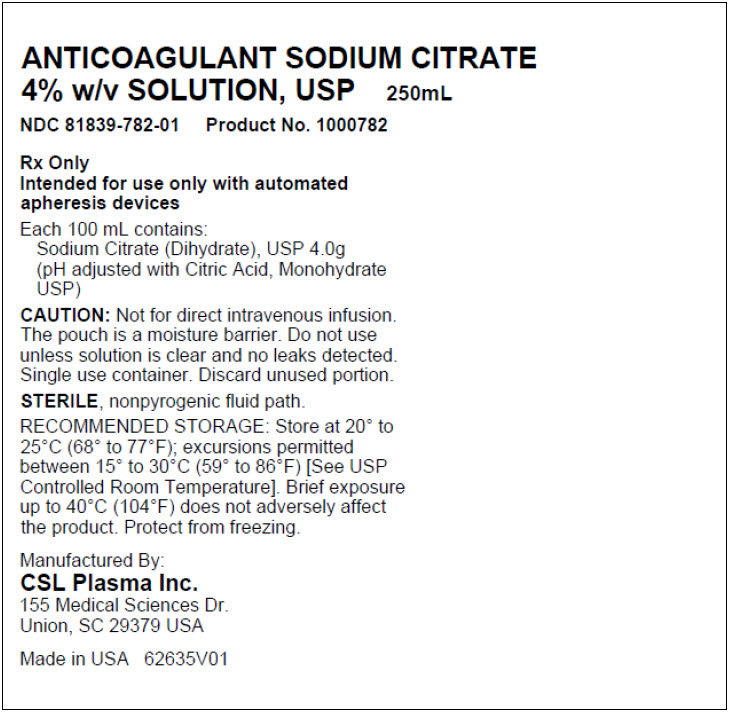
Principal Display Panel (250 mL Bag Label)
Anticoagulant Sodium Citrate is a 4% wiv solution that comes in a 250mL pouch. It is intended for use only with automated apheresis devices and should not be directly infused into the veins. The solution is sterile and non-pyrogenic, pH-adjusted with citric acid, and comes in a moisture barrier pouch. The product may be stored between 15° to 30°C (59° to 86°F) , and brief exposure up to 40°C (104°F) does not affect the product. Any unused or clear solution can be safely discarded, and the solution is made in the USA by CSL Plasma Inc. Product number 1000782, NDC 81839-782-01.*
FDA Label Image

Principal Display Panel (250 mL Bag Label)

Principal Display Panel (250 mL Bag Label)
This is a description of Anticoagulant Sodium Citrate solution, USP 250mL, with a concentration of 4% wiv. It is a prescription-only medication with a unique identification code of NDC# 81839-782-02 and product code 1000782. The recommended storage temperature is between 20°C to 25°C, but it can tolerate brief excursions between 15°C to 30°C. It is advised not to freeze the medication, and each container has a LOT# 21X000XU and an unspecified expiration date. The manufacturer is CSL Plasma, Inc., located in Union, South Carolina, USA.*

* These product label images have been analyzed using experimental machine learning. Please verify findings with the primary label text.