1 Adverse events graded according to CTCAE version 3.0.
2 Includes terms Arthritis, Arthralgia, Joint swelling, and Joint stiffness.
3 Includes terms Muscle spasms, Musculoskeletal pain, Myalgia, Musculoskeletal discomfort, and Musculoskeletal stiffness.
4 Includes terms Edema, Edema peripheral, Pitting edema, and Generalized edema.
5 Includes all fractures with the exception of pathological fracture.
6 Includes terms Arrhythmia, Tachycardia, Atrial fibrillation, Supraventricular tachycardia, Atrial tachycardia,
Ventricular tachycardia, Atrial flutter, Bradycardia, Atrioventricular block complete, Conduction disorder, and
Bradyarrhythmia.
7 Includes terms Angina pectoris, Chest pain, and Angina unstable. Myocardial infarction or ischemia occurred
more commonly in the placebo arm than in the abiraterone acetate arm (1.3% vs. 1.1% respectively).
8 Includes terms Cardiac failure, Cardiac failure congestive, Left ventricular dysfunction, Cardiogenic shock,
Cardiomegaly, Cardiomyopathy, and Ejection fraction decreased.
Table 2 shows laboratory abnormalities of interest from COU-AA-301.
Table 2: Laboratory Abnormalities of Interest in COU-AA-301
Laboratory Abnormality
| Abiraterone acetate with Prednisone
(N=791)
| Placebo with Prednisone (N=394)
|
All Grades (%)
| Grade 3- 4 (%)
| All Grades (%)
| Grade 3- 4 (%)
|
Hypertriglyceridemia
| 63
| 0.4
| 53
| 0
|
High AST
| 31
| 2.1
| 36
| 1.5
|
Hypokalemia
| 28
| 5.3
| 20
| 1.0
|
Hypophosphatemia
| 24
| 7.2
| 16
| 5.8
|
High ALT
| 11
| 1.4
| 10
| 0.8
|
High Total Bilirubin
| 6.6
| 0.1
| 4.6
| 0
|
COU-AA-302: Metastatic CRPC Prior to Chemotherapy
COU-AA-302 enrolled 1088 patients with metastatic CRPC who had not received prior cytotoxic chemotherapy. Patients were ineligible if AST and/or ALT ≥2.5 x ULN and patients were excluded if they had liver metastases.
Table 3 shows adverse reactions on the abiraterone acetate arm in COU-AA-302 that occurred in ≥5% of patients with a ≥2% absolute increase in frequency compared to placebo. The median duration of treatment with abiraterone acetate with prednisone was 13.8 months.
Table 3: Adverse Reactions in ≥5% of Patients on the Abiraterone acetate Arm in COU-AA-302
System/Organ Class
Adverse reaction
| Abiraterone acetate with Prednisone
(N=542)
| Placebo with Prednisone
(N=540)
|
All Grades1
(%)
| Grade 3-4
(%)
| All Grades
(%)
| Grade 3-4
(%)
|
General disorders
|
|
Fatigue
| 39
| 2.2
| 34
| 1.7
|
Edema2
| 25
| 0.4
| 21
| 1.1
|
Pyrexia
| 8.7
| 0.6
| 5.9
| 0.2
|
Musculoskeletal and connective tissue disorders
|
Joint swelling/discomfort3
| 30
| 2.0
| 25
| 2.0
|
Groin pain
| 6.6
| 0.4
| 4.1
| 0.7
|
Gastrointestinal disorders
|
Constipation
| 23
| 0.4
| 19
| 0.6
|
Diarrhea
| 22
| 0.9
| 18
| 0.9
|
Dyspepsia
| 11
| 0.0
| 5.0
| 0.2
|
Vascular disorders
|
|
Hot flush
| 22
| 0.2
| 18
| 0.0
|
Hypertension
| 22
| 3.9
| 13
| 3.0
|
Respiratory, thoracic and mediastinal disorders
|
Cough
| 17
| 0.0
| 14
| 0.2
|
Dyspnea
| 12
| 2.4
| 9.6
| 0.9
|
Psychiatric disorders
|
|
|
|
|
Insomnia
| 14
| 0.2
| 11
| 0.0
|
Injury, poisoning and procedural complications
|
Contusion
| 13
| 0.0
| 9.1
| 0.0
|
Falls
| 5.9
| 0.0
| 3.3
| 0.0
|
Infections and infestations
|
Upper respiratory tract infection
| 13
| 0.0
| 8.0
| 0.0
|
Nasopharyngitis
| 11
| 0.0
| 8.1
| 0.0
|
Renal and urinary disorders
|
Hematuria
| 10
| 1.3
| 5.6
| 0.6
|
Skin and subcutaneous tissue disorders
|
Rash
| 8.1
| 0.0
| 3.7
| 0.0
|
1 Adverse events graded according to CTCAE version 3.0.
2 Includes terms Edema peripheral, Pitting edema, and Generalized edema.
3 Includes terms Arthritis, Arthralgia, Joint swelling, and Joint stiffness.
Table 4 shows laboratory abnormalities that occurred in greater than 15% of patients, and more frequently (>5%) in the abiraterone acetate arm compared to placebo in COU-AA-302.
Table 4: Laboratory Abnormalities in >15% of Patients in the Abiraterone acetate Arm of COU-AA-302
Laboratory Abnormality
| Abiraterone acetate with Prednisone
(N=542)
| Placebo with Prednisone
(N=540)
|
Grade 1-4 (%)
| Grade 3-4
(%)
| Grade 1-4
(%)
| Grade 3-4 (%)
|
Hematology
|
Lymphopenia
| 38
| 8.7
| 32
| 7.4
|
Chemistry
|
Hyperglycemia1
| 57
| 6.5
| 51
| 5.2
|
High ALT
| 42
| 6.1
| 29
| 0.7
|
High AST
| 37
| 3.1
| 29
| 1.1
|
Hypernatremia
| 33
| 0.4
| 25
| 0.2
|
Hypokalemia
| 17
| 2.8
| 10
| 1.7
|
1 Based on non-fasting blood draws
LATITUDE: Patients with Metastatic High-risk CSPC
LATITUDE enrolled 1199 patients with newly-diagnosed metastatic, high-risk CSPC who had not received prior cytotoxic chemotherapy. Patients were ineligible if AST and/or ALT ≥2.5 x ULN or if they had liver metastases. All the patients received GnRH analogs or had prior bilateral orchiectomy during the trial. The median duration of treatment with abiraterone acetate and prednisone was 24 months.
Table 5 shows adverse reactions on the abiraterone acetate arm that occurred in ≥5% of patients with a ≥2% absolute increase in frequency compared to those on the placebos arm.
Table 5: Adverse Reactions in ≥5% of Patients on the Abiraterone acetate Arm in LATITUDE1
System/Organ Class
Adverse reaction
| Abiraterone acetate with
Prednisone
(N=597)
| Placebos
(N=602)
|
All Grades2
%
| Grade 3-4
%
| All Grades
%
| Grade 3-4
%
|
Vascular disorders
|
Hypertension
| 37
| 20
| 13
| 10
|
Hot flush
| 15
| 0.0
| 13
| 0.2
|
Metabolism and nutrition disorders
|
Hypokalemia
| 20
| 10
| 3.7
| 1.3
|
Investigations
|
Alanine aminotransferase increased3
| 16
| 5.5
| 13
| 1.3
|
Aspartate
aminotransferase increased3
| 15
| 4.4
| 11
| 1.5
|
Infections and infestations
|
Urinary tract infection
| 7.0
| 1.0
| 3.7
| 0.8
|
Upper respiratory tract
infection
| 6.7
| 0.2
| 4.7
| 0.2
|
Nervous system disorders
|
Headache
| 7.5
| 0.3
| 5.0
| 0.2
|
Respiratory, Thoracic and Mediastinal Disorders
|
Cough4
| 6.5
| 0.0
| 3.2
| 0
|
1 All patients were receiving an GnRH agonist or had undergone orchiectomy.
2 Adverse events graded according to CTCAE version 4.0
3 Reported as an adverse event or reaction
4 Including cough, productive cough, upper airway cough syndrome
Table 6: Laboratory Abnormalities in >15% of Patients in the Abiraterone acetate Arm of LATITUDE
| Abiraterone acetate with
Prednisone
(N=597)
| Placebos
(N=602)
|
Laboratory
Abnormality
| Grade 1-4
%
| Grade 3-4
%
| Grade 1-4
%
| Grade 3-4
%
|
Hematology |
Lymphopenia | 20
| 4.1
| 14
| 1.8
|
Chemistry |
Hypokalemia | 30
| 9.6
| 6.7
| 1.3
|
Elevated ALT | 46
| 6.4
| 45
| 1.3
|
Elevated total bilirubin | 16
| 0.2
| 6.2
| 0.2
|
Cardiovascular Adverse Reactions
In the combined data of 5 randomized, placebo-controlled clinical studies, cardiac failure occurred more commonly in patients on the abiraterone acetate arm compared to patients on the placebo arm (2.6% versus 0.9%). Grade 3-4 cardiac failure occurred in 1.3% of patients taking abiraterone acetate and led to 5 treatment discontinuations and 4 deaths. Grade 3-4 cardiac failure occurred in 0.2% of patients taking placebo. There were no treatment discontinuations and two deaths due to cardiac failure in the placebo group.
In the same combined data, the majority of arrhythmias were grade 1 or 2. There was one death associated with arrhythmia and three patients with sudden death in the abiraterone acetate arms and five deaths in the placebo arms. There were 7 (0.3%) deaths due to cardiorespiratory arrest in the abiraterone acetate arms and 2 (0.1%) deaths in the placebo arms. Myocardial ischemia or myocardial infarction led to death in 3 patients in the placebo arms and 3 deaths in the abiraterone acetate arms.
The planned final analysis for OS, conducted after 741 deaths (median follow up of 49 months) demonstrated a statistically significant OS improvement in patients treated with abiraterone acetate with prednisone compared to those treated with placebo with prednisone (Table 8 and Figure 2). Sixty-five percent of patients on the abiraterone acetate arm and 78% of patients on the placebo arm used subsequent therapies that may prolong OS in metastatic CRPC. Abiraterone acetate was used as a subsequent therapy in 13% of patients on the abiraterone acetate arm and 44% of patients on the placebo arm.
Table 8: Overall Survival of Patients Treated with Either Abiraterone acetate or Placebo in Combination with Prednisone in COU-AA-302 (Intent-to-Treat Analysis)
Overall Survival
| Abiraterone acetate
with Prednisone
(N=546)
| Placebo with prednisone
(N=542)
|
Deaths
| 354 (65%)
| 387 (71%)
|
Median survival (months) (95%CI) |
34.7 (32.7,36.8)
|
30.3 (28.7,33.3)
|
p-value1
| 0.0033
|
Hazardratio2 (95%CI)
| 0.81(0.70,0.93)
|
1 p-value is derived from a log-rank test stratified by ECOG performance status score (0 vs. 1).
2 Hazard Ratio is derived from a stratified proportional hazards model. Hazard ratio <1 favors abiraterone acetate with prednisone
Figure 2: Kaplan Meier Overall Survival Curves in COU-AA-302

Figure-02 (Abiraterone Figure 02)
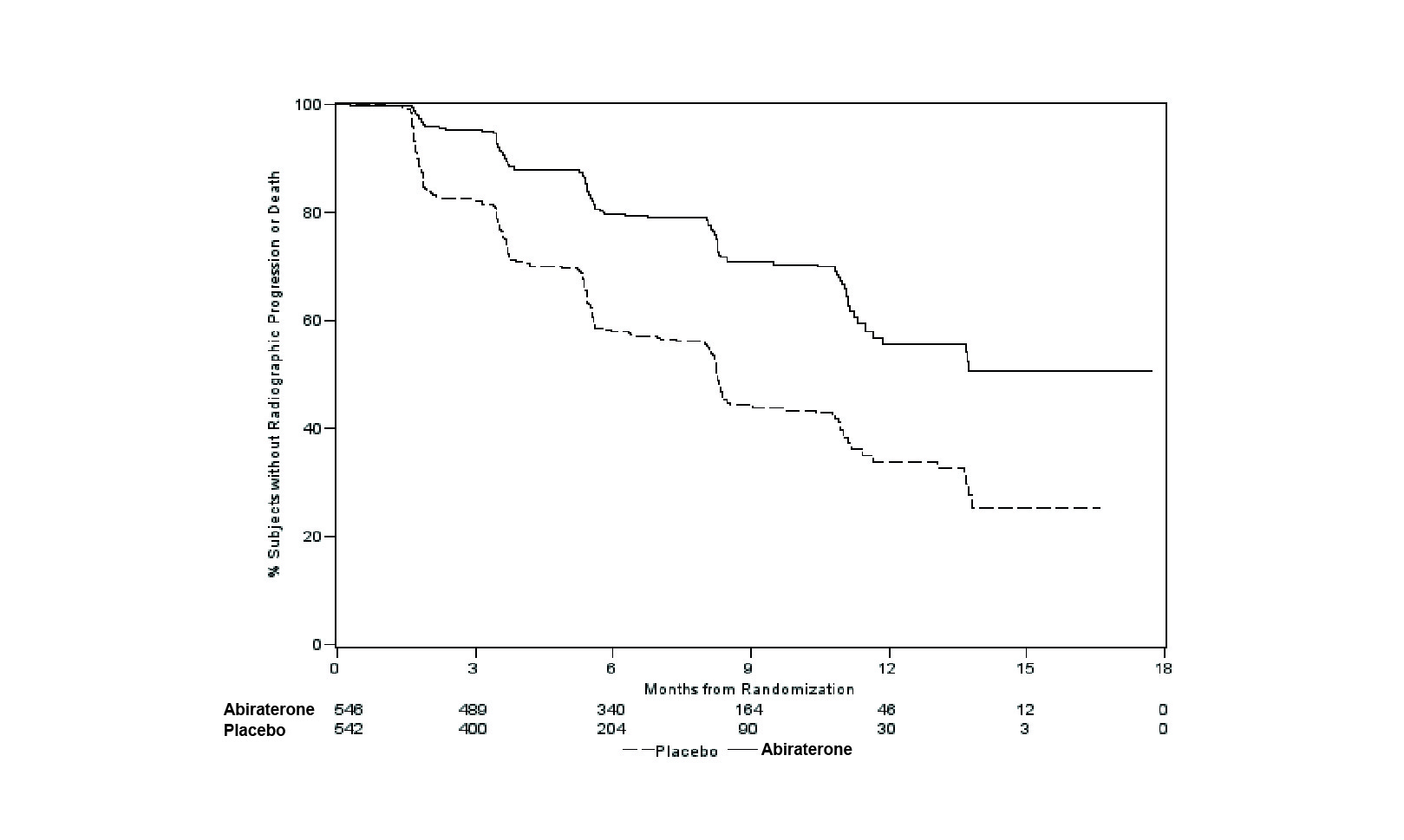
At the pre-specified rPFS analysis, 150 (28%) patients treated with abiraterone acetate with prednisone and 251 (46%) patients treated with placebo with prednisone had radiographic progression. A significant difference in rPFS between treatment groups was observed (Table 9 and Figure 3).
Table 9: Radiographic Progression-free Survival of Patients Treated with Either abiraterone acetate or Placebo in Combination with Prednisone in COU-AA-302 (Intent-to-Treat Analysis)
Radiographic Progression-free Survival
| Abiraterone acetate with Prednisone
(N=546)
| Placebo with Prednisone
(N=542)
|
Progression or death
| 150 (28%)
| 251 (46%)
|
Median rPFS (months)
(95% CI)
|
NR
(11.66, NR) | 8.28
(8.12, 8.54)
|
p-value1
| <0.0001
|
Hazard ratio2(95% CI)
| 0.425 (0.347, 0.522)
|
NR=Not reached.
1 p-value is derived from a log-rank test stratified by ECOG performance status score (0 vs. 1).
2 Hazard Ratio is derived from a stratified proportional hazards model. Hazard ratio <1 favors abiraterone acetate with prednisone.
Figure 3: Kaplan Meier Curves of Radiographic Progression-free Survival in COU-AA-302 (Intent-to-Treat Analysis)

Figure-03 (Abiraterone Figure 03)
The primary efficacy analyses are supported by the following prospectively defined endpoints. The median time to initiation of cytotoxic chemotherapy was 25.2 months for patients in the abiraterone acetate arm and 16.8 months for patients in the placebo arm (HR=0.580; 95% CI: [0.487, 0.691], p < 0.0001).
The median time to opiate use for prostate cancer pain was not reached for patients receiving abiraterone acetate and was 23.7 months for patients receiving placebo (HR=0.686; 95% CI: [0.566, 0.833], p=0.0001). The time to opiate use result was supported by a delay in patient reported pain progression favoring the abiraterone acetate arm.
LATITUDE: Patients with metastatic high-risk CSPC
In LATITUDE (NCT01715285), 1199 patients with metastatic high-risk CSPC were randomized 1:1 to receive either abiraterone acetate orally at a dose of 1,000 mg once daily with prednisone 5 mg once daily (N=597) or placebos orally once daily (N=602). High-risk disease was defined as having at least two of three risk factors at baseline: a total Gleason score of ≥8, presence of ≥3 lesions on bone scan, and evidence of measurable visceral metastases. Patients with significant cardiac, adrenal, or hepatic dysfunction were excluded. Patients continued treatment until radiographic or clinical disease progression, unacceptable toxicity, withdrawal or death. Clinical progression was defined as the need for cytotoxic chemotherapy, radiation or surgical treatment for cancer, pain requiring chronic opioids, or ECOG performance status decline to ≥3.
Patient demographics were balanced between the treatment arms. The median age was 67 years among all randomized subjects. The racial distribution of patients treated with abiraterone acetate was 69% Caucasian, 2.5% Black, 21% Asian, and 8.1% Other. The ECOG performance status was 0 for 55%, 1 for 42%, and 2 for 3.5% of patients. Baseline pain assessment was 0–1 (asymptomatic) in 50% of patients, 2–3 (mildly symptomatic) in 23% of patients, and ≥4 in 28% of patients as defined by the Brief Pain Inventory-Short Form (worst pain over the last 24 hours).
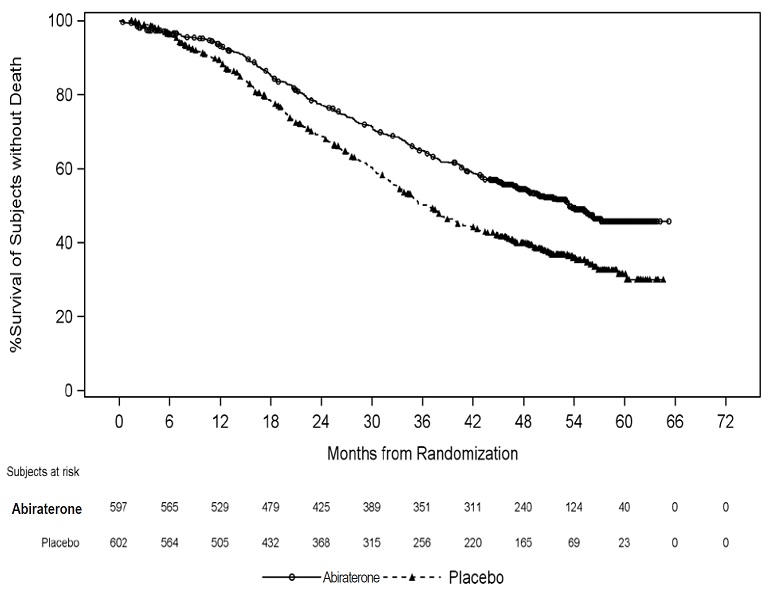
A major efficacy outcome was overall survival. The pre-specified interim analysis after 406 deaths showed a statistically significant improvement in OS in patients on abiraterone acetate with prednisone compared to those on placebos. Twenty-one percent of patients on the abiraterone acetate arm and 41% of patients on the placebos arm received subsequent therapies that may prolong OS in metastatic CRPC. An updated survival analysis was conducted when 618 deaths were observed. The median follow-up time was 52 months. Results from this analysis were consistent with those from the pre-specified interim analysis (Table 10 and Figure 4). At the updated analysis, 29% of patients on the abiraterone acetate arm and 45% of patients on the placebos arm received subsequent therapies that may prolong OS in metastatic CRPC.
Table 10: Overall Survival of Patients Treated with Either Abiraterone acetate or Placebos in LATITUDE (Intent-to-Treat Analysis)
Overall Survival1
| Abiraterone acetate with
Prednisone
(N=597)
| Placebos
(N=602)
|
Deaths (%)
| 169 (28%)
| 237 (39%)
|
Median survival (months)
(95% CI)
| NE (NE, NE)
| 34.7 (33.1, NE)
|
p-value2
| < 0.0001
|
Hazard ratio (95% CI)3
| 0.62 (0.51, 0.76)
|
Updated Overall Survival
|
|
Deaths (%)
| 275 (46%)
| 343 (57%)
|
Median survival (months) (95% CI)
| 53.3
(48.2, NE)
| 36.5
(33.5, 40.0)
|
Hazard ratio (95% CI)3
| 0.66 (0.56, 0.78)
|
NE=Not estimable.
1 This is based on the pre-specified interim analysis
2 p value is from log-rank test stratified by ECOG PS score (0/1 or 2) and visceral (absent or present).
3 Hazard Ratio is derived from a stratified proportional hazards model. Hazard ratio <1 favors abiraterone acetate with prednisone.
Figure 4: Kaplan-Meier Plot of Overall Survival; Intent-to-treat Population in LATITUDE Updated Analysis
Abiraterone-figure-04 (Abiraterone Figure 04)
The major efficacy outcome was supported by a statistically significant delay in time to initiation of chemotherapy for patients in the abiraterone acetate arm compared to those in the placebos arm. The median time to initiation of chemotherapy was not reached for patients on abiraterone acetate with prednisone and was 38.9 months for patients on placebos (HR = 0.44; 95% CI: [0.35, 0.56], p < 0.0001).