The efficacy of MYQORZO was evaluated in SEQUOIA-HCM (NCT05186818), a phase 3, multicenter, randomized, double-blind, placebo-controlled study in 282 adults (142 aficamten, 140 placebo) with symptomatic New York Heart Association (NYHA) class II and III oHCM, LVEF ≥60%, and resting and post-Valsalva peak LVOT-G ≥30 and ≥50 mmHg at screening, respectively. Patients who completed SEQUOIA-HCM were eligible to participate in an ongoing, open-label, single-arm extension study (FOREST-HCM). Patients with a known infiltrative or storage disorder causing cardiac hypertrophy such as Noonan syndrome, Fabry disease or amyloidosis were excluded.
Patients were randomized in a 1:1 ratio to receive either MYQORZO or placebo once daily for 24 weeks. Randomization was stratified by use of beta-blockers (yes or no) and cardiopulmonary exercise testing (CPET) exercise modality (treadmill or bicycle).
At baseline, 76% of the randomized patients were NYHA class II and 24% were NYHA class III. The mean peak oxygen uptake (pVO2) by CPET at baseline was 18.5 mL/kg/min with 55% using treadmill and 45% using bicycle, respectively. At baseline, the median LVEF was 76%, the mean resting LVOT-G was 55 mmHg, the mean Valsalva LVOTG was 83 mmHg, and mean Kansas City Cardiomyopathy Questionnaire – Clinical Summary Score (KCCQ-CSS) was 74. At baseline, 61% of patients were on beta-blockers, 29% were on non-dihydropyridine calcium channel blockers, 13% were on disopyramide, and 15% were not taking any background medication for oHCM.
Groups were balanced with respect to age (mean 59 years; range 18 to 84 years), sex (59% male), race (79% White, 19% Asian and 1% Black or African American), body mass index (mean 28 kg/m2), heart rate (mean 66 bpm) and blood pressure (mean 124/74 mmHg).
Patients were initiated on MYQORZO at a dose of 5 mg once daily. Doses were individually titrated (or sham-titrated if on placebo) at Week 2, 4 and 6 if Valsalva LVOT-G was ≥30 mmHg and LVEF was ≥55% in 5 mg dose increments up to a maximum dose of 20 mg once daily. At Week 24, in the MYQORZO group, 46% of patients were on the 20 mg dose, 35% were on the 15 mg dose, 15% were on the 10 mg dose and 4% were on the 5 mg dose.
Primary Endpoint - Peak Oxygen Uptake (pVO2)
In SEQUOIA-HCM, the primary endpoint of change from baseline in pVO2 to Week 24 was greater with MYQORZO compared to placebo, as shown in Table 4.
Table 4: Change from Baseline in pVO2 by CPET at Week 24 in SEQUOIA-HCM| pVO2 | MYQORZO
(N = 142) | Placebo
(N = 140) |
|---|
| Baseline (mL/min/kg), mean (SD) | 18.4 (4.4) | 18.6 (4.5) |
| Change from baseline to Week 24 |
| LS mean (SE) LS mean (SE), and LS mean difference (95% CI) were estimated from an ANCOVA model. A placebo-based multiple imputation approach was used to impute the missing data. | 1.7 (0.3) | 0.0 (0.3) |
| LS mean difference vs. placebo (95% CI) | 1.7 (1.0, 2.4) |
| p-value | <0.0001 |
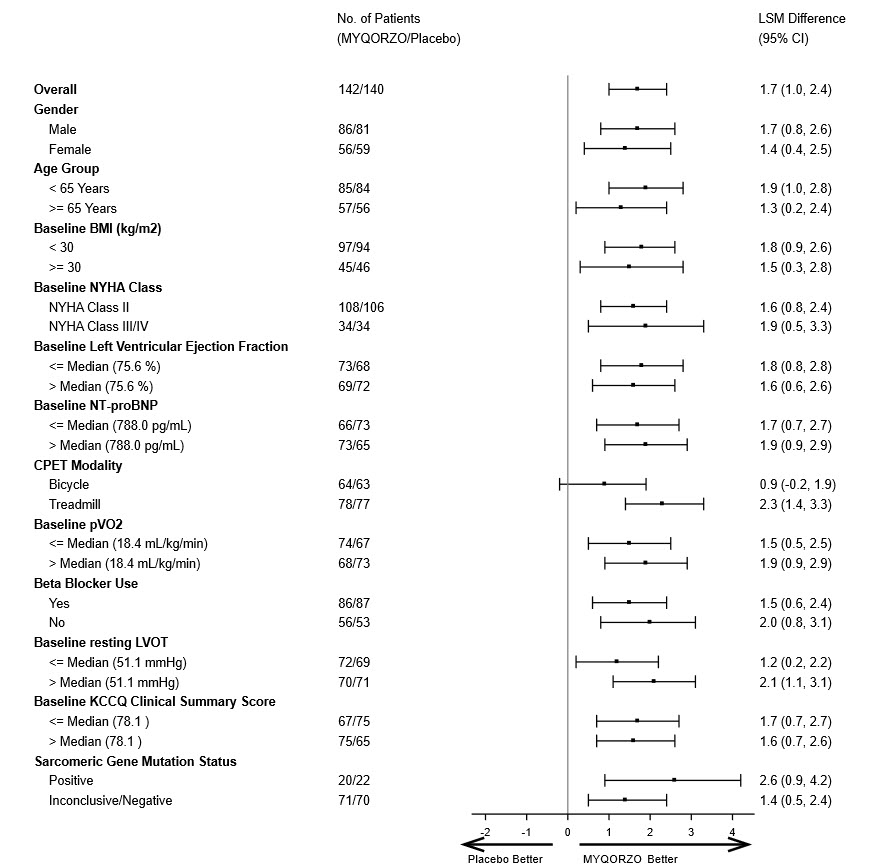
A range of demographic characteristics, baseline disease characteristics, and baseline concomitant medications (e.g., use of beta-blockers) were examined for their influence on outcomes. Results of the primary endpoint analysis consistently favored MYQORZO across all subgroups analyzed (Figure 1).
Figure 1: Forest Plot for Change in Baseline pVO2 by CPET at Week 24 by Subgroups in SEQUOIA-HCM
BMI: Body Mass Index; NYHA: New York Heart Association; NT-proBNP: N-terminal pro-B-type natriuretic peptic; CPET: Cardiac Pulmonary Exercise Test; pVO2: Peak Oxygen Uptake; LVOT: left ventricular outflow tract; KCCQ CSS: Kansas City Cardiomyopathy Questionnaire – Clinical Summary Score.
Note: The figure above presents effects in various subgroups, all of which are baseline characteristics. The 95% confidence limits that are shown do not take into account the number of comparisons made and may not reflect the effect of a particular factor after adjustment for all other factors. Apparent homogeneity or heterogeneity among groups should not be over-interpreted.
Secondary Endpoints
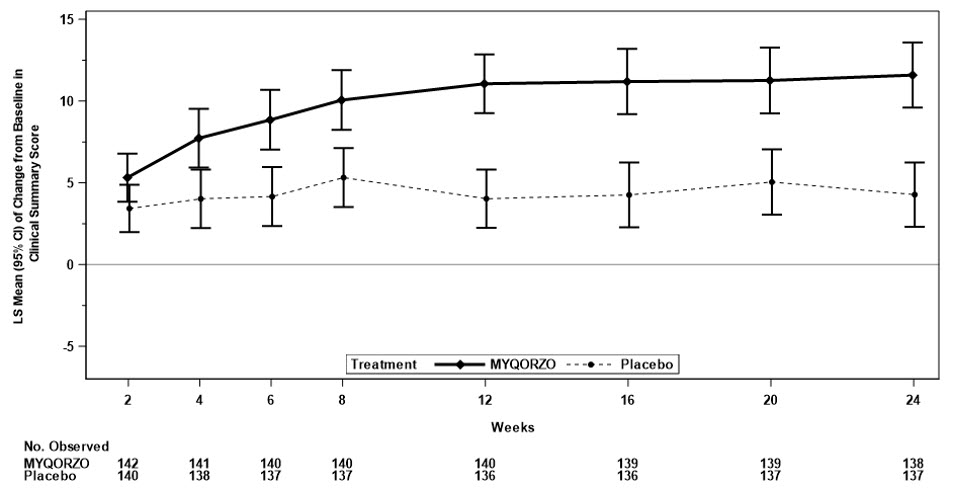
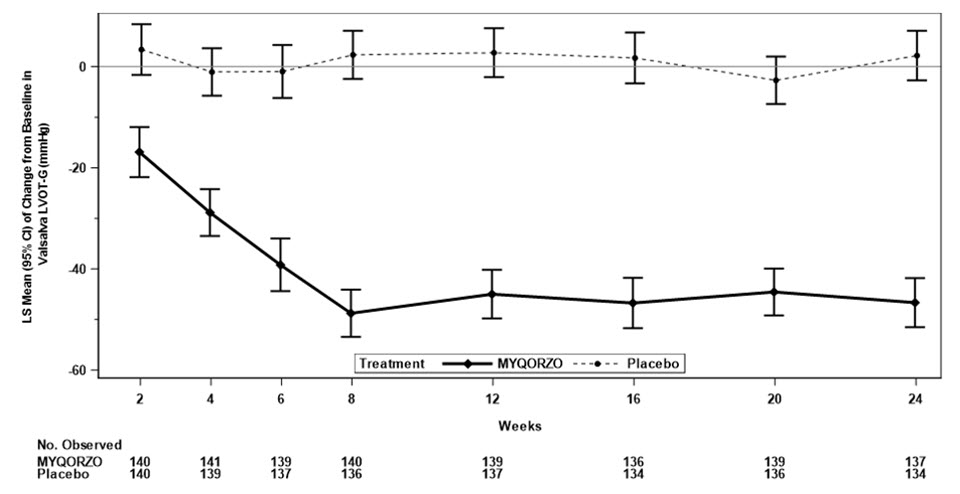
The treatment effects of MYQORZO on health status, functional capacity, and LVOT obstruction were assessed by change in the KCCQ-CSS, proportion of patients with ≥1 class improvement in NYHA functional class, change from baseline in Valsalva LVOT-G, proportion of patients with Valsalva LVOT-G ≤30 mmHg, duration of eligibility for septal reduction therapy (SRT), and change in total workload during CPET. At Week 24, patients receiving MYQORZO had greater improvement compared to the placebo group across all secondary points (Table 5, Figure 2 and Figure 3).
Table 5. Results of Secondary Efficacy Endpoints in SEQUOIA-HCM| Endpoints | MYQORZO
N=142 | Placebo
N=140 | LS Mean Difference
(95% CI) | p-Value |
|---|
| CPET: Cardiac Pulmonary Exercise Test; KCCQ CSS: Kansas City Cardiomyopathy Questionnaire – Clinical Summary Score; NYHA: New York Heart Association; LVOT-G: left ventricular outflow tract gradient; SRT: septal reduction therapy. |
| Mean Change from Baseline in KCCQ-CSS LS means (SE) and LS mean difference (95% CI) was estimated from an ANCOVA model (mixed model with repeated measures was used for longitudinal data) for continuous endpoints. Placebo-based multiple imputation approach was used to impute the missing data. ,The KCCQ-CSS score ranges from 0 to 100, with higher scores indicating better health status. |
| Week 12 | 11.1 (0.9) | 4.0 (0.9) | 7.0 (4.6, 9.5) | <0.0001 |
| Week 24 | 11.6 (1.0) | 4.3 (1.0) | 7.3 (4.6, 10.1) | <0.0001 |
| Mean Change from Baseline in Valsalva LVOT-G (mmHg) |
| Week 12 | -45.0 (2.4) | 2.7 (2.4) | -47.7
(-54.5, -41.0) | <0.0001 |
| Week 24 | -46.7 (2.5) | 2.2 (2.5) | -48.8
(-55.7, -42.0) | <0.0001 |
| Mean Duration of SRT Eligibility |
| Days spent SRT-eligible during 24 Weeks of Treatment | 35 (8) | 113 (8) | −78
(−100, −56) | <0.0001 |
| Mean Change from Baseline in Total Workload (Watts) during CPET |
| Week 24 | 13.1 (2.1) | 0.9 (2.2) | 12.2 (6.3, 18.1) | <0.0001 |
| |
| Endpoints | MYQORZO
N=142 | Placebo
N=140 | Odds Ratio
(95% CI) | p-Value |
| Proportion of Patients with ≥1 NYHA Class Improvement The number (percentage) of responders and common Odds Ratio (OR) obtained using Cochran-Mantel-Haenszel method (95% CI) are presented for binary endpoints. |
| Week 12 | 69 (48.6) | 25 (17.9) | OR: 4.6
(2.6, 8.4) | <0.0001 |
| Week 24 | 83 (58.5) | 34 (24.3) | OR: 4.4
(2.6, 7.6) | <0.0001 |
| Proportion of Patients with Valsalva LVOT-G <30 (mmHg) |
| Week 12 | 73 (51.4) | 8 (5.7) | OR: 16.9
(7.7, 37.2) | <0.0001 |
| Week 24 | 70 (49.3) | 5 (3.6) | OR: 22.9
(8.8, 59.6) | <0.0001 |
Figure 2: Change from Baseline in KCCQ-CSS through Week 24
Figure 3: Change from Baseline in Valsalva LVOT-G through Week 24