Other
Embryo-Fetal Toxicity
Do not uselenalidomideduring pregnancy. Lenalidomide, a thalidomide analogue, caused limb abnormalities in a developmental monkey study. Thalidomide is a known human teratogen that causes severe life-threatening human birth defects. If lenalidomide is used during pregnancy, it may cause birth defects or embryo-fetal death. In females of reproductive potential, obtain 2 negative pregnancy tests before startinglenalidomidetreatment. Females of reproductive potential must use 2 forms of contraception or continuously abstain from heterosexual sex during and for 4 weeks afterlenalidomidetreatment [see Warnings and Precautions (5.1), and Medication Guide (17)]. To avoid embryo-fetal exposure to lenalidomide, lenalidomide capsulesare only available through a restricted distribution program, the Lenalidomide REMS program ( 5.2).
Information about the Lenalidomide REMS program is available atwww.lenalidomiderems.comor by calling the REMS Call Center at 1-888-423-5436.
Hematologic Toxicity (Neutropenia and Thrombocytopenia)
Lenalidomidecan cause significant neutropenia and thrombocytopenia.
Eighty percent of patients with del 5q myelodysplastic syndromes had to have a dose delay/reduction during the major study. Thirty-four percent of patients had to have a second dose delay/reduction. Grade 3 or 4 hematologic toxicity was seen in 80% of patients enrolled in the study. Patients on therapy for del 5q myelodysplastic syndromes should have their complete blood counts monitored weekly for the first 8 weeks of therapy and at least monthly thereafter. Patients may require dose interruption and/or reduction. Patients may require use of blood product support and/or growth factors [see Dosage and Administration (2.2)].
Venous and Arterial Thromboembolism
Lenalidomidehas demonstrated a significantly increased risk of deep vein thrombosis (DVT) and pulmonary embolism (PE), as well as risk of myocardial infarction and stroke in patients with multiple myeloma who were treated withlenalidomideand dexamethasone therapy. Monitor for and advise patients about signs and symptoms of thromboembolism. Advise patients to seek immediate medical care if they develop symptoms such as shortness of breath, chest pain, or arm or leg swelling. Thromboprophylaxis is recommended and the choice of regimen should be based on an assessment of the patient’s underlying risks [see Warnings and Precautions (5.4)].
Lenalidomide Capsules Combination Therapy
The recommended starting dose of lenalidomide capsules is 25 mg orally once daily on Days 1 to 21 of repeated 28-day cycles in combination with dexamethasone. Refer to Section 14.1 for specific dexamethasone dosing. For patients greater than 75 years old, the starting dose of dexamethasone may be reduced [see Clinical Studies (14.1)] . Treatment should be continued until disease progression or unacceptable toxicity.
In patients who are not eligible for auto-HSCT, treatment should continue until disease progression or unacceptable toxicity. For patients who are auto-HSCT-eligible, hematopoietic stem cell mobilization should occur within 4 cycles of a lenalidomide capsules-containing therapy [see Warnings and Precautions (5.12)].
Dose Adjustments for Hematologic Toxicities During MM Treatment
Dose modification guidelines, as summarized in Table 1 below, are recommended to manage Grade 3 or 4 neutropenia or thrombocytopenia or other Grade 3 or 4 toxicity judged to be related to lenalidomide capsules.
Platelet counts | ||
Thrombocytopenia in MM | ||
When Platelets | Recommended Course | |
Fall below 30,000/mcL | Interrupt lenalidomide capsules treatment, follow CBC weekly | |
Return to at least 30,000/mcL | Resume lenalidomide capsules at next lower dose. Do not dose below 2.5 mg daily | |
For each subsequent drop below 30,000/mcL | Interrupt lenalidomide capsules treatment | |
Return to at least 30,000/mcL | Resume lenalidomide capsules at next lower dose. Do not dose below 2.5 mg daily | |
Absolute Neutrophil counts (ANC) | ||
Neutropenia in MM | ||
When Neutrophils | Recommended Course | |
Fall below 1,000/mcL | Interrupt lenalidomide capsules treatment, follow CBC weekly | |
Return to at least 1,000/mcL and neutropenia is the only toxicity | Resume lenalidomide capsules at 25 mg daily or initial starting dose | |
Return to at least 1,000/mcL and if other toxicity | Resume lenalidomide capsules at next lower dose. Do not dose below 2.5 mg daily | |
For each subsequent drop below 1,000/mcL | Interrupt lenalidomide capsules treatment | |
Return to at least 1,000/mcL | Resume lenalidomide capsules at next lower dose. Do not dose below 2.5 mg daily | |
Lenalidomide Capsules Maintenance Therapy Following Auto-HSCT
Following auto-HSCT, initiate lenalidomide capsules maintenance therapy after adequate hematologic recovery (ANC at least 1,000/mcL and/or platelet counts at least 75,000/mcL). The recommended starting dose of lenalidomide capsules is 10 mg once daily continuously (Days 1 to 28 of repeated 28-day cycles) until disease progression or unacceptable toxicity. After 3 cycles of maintenance therapy, the dose can be increased to 15 mg once daily if tolerated.
Dose Adjustments for Hematologic Toxicities During MM Treatment
Dose modification guidelines, as summarized in Table 2 below, are recommended to manage Grade 3 or 4 neutropenia or thrombocytopenia or other Grade 3 or 4 toxicity judged to be related to lenalidomide capsules.
Platelet counts | ||
Thrombocytopenia in MM | ||
When Platelets | Recommended Course | |
Fall below 30,000/mcL | Interrupt lenalidomide capsules treatment, follow CBC weekly | |
Return to at least 30,000/mcL | Resume lenalidomide capsules at next lower dose, continuously for Days 1 to 28 of repeated 28-day cycle | |
If at the 5 mg daily dose,
| Interrupt lenalidomide capsules treatment. Do not dose below 5 mg daily for Days 1 to 21 of 28-day cycle | |
Return to at least 30,000/mcL | Resume lenalidomide capsules at 5 mg daily for Days 1 to 21 of 28-day cycle. Do not dose below 5 mg daily for Days 1 to 21 of 28-day cycle | |
Absolute Neutrophil counts (ANC) | ||
Neutropenia in MM | ||
When Neutrophils | Recommended Course | |
Fall below 500/mcL | Interrupt lenalidomide capsules treatment, follow CBC weekly | |
Return to at least 500/mcL | Resume lenalidomide capsules at next lower dose, continuously for Days 1 to 28 of repeated 28-day cycle | |
If at 5 mg daily dose,
| Interrupt lenalidomide capsules treatment. Do not dose below 5 mg daily for Days 1 to 21 of 28-day cycle | |
Return to at least 500/mcL | Resume lenalidomide capsules at 5 mg daily for Days 1 to 21 of 28-day cycle. Do not dose below 5 mg daily for Days 1 to 21 of 28-day cycle | |
Lenalidomide Capsules Combination Therapy for MM:For CLcr of 30 mL/min to 60 mL/min, consider escalating the dose to 15 mg after 2 cycles if the patient tolerates the 10 mg dose of lenalidomide without dose-limiting toxicity.
Lenalidomide Capsules Maintenance Therapy Following Auto-HSCT for MM and for MCL and MDS:Base subsequent lenalidomide capsules dose increase or decrease on individual patient treatment tolerance [see Dosage and Administration (2.1to 2.3)].
Lenalidomide Capsules Combination Therapy for FL or for MZL:For patients with CLcr of 30 mL/min to 60 mL/min, after 2 cycles, the lenalidomide capsules dose may be increased to 15 mg orally if the patient has tolerated therapy.
Females of Reproductive Potential
Females of reproductive potential must avoid pregnancy for at least 4 weeks before beginning lenalidomide therapy, during therapy, during dose interruptions and for at least 4 weeks after completing therapy.
Females must commit either to abstain continuously from heterosexual sexual intercourse or to use two methods of reliable birth control, beginning 4 weeks prior to initiating treatment with lenalidomide, during therapy, during dose interruptions and continuing for 4 weeks following discontinuation of lenalidomide therapy.
Two negative pregnancy tests must be obtained prior to initiating therapy. The first test should be performed within 10 days to 14 days and the second test within 24 hours prior to prescribing lenalidomide therapy and then weekly during the first month, then monthly thereafter in females with regular menstrual cycles or every 2 weeks in females with irregular menstrual cycles [see Use in Specific Populations (8.3)] .
Males
Lenalidomide is present in the semen of patients receiving the drug. Therefore, males must always use a latex or synthetic condom during any sexual contact with females of reproductive potential while taking lenalidomide and for up to 4 weeks after discontinuing lenalidomide, even if they have undergone a successful vasectomy. Male patients taking lenalidomide must not donate sperm and for up to 4 weeks after discontinuing lenalidomide [see Use in Specific Populations (8.3)] .
Blood Donation
Patients must not donate blood during treatment with lenalidomide and for 4 weeks following discontinuation of the drug because the blood might be given to a pregnant female patient whose fetus must not be exposed to lenalidomide.
Newly Diagnosed MM – Lenalidomide Combination Therapy:
Data were evaluated from 1,613 patients in a large phase 3 study who received at least one dose of lenalidomide with low dose dexamethasone (Rd) given for 2 different durations of time (i.e., until progressive disease [Arm Rd Continuous; N = 532] or for up to eighteen 28-day cycles [72 weeks, Arm Rd18; N = 540] or who received melphalan, prednisone and thalidomide (Arm MPT; N = 541) for a maximum of twelve 42-day cycles (72 weeks). The median treatment duration in the Rd Continuous arm was 80.2 weeks (range 0.7 to 246.7) or 18.4 months (range 0.16 to 56.7).
In general, the most frequently reported adverse reactions were comparable in Arm Rd Continuous and Arm Rd18, and included diarrhea, anemia, constipation, peripheral edema, neutropenia, fatigue, back pain, nausea, asthenia, and insomnia. The most frequently reported Grade 3 or 4 reactions included neutropenia, anemia, thrombocytopenia, pneumonia, asthenia, fatigue, back pain, hypokalemia, rash, cataract, lymphopenia, dyspnea, DVT, hyperglycemia, and leukopenia. The highest frequency of infections occurred in Arm Rd Continuous (75%) compared to Arm MPT (56%). There were more grade 3 and 4 and serious adverse reactions of infection in Arm Rd Continuous than either Arm MPT or Rd18.
In the Rd Continuous arm, the most common adverse reactions leading to dose interruption of lenalidomide were infection events (28.8%); overall, the median time to the first dose interruption of lenalidomide was 7 weeks. The most common adverse reactions leading to dose reduction of lenalidomide in the Rd Continuous arm were hematologic events (10.7%); overall, the median time to the first dose reduction of lenalidomide was 16 weeks. In the Rd Continuous arm, the most common adverse reactions leading to discontinuation of lenalidomide were infection events (3.4%).
In both Rd arms, the frequencies of onset of adverse reactions were generally highest in the first 6 months of treatment and then the frequencies decreased over time or remained stable throughout treatment, except for cataracts. The frequency of onset of cataracts increased over time with 0.7% during the first 6 months and up to 9.6% by the 2nd year of treatment with Rd Continuous.
Table 4 summarizes the adverse reactions reported for the Rd Continuous, Rd18, and MPT treatment arms.
| Note:A subject with multiple occurrences of an adverse reaction is counted only once under the applicable Body System/Adverse Reaction.
aAll treatment-emergent adverse events in at least 5% of subjects in the Rd Continuous or Rd18 Arms and at least a 2% higher frequency (%) in either the Rd Continuous or Rd18 Arms compared to the MPT Arm. bAll grade 3 or 4 treatment-emergent adverse events in at least 1% of subjects in the Rd Continuous or Rd18 Arms and at least a 1% higher frequency (%) in either the Rd Continuous or Rd18 Arms compared to the MPT Arm. cSerious treatment-emergent adverse events in at least 1% of subjects in the Rd Continuous or Rd18 Arms and at least a 1% higher frequency (%) in either the Rd Continuous or Rd18 Arms compared to the MPT Arm. dPreferred terms for the blood and lymphatic system disorders body system were included by medical judgment as known adverse reactions for Rd Continuous/Rd18, and have also been reported as serious. eFootnote “a” not applicable. fFootnote “b” not applicable. @- adverse reactions in which at least one resulted in a fatal outcome. %- adverse reactions in which at least one was considered to be life threatening (if the outcome of the reaction was death, it is included with death cases). *Adverse reactions included in combined adverse reaction terms: Abdominal Pain: Abdominal pain, abdominal pain upper, abdominal pain lower, gastrointestinal pain Pneumonias: Pneumonia, lobar pneumonia, pneumonia pneumococcal, bronchopneumonia, pneumocystis jiroveci pneumonia, pneumonia legionella, pneumonia staphylococcal, pneumonia klebsiella, atypical pneumonia, pneumonia bacterial, pneumonia escherichia, pneumonia streptococcal, pneumonia viral Sepsis: Sepsis, septic shock, urosepsis, escherichia sepsis, neutropenic sepsis, pneumococcal sepsis, staphylococcal sepsis, bacterial sepsis, meningococcal sepsis, enterococcal sepsis, klebsiella sepsis, pseudomonal sepsis Rash: Rash, rash pruritic, rash erythematous, rash maculo-papular, rash generalized, rash papular, exfoliative rash, rash follicular, rash macular, drug rash with eosinophilia and systemic symptoms, erythema multiforme, rash pustular Deep Vein Thrombosis: Deep vein thrombosis, venous thrombosis limb, venous thrombosis | ||||||
Body System | All Adverse Reactions a | Grade 3/4 Adverse Reactions b | ||||
Rd Continuous | Rd18 | MPT | Rd Continuous | Rd18 | MPT | |
General disorders and administration site conditions | ||||||
Fatigue % | 173 (33) | 177 (33) | 154 (28) | 39 (7) | 46 (9) | 31 (6) |
Asthenia | 150 (28) | 123 (23) | 124 (23) | 41 (8) | 33 (6) | 32 (6) |
Pyrexia c | 114 (21) | 102 (19) | 76 (14) | 13 (2) | 7 (1) | 7 (1) |
Non-cardiac chest pain f | 29 (5) | 31 (6) | 18 (3) | < 1% | < 1% | < 1% |
Gastrointestinal disorders | ||||||
Diarrhea | 242 (45) | 208 (39) | 89 (16) | 21 (4) | 18 (3) | 8 (1) |
Abdominal pain %,f | 109 (20) | 78 (14) | 60 (11) | 7 (1) | 9 (2) | < 1% |
Dyspepsia f | 57 (11) | 28 (5) | 36 (7) | < 1% | < 1% | 0 (0) |
Musculoskeletal and connective tissue disorders | ||||||
Back pain c | 170 (32) | 145 (27) | 116 (21) | 37 (7) | 34 (6) | 28 (5) |
Muscle spasms f | 109 (20) | 102 (19) | 61 (11) | < 1% | < 1% | < 1% |
Arthralgia f | 101 (19) | 71 (13) | 66 (12) | 9 (2) | 8 (1) | 8 (1) |
Bone pain f | 87 (16) | 77 (14) | 62 (11) | 16 (3) | 15 (3) | 14 (3) |
Pain in extremity f | 79 (15) | 66 (12) | 61 (11) | 8 (2) | 8 (1) | 7 (1) |
Musculoskeletal pain f | 67 (13) | 59 (11) | 36 (7) | < 1% | < 1% | < 1% |
Musculoskeletal chest pain f | 60 (11) | 51 (9) | 39 (7) | 6 (1) | < 1% | < 1% |
Muscular weakness f | 43 (8) | 35 (6) | 29 (5) | < 1% | 8 (1) | < 1% |
Neck pain f | 40 (8) | 19 (4) | 10 (2) | < 1% | < 1% | < 1% |
Infections and infestations | ||||||
Bronchitis c | 90 (17) | 59 (11) | 43 (8) | 9 (2) | 6 (1) | < 1% |
Nasopharyngitis f | 80 (15) | 54 (10) | 33 (6) | 0 (0) | 0 (0) | 0 (0) |
Urinary tract infection f | 76 (14) | 63 (12) | 41 (8) | 8 (2) | 8 (1) | < 1% |
Upper respiratory tract infection c,%,f | 69 (13) | 53 (10) | 31 (6) | < 1% | 8 (1) | < 1% |
Pneumonia c,@ | 93 (17) | 87 (16) | 56 (10) | 60 (11) | 57 (11) | 41 (8) |
Respiratory tract infection % | 35 (7) | 25 (5) | 21 (4) | 7 (1) | < 1% | < 1% |
Influenza f | 33 (6) | 23 (4) | 15 (3) | < 1% | < 1% | 0 (0) |
Gastroenteritis f | 32 (6) | 17 (3) | 13 (2) | 0 (0) | < 1% | < 1% |
Lower respiratory tract infection | 29 (5) | 14 (3) | 16 (3) | 10 (2) | < 1% | < 1% |
Rhinitis f | 29 (5) | 24 (4) | 14 (3) | 0 (0) | 0 (0) | 0 (0) |
Cellulitis c | < 5% | < 5% | < 5% | 8 (2) | < 1% | < 1% |
Sepsis c,@ | 33 (6) | 26 (5) | 18 (3) | 26 (5) | 20 (4) | 13 (2) |
Nervous system disorders | ||||||
Headache f | 75 (14) | 52 (10) | 56 (10) | < 1% | < 1% | < 1% |
Dysgeusia f | 39 (7) | 45 (8) | 22 (4) | < 1% | 0 (0.0) | < 1% |
Blood and lymphatic system disorders d | ||||||
Anemia | 233 (44) | 193 (36) | 229 (42) | 97 (18) | 85 (16) | 102 (19) |
Neutropenia | 186 (35) | 178 (33) | 328 (61) | 148 (28) | 143 (26) | 243 (45) |
Thrombocytopenia | 104 (20) | 100 (19) | 135 (25) | 44 (8) | 43 (8) | 60 (11) |
Febrile neutropenia | 7 (1) | 17 (3) | 15 (3) | 6 (1) | 16 (3) | 14 (3) |
Pancytopenia | < 1% | 6 (1) | 7 (1) | < 1% | < 1% | < 1% |
Respiratory, thoracic and mediastinal disorders | ||||||
Cough f | 121 (23) | 94 (17) | 68 (13) | < 1% | < 1% | < 1% |
Dyspnea c,e | 117 (22) | 89 (16) | 113 (21) | 30 (6) | 22 (4) | 18 (3) |
Epistaxis f | 32 (6) | 31 (6) | 17 (3) | < 1% | < 1% | 0 (0) |
Oropharyngeal pain f | 30 (6) | 22 (4) | 14 (3) | 0 (0) | 0 (0) | 0 (0) |
Dyspnea exertional e | 27 (5) | 29 (5) | < 5% | 6 (1) | < 1% | 0 (0) |
Metabolism and nutrition disorders | ||||||
Decreased appetite | 123 (23) | 115 (21) | 72 (13) | 14 (3) | 7 (1) | < 1% |
Hypokalemia % | 91 (17) | 62 (11) | 38 (7) | 35 (7) | 20 (4) | 11 (2) |
Hyperglycemia | 62 (12) | 52 (10) | 19 (4) | 28 (5) | 23 (4) | 9 (2) |
Hypocalcemia | 57 (11) | 56 (10) | 31 (6) | 23 (4) | 19 (4) | 8 (1) |
Dehydration % | 25 (5) | 29 (5) | 17 (3) | 8 (2) | 13 (2) | 9 (2) |
Gout e | < 5% | < 5% | < 5% | 8 (2) | 0 (0) | 0 (0) |
Diabetes mellitus %,e | < 5% | < 5% | < 5% | 8 (2) | < 1% | < 1% |
Hypophosphatemia e | < 5% | < 5% | < 5% | 7 (1) | < 1% | < 1% |
Hyponatremia %,e | < 5% | < 5% | < 5% | 7 (1) | 13 (2) | 6 (1) |
Skin and subcutaneous tissue disorders | ||||||
Rash | 139 (26) | 151 (28) | 105 (19) | 39 (7) | 38 (7) | 33 (6) |
Pruritus f | 47 (9) | 49 (9) | 24 (4) | < 1% | < 1% | < 1% |
Psychiatric disorders | ||||||
Insomnia | 147 (28) | 127 (24) | 53 (10) | < 1% | 6 (1) | 0 (0) |
Depression | 58 (11) | 46 (9) | 30 (6) | 10 (2) | < 1% | < 1% |
Vascular disorders | ||||||
Deep vein thrombosis c,% | 55 (10) | 39 (7) | 22 (4) | 30 (6) | 20 (4) | 15 (3) |
Hypotension c,% | 51 (10) | 35 (6) | 36 (7) | 11 (2) | 8 (1) | 6 (1) |
Injury, Poisoning, and Procedural Complications | ||||||
Fall f | 43 (8) | 25 (5) | 25 (5) | < 1% | 6 (1) | 6 (1) |
Contusion f | 33 (6) | 24 (4) | 15 (3) | < 1% | < 1% | 0 (0) |
Eye disorders | ||||||
Cataract | 73 (14) | 31 (6) | < 1% | 31 (6) | 14 (3) | < 1% |
Cataract subcapsular e | < 5% | < 5% | < 5% | 7 (1) | 0 (0) | 0 (0) |
Investigations | ||||||
Weight decreased | 72 (14) | 78 (14) | 48 (9) | 11 (2) | < 1% | < 1% |
Cardiac disorders | ||||||
Atrial fibrillation c | 37 (7) | 25 (5) | 25 (5) | 13 (2) | 9 (2) | 6 (1) |
Myocardial infarction (including acute) c,e | < 5% | < 5% | < 5% | 10 (2) | < 1% | < 1% |
Renal and Urinary disorders | ||||||
Renal failure (including acute) c,@,f | 49 (9) | 54 (10) | 37 (7) | 28 (5) | 33 (6) | 29 (5) |
Neoplasms benign, malignant and unspecified (Including cysts and polyps) | ||||||
Squamous cell carcinoma c,e | < 5% | < 5% | < 5% | 8 (2) | < 1% | 0 (0) |
Basal cell carcinoma c,e,f | < 5% | < 5% | < 5% | < 1% | < 1% | 0 (0) |
After At Least One Prior Therapy for MM:
Data were evaluated from 703 patients in two studies who received at least one dose of lenalidomide/dexamethasone (353 patients) or placebo/dexamethasone (350 patients).
In the lenalidomide/dexamethasone treatment group, 269 patients (76%) had at least one dose interruption with or without a dose reduction of lenalidomide compared to 199 patients (57%) in the placebo/dexamethasone treatment group. Of these patients who had one dose interruption with or without a dose reduction, 50% in the lenalidomide/dexamethasone treatment group had at least one additional dose interruption with or without a dose reduction compared to 21% in the placebo/dexamethasone treatment group. Most adverse reactions and Grade 3/4 adverse reactions were more frequent in patients who received the combination of lenalidomide/dexamethasone compared to placebo/dexamethasone.
Tables 6, 7, and 8 summarize the adverse reactions reported for lenalidomide/dexamethasone and placebo/dexamethasone groups.
Body System | Lenalidomide/Dex | Placebo/Dex |
Blood and lymphatic system disorders | ||
Neutropenia % | 149 (42) | 22 (6) |
Anemia @ | 111 (31) | 83 (24) |
Thrombocytopenia @ | 76 (22) | 37 (11) |
Leukopenia | 28 (8) | 4 (1) |
Lymphopenia | 19 (5) | 5 (1) |
General disorders and administration site conditions | ||
Fatigue | 155 (44) | 146 (42) |
Pyrexia | 97 (27) | 82 (23) |
Peripheral edema | 93 (26) | 74 (21) |
Chest pain | 29 (8) | 20 (6) |
Lethargy | 24 (7) | 8 (2) |
Gastrointestinal disorders | ||
Constipation | 143 (41) | 74 (21) |
Diarrhea @ | 136 (39) | 96 (27) |
Nausea @ | 92 (26) | 75 (21) |
Vomiting @ | 43 (12) | 33 (9) |
Abdominal pain @ | 35 (10) | 22 (6) |
Dry mouth | 25 (7) | 13 (4) |
Musculoskeletal and connective tissue disorders | ||
Muscle cramp | 118 (33) | 74 (21) |
Back pain | 91 (26) | 65 (19) |
Bone pain | 48 (14) | 39 (11) |
Pain in limb | 42 (12) | 32 (9) |
Nervous system disorders | ||
Dizziness | 82 (23) | 59 (17) |
Tremor | 75 (21) | 26 (7) |
Dysgeusia | 54 (15) | 34 (10) |
Hypoesthesia | 36 (10) | 25 (7) |
Neuropathy | 23 (7) | 13 (4) |
Respiratory, thoracic and mediastinal disorders | ||
Dyspnea | 83 (24) | 60 (17) |
Nasopharyngitis | 62 (18) | 31 (9) |
Pharyngitis | 48 (14) | 33 (9) |
Bronchitis | 40 (11) | 30 (9) |
Infections and infestations | ||
Upper respiratory tract infection | 87 (25) | 55 (16) |
Pneumonia @ | 48 (14) | 29 (8) |
Urinary tract infection | 30 (8) | 19 (5) |
Sinusitis | 26 (7) | 16 (5) |
Skin and subcutaneous system disorders | ||
Rash | 75 (21) | 33 (9) |
Sweating increased | 35 (10) | 25 (7) |
Dry skin | 33 (9) | 14 (4) |
Pruritus | 27 (8) | 18 (5) |
Metabolism and nutrition disorders | ||
Anorexia | 55 (16) | 34 (10) |
Hypokalemia | 48 (14) | 21 (6) |
Hypocalcemia | 31 (9) | 10 (3) |
Appetite decreased | 24 (7) | 14 (4) |
Dehydration | 23 (7) | 15 (4) |
Hypomagnesemia | 24 (7) | 10 (3) |
Investigations | ||
Weight decreased | 69 (20) | 52 (15) |
Eye disorders | ||
Blurred vision | 61 (17) | 40 (11) |
Vascular disorders | ||
Deep vein thrombosis % | 33 (9) | 15 (4) |
Hypertension | 28 (8) | 20 (6) |
Hypotension | 25 (7) | 15 (4) |
Body System | Lenalidomide/Dex | Placebo/Dex |
Blood and lymphatic system disorders | ||
Neutropenia % | 118 (33) | 12 (3) |
Thrombocytopenia @ | 43 (12) | 22 (6) |
Anemia @ | 35 (10) | 20 (6) |
Leukopenia | 14 (4) | < 1% |
Lymphopenia | 10 (3) | 4 (1) |
Febrile neutropenia % | 8 (2) | 0 (0) |
General disorders and administration site conditions | ||
Fatigue | 23 (7) | 17 (5) |
Vascular disorders | ||
Deep vein thrombosis % | 29 (8) | 12 (3) |
Infections and infestations | ||
Pneumonia @ | 30 (8) | 19 (5) |
Urinary tract infection | 5 (1) | < 1% |
Metabolism and nutrition disorders | ||
Hypokalemia | 17 (5) | 5 (1) |
Hypocalcemia | 13 (4) | 6 (2) |
Hypophosphatemia | 9 (3) | 0 (0) |
Respiratory, thoracic and mediastinal disorders | ||
Pulmonary embolism @ | 14 (4) | < 1% |
Respiratory distress @ | 4 (1) | 0 (0) |
Musculoskeletal and connective tissue disorders | ||
Muscle weakness | 20 (6) | 10 (3) |
Gastrointestinal disorders | ||
Diarrhea @ | 11 (3) | 4 (1) |
Constipation | 7 (2) | < 1% |
Nausea @ | 6 (2) | < 1% |
Cardiac disorders | ||
Atrial fibrillation @ | 13 (4) | 4 (1) |
Tachycardia | 6 (2) | < 1% |
Cardiac failure congestive @ | 5 (1) | < 1% |
Nervous system disorders | ||
Syncope | 10 (3) | < 1% |
Dizziness | 7 (2) | < 1% |
Eye disorders | ||
Cataract | 6 (2) | < 1% |
Cataract unilateral | 5 (1) | 0 (0) |
Psychiatric disorder | ||
Depression | 10 (3) | 6 (2) |
| Body System Adverse Reaction | Lenalidomide/Dex (N = 353) n (%) | Placebo/Dex (N = 350) n (%) | ||||||
|---|---|---|---|---|---|---|---|---|
| For Tables 6, 7 and 8 above:
@- adverse reactions in which at least one resulted in a fatal outcome. %- adverse reactions in which at least one was considered to be life threatening (if the outcome of the reaction was death, it is included with death cases). | ||||||||
Blood and lymphatic system disorders | ||||||||
Febrile neutropenia % | 6 (2) | 0 (0) | ||||||
Vascular disorders | ||||||||
Deep vein thrombosis % | 26 (7) | 11 (3) | ||||||
Infections and infestations | ||||||||
Pneumonia @ | 33 (9) | 21 (6) | ||||||
Respiratory, thoracic, and mediastinal disorders | ||||||||
Pulmonary embolism @ | 13 (4) | < 1% | ||||||
Cardiac disorders | ||||||||
Atrial fibrillation @ | 11 (3) | < 1% | ||||||
Cardiac failure congestive @ | 5 (1) | 0 (0) | ||||||
Nervous system disorders | ||||||||
Cerebrovascular accident @ | 7 (2) | < 1% | ||||||
Gastrointestinal disorders | ||||||||
Diarrhea @ | 6 (2) | < 1% | ||||||
Musculoskeletal and connective tissue disorders | ||||||||
Bone pain | 4 (1) | 0 (0) | ||||||
Median duration of exposure among patients treated with lenalidomide/dexamethasone was 44 weeks while median duration of exposure among patients treated with placebo/dexamethasone was 23 weeks. This should be taken into consideration when comparing frequency of adverse reactions between two treatment groups lenalidomide/dexamethasone vs. placebo/dexamethasone.
Venous and Arterial Thromboembolism[see Boxed Warning, Warnings and Precautions (5.4)]
VTE and ATE are increased in patients treated with lenalidomide.
Deep vein thrombosis (DVT) was reported as a serious (7.4%) or severe (8.2%) adverse drug reaction at a higher rate in the lenalidomide/dexamethasone group compared to 3.1% and 3.4% in the placebo/dexamethasone group, respectively in the 2 studies in patients with at least 1 prior therapy with discontinuations due to DVT adverse reactions reported at comparable rates between groups. In the NDMM study, DVT was reported as an adverse reaction (all grades: 10.3%, 7.2%, 4.1%), as a serious adverse reaction (3.6%, 2.0%, 1.7%), and as a Grade 3/4 adverse reaction (5.6%, 3.7%, 2.8%) in the Rd Continuous, Rd18, and MPT Arms, respectively. Discontinuations and dose reductions due to DVT adverse reactions were reported at comparable rates between the Rd Continuous and Rd18 Arms (both <1%). Interruption of lenalidomide treatment due to DVT adverse reactions was reported at comparable rates between the Rd Continuous (2.3%) and Rd18 (1.5%) arms. Pulmonary embolism (PE) was reported as a serious adverse drug reaction (3.7%) or Grade 3/4 (4.0%) at a higher rate in the lenalidomide/dexamethasone group compared to 0.9% (serious or grade 3/4) in the placebo/dexamethasone group in the 2 studies in patients with, at least 1 prior therapy, with discontinuations due to PE adverse reactions reported at comparable rates between groups. In the NDMM study, the frequency of adverse reactions of PE was similar between the Rd Continuous, Rd18, and MPT Arms for adverse reactions (all grades: 3.9%, 3.3%, and 4.3%, respectively), serious adverse reactions (3.8%, 2.8%, and 3.7%, respectively), and grade 3/4 adverse reactions (3.8%, 3.0%, and 3.7%, respectively).
Myocardial infarction was reported as a serious (1.7%) or severe (1.7%) adverse drug reaction at a higher rate in the lenalidomide/dexamethasone group compared to 0.6 % and 0.6% respectively in the placebo/dexamethasone group. Discontinuation due to MI (including acute) adverse reactions was 0.8% in lenalidomide/dexamethasone group and none in the placebo/dexamethasone group. In the NDMM study, myocardial infarction (including acute) was reported as an adverse reaction (all grades: 2.4%, 0.6%, and 1.1%), as a serious adverse reaction, (2.3%, 0.6%, and 1.1%), or as a severe adverse reaction (1.9%, 0.6%, and 0.9%) in the Rd Continuous, Rd18, and MPT Arms, respectively.
Stroke (CVA) was reported as a serious (2.3%) or severe (2.0%) adverse drug reaction in the lenalidomide/dexamethasone group compared to 0.9% and 0.9% respectively in the placebo/dexamethasone group. Discontinuation due to stroke (CVA) was 1.4% in lenalidomide/ dexamethasone group and 0.3% in the placebo/dexamethasone group. In the NDMM study, CVA was reported as an adverse reaction (all grades: 0.8%, 0.6%, and 0.6%), as a serious adverse reaction (0.8%, 0.6 %, and 0.6%), or as a severe adverse reaction (0.6%, 0.6%, 0.2%) in the Rd Continuous, Rd18, and MPT arms respectively.
Other Adverse Reactions: After At Least One Prior Therapy for MM
In these 2 studies, the following adverse drug reactions (ADRs) not described above that occurred at ≥1% rate and of at least twice of the placebo percentage rate were reported:
Blood and lymphatic system disorders:pancytopenia, autoimmune hemolytic anemia
Cardiac disorders:bradycardia, myocardial infarction, angina pectoris
Endocrine disorders:hirsutism
Eye disorders:blindness, ocular hypertension
Gastrointestinal disorders:gastrointestinal hemorrhage, glossodynia
General disorders and administration site conditions:malaise
Investigations:liver function tests abnormal, alanine aminotransferase increased
Nervous system disorders:cerebral ischemia
Psychiatric disorders:mood swings, hallucination, loss of libido
Reproductive system and breast disorders:erectile dysfunction
Respiratory, thoracic and mediastinal disorders:cough, hoarseness
Skin and subcutaneous tissue disorders:exanthem, skin hyperpigmentation
Cardiac Electrophysiology
The effect of lenalidomide on the QTc interval was evaluated in 60 healthy male subjects in a thorough QT study. At a dose two times the maximum recommended dose, lenalidomide did not prolong the QTc interval. The largest upper bound of the two-sided 90% CI for the mean differences between lenalidomide and placebo was below 10 ms.
Absorption
Following single and multiple doses of lenalidomide in patients with MM or MDS, the maximum plasma concentrations occurred between 0.5 hour and 6 hours post-dose. The single and multiple dose pharmacokinetic disposition of lenalidomide is linear with AUC and C maxvalues increasing proportionally with dose. Multiple doses of lenalidomide at the recommended dosage does not result in drug accumulation.
Administration of a single 25 mg dose of lenalidomide with a high-fat meal in healthy subjects reduces the extent of absorption, with an approximate 20% decrease in AUC and 50% decrease in C max. In the trials where the efficacy and safety were established for lenalidomide, the drug was administered without regard to food intake. Lenalidomide can be administered with or without food.
The oral absorption rate of lenalidomide in patients with MCL is similar to that observed in patients with MM or MDS.
Distribution
In vitro[ 14C]-lenalidomide binding to plasma proteins is approximately 30%.
Lenalidomide is present in semen at 2 hours (1,379 ng/ejaculate) and 24 hours (35 ng/ejaculate) after the administration of lenalidomide 25 mg daily.
Elimination
The mean half-life of lenalidomide is 3 hours in healthy subjects and 3 hours to 5 hours in patients with MM, MDS or MCL.
Metabolism
Lenalidomide undergoes limited metabolism. Unchanged lenalidomide is the predominant circulating component in humans. Two identified metabolites are 5-hydroxy-lenalidomide and N-acetyl-lenalidomide; each constitutes less than 5% of parent levels in circulation.
Excretion
Elimination is primarily renal. Following a single oral administration of [ 14C]-lenalidomide 25 mg to healthy subjects, approximately 90% and 4% of the radioactive dose was eliminated within ten days in urine and feces, respectively. Approximately 82% of the radioactive dose was excreted as lenalidomide in the urine within 24 hours. Hydroxy-lenalidomide and N-acetyl-lenalidomide represented 4.6% and 1.8% of the excreted dose, respectively. The renal clearance of lenalidomide exceeds the glomerular filtration rate.
Specific Populations
Renal Impairment:Eight subjects with mild renal impairment (creatinine clearance (CLcr) 50 mL/min to 79 mL/min calculated using Cockcroft-Gault), 9 subjects with moderate renal impairment (CLcr 30 mL/min to 49 mL/min), 4 subjects with severe renal impairment (CLcr <30 mL/min), and 6 patients with end stage renal disease (ESRD) requiring dialysis were administered a single 25 mg dose of lenalidomide. Three healthy subjects of similar age with normal renal function (CLcr >80 mL/min) were also administered a single 25 mg dose of lenalidomide. As CLcr decreased, half-life increased and drug clearance decreased linearly. Patients with moderate and severe impairment had a 3-fold increase in half-life and a 66% to 75% decrease in drug clearance compared to healthy subjects. Patients on hemodialysis (n = 6) had an approximate 4.5-fold increase in half-life and an 80% decrease in drug clearance compared to healthy subjects. Approximately 30% of the drug in body was removed during a 4-hour hemodialysis session.
Adjust the starting dose of lenalidomide in patients with renal impairment based on the CLcr value [see Dosage and Administration (2.6)] .
Hepatic Impairment:Mild hepatic impairment (defined as total bilirubin >1 time to 1.5 times upper limit normal (ULN) or any aspartate transaminase greater than ULN) did not influence the disposition of lenalidomide. No pharmacokinetic data is available for patients with moderate to severe hepatic impairment.
Other Intrinsic Factors:Age (39 years to 85 years), body weight (33 kg to 135 kg), sex, race, and type of hematological malignancies (MM, MDS or MCL) did not have a clinically relevant effect on lenalidomide clearance in adult patients.
Drug Interactions
Co-administration of a single dose or multiple doses of dexamethasone (40 mg) had no clinically relevant effect on the multiple dose pharmacokinetics of lenalidomide (25 mg).
Co-administration of lenalidomide (25 mg) after multiple doses of a P-gp inhibitor such as quinidine (600 mg twice daily) did not significantly increase the C maxor AUC of lenalidomide.
Co-administration of the P-gp inhibitor and substrate temsirolimus (25 mg), with lenalidomide (25 mg) did not significantly alter the pharmacokinetics of lenalidomide, temsirolimus, or sirolimus (metabolite of temsirolimus).
In vitrostudies demonstrated that lenalidomide is a substrate of P-glycoprotein (P-gp). Lenalidomide is not a substrate of human breast cancer resistance protein (BCRP), multidrug resistance protein (MRP) transporters MRP1, MRP2, or MRP3, organic anion transporters (OAT) OAT1 and OAT3, organic anion transporting polypeptide 1B1 (OATP1B1), organic cation transporters (OCT) OCT1 and OCT2, multidrug and toxin extrusion protein (MATE) MATE1, and organic cation transporters novel (OCTN) OCTN1 and OCTN2. Lenalidomide is not an inhibitor of P-gp, bile salt export pump (BSEP), BCRP, MRP2, OAT1, OAT3, OATP1B1, OATP1B3, or OCT2. Lenalidomide does not inhibit or induce CYP450 isoenzymes. Also, lenalidomide does not inhibit bilirubin glucuronidation formation in human liver microsomes with UGT1A1 genotyped as UGT1A1*1/*1, UGT1A1*1/*28, and UGT1A1*28/*28.
Randomized, Open-Label Clinical Trial in Patients with Newly Diagnosed MM:
A randomized multicenter, open-label, 3-arm trial of 1,623 patients, was conducted to compare the efficacy and safety of lenalidomide and low-dose dexamethasone (Rd) given for 2 different durations of time to that of melphalan, prednisone and thalidomide (MPT) in newly diagnosed MM patients who were not a candidate for stem cell transplant. In the first arm of the study, Rd was given continuously until progressive disease [Arm Rd Continuous]. In the second arm, Rd was given for up to eighteen 28-day cycles [72 weeks, Arm Rd18]). In the third arm, melphalan, prednisone and thalidomide (MPT) was given for a maximum of twelve 42-day cycles (72 weeks). For the purposes of this study, a patient who was <65 years of age was not a candidate for SCT if the patient refused to undergo SCT therapy or the patient did not have access to SCT due to cost or other reasons. Patients were stratified at randomization by age (≤75 versus >75 years), stage (ISS Stages I and II versus Stage III), and country.
Patients in the Rd Continuous and Rd18 arms received lenalidomide 25 mg once daily on Days 1 to 21 of 28-day cycles. Dexamethasone was dosed 40 mg once daily on Days 1, 8, 15, and 22 of each 28-day cycle. For patients over >75 years old, the starting dose of dexamethasone was 20 mg orally once daily on days 1, 8, 15, and 22 of repeated 28-day cycles. Initial dose and regimens for Rd Continuous and Rd18 were adjusted according to age and renal function. All patients received prophylactic anticoagulation with the most commonly used being aspirin.
The demographics and disease-related baseline characteristics of the patients were balanced among the 3 arms. In general, study subjects had advanced-stage disease. Of the total study population, the median age was 73 in the 3 arms with 35% of total patients >75 years of age; 59% had ISS Stage I/II; 41% had ISS stage III; 9% had severe renal impairment (creatinine clearance [CLcr] <30 mL/min); 23% had moderate renal impairment (CLcr >30 mL/min to 50 mL/min; 44% had mild renal impairment (CLcr >50 mL/min to 80 mL/min). For ECOG Performance Status, 29% were Grade 0, 49% Grade 1, 21% Grade 2, 0.4% ≥Grade 3.
The primary efficacy endpoint, progression-free survival (PFS), was defined as the time from randomization to the first documentation of disease progression as determined by Independent Response Adjudication Committee (IRAC), based on International Myeloma Working Group [IMWG] criteria or death due to any cause, whichever occurred first during the study until the end of the PFS follow-up phase. For the efficacy analysis of all endpoints, the primary comparison was between Rd Continuous and MPT arms. The efficacy results are summarized in the table below. PFS was significantly longer with Rd Continuous than MPT: HR 0.72 (95% CI: 0.61 to 0.85 p <0.0001). A lower percentage of subjects in the Rd Continuous arm compared with the MPT arm had PFS events (52% versus 61%, respectively). The improvement in median PFS time in the Rd Continuous arm compared with the MPT arm was 4.3 months. The myeloma response rate was higher with Rd Continuous compared with MPT (75.1% versus 62.3%); with a complete response in 15.1% of Rd Continuous arm patients versus 9.3% in the MPT arm. The median time to first response was 1.8 months in the Rd Continuous arm versus 2.8 months in the MPT arm.
For the interim OS analysis with 03 March 2014 data cutoff, the median follow-up time for all surviving patients is 45.5 months, with 697 death events, representing 78% of prespecified events required for the planned final OS analysis (697/896 of the final OS events). The observed OS HR was 0.75 for Rd Continuous versus MPT (95% CI = 0.62, 0.90).
| CR = complete response; d = low-dose dexamethasone; HR = hazard ratio; IRAC = Independent Response Adjudication Committee; M = melphalan; NE = not estimable; OS = overall survival; P = prednisone; PFS = progression-free survival; PR = partial response; R = lenalidomide; Rd Continuous = Rd given until documentation of progressive disease; Rd18 = Rd given for ≤18 cycles; T = thalidomide; VGPR = very good partial response; vs = versus.
aThe median is based on the Kaplan-Meier estimate. bThe 95% Confidence Interval (CI) about the median. cBased on Cox proportional hazards model comparing the hazard functions associated with the indicated treatment arms. dThe p-value is based on the unstratified log-rank test of Kaplan-Meier curve differences between the indicated treatment arms. eBest assessment of response during the treatment phase of the study. fIncluding patients with no response assessment data or whose only assessment was "response not evaluable." gData cutoff date = 24 May 2013. hData cutoff date = 3 March 2014. | |||
Rd Continuous | Rd18 | MPT | |
PFS – IRAC (months) g | |||
Number of PFS events | 278 (52) | 348 (64.3) | 334 (61.1) |
Median aPFS time, months (95% CI) b | 25.5 (20.7, 29.4) | 20.7 (19.4, 22) | 21.2 (19.3, 23.2) |
HR [95% CI] c; p-value d | |||
Rd Continuous vs MPT | 0.72 (0.61, 0.85);
| ||
Rd Continuous vs Rd18 | 0.70 (0.60, 0.82) | ||
Rd18 vs MPT | 1.03 (0.89, 1.20) | ||
Overall Survival (months) h | |||
Number of Death events | 208 (38.9) | 228 (42.1) | 261 (47.7) |
Median aOS time, months (95% CI) b | 58.9 (56, NE) f | 56.7 (50.1, NE) | 48.5 (44.2, 52) |
HR [95% CI] c | |||
Rd Continuous vs MPT | 0.75 (0.62, 0.90) | ||
Rd Continuous vs Rd18 | 0.91 (0.75, 1.09) | ||
Rd18 vs MPT | 0.83 (0.69, 0.99) | ||
Response Rate e– IRAC, n (%) g | |||
CR | 81 (15.1) | 77 (14.2) | 51 (9.3) |
VGPR | 152 (28.4) | 154 (28.5) | 103 (18.8) |
PR | 169 (31.6) | 166 (30.7) | 187 (34.2) |
Overall response: CR, VGPR, or PR | 402 (75.1) | 397 (73.4) | 341 (62.3) |
Kaplan-Meier Curves of Progression-free Survival Based on IRAC Assessment (ITT MM Population) Between Arms Rd Continuous, Rd18 and MPT Cutoff date: 24 May 2013
Figure 1 (Figure1)
CI = confidence interval; d = low-dose dexamethasone; HR = hazard ratio; IRAC = Independent Response Adjudication Committee; M = melphalan; P = prednisone; R = lenalidomide; Rd Continuous = Rd given until documentation of progressive disease; Rd18 = Rd given for ≤18 cycles; T = thalidomide.
Kaplan-Meier Curves of Overall Survival (ITT MM Population) Between Arms Rd Continuous, Rd18 and MPT Cutoff date: 03 Mar 2014
Figure 2 (Figure2)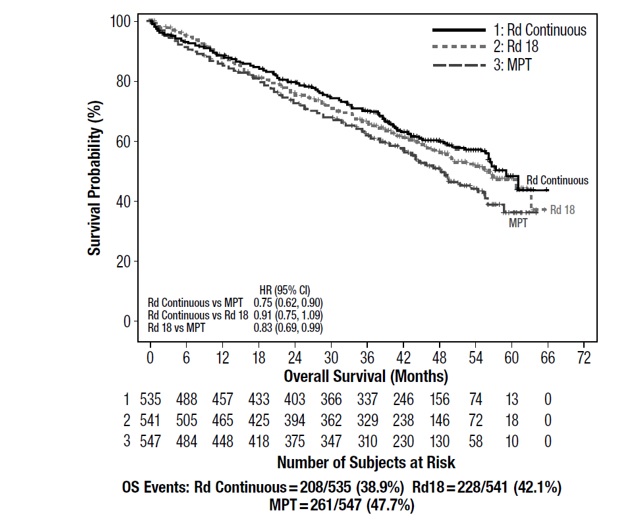
CI = confidence interval; d = low-dose dexamethasone; HR = hazard ratio; M = melphalan; P = prednisone; R = lenalidomide; Rd Continuous = Rd given until documentation of progressive disease; Rd18 = Rd given for ≤18 cycles; T = thalidomide.
Randomized, Open-Label Clinical Studies in Patients with MM After At Least One Prior Therapy
Two randomized studies (Studies 1 and 2) were conducted to evaluate the efficacy and safety of lenalidomide. These multicenter, multinational, double-blind, placebo-controlled studies compared lenalidomide plus oral pulse high-dose dexamethasone therapy to dexamethasone therapy alone in patients with MM who had received at least one prior treatment. These studies enrolled patients with absolute neutrophil counts (ANC) ≥1,000/mm 3, platelet counts ≥75,000/mm 3, serum creatinine ≤2.5 mg/dL, serum SGOT/AST or SGPT/ALT ≤3× upper limit of normal (ULN), and serum direct bilirubin ≤2 mg/dL.
In both studies, patients in the lenalidomide/dexamethasone group took 25 mg of lenalidomide orally once daily on Days 1 to 21 and a matching placebo capsule once daily on Days 22 to 28 of each 28-day cycle. Patients in the placebo/dexamethasone group took 1 placebo capsule on Days 1 to 28 of each 28-day cycle. Patients in both treatment groups took 40 mg of dexamethasone orally once daily on Days 1 to 4, 9 to 12, and 17 to 20 of each 28-day cycle for the first 4 cycles of therapy.
The dose of dexamethasone was reduced to 40 mg orally once daily on Days 1 to 4 of each 28-day cycle after the first 4 cycles of therapy. In both studies, treatment was to continue until disease progression.
In both studies, dose adjustments were allowed based on clinical and laboratory findings. Sequential dose reductions to 15 mg daily, 10 mg daily and 5 mg daily were allowed for toxicity [see Dosage and Administration (2.1)].
Table 16 summarizes the baseline patient and disease characteristics in the two studies. In both studies, baseline demographic and disease-related characteristics were comparable between the lenalidomide/dexamethasone and placebo/dexamethasone groups.
Study 1 | Study 2 | |||
Lenalidomide/Dex | Placebo/Dex | Lenalidomide/Dex | Placebo/Dex | |
Patient Characteristics | ||||
Age (years) | ||||
Median | 64 | 62 | 63 | 64 |
Min, Max | 36, 86 | 37, 85 | 33, 84 | 40, 82 |
Sex | ||||
Male | 106 (60%) | 104 (59%) | 104 (59%) | 103 (59%) |
Female | 71 (40%) | 72 (41%) | 72 (41%) | 72 (41%) |
Race/Ethnicity | ||||
White | 141(80%) | 148 (84%) | 172 (98%) | 175 (100%) |
Other | 36 (20%) | 28 (16%) | 4 (2%) | 0 (0%) |
ECOG Performance | ||||
Status 0 to 1 | 157 (89%) | 168 (95%) | 150 (85%) | 144 (82%) |
Disease Characteristics | ||||
Multiple Myeloma Stage (Durie-Salmon) | ||||
I | 3% | 3% | 6% | 5% |
II | 32% | 31% | 28% | 33% |
III | 64% | 66% | 65% | 63% |
β2-microglobulin (mg/L) | ||||
≤ 2.5 mg/L | 52 (29%) | 51 (29%) | 51 (29%) | 48 (27%) |
> 2.5 mg/L | 125 (71%) | 125 (71%) | 125 (71%) | 127 (73%) |
Number of Prior Therapies | ||||
1 | 38% | 38% | 32% | 33% |
≥ 2 | 62% | 62% | 68% | 67% |
Types of Prior Therapies | ||||
Stem Cell Transplantation | 62% | 61% | 55% | 54% |
Thalidomide | 42% | 46% | 30% | 38% |
Dexamethasone | 81% | 71% | 66% | 69% |
Bortezomib | 11% | 11% | 5% | 4% |
Melphalan | 33% | 31% | 56% | 52% |
Doxorubicin | 55% | 51% | 56% | 57% |
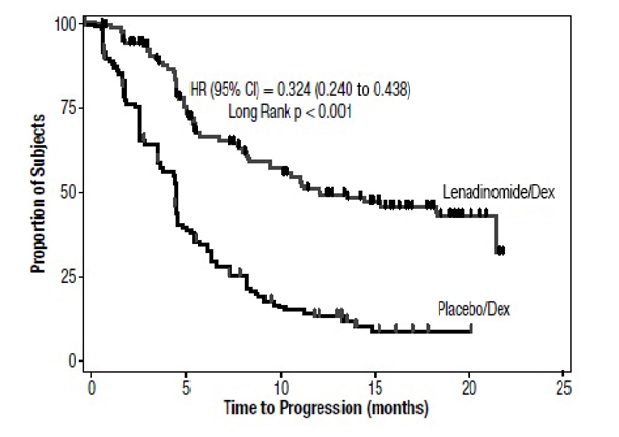
The primary efficacy endpoint in both studies was time to progression (TTP). TTP was defined as the time from randomization to the first occurrence of progressive disease.
Pre-planned interim analyses of both studies showed that the combination of lenalidomide/dexamethasone was significantly superior to dexamethasone alone for TTP. The studies were unblinded to allow patients in the placebo/dexamethasone group to receive treatment with the lenalidomide/dexamethasone combination. For both studies, the extended follow-up survival data with crossovers were analyzed. In study 1, the median survival time was 39.4 months (95% CI: 32.9, 47.4) in lenalidomide/dexamethasone group and 31.6 months (95% CI: 24.1, 40.9) in placebo/dexamethasone group, with a hazard ratio of 0.79 (95% CI: 0.61 to 1.03). In study 2, the median survival time was 37.5 months (95% CI: 29.9, 46.6) in lenalidomide/dexamethasone group and 30.8 months (95% CI: 23.5, 40.3) in placebo/dexamethasone group, with a hazard ratio of 0.86 (95% CI: 0.65 to 1.14).
Study 1 | Study 2 | |||
Lenalidomide/Dex | Placebo/Dex | Lenalidomide/Dex | Placebo/Dex | |
TTP | ||||
Events n (%) | 73 (41) | 120 (68) | 68 (39) | 130 (74) |
Median TTP in months [95% CI] | 13.9
| 4.7
| 12.1
| 4.7
|
Hazard Ratio
| 0.285
| 0.324
| ||
Log-rank Test p-value 3 | <0.001 | <0.001 | ||
Response | ||||
Complete Response (CR) n (%) | 23 (13) | 1 (1) | 27 (15) | 7 (4) |
Partial Response (RR/PR) n (%) | 84 (48) | 33 (19) | 77 (44) | 34 (19) |
Overall Response n (%) | 107 (61) | 34 (19) | 104 (59) | 41 (23) |
p-value | <0.001 | <0.001 | ||
Odds Ratio [95% CI] | 6.38
| 4.72
| ||
Kaplan-Meier Estimate of Time to Progression - MM Study 1
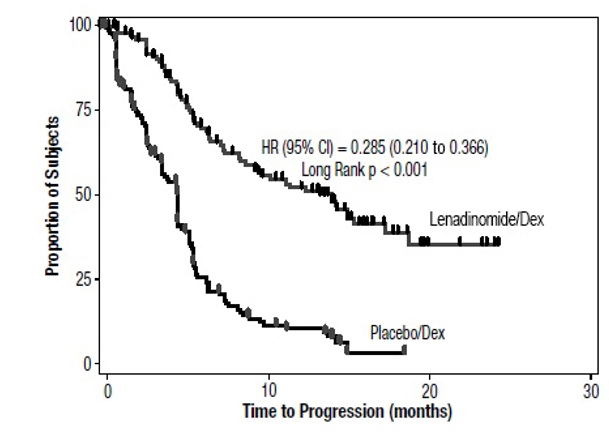
Figure 5 (Figure5)
Kaplan-Meier Estimate of Time to Progression - MM Study 2
Figure 6 (Figure6)