1 Indications And Usage
LYTENAVA is indicated for the treatment of patients with neovascular (wet) age-related macular degeneration (nAMD).
The following Structured Product Label (SPL) was submitted to the FDA by Outlook Therapeutics, Inc. for the product Lytenava (NDC 82491-025). This document serves as the official prescribing information, containing essential scientific data and clinical materials required for healthcare providers and patients.
This specific version of the label includes detailed information regarding 1 indications and usage, 2.1 general dosing information, 2.2 neovascular (wet) age-related macular degeneration, 2.3 preparation for administration, 2.4 administration, 3 dosage forms and strengths, 4.1 ocular or periocular infections, 4.2 active intraocular inflammation, and other regulatory disclosures. Use the navigation below to review specific sections of the FDA submission.
LYTENAVA is indicated for the treatment of patients with neovascular (wet) age-related macular degeneration (nAMD).
FOR OPHTHALMIC INTRAVITREAL INJECTION. LYTENAVA must only be administered by a qualified physician.
A 5-micron sterile filter needle (18-gauge x 1½-inch), a 1-mL syringe (with marking to measure 0.05 mL), and a 30-gauge x ½-inch sterile injection needle are needed.
The recommended dose for LYTENAVA is 1.25 mg (0.05 mL of 25 mg/mL) administered by intravitreal injection once monthly (approximately 28 days).
Parenteral drug products should be inspected visually for particulate matter and discoloration prior to administration, whenever solution and container permit.
The glass vial is for one-time use in one eye only.
Using aseptic technique, the total vial volume of a LYTENAVA vial should be withdrawn through a 5-micron (18-gauge x 1½-inch) sterile filter needle attached to a 1 mL syringe. The filter needle should be discarded after withdrawal of the vial contents and should not be used for the intravitreal injection. The filter needle should be replaced with a sterile 30-gauge x ½-inch needle for the intravitreal injection. The contents should be expelled until the plunger tip is aligned with the line that marks 0.05 mL on the syringe.
Use aseptic technique to carry out the following preparation steps:
1. Prepare for intravitreal injection with the following recommended devices for one-time use (not provided):
• 5-micron sterile filter needle (18-gauge x 1½-inch)
• 1 mL sterile syringe (with marking to measure 0.05 mL)
• sterile injection needle (30-gauge x ½-inch)
• alcohol swab
2. Remove the protective plastic cap from the vial. Clean the top of the vial with an alcohol swab.
3. Attach the 5-micron filter needle (18-gauge x 1½-inch) to the syringe by twisting it onto the syringe tip.
4. Push the filter needle into the center of the vial stopper and ensure the tip of the needle remains within the solution to minimize the potential for air bubbles.
5. Withdraw the total volume of LYTENAVA, keeping the vial in an upright position, slightly inclined to ease sufficient withdrawal.
6. Ensure that the plunger rod is drawn sufficiently back when drawing up LYTENAVA in order to completely empty the filter needle.
7. The filter needle should be discarded after withdrawal of the vial contents and must not be used for the intravitreal injection.
8. Attach the 30-gauge x ½-inch sterile injection needle to the syringe by firmly screwing it onto the syringe hub. Carefully remove the needle cap by pulling it straight off. Do not wipe the needle at any time.
9. Hold the syringe with the needle pointing up. If there are any air bubbles, gently tap the syringe with your finger until the bubbles rise to the top.
10. Hold the syringe at eye level and slowly push the plunger rod until the plunger tip is aligned with the line that marks 0.05 mL on the syringe.
The intravitreal injection procedure should be carried out under controlled aseptic conditions, which include the use of sterile gloves, a sterile drape, and a sterile eyelid speculum (or equivalent). Adequate anesthesia and a broad-spectrum microbicide should be given prior to injection.
Prior to and 30 minutes following the intravitreal injection, patients should be monitored for elevation in intraocular pressure using tonometry. Monitoring may also consist of a check for perfusion of the optic nerve head immediately after the injection [see Warnings and Precautions (5.2)]. Patients should also be monitored for and instructed to report any symptoms suggestive of endophthalmitis without delay following the injection [see Warnings and Precautions (5.1)].
Each single-dose vial should only be used for the treatment of a single eye. If the contralateral eye
requires treatment, a new vial should be used and the sterile field, syringe, gloves, drapes, eyelid speculum, filter needle, and injection needles should be changed before LYTENAVA is administered to the other eye.
Injection: 1.25 mg (0.05 mL of 25 mg/mL) colorless to light brown, opalescent solution for intravitreal injection in a single-dose vial.
LYTENAVA is contraindicated in patients with ocular or periocular infections.
LYTENAVA is contraindicated in patients with active intraocular inflammation.
LYTENAVA is contraindicated in patients with known hypersensitivity to bevacizumab products or any of the ingredients in LYTENAVA. Hypersensitivity reactions may manifest as severe intraocular inflammation.
Intravitreal injections have been associated with endophthalmitis and retinal detachments. Proper aseptic injection technique should always be used when administering LYTENAVA. In addition, patients should be monitored following the injection to permit early treatment should an infection occur [see Dosage and Administration (2.3) and Patient Counseling Information (17)].
Increases in intraocular pressure have been noted post-injection (up to 60 minutes) while being treated with LYTENAVA. Monitor intraocular pressure prior to and following intravitreal injection with LYTENAVA and manage appropriately [see Dosage and Administration (2.4)].
Although there was a low rate of arterial thromboembolic events (ATEs) observed in the LYTENAVA clinical trials, there is a potential risk of ATEs following intravitreal use of VEGF inhibitors. ATEs are defined as nonfatal stroke, nonfatal myocardial infarction, or vascular death (including deaths of unknown cause).
The following adverse reactions are discussed in greater detail in other sections of the label:
Because clinical trials are conducted under widely varying conditions, adverse reaction rates observed in one clinical trial of a drug cannot be directly compared with rates in the clinical trials of the same or another drug and may not reflect the rates observed in practice.
The data described below reflect exposure to LYTENAVA in 601 patients, in five clinical trials [see Clinical Studies (14)].
Table 1 shows the most common ocular adverse reactions in LYTENAVA treated patients compared with ranibizumab 0.5 mg.
| Adverse Reactions | LYTENAVA 1.25 mg (N = 601) | Ranibizumab 0.5 mg (N = 345) |
| Conjunctival hemorrhage | 4% | 3% |
| Eye pain | 2% | 1% |
| Vitreous floaters | 2% | 1% |
Less common ocular adverse reactions reported in the study eye in <1% of patients treated with LYTENAVA were corneal abrasion, dry eye, eye irritation, and intraocular pressure increased.
Risk Summary
Based on the anti-VEGF mechanism of action for bevacizumab products [see Clinical Pharmacology (12.1)], treatment with LYTENAVA may pose a risk to human embryofetal development.
There are no adequate and well-controlled studies of LYTENAVA administration in pregnant women or pregnant animals. It is not known whether bevacizumab-vikg can cause fetal harm when administered to a pregnant woman. LYTENAVA should be given to a pregnant woman only if clearly needed.
All pregnancies have a background risk of birth defect, loss, and other adverse outcomes. The background risk of major birth defects and miscarriage for the indicated population is unknown. In the U.S. general population, the estimated background risk of major birth defects is 2% to 4% and of miscarriage is 15% to 20% of clinically recognized pregnancies.
Risk Summary
There are no data available on the presence of bevacizumab-vikg in human milk, the effects of bevacizumab-vikg on the breastfed infant or the effects of bevacizumab-vikg on milk production/excretion.
Because many drugs are excreted in human milk, and because the potential for absorption and harm to infant growth and development exists, caution should be exercised when LYTENAVA is administered to a nursing woman.
The developmental and health benefits of breastfeeding should be considered along with the mother’s clinical need for LYTENAVA and any potential adverse effects on the breastfed child from bevacizumab-vikg.
Contraception
Females of reproductive potential should use effective contraception during treatment with LYTENAVA and for at least 3 months after the last dose when stopping treatment with LYTENAVA.
Infertility
There are no data regarding the effects of LYTENAVA on human fertility. Based on the anti-VEGF mechanism of action LYTENAVA may pose a risk to reproductive capacity [see Clinical Pharmacology (12.1)].
The safety and effectiveness of LYTENAVA in pediatric patients have not been established.
In the three completed Phase 3 clinical studies, approximately 70% (238/341) of patients treated with LYTENAVA were ≥ 65 years of age and approximately 47 % (160/341) were ≥ 75 years of age. No overall differences in efficacy or safety were seen with increasing age in these studies [see Clinical Studies (14)].
Bevacizumab-vikg is a recombinant humanized IgG1 monoclonal antibody specific for human vascular endothelial growth factor (VEGF). Bevacizumab-vikg has a molecular weight of approximately 149 kDa (kilodaltons) and was produced using recombinant CHO cells.
LYTENAVA (bevacizumab-vikg) injection is a sterile, colorless to light brown, opalescent solution for intravitreal use. LYTENAVA does not contain an anti-microbial preservative.
LYTENAVA is supplied in a single-dose vial designed to deliver 0.05 mL of 25 mg/mL (1.25 mg) aqueous solution that also contains dibasic sodium phosphate (0.06 mg), monobasic sodium phosphate (0.29 mg), polysorbate 20 (0.02 mg), trehalose (2.71 mg), and Water for Injection. The pH is 6.
Bevacizumab is a human vascular endothelial growth factor (VEGF) inhibitor. Bevacizumab binds VEGF and prevents the interaction of VEGF to its receptors (Flt-1 and KDR) on the surface of endothelial cells.
LYTENAVA binds to all isoforms of VEGF-A, thereby preventing interaction with receptors VEGFR-1 and VEGFR-2. By inhibiting VEGF-A, LYTENAVA suppresses endothelial cell proliferation, neovascularization, and vascular permeability. Inhibition of such activity targets a pathophysiologic process that contributes to vision loss.
Increased retinal thickness (e.g., central foveal thickness (CFT)) and leakage of blood and fluid from choroidal neovascularization is associated with nAMD. CFT is known to be a reproducible, early indication of pharmacodynamic response to anti-VEGF treatments.
Changes in CFT were assessed using optical coherence tomography in NORSE TWO and NORSE EIGHT [see Clinical Studies (14)]. Increasingly greater reductions in CFT were observed at Weeks 4, 8, and 12 across both treatment arms.
Anatomic data were not used to influence LYTENAVA treatment decisions.
Following intravitreal administration of LYTENAVA, the systemic exposure to bevacizumab-vikg is minimal. In 14 subjects who received a single 1.25 mg dose of LYTENAVA, the serum bevacizumab-vikg concentration was assessed up to Day 4. The serum bevacizumab-vikg concentrations gradually increased over time, so the highest concentrations observed were approximately at Day 4 (the last collection time) ranging from 33 to 270 ng/mL, which was <1% of the Cmax after intravenous infusion of 2 mg/kg bevacizumab-vikg. However, due to the limited sample collection, Cmax or AUC could not be adequately characterized.
The observed incidence of anti-drug antibodies (ADA) is highly dependent on the sensitivity and specificity of the assay. Differences in assay methods preclude meaningful comparisons of the incidence of ADA in the studies described below with the incidence of ADA in other studies, including those of LYTENAVA or of other bevacizumab products.
In a 52-week study, a total of 14 subjects who received LYTENAVA and were subsequently evaluated for immunogenicity did not show detectable ADA at any timepoint but the ADA assay sensitivity data in the presence of free drug was insufficient. However, due to the minimal systemic exposure to LYTENAVA following intravitreal injection, the risk of immunogenicity is not expected to be clinically significant.
Long term studies in animals have not been performed to evaluate the carcinogenic potential of LYTENAVA. Based on the anti-VEGF mechanism of action, LYTENAVA may pose a risk to reproductive capacity [see Use in Specific Populations (8.3)].
An investigational IV formulation of bevacizumab-vikg was evaluated for systemic toxic potential and toxicokinetics in a 4-week intravenous 50 mg IV (slow bolus) with biweekly administration in cynomolgus monkeys (9 males and 9 females). Target organs and differences in sensitivity between sexes were evaluated and found to be similar. Physeal dysplasia of the distal femur in male cynomolgus monkeys was observed but was indistinguishable between the treatment groups.
The efficacy of LYTENAVA for the treatment of neovascular (wet) age-related macular degeneration (nAMD) was demonstrated in a randomized, multi-center, masked, active-controlled study (NORSE TWO – NCT03834753).
In NORSE TWO, adult patients with nAMD were randomized to LYTENAVA 1.25 mg (N=113) administered once monthly for 1 year or ranibizumab 0.5 mg (N=115) administered once monthly for 3 months (Days 0, 30, and 60) followed by once every 3 months for 1 year (Days 150 and 240). Patient ages ranged from 54 to 98 years, with a median age of 79 years.
The primary efficacy endpoint was the proportion of patients who gained ≥ 15 Best Corrected Visual Acuity (BCVA) letters from baseline to Month 11 as measured by the Early Treatment Diabetic Retinopathy Study (ETDRS) letter score. The difference observed between the study drug groups was significant, in favor of LYTENAVA (see Table 2).
The pre-specified secondary efficacy endpoint of mean change in BCVA from baseline to Month 11 favored LYTENAVA once monthly compared to ranibizumab administered once monthly for 3 months then every 3 months and is displayed over time in Figure 1.
Ranibizumab 0.5 mg Once Monthly x 3 Months | LYTENAVA 1.25 mg | |
| Number of subjects, n/N (%) | 24/104 (23.1) | 45/108 (41.7) |
| Risk difference | 0.1859 | |
| 95% CI | 0.0442, 0.3086 |
Figure 1. NORSE TWO – Mean Change in Best Corrected Visual Acuity from Baseline (LYTENAVA once monthly; ranibizumab once monthly x 3, then every 3 months)
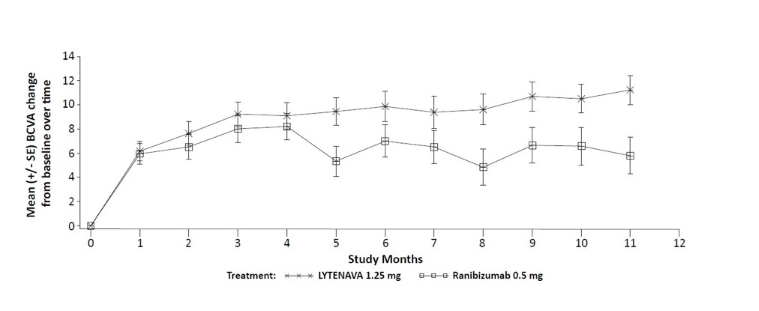
Figure 1 (Lytenava Figure 1)
In a multicenter, randomized, masked, controlled study (NORSE EIGHT – NCT06190093), 400 adult patients with nAMD were randomized (1:1) to LYTENAVA 1.25 mg or ranibizumab 0.5 mg, administered every 4 weeks for 3 total doses (Day 0, Week 4, and Week 8). The primary efficacy endpoint was the mean change in baseline BCVA as measured by ETDRS score at Week 8 using a non-inferiority (NI) margin of -3.5 letters.
NORSE EIGHT did not meet its pre-specified NI margin of -3.5 letters in mean change from baseline BCVA at Week 8 compared to ranibizumab.
At Week 8, the LYTENAVA group had a mean increase in BCVA of 3.3 compared to a mean increase of 4.5 in the ranibizumab group. The LS mean difference and 95% CI was -2.3 (-4.0, -0.5).
LYTENAVA showed an increase from baseline in BCVA at Week 12 consistent with NORSE TWO.
LYTENAVA (bevacizumab-vikg) injection is a colorless to light brown, opalescent solution. Each carton (NDC 82491-025-10) contains LYTENAVA 1.25 mg (0.05 mL of 25 mg/mL bevacizumab-vikg solution) in a single-dose glass vial with a BLUE CAP.
EACH CARTON IS FOR SINGLE-EYE USE ONLY.
Store LYTENAVA refrigerated at 2°C to 8°C (36°F to 46°F) in the original carton until use to protect from light. DO NOT FREEZE.
Prior to use, the unopened glass vial of LYTENAVA may be kept at room temperature, 20°C to 25°C (68°F to 77°F), for up to 12 hours. Ensure the injection is given immediately after preparation of the dose.
Advise patients that in the days following LYTENAVA administration, patients are at risk of developing endophthalmitis, retinal detachment, and intraocular inflammation. If the eye becomes red, sensitive to light, painful, or develops a change in vision, advise the patient to seek immediate care from an ophthalmologist [see Warnings and Precautions (5.1, 5.3)].
Patients may experience temporary visual disturbances after an intravitreal injection with LYTENAVA and the associated eye examinations [see Adverse Reactions (6)]. Advise patients not to drive or use machinery until visual function has recovered sufficiently.
| LYTENAVA™ (bevacizumab-vikg) | |
| Manufactured by: | LYTENAVA is a trademark of Outlook Therapeutics, Inc. |
| Outlook Therapeutics, Inc. | ©2026 Outlook Therapeutics Inc. |
| 111 S. Wood Ave, Unit #100 Iselin, NJ 08830 U.S. U.S. License No.: 2292 |
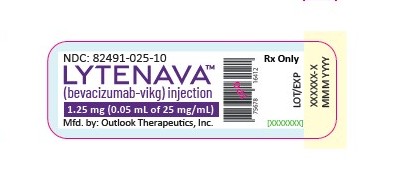
Vial Label (Lytenava 4)
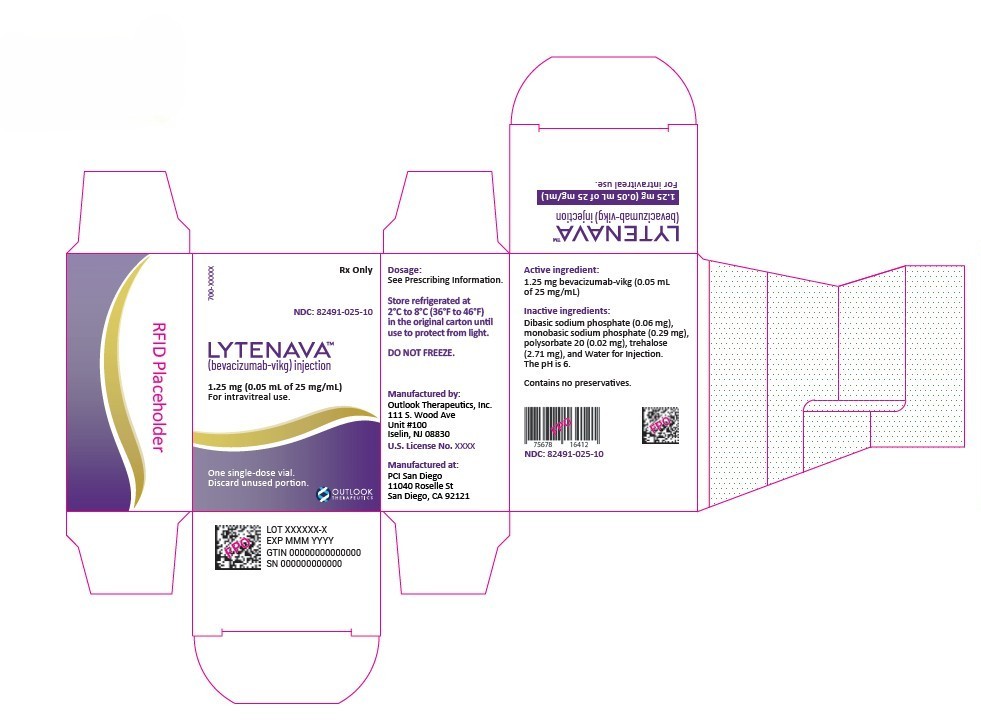
Carton Label (Lytenava 5)
* Please review the disclaimer below.
