The pharmacokinetics of silodosin have been evaluated in adult male subjects with doses ranging from 0.1 mg to 24 mg per day. The pharmacokinetics of silodosin are linear throughout this dosage range.
Absorption
The pharmacokinetic characteristics of silodosin 8 mg once daily were determined in a multi-dose, open-label, 7‑day pharmacokinetic study completed in 19 healthy, target-aged (≥ 45 years of age) male subjects. Table 3 presents the steady state pharmacokinetics of this study.
Table 3 Mean (±SD) Steady State Pharmacokinetic Parameters in Healthy Males Following Silodosin 8 mg Once Daily with Food Cmax
(ng/mL)
| tmax
(hours)
| t1/2
(hours)
| AUCss
(ng•hr/mL)
|
61.6 ± 27.54
| 2.6 ± 0.90
| 13.3 ± 8.07
| 373.4 ± 164.94
|
Cmax = maximum concentration, tmax = time to reach Cmax, t1/2 = elimination half-life, AUCss = steady state area under the concentration-time curve
|
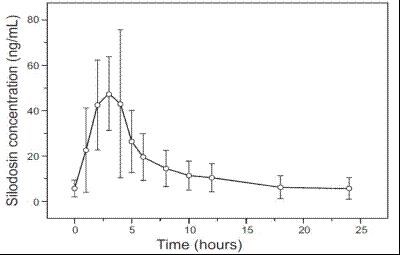
Image (0fdaf6c9 C861 4894 B4a9 2f6a281998c1 02)
Figure 1 Mean (±SD) Silodosin Steady State Plasma Concentration-Time Profile in Healthy Target-Aged Subjects Following Silodosin 8 mg Once Daily with Food
The absolute bioavailability is approximately 32%.
Food Effect
The maximum effect of food (i.e., co‑administration with a high fat, high calorie meal) on the PK of silodosin was not evaluated. The effect of a moderate fat, moderate calorie meal was variable and decreased silodosin Cmax by approximately 18% to 43% and AUC by 4% to 49% across three different studies.
In a single-center, open-label, single-dose, randomized, two-period crossover study in twenty healthy male subjects age 21 to 43 years under fed conditions, a study was conducted to evaluate the relative bioavailability of the contents of an 8 mg capsule (size #1) of silodosin sprinkled on applesauce compared to the product administered as an intact capsule. Based on AUC0–24 and Cmax, silodosin administered by sprinkling the contents of a silodosin capsule onto a tablespoonful of applesauce was found to be bioequivalent to administering the capsule whole.
Distribution
Silodosin has an apparent volume of distribution of 49.5 L and is approximately 97% protein bound.
Elimination
Metabolism
Silodosin undergoes extensive metabolism through glucuronidation, alcohol and aldehyde dehydrogenase, and cytochrome P450 3A4 (CYP3A4) pathways. The main metabolite of silodosin is a glucuronide conjugate (KMD‑3213G) that is formed via direct conjugation of silodosin by UDP-glucuronosyltransferase 2B7 (UGT2B7). Co‑administration with inhibitors of UGT2B7 (e.g., probenecid, valproic acid, fluconazole) may potentially increase exposure to silodosin. KMD‑3213G, which has been shown in vitro to be active, has an extended half-life (approximately 24 hours) and reaches plasma exposure (AUC) approximately four times greater than that of silodosin. The second major metabolite (KMD‑3293) is formed via alcohol and aldehyde dehydrogenases and reaches plasma exposures similar to that of silodosin. KMD‑3293 is not expected to contribute significantly to the overall pharmacologic activity of silodosin capsules.
Excretion
Following oral administration of 14C‑labeled silodosin, the recovery of radioactivity after 10 days was approximately 33.5% in urine and 54.9% in feces. After intravenous administration, the plasma clearance of silodosin was approximately 10 L/hour.
Special Populations
Race
No clinical studies specifically investigating the effects of race have been performed.
Geriatric
In a study comparing 12 geriatric males (mean age 69 years) and 9 young males (mean age 24 years), the exposure (AUC) and elimination half-life of silodosin were approximately 15% and 20%, respectively, greater in geriatric than young subjects. No difference in the Cmax of silodosin was observed [see USE IN SPECIFIC POPULATIONS (8.5)].
Pediatric
Silodosin capsules has not been evaluated in patients less than 18 years of age.
Renal Impairment
In a study with six subjects with moderate renal impairment, the total silodosin (bound and unbound) AUC, Cmax, and elimination half-life were 3.2-, 3.1-, and 2‑fold higher, respectively, compared to seven subjects with normal renal function. The unbound silodosin AUC and Cmax were 2.0- and 1.5‑fold higher, respectively, in subjects with moderate renal impairment compared to the normal controls.
In controlled and uncontrolled clinical studies, the incidence of orthostatic hypotension and dizziness was greater in subjects with moderate renal impairment treated with 8 mg silodosin capsules daily than in subjects with normal or mildly impaired renal function [see CONTRAINDICATIONS (4), WARNINGS AND PRECAUTIONS (5.2) and USE IN SPECIFIC POPULATIONS (8.6)].
Hepatic Impairment
In a study comparing nine male patients with moderate hepatic impairment (Child-Pugh scores 7 to 9), to nine healthy male subjects, the single dose pharmacokinetic disposition of silodosin was not significantly altered in the patients with moderate hepatic impairment. No dosing adjustment is required in patients with mild or moderate hepatic impairment. The pharmacokinetics of silodosin in patients with severe hepatic impairment have not been studied [see CONTRAINDICATIONS (4), WARNINGS AND PRECAUTIONS (5.3) and USE IN SPECIFIC POPULATIONS (8.7)].
Drug Interactions
Cytochrome P450 (CYP) 3A4 Inhibitors
Two clinical drug interaction studies were conducted in which a single oral dose of silodosin was co‑administered with the strong CYP3A4 inhibitor, ketoconazole, at doses of 400 mg and 200 mg, respectively, once daily for 4 days. Co‑administration of 8 mg silodosin with 400 mg ketoconazole led to 3.8‑fold increase in silodosin Cmax and 3.2‑fold increase in AUC. Co‑administration of 4 mg silodosin with 200 mg ketoconazole led to similar increases: 3.7- and 2.9‑fold in silodosin Cmax and AUC, respectively. Silodosin is contraindicated with strong CYP3A4 inhibitors.
The effect of moderate CYP3A4 inhibitors on the pharmacokinetics of silodosin has not been evaluated. Due to the potential for increased exposure to silodosin, caution should be exercised when co‑administering silodosin with moderate CYP3A4 inhibitors, particularly those that also inhibit P‑glycoprotein (e.g., verapamil, erythromycin).
P‑glycoprotein (P‑gp) Inhibitors
In vitro studies indicated that silodosin is a P‑gp substrate. A drug interaction study with a strong P‑gp inhibitor has not been conducted. However, in drug interaction studies with ketoconazole, a CYP3A4 inhibitor that also inhibits P‑gp, significant increase in exposure to silodosin was observed [see CLINICAL PHARMACOLOGY (12.3)]. Inhibition of P‑gp may lead to increased silodosin concentration. Silodosin is not recommended in patients taking strong P‑gp inhibitors (e.g., cyclosporine).
Digoxin
The effect of silodosin on the pharmacokinetics of digoxin was evaluated in a multiple dose, single-sequence, crossover study of 16 healthy males, aged 18 to 45 years. A loading dose of digoxin was administered as 0.5 mg twice daily for one day. Following the loading doses, digoxin (0.25 mg once daily) was administered alone for seven days and then concomitantly with silodosin 4 mg twice a day for the next seven days. No significant differences in digoxin AUC and Cmax were observed when digoxin was administered alone or concomitantly with silodosin.
Other Metabolic Enzymes and Transporters
In vitro studies indicated that silodosin administration is not likely to inhibit the activity of CYP1A2, CYP2A6, CYP2C9, CYP2C19, CYP2D6, CYP2E1, and CYP3A4 or induce the activity of CYP1A2, CYP2C8, CYP2C9, CYP2C19, CYP3A4, and P‑gp.