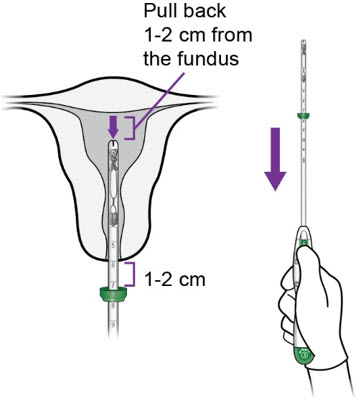
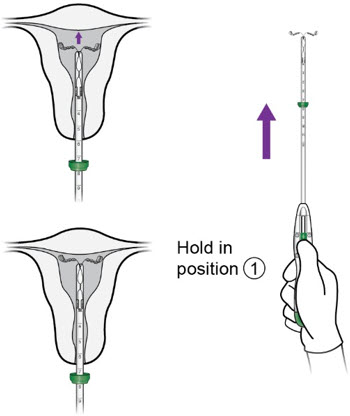
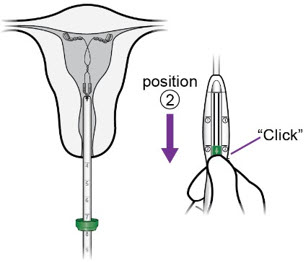
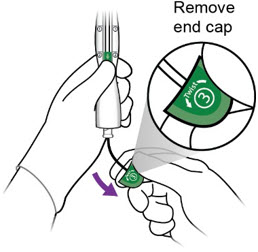
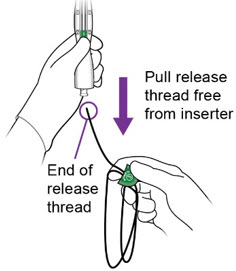
- Use a speculum and visualize the cervix.
- Remove Miudella with forceps, pulling gently on the exposed threads. The flexible arms of Miudella will fold upwards as it is withdrawn from the uterus. If the threads are not visible, determine location of Miudella by ultrasound.
- If Miudella is found to be in the uterine cavity on an ultrasound exam, it may be removed using a narrow forceps, such as an alligator forceps. Consider use of local anesthetic for a paracervical block if cervical dilation is required. After removal of Miudella, examine the system to ensure that it is intact.
- Removal may be associated with some pain and/or bleeding or vasovagal reactions (e.g. syncope, bradycardia, seizures) especially in patients with a predisposition to these conditions.
Intrauterine system: 175 mm
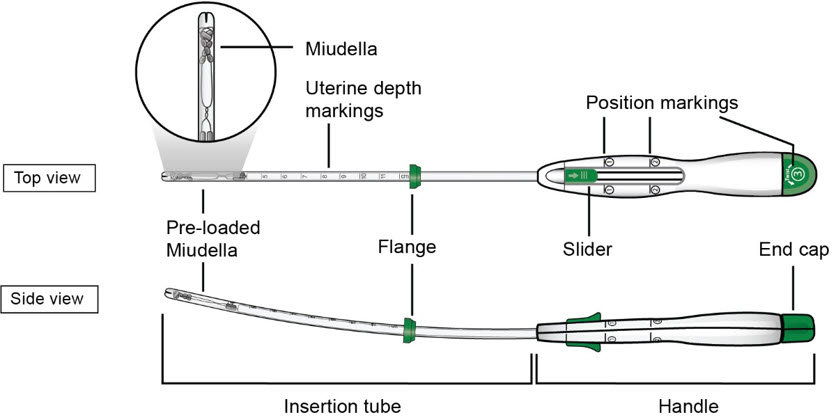
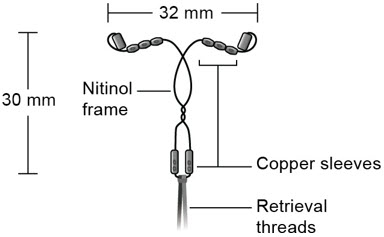
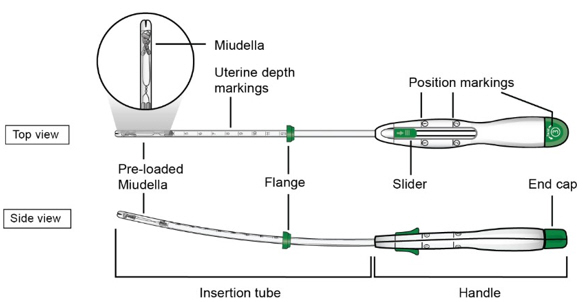
2exposed copper surface area. Miudella is a copper-containing IUS that has a flexible nitinol frame with copper sleeves and monofilament polymer retrieval thread, preloaded in a sterile inserter with a tapered rounded tip and packaged in a sealed tray with lid.
Septic Abortion
In females becoming pregnant with an intrauterine system (IUS), including Miudella in place, septic abortion, with septicemia, septic shock, and death, may occur. Septic abortion typically requires hospitalization and treatment with intravenous antibiotics. Septic abortion may result in spontaneous abortion or a medical indication for pregnancy termination. A hysterectomy may be required if severe infection of the uterus occurs, which will result in permanent infertility.
Continuation of Pregnancy
If a female becomes pregnant with Miudella in place and if Miudella cannot be removed or the female chooses not to have it removed, warn her that failure to remove Miudella increases the risk of miscarriage, sepsis, premature labor, and premature delivery. Prenatal care should include counseling about these risks and that she should report immediately any flu-like symptoms, fever, chills, cramping, pain, bleeding, vaginal discharge or leakage of fluid, or any other symptom that suggests complications of the pregnancy.
Pelvic Inflammatory Disease (PID)
Miudella is contraindicated in the presence of known or suspected PID or endometritis
[see
Contraindications (4)]
. IUSs have been associated with an increased risk of PID, most likely due to organisms being introduced into the uterus during insertion.
Females at increased risk for PID
PID is often associated with a sexually transmitted infection (STI), and Miudella does not protect against STI. The risk of PID is greater for females who have multiple sexual partners, and also for females whose sexual partner(s) have multiple sexual partners. Females who have had PID are at increased risk for a recurrence or re-infection. In particular, ascertain whether the female is at increased risk of infection (for example, leukemia, acquired immune deficiency syndrome [AIDS], intravenous drug abuse).
Subclinical PID
PID may be asymptomatic but still result in tubal damage and its sequelae.
Treatment of PID
Following a diagnosis of PID, or suspected PID, bacteriologic specimens should be obtained and antibiotic therapy should be initiated promptly. Removal of Miudella after initiation of antibiotic therapy is appropriate in cases of recurrent PID or endometritis, or if an acute pelvic infection is severe or does not respond to treatment.
Actinomycosis
Actinomycosis has been associated with IUS use. Symptomatic patients with known actinomycosis infection should have Miudella removed and receive antibiotics. Actinomycetes can be found in the genital tract cultures in healthy patients without IUSs. The significance of actinomyces-like organisms on Pap test in an asymptomatic IUS user is unknown, and so this finding alone does not always require Miudella removal and treatment. When possible, confirm a Pap test diagnosis with cultures.
Risk Summary
Use of Miudella is contraindicated for use in pregnant females because there is no need for pregnancy prevention in a female who is already pregnant and Miudella may cause adverse pregnancy outcomes. If a female becomes pregnant with Miudella in place, there is an increased risk of miscarriage, sepsis, premature labor, and premature delivery
[see
Contraindications (4)and
Warnings and Precautions (5.3,
5.4)]
. Advise the female of the potential risks if pregnancy occurs with Miudella in place.
Published studies on pregnancy outcomes exposed to copper IUSs report up to 27% miscarriage when the IUS was removed compared to 77% miscarriage when the IUS remained in the uterus. Studies on Miudella and birth defects have not been conducted.
Risk Summary
No difference has been detected in concentration of copper in human milk before and after insertion of copper IUSs, such as Miudella. There is no information on the effect of copper in a breastfed child or the effect on milk production. The developmental and health benefits of breastfeeding should be considered along with the mother's clinical need for Miudella and any potential adverse effects on the breastfed child from Miudella.
Return to Fertility After Discontinuing Miudella
In Study 1 (NCT03633799), return to fertility was investigated in a total of 63 women who desired pregnancy after study discontinuation and provided follow-up information. The probability to conceive within 12 months after removal of Miudella was 74.1%
[see
Clinical Studies (14)].
Sexually Transmitted Infections: Advise patients that Miudella does not protect against HIV infection and other sexually transmitted infections.
Ectopic Pregnancy: Advise patients to report pregnancies and be evaluated immediately, as a pregnancy with Miudella in place is more likely to be an ectopic pregnancy, and the risks of ectopic pregnancy include the loss of fertility
[See
Warnings and Precautions (5.3)].
Intrauterine Pregnancy: Advise the patient to contact her healthcare provider if she thinks she might be pregnant. Inform the patient about the risks of intrauterine pregnancy while using Miudella, including the risks of leaving Miudella in place and the risks of removing Miudella or probing of the uterus. An intrauterine pregnancy with Miudella in place may result in septic abortion, with septicemia, septic shock, and possible death. Septic abortion typically requires hospitalization and treatment with intravenous antibiotics. Septic abortion may result in spontaneous abortion or a medical indication for pregnancy termination. A hysterectomy may be required if severe infection of the uterus occurs, which will result in permanent infertility.
If Miudella cannot be removed in a pregnant patient and remains in the uterus during a pregnancy, there is an increased risk of miscarriage, sepsis, premature labor and premature delivery. Advise patients that a pregnancy must be followed closely and advise patients to report immediately any symptom, such as flu- like symptoms, fever, chills, cramping, pain, bleeding, vaginal discharge or leaking of fluid, or any other symptom that suggests complications of the pregnancy.
[See
Warnings and Precautions (5.4)and
Use in Special Populations (8.1)].
Sepsis: Advise the patient that severe infection or sepsis, including Group A streptococcal sepsis (GAS), can occur within the first few days after Miudella is inserted. Instruct her to contact a healthcare provider immediately if she develops severe pain or fever shortly after Miudella is inserted, as untreated sepsis can result in death
[See
Warnings and Precautions (5.5)].
Pelvic Infection: Advise the patient about the possibility of pelvic infections, including PID, after insertion of Miudella and that these infections can cause tubal damage leading to ectopic pregnancy or infertility, or infrequently can necessitate hysterectomy, or cause death. Teach patients to recognize and report to their healthcare provider promptly any symptoms of pelvic infection. These symptoms include development of menstrual disorders (spotting or prolonged or heavy bleeding), unusual vaginal discharge, abdominal or pelvic pain or tenderness, dyspareunia, chills, and fever.
[See
Warnings and Precautions (5.6)].
Perforation and Expulsion: Advise the patient that the IUS may be expelled from or perforate the uterus and instruct her on how she can check that the thread ends still protrude from the cervix. Inform her that excessive pain or vaginal bleeding during Miudella placement, worsening pain or bleeding after placement, or the inability to feel Miudella strings may occur with Miudella perforation and expulsion. Caution her not to pull on the thread ends and displace Miudella. Inform her that there is no contraceptive protection if Miudella is displaced (for example, expelled or perforated through the uterus). If perforation resulting in displacement occurs, Miudella will have to be located and removed; surgery may be required. Instruct the patient to contact her healthcare provider if she cannot feel the thread ends and to avoid intercourse or use a non-hormonal back-up birth control (such as condoms or spermicide) until the location of Miudella has been confirmed
[See
Warnings and Precautions (5.7,
5.8)].
Bleeding Pattern Alterations: Advise patients that heavier or longer periods and spotting between periods may occur. Instruct patients to report continued or severe symptoms to their healthcare provider
[See
Warnings and Precautions (5.10)].
Magnetic Resonance Imaging (MRI) Safety Information: Inform patients that Miudella can be safely scanned with MRI only under specific conditions. Instruct patients who will have an MRI to tell their healthcare provider that they have Miudella.
[See
Warnings and Precautions (5.11)].
Medical Diathermy: Instruct patients to tell their healthcare provider that they have Miudella prior to undergoing medical diathermy
[see
Warnings and Precautions (5.12)].
Clinical Considerations for Use and Removal:
- Advise patients to contact their healthcare provider if any of the following occur:
- Pelvic pain or pain during sex
- Unusual vaginal discharge or genital sores
- Possible exposure to STIs
- Very heavy or prolonged vaginal bleeding
- Missed period
- Advise patients that they may use tampons or pads while using Miudella.
- Advise patients that menstrual cups or discs are not recommended for use with Miudella. Use may cause Miudella to become displaced or expelled.
Manufactured for:
Sebela Women's Health Inc.
Roswell, GA 30076
www.miudella.com