Of the 157 patients treated, the median age was 64 years (range: 20 to 83), 60% were male, and 97% had an ECOG performance status of 0 or 1. Race was reported in 133 (85%) patients; of these patients, 61% were White, 19% were Asian, and 0.6% were Native Hawaiian or Other Pacific Islander. There were no Black or African American or Hispanic or Latino patients treated in the clinical trial as reported. The median number of prior therapies was 3 (range: 2 to 11). The study excluded patients with CNS involvement of lymphoma, allogeneic HSCT or solid organ transplant, an ongoing active infection, and any patients with known impaired T-cell immunity.
The median duration of exposure for patients receiving EPKINLY was 5 cycles (range: 1 to 20 cycles).
Serious adverse reactions occurred in 54% of patients who received EPKINLY. Serious adverse reactions in ≥ 2% of patients included CRS, infections (including sepsis, COVID-19, pneumonia, and upper respiratory tract infections), pleural effusion, febrile neutropenia, fever, and ICANS. Fatal adverse reactions occurred in 3.8% of patients who received EPKINLY, including COVID-19 (1.3%), hepatotoxicity (0.6%), ICANS (0.6%), myocardial infarction (0.6%), and pulmonary embolism (0.6%).
Permanent discontinuation of EPKINLY due to an adverse reaction occurred in 3.8% of patients. Adverse reactions which resulted in permanent discontinuation of EPKINLY included COVID-19, CRS, ICANS, pleural effusion, and fatigue.
Dosage interruptions of EPKINLY due to an adverse reaction occurred in 34% of patients who received EPKINLY. Adverse reactions which required dosage interruption in ≥ 3% of patients included CRS, neutropenia, sepsis, and thrombocytopenia.
The most common (≥ 20%) adverse reactions were CRS, fatigue, musculoskeletal pain, injection site reactions, pyrexia, abdominal pain, nausea, and diarrhea. The most common Grade 3 to 4 laboratory abnormalities (≥ 10%) were decreased lymphocyte count, decreased neutrophil count, decreased white blood cell count, decreased hemoglobin, and decreased platelets.
Table 11 summarizes the adverse reactions in EPCORE NHL-1.
Clinically relevant adverse reactions in < 10% of patients who received EPKINLY included ICANS, sepsis, pleural effusion, COVID-19, pneumonia (including pneumonia and COVID-19 pneumonia), tumor flare, febrile neutropenia, upper respiratory tract infections, and tumor lysis syndrome.
Table 12 summarizes laboratory abnormalities in EPCORE NHL-1.
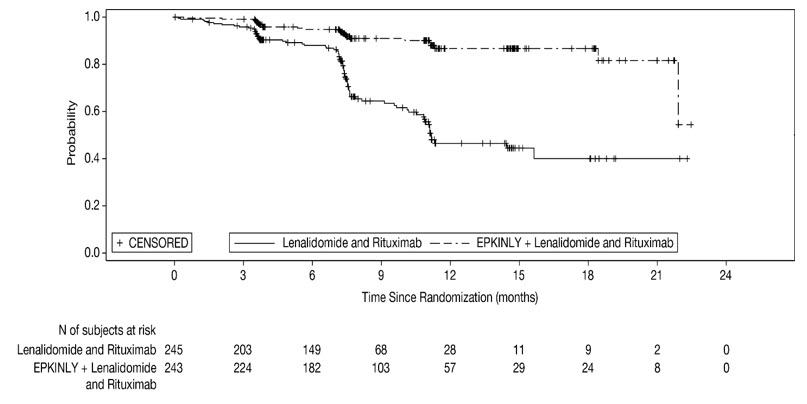
The safety of EPKINLY in combination with lenalidomide and rituximab was evaluated in EPCORE FL-1, an open-label, randomized, multicenter trial that included patients with relapsed or refractory FL after at least one line of systemic therapy [see Clinical Studies (14.2)]. The study excluded patients with transformed lymphoma, absolute neutrophil count < 1.0 × 10⁹/L, platelet count < 70 × 109/L (or < 50 × 109/L if bone marrow infiltration by lymphoma or splenomegaly), known active infection, creatinine clearance < 50 mL/min, alanine or aspartate transaminase > 3 times the upper limit of normal, and clinically significant cardiovascular disease. Patients were randomized to receive EPKINLY in combination with lenalidomide and rituximab (N=243) or lenalidomide and rituximab alone (N=238). Patients received EPKINLY via subcutaneous injection in 28-day cycles for a total of 12 cycles or until disease progression or unacceptable toxicity, whichever occurred first. Of the 243 patients who received EPKINLY, 131 received the recommended 3 step-up dosage schedule.
- Cycle 1: EPKINLY 0.16 mg on Day 1, 0.8 mg on Day 8, 3 mg on Day 15, and 48 mg on Day 22
- Cycles 2-3: EPKINLY 48 mg on Days 1, 8, 15, and 22
- Cycles 4-12: EPKINLY 48 mg on Day 1
In both treatment arms, lenalidomide was given orally at a dose of 20 mg once daily from Days 1 to 21 for 12 cycles. Rituximab was administered intravenously at a dose of 375 mg/m2 on Days 1, 8, 15, and 22 of Cycle 1, followed by administration on Day 1 of Cycles 2 to 5.
Safety results are based on all 243 patients who received EPKINLY, with the exception of data for CRS and ICANS which are based on patients who received EPKINLY at the recommended dosage schedule. The median duration of exposure in this arm was 10 cycles for EPKINLY and 9 cycles for lenalidomide.
Serious adverse reactions occurred in 51% of these patients, including serious infections in 28% of patients and serious CRS in 12% of patients. Fatal adverse reactions within 60 days of last treatment occurred in 0.8% of patients.
Adverse reactions led to permanent discontinuation of EPKINLY in 6% of patients and dose interruption in 75% of patients, with infection as a leading cause. Adverse reactions leading to interruption of EPKINLY in ≥ 5% of patients included respiratory tract infections, CRS, and rash.
In the EPKINLY arm, adverse reactions led to lenalidomide dose interruption in 72%, dose reduction in 22%, and permanent discontinuation in 15%.
The most common (≥ 20%) adverse reactions in the EPKINLY arm were rash, upper respiratory tract infections, fatigue, injection site reactions, constipation, diarrhea, CRS, pneumonia, COVID-19, and fever. The most common Grade 3 to 4 laboratory abnormalities (≥ 10%) were decreases in neutrophil count, lymphocyte count, and platelets.
Table 13 summarizes select adverse reactions in EPCORE FL-1.
Table 13: Adverse Reactions (≥ 10% All Grade and ≥ 5% Higher) in Patients with Relapsed or Refractory FL Who Received EPKINLY in Combination with Lenalidomide and Rituximab in EPCORE FL-1 | Adverse Reaction Adverse reactions were graded using CTCAE Version 5.0. CRS was graded using ASTCT consensus criteria (Lee et al., 2019). | EPKINLY + Lenalidomide and Rituximab | Lenalidomide and Rituximab |
|---|
All Grades
(%) | Grade 3 or 4
(%) | All Grades
(%) | Grade 3 or 4
(%) |
|---|
| This table includes a combination of grouped and ungrouped terms. |
| (N=131) | (N=238) |
| Immune system disorders |
| Cytokine release syndrome | 24 The frequency of CRS is based on 131 patients who received EPKINLY at the recommended dosage schedule [see Dosage and Administration (2.2)]. Grade 1 CRS: 19%; Grade 2 CRS: 5%. The frequency of CRS among the 243 patients who received either the 2-step up or 3-step up dosage schedule was the following: Any grade CRS 35%; Grade 1 CRS: 28%; Grade 2 CRS: 7%. | 0 | 0.8 | 0 |
| (N=243) | (N=238) |
| Skin and subcutaneous tissue disorders |
| Rash Rash includes blister, dermatitis, erythema, rash, skin exfoliation, skin reaction, toxic skin eruption, urticaria and related terms. | 46 | 11 Only Grade 3 adverse reactions occurred. | 34 | 6 |
| Infections and infestations |
| Upper respiratory tract infections Upper respiratory tract infections include sinusitis, laryngitis, nasopharyngitis, pharyngitis, rhinitis, rhinovirus infection, upper respiratory tract infection, and related terms. | 33 | 3.3 | 18 | 0.4 |
| Pneumonia Pneumonia includes pneumonia, COVID-19 pneumonia, pneumonia fungal, Pneumocystis jirovecii pneumonia, pneumonia cytomegaloviral, and related terms. | 24 | 16 | 8 Includes one case with a fatal outcome. | 4.6 |
| COVID-19 COVID-19 includes COVID-19, COVID-19 pneumonia, coronavirus infection, coronavirus pneumonia. | 23 | 5 | 13 | 1.3 |
| General disorders and administration site conditions |
| Fatigue Fatigue includes asthenia, fatigue, lethargy, malaise. | 31 | 4.9 | 24 | 2.1 |
| Injection site reactions | 27 | 0 | 0.4 | 0 |
| Fever | 23 | 0.4 | 11 | 1.3 |
| Gastrointestinal disorders |
| Constipation | 26 | 0.8 | 21 | 0 |
| Mucositis Mucositis includes gingival pain, glossitis, mouth ulceration, mucosal infection, mucosal inflammation, oral discomfort, oral mucosal exfoliation, oropharyngeal pain, stomatitis. | 12 | 0 | 3.4 | 0 |
| Nervous system disorders |
| Neurological changes Neurological changes include brain fog, cognitive disorder, confusional state, disturbance in attention, dysphonia, epilepsy, essential tremor, gait disturbance, hypoacusis, lethargy, loss of consciousness, memory impairment, somnolence, syncope, tremor, vertigo, and ICANS. | 15 | 1.2 | 8 | 1.3 |
| Headache | 11 | 0 | 3.8 | 0 |
| Psychiatric disorders |
| Insomnia | 14 | 0 | 2.9 | 0 |
Other clinically relevant adverse reactions include:
Gastrointestinal disorders: diarrhea (26%), nausea (16%), abdominal pain (11%), vomiting (4.1%)
Musculoskeletal and connective tissue disorders: musculoskeletal pain (14%), arthralgia (8%)
Nervous system disorders: peripheral neuropathy (12%), dizziness (7%), ICANS (0.8%)
General disorders: edema (12%)
Infections: cytomegalovirus infection (7%), herpesvirus infection (7%), sepsis (2.9%)
Blood and lymphatic system disorders: febrile neutropenia (6%)
Neoplasms: tumor flare (1.2%)
Table 14 summarizes laboratory abnormalities in EPCORE FL-1. Grade 4 laboratory abnormalities in ≥ 2% of the EPKINLY arm included decreases in neutrophils (41%), lymphocytes (13%), and platelets decreased (4.1%).
Table 14: Select Laboratory Abnormalities (≥ 30% All Grade and ≥ 10% Higher) That Worsened from Baseline in Patients with Relapsed or Refractory FL Who Received EPKINLY in Combination with Lenalidomide and Rituximab in EPCORE FL-1| Laboratory Abnormality | EPKINLY + Lenalidomide and Rituximab The denominator used to calculate the rate varied from 240 to 242 in the EPKINLY arm, and 225 to 236 in the comparator arm, based on the number of patients with a baseline value and at least one post-treatment value. | Lenalidomide and Rituximab |
|---|
All Grades
(%) | Grade 3 or 4
(%) | All Grades
(%) | Grade 3 or 4
(%) |
|---|
| Laboratory abnormalities were graded based on CTCAE Version 5.0 |
| Hematology |
| Neutrophils decreased | 86 | 67 | 75 | 41 |
| Lymphocytes decreased | 86 | 62 | 56 | 15 |
| Hemoglobin decreased | 66 | 7 | 52 | 4.7 |
| Platelets decreased | 50 | 10 | 37 | 7 |
| Chemistry |
| Alanine aminotransferase increased | 58 | 7 | 36 | 0.9 |
| Phosphate decreased CTCAE Version 5.0 does not include numeric thresholds for grading of hypophosphatemia; all grades represent patients with lab value < Lower Limit of Normal (LLN). | 49 | N/A | 28 | N/A |
| Sodium decreased | 43 | 4.1 | 23 | 2.6 |
| Potassium decreased | 41 | 9 | 20 | 4.7 |
| Aspartate aminotransferase increased | 40 | 2.9 | 29 | 0.9 |
EPCORE NHL-1
The safety of EPKINLY as monotherapy was evaluated in EPCORE NHL-1, a single-arm study of patients with relapsed or refractory FL after two or more lines of systemic therapy who received EPKINLY following a 2-step up dosage schedule (N=127) [see Clinical Studies (14.2)]. A separate dose optimization cohort evaluated the recommended 3-step up dosage schedule for CRS mitigation (N=86), where EPKINLY was administered via subcutaneous injection until disease progression or unacceptable toxicities according to the following 28-day cycle schedule:
- Cycle 1: EPKINLY 0.16 mg on Day 1, 0.8 mg on Day 8, 3 mg on Day 15, and 48 mg on Day 22
- Cycle 2-3: EPKINLY 48 mg on Days 1, 8, 15, and 22
- Cycles 4-9: EPKINLY 48 mg on Days 1 and 15
- Cycles 10 and beyond: EPKINLY 48 mg on Day 1
With the exception of CRS, the safety results presented below and in Tables 15 and 16 represent data from patients who received the 2-step up dosage schedule. The data presented for CRS reflects the 86 patients who received the recommended 3-step up dosage schedule. The study excluded patients with CNS involvement of lymphoma, allogeneic HSCT or solid organ transplant, ongoing active infection, any patients with known impaired T-cell immunity, creatinine clearance < 45 ml/min, alanine aminotransferase > 3 times the upper limit of normal, and a cardiac ejection fraction < 45%.
Recommended 3-step up Dosage Schedule
Of the 86 patients with relapsed or refractory FL who received EPKINLY following the recommended 3-step up dosage schedule, the median age was 63 years (range: 33 to 90), 57% were male, and 100% had an ECOG performance status of 0 or 1.
The median duration of exposure was 5 cycles (range: 1 to 12 cycles). CRS occurred in 49% of patients, with Grade 1 CRS occurring in 45% and Grade 2 in 9% of patients. Serious adverse reactions due to CRS occurred in 28% of patients who received EPKINLY. Dose interruptions due to CRS occurred in 19% of patients who received EPKINLY.
2-step up Dosage Schedule
Of the 127 patients with relapsed or refractory FL who received EPKINLY following a 2-step up dosage schedule, the median age was 65 years (range: 39 to 84), 62% were male, and 95% had an ECOG performance status of 0 or 1 [see Clinical Studies (14.2)]. The median duration of exposure for patients receiving EPKINLY was 8 cycles (range: 1 to 33 cycles).
Serious adverse reactions occurred in 66% of patients who received EPKINLY. Serious adverse reactions in ≥ 5% of patients included CRS, COVID-19, pneumonia, and second primary malignancies.
Fatal adverse reactions occurred in 9% of patients who received EPKINLY, including COVID-19 (5%), pneumonitis (1.6%), cardiac failure (0.8%), pneumonia (0.8%), and sepsis (0.8%).
Permanent discontinuation of EPKINLY due to an adverse reaction occurred in 19% of patients who received EPKINLY. Adverse reactions which resulted in permanent discontinuation of EPKINLY in ≥ 2% of patients included COVID-19, Hepatitis E, pneumonitis, and second primary malignancy.
Dosage interruptions of EPKINLY due to an adverse reaction occurred in 59% of patients who received EPKINLY. Adverse reactions which required dosage interruption in ≥ 5% of patients included COVID-19, CRS, pneumonia, upper respiratory tract infection, and fatigue.
The most common (≥ 20%) adverse reactions were injection site reactions, CRS, COVID-19, fatigue, upper respiratory tract infection, musculoskeletal pain, rash, diarrhea, pyrexia, cough, and headache. The most common Grade 3 to 4 laboratory abnormalities (≥ 10%) were decreased lymphocyte count, decreased neutrophil count, decreased white blood cell count, and decreased hemoglobin.
Table 15 summarizes the adverse reactions in EPCORE NHL-1.
Table 15: Adverse Reactions (≥ 10%) in Patients with Relapsed or Refractory FL Who Received EPKINLY as Monotherapy in EPCORE NHL-1| Adverse Reaction Adverse reactions were graded based on CTCAE Version 5.0. | EPKINLY |
|---|
All Grades
(%) | Grade 3 or 4
(%) |
|---|
| (N=86) The frequency of CRS is based on 86 patients with FL who received the recommended 3-step up dosage schedule in EPCORE NHL-1 [see Dosage and Administration (2.2)]. |
| Immune system disorders |
| Cytokine release syndrome CRS was graded using ASTCT consensus criteria (Lee et al., 2019). The frequency of CRS based on the 127 patients with FL who received the 2-step up dosage schedule in EPCORE NHL-1 was the following: Any grade CRS 66%; Grade 1 CRS: 50%; Grade 2 CRS: 26%; Grade 3 CRS: 1.6%. | 49 | 0 |
| (N=127) |
| General disorders and administration site conditions |
| Injection site reactions Includes related grouped terms. | 58 | 0 |
| Fatigue | 37 | 5 Only Grade 3 adverse reactions occurred. |
| Pyrexia | 26 | 2 |
| Edema | 17 | 0 |
| Infections and Infestations |
| COVID-19 COVID-19 includes COVID-19, COVID-19 pneumonia, SARS-CoV-2 test positive. | 40 | 19 |
| Upper respiratory tract infection Upper respiratory tract infection includes preferred terms with upper respiratory infection and sinusitis, laryngitis viral, nasopharyngitis, oropharyngitis fungal, pharyngitis, rhinitis, rhinovirus infection, tonsillitis. | 29 | 2 |
| Pneumonia Pneumonia includes preferred terms with pneumonia, bronchopulmonary aspergillosis, infectious pleural effusion, infective exacerbation of bronchiectasis, Pneumocystis jirovecii pneumonia, pneumonia respiratory syncytial viral. | 17 | 13 |
| Urinary tract infection | 13 | 5 |
| Herpesvirus infection Herpesvirus infection includes herpes simplex, herpes simplex reactivation, herpes virus infection, herpes zoster, oral herpes, varicella zoster virus infection. | 12 | 1.6 |
| Musculoskeletal and connective tissue disorders |
| Musculoskeletal pain | 28 | 0.8 |
| Arthralgia | 14 | 0.8 |
| Skin and subcutaneous disorders |
| Rash | 28 | 0 |
| Gastrointestinal disorders |
| Diarrhea | 26 | 1.6 |
| Nausea | 17 | 0 |
| Abdominal pain | 17 | 0.8 |
| Constipation | 16 | 0 |
| Mucositis Mucositis includes aphthous ulcer, mouth ulceration, mucosal inflammation, oral pain, oropharyngeal pain, stomatitis, tongue ulceration. | 12 | 0 |
| Respiratory disorders |
| Cough | 20 | 0 |
| Dyspnea | 17 | 0 |
| Nervous system disorders |
| Headache | 20 | 0 |
| Neurological changes Neurological changes includes amnesia, aphasia, balance disorder, brain fog, confusional state, dysphonia, encephalopathy, extrapyramidal disorder, hallucination, hypoacusis, memory impairment, mental status changes, tremor, vertigo. | 13 | 0 |
| Peripheral neuropathy and paresthesia Peripheral neuropathy and paresthesia includes bell's palsy, hypoesthesia, neuralgia, neuropathy peripheral, paresthesia, peripheral sensory neuropathy, polyneuropathy. | 13 | 1.6 |
| Dizziness | 11 | 0 |
| Psychiatric disorders |
| Insomnia | 13 | 0 |
| Renal and urinary disorders |
| Renal insufficiency Renal insufficiency includes acute kidney injury, blood creatinine increased, renal impairment. | 10 | 1.6 |
Clinically relevant adverse reactions in < 10% of patients (N=127) who received EPKINLY included vomiting, pruritus, hepatotoxicity, ICANS, lower respiratory tract infections, cardiac arrhythmias, respiratory tract infections, pneumonitis, second primary malignancy, vision changes, cellulitis, febrile neutropenia, cardiac failure, cytomegalovirus infection and sepsis.
Table 16 summarizes laboratory abnormalities in EPCORE NHL-1.
Table 16: Select Laboratory Abnormalities (≥ 20%) That Worsened from Baseline in Patients with Relapsed or Refractory FL Who Received EPKINLY in EPCORE NHL-1| Laboratory Abnormality Laboratory abnormalities were graded based on CTCAE Version 5.0 | EPKINLY The denominator used to calculate the rate varied from 123 to 127 based on the number of patients with a baseline value and at least one post-treatment value.
(N=127) |
|---|
| All Grades | Grade 3 or 4 (%) |
|---|
| Hematology |
| Lymphocytes decreased | 94 | 82 |
| Hemoglobin decreased | 59 | 10 |
| White blood cells decreased | 58 | 19 |
| Neutrophils decreased | 55 | 30 |
| Platelets decreased | 49 | 8 |
| Chemistry |
| Sodium decreased | 51 | 1.6 |
| ALT increased | 47 | 8 |
| AST increased | 44 | 6 |
| Creatinine increased | 36 | 0.8 |
| Alkaline phosphatase increased | 29 | 0 |
| Bilirubin increased | 28 | 1.6 |
| Potassium decreased | 20 | 3.1 |
| Magnesium decreased | 20 | 0.8 |
Other Clinical Trials Experience
The following adverse reactions have been reported following administration of epcoritamab-bysp: hypogammaglobulinemia.