Pneumocystis jirovecii pneumonia (PJP)
Provide PJP prophylaxis prior to starting treatment with EPKINLY.
Herpes virus
Consider initiating prophylaxis against herpes virus prior to starting EPKINLY to prevent herpes zoster reactivation.
Cytokine Release Syndrome (CRS)
Identify CRS based on clinical presentation [see Warnings and Precautions (5.1)]. Evaluate for and treat other causes of fever, hypotension, and hypoxia.
If CRS is suspected, withhold EPKINLY until CRS resolves. Manage according to the recommendations in Table 4 and consider further management per current practice guidelines. Administer supportive therapy for CRS, which may include intensive care for severe or life-threatening CRS.
Table 4: Recommendations for Management of Cytokine Release Syndrome| Grade Based on American Society for Transplantation and Cellular Therapy (ASTCT) 2019 grading for CRS. | Presenting Symptoms | Actions |
|---|
| Grade 1 | Temperature ≥ 100.4°F (38°C) Premedication may mask fever, therefore if clinical presentation is consistent with CRS, follow these management guidelines. | |
| Grade 2 | Temperature ≥ 100.4°F (38°C) with:
Hypotension not requiring vasopressors
and/or
Hypoxia requiring low-flow oxygenLow-flow oxygen defined as oxygen delivered at < 6L/minute; high-flow oxygen defined as oxygen delivered at ≥ 6 L/minute. by nasal cannula or blow-by. | |
| Grade 3 | Temperature ≥ 100.4°F (38°C) with:
Hypotension requiring a vasopressor (with or without vasopressin)
and/or
Hypoxia requiring high-flow oxygen by nasal cannula, face mask, non-rebreather mask, or Venturi mask. | - Withhold EPKINLY and manage per current practice guidelines, which may include intensive care.
- Ensure CRS symptoms are resolved prior to the next dose of EPKINLY.
- Administer premedication prior to next dose of EPKINLY.
- Hospitalize for the next dose of EPKINLY.
|
| Recurrent Grade 3 CRS - Permanently discontinue EPKINLY.
- Manage CRS per current practice guidelines and provide supportive therapy, which may include intensive care.
|
| Grade 4 | Temperature ≥ 100.4°F (38°C) with:
Hypotension requiring multiple vasopressors (excluding vasopressin)
and/or
Hypoxia requiring oxygen by positive pressure (e.g., CPAP, BiPAP, intubation and mechanical ventilation). | - Permanently discontinue EPKINLY.
- Manage CRS per current practice guidelines and provide supportive therapy, which may include intensive care.
|
Immune Effector Cell-Associated Neurological Toxicity Syndrome (ICANS)
Monitor patients for signs and symptoms of ICANS [see Warnings and Precautions (5.2)]. At the first sign of ICANS, withhold EPKINLY and consider neurology evaluation. Rule out other causes of neurologic symptoms. Provide supportive therapy, which may include intensive care, for ICANS [see Warnings and Precautions (5.2)]. Manage ICANS according to the recommendations in Table 5 and consider further management per current practice guidelines.
Table 5: Recommendations for Management of Immune Effector Cell-Associated Neurotoxicity Syndrome| Grade Based on American Society for Transplantation and Cellular Therapy (ASTCT) 2019 grading for ICANS. | Presenting Symptoms Management is determined by the most severe event, not attributable to any other cause. | Actions |
|---|
| Grade 1 | ICE score 7-9 If patient is arousable and able to perform Immune Effector Cell-Associated Encephalopathy (ICE) Assessment, assess: Orientation (oriented to year, month, city, hospital = 4 points); Naming (names 3 objects, e.g., point to clock, pen, button = 3 points); Following Commands (e.g., "show me 2 fingers" or "close your eyes and stick out your tongue" = 1 point); Writing (ability to write a standard sentence = 1 point); and Attention (count backwards from 100 by ten = 1 point). If patient is unarousable and unable to perform ICE Assessment (Grade 4 ICANS) = 0 points. ,
Or depressed level of consciousnessNot attributable to any other cause. : awakens spontaneously. | |
| Grade 2 | ICE score 3-6,
Or depressed level of consciousness: awakens to voice. | |
| Grade 3 | ICE score 0-2,
Or depressed level of consciousness: awakens only to tactile stimulus,
Or seizures, either:- Any clinical seizure, focal or generalized, that resolves rapidly, or
- Non-convulsive seizures on electroencephalogram (EEG) that resolve with intervention,
Or raised intracranial pressure: focal/local edema on neuroimaging.
| First Occurrence of Grade 3 ICANS - Withhold EPKINLY until ICANS resolves.
- Administer dexamethasone 10 mg intravenously every 6 hours. Continue dexamethasone use until resolution to Grade 1 or less, then taper.
- Monitor neurologic symptoms and consider consultation with neurologist and other specialists for further evaluation and management, including consideration for starting non-sedating, anti-seizure medicines for seizure prophylaxis.
- Provide supportive therapy, which may include intensive care.
|
| Recurrent Grade 3 ICANS - Permanently discontinue EPKINLY
- Administer dexamethasone 10 mg intravenously every 6 hours. Continue dexamethasone use until resolution to Grade 1 or less, then taper.
- Monitor neurologic symptoms and consider consultation with neurologist and other specialists for further evaluation and management, including consideration for starting non-sedating, anti-seizure medicines for seizure prophylaxis.
- Provide supportive therapy, which may include intensive care.
|
| Grade 4 | ICE score 0,
Or depressed level of consciousness: either:- Patient is unarousable or requires vigorous or repetitive tactile stimuli to arouse, or
- Stupor or coma
Or seizures, either:- Life-threatening prolonged seizure (> 5 minutes), or
- Repetitive clinical or electrical seizures without return to baseline in between,
Or motor findings:- Deep focal motor weakness, such as hemiparesis or paraparesis,
or raised intracranial pressure/cerebral edema, with signs/symptoms such as:- Diffuse cerebral edema on neuroimaging, or
- Decerebrate or decorticate posturing, or
- Cranial nerve VI palsy, or
- Papilledema, or
- Cushing's triad.
| - Permanently discontinue EPKINLY.
- Administer dexamethasone 10 mg intravenously every 6 hours. Continue dexamethasone use until resolution to Grade 1 or less, then taper.
- Alternatively, consider administration of methylprednisolone 1,000 mg per day intravenously and continue methylprednisolone 1,000 mg per day intravenously for 2 or more days.
- Monitor neurologic symptoms and consider consultation with neurologist and other specialists for further evaluation and management, including consideration for starting non-sedating, anti-seizure medicines for seizure prophylaxis.
- Provide supportive therapy, which may include intensive care.
|
Table 6: Recommended Dosage Modifications for Other Adverse Reactions| Adverse Reaction Based on National Cancer Institute Common Terminology Criteria for Adverse Events (NCI CTCAE), Version 5.0. | Severity | Action |
|---|
| Infections [see Warnings and Precautions (5.3)] | Grades 1-4 | |
| Neutropenia [see Warnings and Precautions (5.4)] | Absolute neutrophil count less than 0.5 × 10⁹/L | - Withhold EPKINLY until absolute neutrophil count is 0.5 × 10⁹/L or higher.
|
| Thrombocytopenia [see Warnings and Precautions (5.4)] | Platelet count less than 50 × 109/L | - Withhold EPKINLY until platelet count is 50 × 109/L or higher.
|
| Other Adverse Reactions [see Adverse Reactions (6.1)] | Grade 3 or higher | - Withhold EPKINLY until the toxicity resolves to Grade 1 or baseline.
|
Preparation of EPKINLY
Use aseptic technique to prepare EPKINLY. Filtration of the diluted solution is not required.
Preparation instructions for 0.16 mg and 0.8 mg dose of EPKINLY
0.16 mg Dose Preparation Instructions (2 dilutions required)
Use an appropriately sized syringe, vial, and needle for each transfer step.
1. Prepare EPKINLY vial- Retrieve one 4 mg/0.8 mL EPKINLY vial from the refrigerator.
- Allow the vial to come to room temperature for no more than 1 hour.
- Gently swirl the EPKINLY vial.
DO NOT invert, vortex, or vigorously shake the vial.
|
2. Perform first dilution - Label an appropriately sized empty vial as "Dilution A."
- Transfer 0.8 mL of EPKINLY into the Dilution A vial.
- Transfer 4.2 mL of 0.9% Sodium Chloride Injection, USP into the Dilution A vial.
The initially diluted solution contains 0.8 mg/mL of EPKINLY. - Gently swirl the Dilution A vial for 30 to 45 seconds.
|
3. Perform second dilution - Label an appropriately sized empty vial as "Dilution B."
- Transfer 2 mL of solution from the Dilution A vial into the Dilution B vial. The Dilution A vial is no longer needed.
- Transfer 8 mL of 0.9% Sodium Chloride Injection, USP into the Dilution B vial to make a final concentration of 0.16 mg/mL.
- Gently swirl the Dilution B vial for 30 to 45 seconds.
|
4. Withdraw dose- Withdraw 1 mL of the diluted EPKINLY from the Dilution B vial into a syringe.
|
5. Label syringe- Label the syringe with the dose strength (0.16 mg) and the time of day.
|
Discard the vial containing unused EPKINLY.
0.8 mg Dose Preparation Instructions (1 dilution required)
Use an appropriately sized syringe, vial, and needle for each transfer step.
1. Prepare EPKINLY vial- Retrieve one 4 mg/0.8 mL EPKINLY vial from the refrigerator.
- Allow the vial to come to room temperature for no more than 1 hour.
- Gently swirl the EPKINLY vial.
DO NOT invert, vortex, or vigorously shake the vial.
|
2. Perform dilution - Label an appropriately sized empty vial as "Dilution A".
- Transfer 0.8 mL of EPKINLY into the Dilution A vial.
- Transfer 4.2 mL of 0.9% Sodium Chloride Injection, USP into the Dilution A vial to make a final concentration of 0.8 mg/mL.
- Gently swirl the Dilution A vial for 30 to 45 seconds.
|
3. Withdraw dose - Withdraw 1 mL of the diluted EPKINLY from the Dilution A vial into a syringe.
|
4. Label syringe- Label the syringe with the dose strength (0.8 mg) and the time of day.
|
Discard the vial containing unused EPKINLY.
48 mg Dose Preparation Instructions (No dilution required)
EPKINLY 48 mg/0.8 mL vial is supplied as ready-to-use solution that does not need dilution prior to administration.
1. Prepare EPKINLY vial- Retrieve one 48 mg/0.8 mL EPKINLY vial from the refrigerator.
- Allow the vial to come to room temperature for no more than 1 hour.
- Gently swirl the EPKINLY vial.
DO NOT invert, vortex, or vigorously shake the vial.
|
2. Withdraw dose- Withdraw 0.8 mL of EPKINLY into a syringe.
|
3. Label syringe- Label the syringe with the dose strength (48 mg) and the time of day.
|
Discard the vial containing unused EPKINLY.
Diluted EPKINLY Storage
Use diluted EPKINLY solution immediately. If not used immediately, store the solution refrigerated at 2°C to 8°C (36°F to 46°F) for up to 24 hours or at room temperature at 20°C to 25°C (68°F to 77°F) for up to 12 hours. The total storage time from the start of dose preparation to administration should not exceed 24 hours. Protect from direct sunlight. Allow EPKINLY solution to equilibrate to room temperature for no more than 1 hour before administration. Discard unused EPKINLY solution beyond the allowable storage time.
Administration
Inject the required volume of EPKINLY into the subcutaneous tissue of the lower part of the abdomen (preferred injection site) or the thigh. Change of injection site from the left or right side or vice versa is recommended, especially during the weekly administrations (Cycles 1 to 3).
Do not inject into tattoos or scars or areas where the skin is red, bruised, tender, hard, or not intact.
Relapsed or Refractory Large B-cell Lymphoma (LBCL)
EPCORE NHL-1
The safety of EPKINLY was evaluated in EPCORE NHL-1, a single-arm study of patients with relapsed or refractory LBCL after two or more lines of systemic therapy, including DLBCL not otherwise specified, DLBCL arising from indolent lymphoma, high grade B-cell lymphoma, and other B-cell lymphomas [see Clinical Studies (14)]. A total of 157 patients received EPKINLY via subcutaneous injection until disease progression or unacceptable toxicities according to the following 28-day cycle schedule:
- Cycle 1: EPKINLY 0.16 mg on Day 1, 0.8 mg on Day 8, 48 mg on Days 15 and 22
- Cycles 2-3: EPKINLY 48 mg on Days 1, 8, 15, and 22
- Cycles 4-9: EPKINLY 48 mg on Days 1 and 15
- Cycles 10 and beyond: EPKINLY 48 mg on Day 1
Of the 157 patients treated, the median age was 64 years (range: 20 to 83), 60% male, and 97% had an ECOG performance status of 0 or 1. Race was reported in 133 (85%) patients; of these patients, 61% were White, 19% were Asian, and 0.6% were Native Hawaiian or Other Pacific Islander. There were no Black or African American or Hispanic or Latino patients treated in the clinical trial as reported. The median number of prior therapies was 3 (range: 2 to 11). The study excluded patients with CNS involvement of lymphoma, allogeneic HSCT or solid organ transplant, an ongoing active infection, and any patients with known impaired T-cell immunity.
The median duration of exposure for patients receiving EPKINLY was 5 cycles (range: 1 to 20 cycles).
Serious adverse reactions occurred in 54% of patients who received EPKINLY. Serious adverse reactions in ≥ 2% of patients included CRS, infections (including sepsis, COVID-19, pneumonia, and upper respiratory tract infections), pleural effusion, febrile neutropenia, fever, and ICANS. Fatal adverse reactions occurred in 3.8% of patients who received EPKINLY, including COVID-19 (1.3%), hepatotoxicity (0.6%), ICANS (0.6%), myocardial infarction (0.6%), and pulmonary embolism (0.6%).
Permanent discontinuation of EPKINLY due to an adverse reaction occurred in 3.8% of patients. Adverse reactions which resulted in permanent discontinuation of EPKINLY included COVID-19, CRS, ICANS, pleural effusion, and fatigue.
Dosage interruptions of EPKINLY due to an adverse reaction occurred in 34% of patients who received EPKINLY. Adverse reactions which required dosage interruption in ≥ 3% of patients included CRS, neutropenia, sepsis, and thrombocytopenia.
The most common (≥ 20%) adverse reactions were CRS, fatigue, musculoskeletal pain, injection site reactions, pyrexia, abdominal pain, nausea, and diarrhea. The most common Grade 3 to 4 laboratory abnormalities (≥ 10%) were decreased lymphocyte count, decreased neutrophil count, decreased white blood cell count, decreased hemoglobin, and decreased platelets.
Table 7 summarizes the adverse reactions in EPCORE NHL-1.
Table 7: Adverse Reactions (≥ 10%) in Patients with Relapsed or Refractory LBCL Who Received EPKINLY in EPCORE NHL-1| Adverse Reaction Adverse reactions were graded based on CTCAE Version 5.0 | EPKINLY
(N=157) |
|---|
All Grades
(%) | Grade 3 or 4
(%) |
|---|
| Immune system disorders |
| Cytokine release syndrome CRS was graded using ASTCT consensus criteria (Lee et al., 2019). | 51 | 2.5 Only grade 3 adverse reactions occurred. |
| General disorders and administration site conditions |
| Fatigue Fatigue includes asthenia, fatigue, lethargy. | 29 | 2.5 |
| Injection site reactions Injection site reactions includes injection site erythema, injection site hypertrophy, injection site inflammation, injection site mass, injection site pain, injection site pruritus, injection site rash, injection site reaction, injection site swelling, injection site urticaria. | 27 | 0 |
| Pyrexia | 24 | 0 |
| Edema Edema includes edema, edema peripheral, face edema, generalized edema, peripheral swelling. | 14 | 1.9 |
| Musculoskeletal and connective tissue disorders |
| Musculoskeletal pain Musculoskeletal pain includes back pain, bone pain, flank pain, musculoskeletal chest pain, musculoskeletal pain, myalgia, neck pain, non-cardiac chest pain, pain, pain in extremity, spinal pain. | 28 | 1.3 |
| Gastrointestinal disorders |
| Abdominal pain Abdominal pain includes abdominal discomfort, abdominal pain, abdominal pain lower, abdominal pain upper, abdominal tenderness. | 23 | 1.9 |
| Diarrhea | 20 | 0 |
| Nausea | 20 | 1.3 |
| Vomiting | 12 | 0.6 |
| Skin and subcutaneous disorders |
| Rash Rash includes dermatitis bullous, erythema, palmar erythema, penile erythema, rash, rash erythematous, rash maculo-papular, rash pustular, recall phenomenon, seborrheic dermatitis, skin exfoliation. | 15 | 0.6 |
| Nervous system disorder |
| Headache | 13 | 0.6 |
| Metabolism and nutrition disorders |
| Decreased appetite | 12 | 0.6 |
| Cardiac disorders |
| Cardiac arrhythmias Cardiac arrhythmias includes bradycardia, sinus bradycardia, sinus tachycardia, supraventricular extrasystoles, supraventricular tachycardia, tachycardia. | 10 | 0.6 |
Clinically relevant adverse reactions in < 10% of patients who received EPKINLY included ICANS, sepsis, pleural effusion, COVID-19, pneumonia (including pneumonia and COVID-19 pneumonia), tumor flare, febrile neutropenia, upper respiratory tract infections, and tumor lysis syndrome.
Table 8 summarizes laboratory abnormalities in EPCORE NHL-1.
Table 8: Select Laboratory Abnormalities (≥ 20%) That Worsened from Baseline in Patients with Relapsed or Refractory LBCL Who Received EPKINLY in EPCORE NHL-1| Laboratory Abnormality Laboratory abnormalities were graded based on CTCAE Version 5.0 | EPKINLY The denominator used to calculate the rate varied from 146 to 153 based on the number of patients with a baseline value and at least one post-treatment value. |
|---|
| All Grades (%) | Grade 3 or 4 (%) |
|---|
| Hematology |
| Lymphocyte count decreased | 87 | 77 |
| Hemoglobin decreased | 62 | 12 |
| White blood cells decreased | 53 | 22 |
| Neutrophils decreased | 50 | 32 |
| Platelets decreased | 48 | 12 |
| Chemistry |
| Sodium decreased | 56 | 2.6 |
| Phosphate decreased CTCAE Version 5.0 does not include numeric thresholds for grading of hypophosphatemia; all grades represent patients with lab value < Lower Limit of Normal (LLN). | 56 | N/A |
| Aspartate aminotransferase increased | 48 | 4.6 |
| Alanine aminotransferase increased | 45 | 5.3 |
| Potassium decreased | 34 | 5.3 |
| Magnesium decreased | 31 | 0 |
| Creatinine increased | 24 | 3.3 |
| Potassium increased | 21 | 1.3 |
Risk Summary
Based on the mechanism of action, EPKINLY may cause fetal harm when administered to a pregnant woman [see Clinical Pharmacology (12.1)]. There are no available data on the use of EPKINLY in pregnant women to evaluate for a drug-associated risk. No animal reproductive or developmental toxicity studies have been conducted with epcoritamab-bysp.
Epcoritamab-bysp causes T-cell activation and cytokine release; immune activation may compromise pregnancy maintenance. In addition, based on expression of CD20 on B-cells and the finding of B-cell depletion in non-pregnant animals, epcoritamab-bysp can cause B-cell lymphocytopenia in infants exposed to epcoritamab-bysp in-utero. Human immunoglobulin G (IgG) is known to cross the placenta; therefore, EPKINLY has the potential to be transmitted from the mother to the developing fetus. Advise women of the potential risk to the fetus.
In the U.S. general population, the estimated background risk of major birth defects and miscarriage in clinically recognized pregnancies is 2% to 4% and 15% to 20%, respectively.
Risk Summary
There is no information regarding the presence of epcoritamab-bysp in human milk, the effect on the breastfed child, or milk production. Because maternal IgG is present in human milk, and there is potential for epcoritamab-bysp absorption leading to serious adverse reactions in a breastfed child, advise women not to breastfeed during treatment with EPKINLY and for 4 months after the last dose.
Pregnancy Testing
Verify pregnancy status in females of reproductive potential prior to initiating EPKINLY.
Contraception
Females
Advise females of reproductive potential to use effective contraception during treatment with EPKINLY and for 4 months after the last dose.
Circulating B Cell Count
Circulating B cells decreased to undetectable levels (< 10 cells/microliter) after administration of the approved recommended dosage of EPKINLY in patients who had detectable B cells at treatment initiation by Cycle 1 Day 15 (after the first full dose of 48 mg) and the depletion was sustained while patients remained on treatment.
Cytokine Concentrations
Plasma concentrations of cytokines (IL-2, IL-6, IL-10, TNF-α, and IFN-γ) were measured. Transient elevation of circulating cytokines was observed at dose levels of 0.04 mg and above. After administration of the approved recommended dosage of EPKINLY, the cytokine levels increased within 24 hours after the first dose on Cycle 1 Day 1, reached maximum levels after the first 48 mg dose on Cycle 1 Day 15, and returned to baseline prior to the next 48 mg full dose on Cycle 1 Day 22.
Absorption
The median (range) Tmax of epcoritamab-bysp after the first full dose and end of the weekly dosing regimen (end of Cycle 3) treatment doses were 4 (0.3 to 7) days and 2.3 (0.3 to 3.2) days, respectively.
Distribution
The apparent total volume of distribution is 25.6 L (82%).
Elimination
The half-life of full dose epcoritamab-bysp (48 mg) was approximately 22 days (58%) at the end of Cycle 3, with apparent total clearance of approximately 0.53 L/day (40%) after the end of Cycle 3.
Metabolism
Epcoritamab-bysp is expected to be metabolized into small peptides by catabolic pathways.
Specific Populations
No clinically significant differences in the PK of epcoritamab-bysp were observed based on age (20 to 89 years), sex, race (White or Asian), mild to moderate renal impairment (creatinine clearance [CLcr] 30 to < 90 mL/min as estimated by Cockcroft-Gault formula), and mild hepatic impairment (total bilirubin ≤ ULN and AST > ULN, or total bilirubin 1 to 1.5 times ULN and any AST) after accounting for differences in bodyweight.
The effects of severe renal impairment (CLcr 15 to < 30 mL/min), end-stage renal disease (CLcr < 15 mL/min), or moderate to severe hepatic impairment (total bilirubin > 1.5 times ULN and any AST) on the PK of epcoritamab-bysp are unknown.
Body Weight
In patients who received the recommended dosage of EPKINLY, Cycle 1 median average concentration was 13% lower in the higher body weight (BW) group (85 to 144 kg) and 37% higher in the lower BW group (39 to 65 kg) compared to patients with BW of 65 to less than 85 kg.
Drug Interaction Studies
No clinical studies evaluating the drug interaction potential of epcoritamab-bysp have been conducted.
How Supplied
EPKINLY (epcoritamab-bysp) injection is a sterile, preservative-free, clear to slightly opalescent, colorless to slightly yellow solution, free of visible particles, supplied in glass vials as follows:
| Carton contents | NDC number |
|---|
| One 4 mg/0.8 mL single-dose vial | NDC 82705-002-01 |
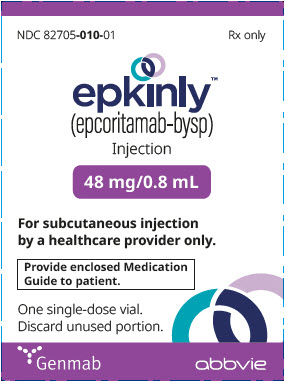
| One 48 mg/0.8 mL single-dose vial | NDC 82705-010-01 |
The vial stopper is not made with natural rubber latex.
Cytokine Release Syndrome (CRS)
Inform patients of the risk of CRS, and to immediately contact their healthcare provider should signs and symptoms associated with CRS (e.g., pyrexia, hypotension, hypoxia, chills, tachycardia, headache, and dyspnea) occur at any time. Advise patients that they should be hospitalized for 24 hours after administration of the Cycle 1 Day 15 dosage of 48 mg. Advise patients who experience symptoms that impair consciousness not to drive and refrain from operating heavy or potentially dangerous machinery until events resolve [see Warnings and Precautions (5.1)].
Immune Effector Cell-Associated Neurotoxicity Syndrome (ICANS)
Advise patients of the risk of ICANS, to immediately contact their healthcare provider for signs and symptoms associated with ICANS, which may manifest, for example, as confusional state, lethargy, tremor, dysgraphia, aphasia, and non-convulsive status epilepticus, and that the onset of events may be delayed. Advise patients who experience symptoms of ICANS that impair consciousness to refrain from driving or operating heavy or potentially dangerous machinery until symptoms of ICANS resolve [see Warnings and Precautions (5.2)].
Infections
Advise patients of the risk of serious infections, and to contact their healthcare professional for signs or symptoms of serious infection [see Warnings and Precautions (5.3)].
Cytopenias
Discuss the signs and symptoms associated with cytopenias, including neutropenia and febrile neutropenia, anemia, and thrombocytopenia [see Warnings and Precautions (5.4)].
Embryo-Fetal Toxicity
Advise pregnant women of the potential risk to a fetus. Advise females of reproductive potential to inform their healthcare provider if they are pregnant or become pregnant [see Use in Specific Populations (8.1)]. Advise females of reproductive potential to use effective contraception during treatment with EPKINLY and for 4 months after the last dose [see Use in Specific Populations (8.3)].
Lactation
Advise women not to breastfeed during treatment with EPKINLY and for 4 months after the last dose [see Use in Specific Populations (8.2)].
Manufactured by:
Genmab US, Inc.
Plainsboro, NJ 08536, USA
1-855-4GENMAB (1-855-443-6622)
U.S. License Number: 2293
Marketed by:
Genmab US, Inc.
Plainsboro, NJ 08536
and
AbbVie Inc.
North Chicago, IL 60064
EPKINLY is a trademark owned by Genmab A/S
©2023 Genmab A/S