Extrapyramidal Symptoms
The following table enumerates the percentage of patients with treatment-emergent extrapyramidal symptoms as assessed by categorical analyses of formal rating scales during acute therapy in a controlled clinical trial comparing oral olanzapine at 3 fixed doses with placebo in the treatment of schizophrenia in a 6-week trial.
Table 15: Treatment-Emergent Extrapyramidal Symptoms Assessed by Rating Scales Incidence in a Fixed Dosage Range, Placebo-Controlled Clinical Trial of Oral Olanzapine in Schizophrenia — Acute Phase | Percentage of Patients Reporting Event |
Placebo | Olanzapine
5 ± 2.5 mg/day | Olanzapine
10 ± 2.5 mg/day | Olanzapine
15 ± 2.5 mg/day |
Parkinsonisma | 15 | 14 | 12 | 14 |
Akathisiab | 23 | 16 | 19 | 27 |
a Percentage of patients with a Simpson-Angus Scale total score >3.
b Percentage of patients with a Barnes Akathisia Scale global score ≥2.
The following table enumerates the percentage of patients with treatment-emergent extrapyramidal symptoms as assessed by spontaneously reported adverse reactions during acute therapy in the same controlled clinical trial comparing olanzapine at 3 fixed doses with placebo in the treatment of schizophrenia in a 6-week trial.
Table 16: Treatment-Emergent Extrapyramidal Symptoms Assessed by Adverse Reactions Incidence in a Fixed Dosage Range, Placebo-Controlled Clinical Trial of Oral Olanzapine in Schizophrenia — Acute Phase | Percentage of Patients Reporting Event |
Placebo (N=68) | Olanzapine
5 ± 2.5 mg/day
(N=65) | Olanzapine
10 ± 2.5 mg/day
(N=64) | Olanzapine
15 ± 2.5 mg/day
(N=69) |
Dystonic eventsa | 1 | 3 | 2 | 3 |
Parkinsonism eventsb | 10 | 8 | 14 | 20 |
Akathisia eventsc | 1 | 5 | 11 | 10 |
Dyskinetic eventsd | 4 | 0 | 2 | 1 |
Residual eventse | 1 | 2 | 5 | 1 |
Any extrapyramidal event | 16 | 15 | 25 | 32 |
a Patients with the following COSTART terms were counted in this category: dystonia, generalized spasm, neck rigidity, oculogyric crisis, opisthotonos, torticollis.
b Patients with the following COSTART terms were counted in this category: akinesia, cogwheel rigidity, extrapyramidal syndrome, hypertonia, hypokinesia, masked facies, tremor.
c Patients with the following COSTART terms were counted in this category: akathisia, hyperkinesia.
d Patients with the following COSTART terms were counted in this category: buccoglossal syndrome, choreoathetosis, dyskinesia, tardive dyskinesia.
e Patients with the following COSTART terms were counted in this category: movement disorder, myoclonus, twitching.
The following table enumerates the percentage of adolescent patients with treatment-emergent extrapyramidal symptoms as assessed by spontaneously reported adverse reactions during acute therapy (dose range: 2.5 to 20 mg/day).
Table 17: Treatment-Emergent Extrapyramidal Symptoms Assessed by Adverse Reactions Incidence in Placebo-Controlled Clinical Trials of Oral Olanzapine in Schizophrenia and Bipolar I Disorder — AdolescentsCategoriesa | Percentage of Patients Reporting Event |
Placebo
(N=89) | Olanzapine
(N=179) |
Dystonic events | 0 | 1 |
Parkinsonism events | 2 | 1 |
Akathisia events | 4 | 6 |
Dyskinetic events | 0 | 1 |
Nonspecific events | 0 | 4 |
Any extrapyramidal event | 6 | 10 |
a Categories are based on Standard MedDRA Queries (SMQ) for extrapyramidal symptoms as defined in MedDRA version 12.0.
Dystonia, Class Effect: Symptoms of dystonia, prolonged abnormal contractions of muscle groups, may occur in susceptible individuals during the first few days of treatment. Dystonic symptoms include: spasm of the neck muscles, sometimes progressing to tightness of the throat, swallowing difficulty, difficulty breathing, and/or protrusion of the tongue. While these symptoms can occur at low doses, the frequency and severity are greater with high potency and at higher doses of first generation antipsychotic drugs. In general, an elevated risk of acute dystonia may be observed in males and younger age groups receiving antipsychotics; however, events of dystonia have been reported infrequently (<1%) with olanzapine use.
Other Adverse Reactions
Other Adverse Reactions Observed During the Clinical Trial Evaluation of Oral Olanzapine
Following is a list of treatment-emergent adverse reactions reported by patients treated with oral olanzapine (at multiple doses ≥1 mg/day) in clinical trials. This listing is not intended to include reactions (1) already listed in previous tables or elsewhere in labeling, (2) for which a drug cause was remote, (3) which were so general as to be uninformative, (4) which were not considered to have significant clinical implications, or (5) which occurred at a rate equal to or less than placebo. Reactions are classified by body system using the following definitions: frequent adverse reactions are those occurring in at least 1/100 patients; infrequent adverse reactions are those occurring in 1/100 to 1/1,000 patients; rare reactions are those occurring in fewer than 1/1,000 patients.
Body as a Whole — Infrequent: chills, face edema, photosensitivity reaction, suicide attempt1; Rare: chills and fever, hangover effect, sudden death1.
Cardiovascular System — Infrequent: cerebrovascular accident, vasodilatation.
Digestive System — Infrequent: abdominal distension, nausea and vomiting, tongue edema; Rare: ileus, intestinal obstruction, liver fatty deposit.
Hemic and Lymphatic System — Infrequent: thrombocytopenia.
Metabolic and Nutritional Disorders — Frequent: alkaline phosphatase increased; Infrequent: bilirubinemia, hypoproteinemia.
Musculoskeletal System — Rare: osteoporosis.
Nervous System — Infrequent: ataxia, dysarthria, libido decreased, stupor; Rare: coma.
Respiratory System — Infrequent: epistaxis; Rare: lung edema.
Skin and Appendages — Infrequent: alopecia.
Special Senses — Infrequent: abnormality of accommodation, dry eyes; Rare: mydriasis.
Urogenital System — Infrequent: amenorrhea2, breast pain, decreased menstruation, impotence2, increased menstruation2, menorrhagia2, metrorrhagia2, polyuria2, urinary frequency, urinary retention, urinary urgency, urination impaired.
1 These terms represent serious adverse events but do not meet the definition for adverse drug reactions. They are included here because of their seriousness.
2 Adjusted for gender.
Clinical Trials in Adolescent Patients (age 13 to 17 years)
Commonly Observed Adverse Reactions in Oral Olanzapine Short-Term, Placebo-Controlled Trials
Adverse reactions in adolescent patients treated with oral olanzapine (doses ≥2.5 mg) reported with an incidence of 5% or more and reported at least twice as frequently as placebo-treated patients are listed in Table 21.
Table 18: Treatment-Emergent Adverse Reactions of ≥5% Incidence among Adolescents (13 to 17 Years Old) with Schizophrenia or Bipolar I Disorder (Manic or Mixed Episodes)Adverse Reactions | Percentage of Patients Reporting Event |
6 Week Trial
% Schizophrenia Patients | 3 Week Trial
% Bipolar Patients |
Olanzapine
(N=72) | Placebo
(N=35) | Olanzapine
(N=107) | Placebo
(N=54) |
Sedationa | 39 | 9 | 48 | 9 |
Weight increased | 31 | 9 | 29 | 4 |
Headache | 17 | 6 | 17 | 17 |
Increased appetite | 17 | 9 | 29 | 4 |
Dizziness | 8 | 3 | 7 | 2 |
Abdominal painb | 6 | 3 | 6 | 7 |
Pain in extremity | 6 | 3 | 5 | 0 |
Fatigue | 3 | 3 | 14 | 6 |
Dry mouth | 4 | 0 | 7 | 0 |
a Patients with the following MedDRA terms were counted in this category: hypersomnia, lethargy, sedation, somnolence.
b Patients with the following MedDRA terms were counted in this category: abdominal pain, abdominal pain lower, abdominal pain upper.
Adverse Reactions Occurring at an Incidence of 2% or More among Oral Olanzapine-Treated Patients in Short-Term (3 to 6 weeks), Placebo-Controlled Trials
Adverse reactions in adolescent patients treated with oral olanzapine (doses ≥2.5 mg) reported with an incidence of 2% or more and greater than placebo are listed in Table 22.
Table 19: Treatment-Emergent Adverse Reactions of ≥2% Incidence among Adolescents (13 to 17 Years Old) (Combined Incidence from Short-Term, Placebo-Controlled Clinical Trials of Schizophrenia or Bipolar I Disorder [Manic or Mixed Episodes]) | Percentage of Patients Reporting Event |
Adverse Reaction | Olanzapine
(N=179) | Placebo
(N=89) |
Sedationa | 44 | 9 |
Weight increased | 30 | 6 |
Increased appetite | 24 | 6 |
Headache | 17 | 12 |
Fatigue | 9 | 4 |
Dizziness | 7 | 2 |
Dry mouth | 6 | 0 |
Pain in extremity | 5 | 1 |
Constipation | 4 | 0 |
Nasopharyngitis | 4 | 2 |
Diarrhea | 3 | 0 |
Restlessness | 3 | 2 |
Liver enzymes increasedb | 8 | 1 |
Dyspepsia | 3 | 1 |
Epistaxis | 3 | 0 |
Respiratory tract infectionc | 3 | 2 |
Sinusitis | 3 | 0 |
Arthralgia | 2 | 0 |
Musculoskeletal stiffness | 2 | 0 |
a Patients with the following MedDRA terms were counted in this category: hypersomnia, lethargy, sedation, somnolence.
b The terms alanine aminotransferase (ALT), aspartate aminotransferase (AST), and hepatic enzyme were combined under liver enzymes.
c Patients with the following MedDRA terms were counted in this category: lower respiratory tract infection, respiratory tract infection, respiratory tract infection viral, upper respiratory tract infection, viral upper respiratory tract infection.
Vital Signs and Laboratory Studies
Vital Sign Changes — Oral olanzapine was associated with orthostatic hypotension and tachycardia in clinical trials [see Warnings and Precautions (5)].
Laboratory Changes
Olanzapine Monotherapy in Adults: An assessment of the premarketing experience for olanzapine revealed an association with asymptomatic increases in ALT, AST, and GGT. Within the original premarketing database of about 2400 adult patients with baseline ALT ≤90 IU/L, the incidence of ALT elevations to >200 IU/L was 2% (50/2381). None of these patients experienced jaundice or other symptoms attributable to liver impairment and most had transient changes that tended to normalize while olanzapine treatment was continued.
In placebo-controlled olanzapine monotherapy studies in adults, clinically significant ALT elevations (change from <3 times the upper limit of normal [ULN] at baseline to ≥3 times ULN) were observed in 5% (77/1426) of patients exposed to olanzapine compared to 1% (10/1187) of patients exposed to placebo. ALT elevations ≥5 times ULN were observed in 2% (29/1438) of olanzapine-treated patients, compared to 0.3% (4/1196) of placebo-treated patients. ALT values returned to normal, or were decreasing, at last follow-up in the majority of patients who either continued treatment with olanzapine or discontinued olanzapine. No patient with elevated ALT values experienced jaundice, liver failure, or met the criteria for Hy’s Rule.
From an analysis of the laboratory data in an integrated database of 41 completed clinical studies in adult patients treated with oral olanzapine, high GGT levels were recorded in ≥1% (88/5245) of patients.
Caution should be exercised in patients with signs and symptoms of hepatic impairment, in patients with pre-existing conditions associated with limited hepatic functional reserve, and in patients who are being treated with potentially hepatotoxic drugs.
Olanzapine administration was also associated with increases in serum prolactin [see Warnings and Precautions (5.15)], with an asymptomatic elevation of the eosinophil count in 0.3% of patients, and with an increase in CPK.
From an analysis of the laboratory data in an integrated database of 41 completed clinical studies in adult patients treated with oral olanzapine, elevated uric acid was recorded in ≥3% (171/4641) of patients.
Olanzapine Monotherapy in Adolescents: In placebo-controlled clinical trials of adolescent patients with schizophrenia or bipolar I disorder (manic or mixed episodes), greater frequencies for the following treatment-emergent findings, at anytime, were observed in laboratory analytes compared to placebo: elevated ALT (≥3X ULN in patients with ALT at baseline <3X ULN), (12% vs 2%); elevated AST (28% vs 4%); low total bilirubin (22% vs 7%); elevated GGT (10% vs 1%); and elevated prolactin (47% vs 7%).
In placebo-controlled olanzapine monotherapy studies in adolescents, clinically significant ALT elevations (change from <3 times ULN at baseline to ≥3 times ULN) were observed in 12% (22/192) of patients exposed to olanzapine compared to 2% (2/109) of patients exposed to placebo. ALT elevations ≥5 times ULN were observed in 4% (8/192) of olanzapine-treated patients, compared to 1% (1/109) of placebo-treated patients. ALT values returned to normal, or were decreasing, at last follow-up in the majority of patients who either continued treatment with olanzapine or discontinued olanzapine. No adolescent patient with elevated ALT values experienced jaundice, liver failure, or met the criteria for Hy’s Rule.
ECG Changes — In pooled studies of adults as well as pooled studies of adolescents, there were no significant differences between olanzapine and placebo in the proportions of patients experiencing potentially important changes in ECG parameters, including QT, QTc (Fridericia corrected), and PR intervals. Olanzapine use was associated with a mean increase in heart rate compared to placebo (adults: +2.4 beats per minute vs no change with placebo; adolescents: +6.3 beats per minute vs -5.1 beats per minute with placebo). This increase in heart rate may be related to olanzapine’s potential for inducing orthostatic changes [see Warnings and Precautions (5.7)].
Elderly Patients with Dementia-Related Psychosis: Increased Mortality and Cerebrovascular Adverse Events (CVAE), Including Stroke
Patients and caregivers should be advised that elderly patients with dementia-related psychosis treated with antipsychotic drugs are at an increased risk of death. Patients and caregivers should be advised that elderly patients with dementia-related psychosis treated with olanzapine had a significantly higher incidence of cerebrovascular adverse events (e.g., stroke, transient ischemic attack) compared with placebo.
Olanzapine tablets are not approved for elderly patients with dementia-related psychosis [see Boxed Warning and Warnings and Precautions (5.1)].
Neuroleptic Malignant Syndrome (NMS)
Patients and caregivers should be counseled that a potentially fatal symptom complex sometimes referred to as NMS has been reported in association with administration of antipsychotic drugs, including olanzapine. Signs and symptoms of NMS include hyperpyrexia, muscle rigidity, altered mental status, and evidence of autonomic instability (irregular pulse or blood pressure, tachycardia, diaphoresis, and cardiac dysrhythmia) [see Warnings and Precautions (5.3)].
Drug Reaction with Eosinophilia and Systemic Symptoms (DRESS)
Patients should be advised to report to their health care provider at the earliest onset of any signs and symptoms that may be associated with Drug Reaction with Eosinophilia and Systemic Symptoms (DRESS) [see Warnings and Precautions (5.4)].
Hyperglycemia and Diabetes Mellitus
Patients should be advised of the potential risk of hyperglycemia-related adverse reactions. Patients should be monitored regularly for worsening of glucose control. Patients who have diabetes should follow their doctor's instructions about how often to check their blood sugar while taking olanzapine tablets [see Warnings and Precautions (5.5)].
Dyslipidemia
Patients should be counseled that dyslipidemia has occurred during treatment with olanzapine. Patients should have their lipid profile monitored regularly [see Warnings and Precautions (5.5)].
Weight Gain
Patients should be counseled that weight gain has occurred during treatment with olanzapine. Patients should have their weight monitored regularly [see Warnings and Precautions (Error! Hyperlink reference not valid.)].
Orthostatic Hypotension
Patients should be advised of the risk of orthostatic hypotension, especially during the period of initial dose titration and in association with the use of concomitant drugs that may potentiate the orthostatic effect of olanzapine tablets, e.g., diazepam or alcohol [see Warnings and Precautions (5.7) and Drug Interactions (7)]. Patients should be advised to change positions carefully to help prevent orthostatic hypotension, and to lie down if they feel dizzy or faint, until they feel better. Patients should be advised to call their doctor if they experience any of the following signs and symptoms associated with orthostatic hypotension: dizziness, fast or slow heartbeat, or fainting.
Potential for Cognitive and Motor Impairment
Because olanzapine tablets have the potential to impair judgment, thinking, or motor skills, patients should be cautioned about operating hazardous machinery, including automobiles, until they are reasonably certain that olanzapine tablets therapy does not affect them adversely [see Warnings and Precautions (5.12)].
Body Temperature Regulation
Patients should be advised regarding appropriate care in avoiding overheating and dehydration. Patients should be advised to call their doctor right away if they become severely ill and have some or all of these symptoms of dehydration: sweating too much or not at all, dry mouth, feeling very hot, feeling thirsty, not able to produce urine [see Warnings and Precautions (5.13)].
Concomitant Medication
Patients should be advised to inform their healthcare providers if they are taking, or plan to take, Symbyax. Patients should also be advised to inform their healthcare providers if they are taking, plan to take, or have stopped taking any prescription or over-the-counter drugs, including herbal supplements, since there is a potential for interactions [see Drug Interactions (7)].
Alcohol
Patients should be advised to avoid alcohol while taking olanzapine tablets [see Drug Interactions (7)].
Use in Specific Populations
Pregnancy — Advise women to notify their healthcare provider if they become pregnant or intend to become pregnant during treatment with olanzapine tablets. Advise patients that olanzapine may cause extrapyramidal and/or withdrawal symptoms (agitation, hypertonia, hypotonia, tremor, somnolence, respiratory distress, and feeding disorder) in a neonate. Advise patients that there is a pregnancy exposure registry that monitors pregnancy outcomes in women exposed to olanzapine during pregnancy [see Use in Specific Populations (8.1)].
Lactation — Advise breastfeeding women using olanzapine tablets to monitor infants for excess sedation, irritability, poor feeding and extrapyramidal symptoms (tremors and abnormal muscle movements) and to seek medical care if they notice these signs. [see Use in Specific Populations (8.3)].
Infertility — Advise females of reproductive potential that olanzapine tablets may impair fertility due to an increase in serum prolactin levels. The effects on fertility are reversible [see Use in Specific Populations (8.3)].
Pediatric Use — Olanzapine is indicated for treatment of schizophrenia and manic or mixed episodes associated with bipolar I disorder in adolescents 13 to 17 years of age. Compared to patients from adult clinical trials, adolescents were likely to gain more weight, experience increased sedation, and have greater increases in total cholesterol, triglycerides, LDL cholesterol, prolactin, and hepatic aminotransferase levels. Patients should be counseled about the potential long-term risks associated with olanzapine and advised that these risks may lead them to consider other drugs first [see Indications and Usage (1.1, 1.2)]. Safety and effectiveness of olanzapine tablets in patients under 13 years of age have not been established. Safety and efficacy of olanzapine and fluoxetine in combination in patients 10 to 17 years of age have been established for the acute treatment of depressive episodes associated with bipolar I disorder. Safety and effectiveness of olanzapine tablets and fluoxetine in combination in patients <10 years of age have not been established [see Warnings and Precautions (5.5) and Use in Specific Populations (8.4)].
Need for Comprehensive Treatment Program in Pediatric Patients
Olanzapine is indicated as an integral part of a total treatment program for pediatric patients with schizophrenia and bipolar disorder that may include other measures (psychological, educational, social) for patients with the disorder.
Effectiveness and safety of olanzapine have not been established in pediatric patients less than 13 years of age. Atypical antipsychotics are not intended for use in the pediatric patient who exhibits symptoms secondary to environmental factors and/or other primary psychiatric disorders. Appropriate educational placement is essential and psychosocial intervention is often helpful. The decision to prescribe atypical antipsychotic medication will depend upon the healthcare provider’s assessment of the chronicity and severity of the patient’s symptoms [see Indications and Usage (1.3)].
All registered trademarks in this document are the property of their respective owners.
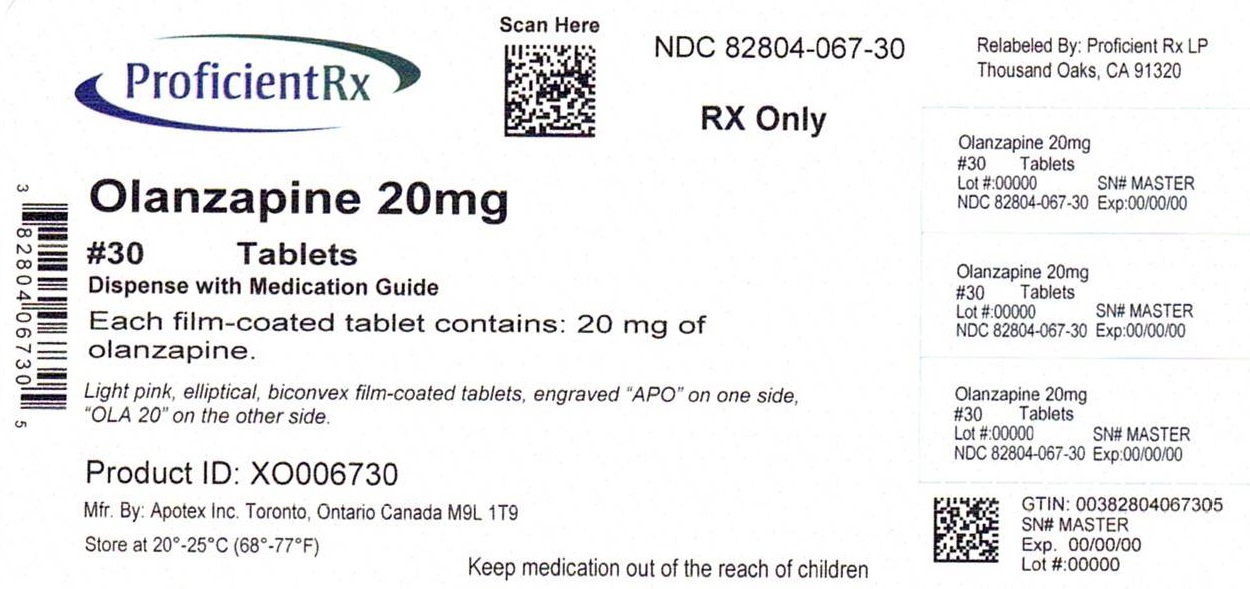
Dispense with Medication Guide available at www1.apotex.com/products/us
OLANZAPINE TABLETS, USP
20 mg
Manufactured by | Manufactured for | Relabeled by |
Apotex Inc. | Apotex Corp. | Proficient Rx LP |
Toronto, Ontario | Weston, Florida | Thousand Oaks, CA 91320 |
Canada M9L 1T9 | USA 33326 | |
Revised: June 2021
Revision 8