Table 8: Effect of Coadministered Drugs on Rosuvastatin Systemic Exposure
Coadministered drug and dosing regimen
| Rosuvastatin
|
|
| Mean Ratio
(ratio with/without coadministered drug)
No Effect=1.0
|
| Dose (mg)1
| Change in AUC
| Change in Cmax
|
Sofosbuvir/velpatasvir/voxilaprevir (400 mg-100 mg-100 mg) + Voxilaprevir (100 mg) once daily for 15 days
| 10 mg, single dose
| 7.392
(6.68-8.18) 3
| 18.882
(16.23-21.96) 3
|
Cyclosporine – stable dose required (75 mg – 200 mg BID)
| 10 mg, QD for 10 days
| 7.12
| 112
|
Darolutamide 600 mg BID, 5 days
| 5 mg, single dose
| 5.22
| ~52
|
Regorafenib 160 mg QD, 14 days
| 5 mg, single dose
| 3.82
| 4.62
|
Atazanavir/ritonavir combination 300 mg/100 mg QD for 8 days
| 10 mg
| 3.12
| 72
|
Simeprevir 150 mg QD, 7 days
| 10 mg, single dose
| 2.82
(2.3-3.4)3
| 3.22
(2.6-3.9)3
|
Velpatasvir 100 mg once daily
| 10 mg, single dose
| 2.692
(2.46-2.94) 3
| 2.612
(2.32-2.92)3
|
Ombitasvir 25 mg/paritaprevir 150 mg/ ritonavir 100 mg + dasabuvir 400 mg BID
| 5 mg, single dose
| 2.592
(2.09-3.21) 3
| 7.132
(5.11-9.96)3
|
Teriflunomide
| Not available
| 2.512
| 2.652
|
Enasidenib 100 mg QD, 28 days | 10 mg, single dose | 2.44 | 3.66 |
Elbasvir 50 mg/grazoprevir 200 mg once daily
| 10 mg, single dose
| 2.262
(1.89-2.69) 3
| 5.492
(4.29-7.04)3
|
Glecaprevir 400 mg/pibrentasvir 120 mg once daily
| 5 mg, once daily
| 2.152
(1.88-2.46) 3
| 5.622
(4.80-6.59)3
|
Lopinavir/ritonavir combination 400 mg/100 mg BID for 17 days
| 20 mg, QD for 7 days
| 2.12
(1.7-2.6)3
| 52
(3.4-6.4)3
|
Capmatinib 400 mg BID
| 10 mg, single dose
| 2.082
(1.56-2.76) 3
| 3.042
(2.36-3.92)3
|
Fostamatinib 100 mg BID
| 20 mg, single dose
| 1.962
(1.77-2.15) 3
| 1.882
(1.69-2.09) 3
|
Febuxostat 120 mg OD for 4 days
| 10 mg, single dose
| 1.92
(1.5-2.5) 3
| 2.12
(1.8-2.6)3
|
Gemfibrozil 600 mg BID for 7 days
| 80 mg
| 1.92
(1.6-2.2)3
| 2.22
(1.8-2.7)3
|
Tafamidis 61 mg QD, 7 days
| 10 mg
| 1.972
(1.68-2.31)3
| 1.862
(1.59-2.16)3
|
Eltrombopag 75 mg QD, 5 days
| 10 mg
| 1.6
(1.4-1.7)3
| 2
(1.8-2.3)3
|
Darunavir 600 mg/ritonavir 100 mg BID, 7 days
| 10 mg, QD for 7 days
| 1.5
(1.0-2.1)3
| 2.4
(1.6-3.6)3
|
Tipranavir/ritonavir combination 500 mg/200 mg BID for 11 days
| 10 mg
| 1.4
(1.2-1.6)3
| 2.2
(1.8-2.7)3
|
Dronedarone 400 mg BID
| 10 mg
| 1.4
|
|
Itraconazole 200 mg QD, 5 days
| 10 mg or 80 mg
| 1.4
(1.2-1.6)3
1.3
(1.1-1.4)3
| 1.4
(1.2-1.5)3
1.2
(0.9-1.4)3
|
Ezetimibe 10 mg QD, 14 days
| 10 mg, QD for 14 days
| 1.2
(0.9-1.6)3
| 1.2
(0.8-1.6)3
|
Fosamprenavir/ritonavir 700 mg/100 mg BID for 7 days
| 10 mg
| 1.1
| 1.5
|
Fenofibrate 67 mg TID for 7 days
| 10 mg
| ↔
| 1.2
(1.1-1.3)3
|
Rifampicin 450 mg QD, 7 days
| 20 mg
| ↔
|
|
Aluminum & magnesium hydroxide combination antacid
Administered simultaneously Administered 2 hours apart
| 40 mg
40 mg
| 0.52
(0.4-0.5)3
0.8
(0.7-0.9)3
| 0.52
(0.4-0.6)3
0.8
(0.7-1.0)3
|
Ketoconazole 200 mg BID for 7 days
| 80 mg
| 1.0
(0.8-1.2)3
| 1.0
(0.7-1.3)3
|
Fluconazole 200 mg QD for 11 days
| 80 mg
| 1.1
(1.0-1.3)3
| 1.1
(0.9-1.4)3
|
Erythromycin 500 mg QID for 7 days
| 80 mg
| 0.8
(0.7-0.9)3
| 0.7
(0.5-0.9)3
|
QD= Once daily, BID= Twice daily, TID= Three times daily, QID= Four times daily
1Single dose unless otherwise noted.
2Clinically significant [see Dosage and Administration (2) and Warnings and Precautions (5)]
3Mean ratio with 90% CI (with/without coadministered drug, e.g., 1= no change, 0.7 = 30% decrease, 11=11-fold increase in exposure)
Table 9: Effect of Rosuvastatin Coadministration on Systemic Exposure to Other Drugs
Rosuvastatin Dosage Regimen
| Coadministered Drug
|
| | Mean Ratio (ratio with/without coadministered drug)
No Effect=1.0
|
| Name and Dose
| Change in AUC
| Change in Cmax
|
40 mg QD for 10 days
| Warfarin1
25 mg single dose
| R-Warfarin
1.0
(1.0-1.1)2
S-Warfarin
1.1
(1.0-1.1)2
| R-Warfarin 1.0
(0.9-1.0)2
S-Warfarin
1.0
(0.9-1.1)2
|
40 mg QD for 12 days
| Digoxin 0.5 mg
single dose
| 1.0
(0.9-1.2)2
| 1.0
(0.9-1.2)2
|
40 mg QD for 28 days
| Oral Contraceptive
(ethinyl estradiol 0.035 mg & norgestrel 0.180, 0.215 and 0.250 mg) QD for 21 Days
|
EE 1.3
(1.2-1.3)2
NG 1.3
(1.3-1.4)2
| EE 1.3
(1.2-1.3)2
NG 1.2
(1.1-1.3)2
|
EE = ethinyl estradiol, NG = norgestrel, QD= Once daily
1Clinically significant pharmacodynamic effects [see Drug Interactions (7.3)]
2Mean ratio with 90% CI (with/without coadministered drug, e.g., 1= no change, 0.7=30% decrease, 11=11-fold increase in exposure)
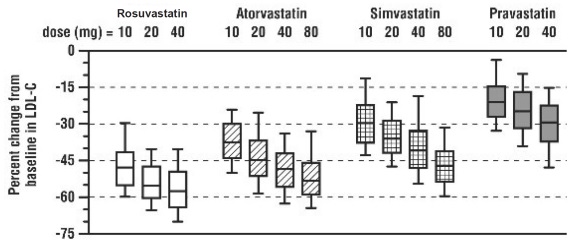
Figure 3. Percent LDL-C Change by Dose of Rosuvastatin calcium, Atorvastatin, Simvastatin, and Pravastatin at Week 6 in Adult Patients with Hyperlipidemia or Mixed Dyslipidemia

Rosuvastatin-fig-03 (Rosuvastatin Fig 03)
Box plots are a representation of the 25th, 50th, and 75th percentile values, with whiskers representing the 10th and 90th percentile values. Mean baseline LDL-C: 189 mg/dL
Table 11: Percent Change in LDL-C by Dose of Rosuvastatin calcium, Atorvastatin, Simvastatin, and Pravastatin From Baseline to Week 6 (LS Mean1) in Adult Patients with Hyperlipidemia or Mixed Dyslipidemia (Sample Sizes Ranging from 156–167 Patients Per Group)
| Treatment Daily Dose
|
Treatment
| 10 mg
| 20 mg
| 40 mg
| 80 mg
|
Rosuvastatin calcium
| -462
| -523
| -554
| ---
|
Atorvastatin
| -37
| -43
| -48
| -51
|
Simvastatin
| -28
| -35
| -39
| -46
|
Pravastatin
| -20
| -24
| -30
| --- |
1Corresponding standard errors are approximately 1.00.
2Rosuvastatin calcium 10 mg reduced LDL-C significantly more than atorvastatin 10 mg; pravastatin 10 mg, 20 mg, and 40 mg; simvastatin 10 mg, 20 mg, and 40 mg. (p<0.002)
3Rosuvastatin calcium 20 mg reduced LDL-C significantly more than atorvastatin 20 mg and 40 mg; pravastatin 20 mg and 40 mg; simvastatin 20 mg, 40 mg, and 80 mg. (p<0.002)
4Rosuvastatin calcium 40 mg reduced LDL-C significantly more than atorvastatin 40 mg; pravastatin 40 mg; simvastatin 40 mg, and 80 mg. (p<0.002)
Slowing of the Progression of Atherosclerosis
In the Measuring Effects on Intima Media Thickness: an Evaluation Of Rosuvastatin 40 mg (METEOR) study, the effect of therapy with rosuvastatin calcium on carotid atherosclerosis was assessed by B-mode ultrasonography in patients with elevated LDL-C, at low risk (Framingham risk <10% over ten years) for symptomatic coronary artery disease and with subclinical atherosclerosis as evidenced by carotid intimal-medial thickness (cIMT). In this double-blind, placebo-controlled clinical study 984 adult patients were randomized (of whom 876 were analyzed) in a 5:2 ratio to rosuvastatin calcium 40 mg or placebo once daily. Ultrasonograms of the carotid walls were used to determine the annualized rate of change per patient from baseline to two years in mean maximum cIMT of 12 measured segments. The estimated difference in the rate of change in the maximum cIMT analyzed over all 12 carotid artery sites between patients treated with rosuvastatin calcium and placebo-treated patients was -0.0145 mm/year (95% CI –0.0196, – 0.0093; p<0.0001).
The annualized rate of change from baseline for the placebo group was +0.0131 mm/year (p<0.0001). The annualized rate of change from baseline for the group treated with rosuvastatin calcium was -0.0014 mm/year (p=0.32).
At an individual patient level in the group treated with rosuvastatin calcium, 52.1% of patients demonstrated an absence of disease progression (defined as a negative annualized rate of change), compared to 37.7% of patients in the placebo group.
HeFH in Adults
In a study of adult patients with HeFH (baseline mean LDL of 291 mg/dL), patients were randomized to rosuvastatin calcium 20 mg or atorvastatin 20 mg. The dose was increased at 6-week intervals. Significant LDL-C reductions from baseline were seen at each dose in both treatment groups (Table 12).
Table 12: LDL-C Percent Change from Baseline
|
| Rosuvastatin calcium (n=435)
LS Mean1
(95% CI)
| Atorvastatin (n=187)
LS Mean1 (95% CI)
|
Week 6
| 20 mg
| -47% (-49%, -46%)
| -38% (-40%, -36%)
|
Week 12
| 40 mg
| -55% (-57%, -54%)
| -47% (-49%, -45%)
|
Week 18
| 80 mg
| NA
| -52% (-54%, -50%)
|
1LS Means are least square means adjusted for baseline LDL-C
HeFH in Pediatric Patients
In a double-blind, randomized, multicenter, placebo-controlled, 12-week study, 176 (97 male and 79 female) children and adolescents with heterozygous familial hypercholesterolemia were randomized to rosuvastatin 5 mg, 10 mg or 20 mg or placebo daily. Patients ranged in age from 10 to 17 years (median age of 14 years) with approximately 30% of the patients 10 to 13 years and approximately 17%, 18%, 40%, and 25% at Tanner stages II, III, IV, and V, respectively. Females were at least 1 year postmenarche. Mean LDL-C at baseline was 233 mg/dL (range of 129 to 399). The 12-week double-blind phase was followed by a 40 week open label dose-titration phase, where all patients (n=173) received 5 mg, 10 mg or 20 mg rosuvastatin daily.
Rosuvastatin significantly reduced LDL-C (primary end point), total cholesterol and ApoB levels at each dose compared to placebo. Results are shown in Table 13 below.
Table 13: Lipid-Modifying Effects of Rosuvastatin calcium in Pediatric Patients 10 to 17 years of Age with Heterozygous Familial Hypercholesterolemia (Least-Squares Mean Percent Change from Baseline To Week 12)
Dose (mg)
| N
| LDL-C
| HDL-C
| Total-C
| TG1
| ApoB
|
Placebo
| 46
| -1%
| +7%
| 0%
| -7%
| -2%
|
5
| 42
| -38%
| +4%2
| -30%
| -13%2
| -32%
|
10
| 44
| -45%
| +11%2
| -34%
| -15%2
| -38%
|
20
| 44
| -50%
| +9%2
| -39%
| 16%2
| -41%
|
1Median percent change
2Difference from placebo not statistically significant
Rosuvastatin was also studied in a two-year open-label, uncontrolled, titration-to-goal trial that included 175 children and adolescents with heterozygous familial hypercholesterolemia who were 8 to 17 years old (79 boys and 96 girls). All patients had a documented genetic defect in the LDL receptor or in ApoB. Approximately 89% were White, 7% were Asian, 1% were Black, and fewer than 1% were Hispanic. Mean LDL-C at baseline was 236 mg/dL. Fifty-eight (33%) patients were prepubertal at baseline. The starting rosuvastatin dosage for all children and adolescents was 5 mg once daily. Children 8 to less than 10 years of age (n=41 at baseline) could titrate to a maximum dosage of 10 mg once daily, and children and adolescents 10 to 17 years of age could titrate to a maximum dosage of 20 mg once daily.
The reductions in LDL-C from baseline were generally consistent across age groups within the trial as well as with previous experience in both adult and pediatric controlled trials.
HoFH in Adult and Pediatric Patients
In an open-label, forced-titration study, HoFH patients (n=40, 8-63 years) were evaluated for their response to rosuvastatin calcium 20 to 40 mg titrated at a 6-week interval. In the overall population, the mean LDL-C reduction from baseline was 22%. About one-third of the patients benefited from increasing their dose from 20 mg to 40 mg with further LDL-C lowering of greater than 6%. In the 27 patients with at least a 15% reduction in LDL-C, the mean LDL-C reduction was 30% (median 28% reduction). Among 13 patients with an LDL-C reduction of <15%, 3 had no change or an increase in LDL-C. Reductions in LDL-C of 15% or greater were observed in 3 of 5 patients with known receptor negative status.
HoFH in Pediatric Patients
Rosuvastatin calcium was studied in a randomized, double-blind, placebo-controlled, multicenter, cross¬over study in 14 pediatric patients with HoFH. The study included a 4-week dietary lead-in phase during which patients received rosuvastatin calcium 10 mg daily, a cross-over phase that included two 6-week treatment periods with either rosuvastatin calcium 20 mg or placebo in random order, followed by a 12-week open-label phase during which all patients received rosuvastatin calcium 20 mg. Patients ranged in age from 7 to 15 years of age (median 11 years), 50% were male, 71% were White, 21% were Asian, 7% were Black, and no patients were of Hispanic ethnicity. Fifty percent were on apheresis therapy and 57% were taking ezetimibe. Patients who entered the study on apheresis therapy or ezetimibe continued the treatment throughout the entire study. Mean LDL-C at baseline was 416 mg/dL (range 152 to 716 mg/dL). A total of 13 patients completed both treatment periods of the randomized cross-over phase; one patient withdrew consent due to inability to have blood drawn during the cross-over phase.
Rosuvastatin calcium 20 mg significantly reduced LDL-C, total cholesterol, ApoB, and non-HDL-C compared to placebo (Table 14).
Table 14: Lipid-modifying Effects of Rosuvastatin calcium in Pediatric Patients 7 to 15 years of Age with Homozygous Familial Hypercholesterolemia After 6 Weeks
| Placebo (N=13)
| Rosuvastatin calcium
20 mg (N=13)
| Percent difference (95% CI)
|
LDL-C (mg/dL)
| 481
| 396
| -22.3% (-33.5, -9.1)1
|
Total-C (mg/dL)
| 539
| 448
| -20.1% (-29.7, -9.1)2
|
Non-HDL-C (mg/dL)
| 505
| 412
| -22.9% (-33.7, -10.3)2
|
ApoB (mg/dL)
| 268
| 235
| -17.1% (-29.2, -2.9)3
|
%Difference estimates are based on transformations of the estimated mean difference in log LDL measurements between rosuvastatin calcium and placebo using a mixed model adjusted for study period 1 p=0.005, 2 p=0.003, 3 p=0.024
Primary Dysbetalipoproteinemia in Adults
In a randomized, multicenter, double-blind crossover study, 32 adult patients (27 with є2/є2 and 4 with apo E mutation [Arg145Cys] with primary dysbetalipoproteinemia entered a 6-week dietary lead-in period on the NCEP Therapeutic Lifestyle Change (TLC) diet. Following dietary lead-in, patients were randomized to a sequence of treatments for 6 weeks each: rosuvastatin 10 mg followed by rosuvastatin 20 mg or rosuvastatin 20 mg followed by rosuvastatin 10 mg. Rosuvastatin calcium reduced non-HDL-C (primary end point) and circulating remnant lipoprotein levels. Results are shown in the table below.
Table 15: Lipid-modifying Effects of Rosuvastatin calcium 10 mg and 20 mg in Adult Patients with Primary Dysbetalipoproteinemia (Type III hyperlipoproteinemia) After Six Weeks by Median Percent Change (95% CI) from Baseline (N=32)
| Median at Baseline (mg/dL)
| Median percent change from baseline (95% CI) rosuvastatin calcium 10 mg
| Median percent change from baseline (95% CI) rosuvastatin calcium 20 mg
|
Total-C
| 342.5
| -43.3
(-46.9, -37.5)
| -47.6
(-51.6,-42.8)
|
Triglycerides
| 503.5
| -40.1
(-44.9, -33.6)
| -43.0
(-52.5, -33.1)
|
Non-HDL-C
| 294.5
| -48.2
(-56.7, -45.6)
| -56.4
(-61.4, -48.5)
|
VLDL-C + IDL-C
| 209.5
| -46.8
(-53.7, -39.4)
| -56.2
(-67.7, -43.7)
|
LDL-C
| 112.5
| -54.4
(-59.1, -47.3)
| -57.3
(-59.4, -52.1)
|
HDL-C
| 35.5
| 10.2
(1.9, 12.3)
| 11.2
(8.3, 20.5)
|
RLP-C
| 82.0
| -56.4
(-67.1, -49.0)
| -64.9
(-74.0, -56.6)
|
Apo-E
| 16.0
| -42.9
(-46.3, -33.3)
| -42.5
(-47.1, -35.6)
|
Hypertriglyceridemia in Adults
In a double-blind, placebo-controlled study in adult patients with baseline TG levels from 273 to 817 mg/dL, rosuvastatin calcium given as a single daily dose (5 to 40 mg) over 6 weeks significantly reduced serum TG levels (Table 16).
Table 16: Lipid-Modifying Effect of Rosuvastatin calcium in Adult Patients with Primary Hypertriglyceridemia After Six Weeks by Median (Min, Max) Percent Change from Baseline to Week 6
Dose
| Placebo (n=26)
| Rosuvastatin calcium
5 mg
(n=25)
| Rosuvastatin calcium
10 mg
(n=23)
| Rosuvastatin calcium
20 mg
(n=27)
| Rosuvastatin calcium
40 mg
(n=25)
|
Triglycerides
| 1 (-40, 72)
| -21 (-58, 38)
| -37 (-65, 5)
| -37 (-72, 11)
| -43 (-80, -7)
|
Non-HDL-C
| 2 (-13, 19)
| -29 (-43, -8)
| -49 (-59, -20)
| -43 (-74, 12)
| -51 (-62, -6)
|
Total-C
| 1 (-13, 17)
| -24 (-40, -4)
| -40 (-51, -14)
| -34 (-61, -11)
| -40 (-51, -4)
|
LDL-C
| 5 (-30, 52)
| -28 (-71, 2)
| -45 (-59, 7)
| -31 (-66, 34)
| -43 (-61, -3)
|
HDL-C
| -3 (-25, 18)
| 3 (-38, 33)
| 8 (-8, 24)
| 22 (-5, 50)
| 17 (-14, 63)
|