Bleeding
CURE
In CURE, clopidogrel use with aspirin was associated with an increase in major bleeding (primarily gastrointestinal and at puncture sites) compared to placebo with aspirin (see Table 1). The incidence of intracranial hemorrhage (0.1%) and fatal bleeding (0.2%) were the same in both groups. Other bleeding events that were reported more frequently in the clopidogrel group were epistaxis, hematuria, and bruise.
The overall incidence of bleeding is described in Table 1.
Table 1: CURE Incidence of Bleeding Complications (% patients)| Event | Clopidogrel
(+ aspirin)
(n=6,259) | Placebo
(+ aspirin)
(n=6,303) |
|---|
Major bleeding Life-threatening and other major bleeding. | 3.7 | 2.7 |
Life-threatening bleeding | 2.2 | 1.8 |
Fatal | 0.2 | 0.2 |
5 g/dL hemoglobin drop | 0.9 | 0.9 |
Requiring surgical intervention | 0.7 | 0.7 |
Hemorrhagic strokes | 0.1 | 0.1 |
Requiring inotropes | 0.5 | 0.5 |
Requiring transfusion (≥4 units) | 1.2 | 1.0 |
Other major bleeding | 1.6 | 1.0 |
Significantly disabling | 0.4 | 0.3 |
Intraocular bleeding with significant loss of vision | 0.05 | 0.03 |
Requiring 2-3 units of blood | 1.3 | 0.9 |
Minor bleeding Led to interruption of study medication. | 5.1 | 2.4 |
COMMIT
In COMMIT, similar rates of major bleeding were observed in the clopidogrel and placebo groups, both of which also received aspirin (see Table 2).
Table 2: Incidence of Bleeding Events in COMMIT (% patients)| Type of Bleeding | Clopidogrel
(+ aspirin)
(n=22,961) | Placebo
(+ aspirin)
(n=22,891) | p-value |
|---|
Major Major bleeds were cerebral bleeds or noncerebral bleeds thought to have caused death or that required transfusion. noncerebral or cerebral bleeding | 0.6 | 0.5 | 0.59 |
Major noncerebral | 0.4 | 0.3 | 0.48 |
Fatal | 0.2 | 0.2 | 0.90 |
Hemorrhagic stroke | 0.2 | 0.2 | 0.91 |
Fatal | 0.2 | 0.2 | 0.81 |
Other noncerebral bleeding (nonmajor) | 3.6 | 3.1 | 0.005 |
Any noncerebral bleeding | 3.9 | 3.4 | 0.004 |
CAPRIE (Clopidogrel vs Aspirin)
In CAPRIE, gastrointestinal hemorrhage occurred at a rate of 2.0% in those taking clopidogrel versus 2.7% in those taking aspirin; bleeding requiring hospitalization occurred in 0.7% and 1.1%, respectively. The incidence of intracranial hemorrhage was 0.4% for clopidogrel compared to 0.5% for aspirin.
Other bleeding events that were reported more frequently in the clopidogrel group were epistaxis and hematoma.
Other Adverse Events
In CURE and CHARISMA, which compared clopidogrel plus aspirin to aspirin alone, there was no difference in the rate of adverse events (other than bleeding) between clopidogrel and placebo.
In CAPRIE, which compared clopidogrel to aspirin, pruritus was more frequently reported in those taking clopidogrel. No other difference in the rate of adverse events (other than bleeding) was reported.
Omeprazole or Esomeprazole
Avoid concomitant use of clopidogrel with omeprazole or esomeprazole. In clinical studies, omeprazole was shown to reduce significantly the antiplatelet activity of clopidogrel when given concomitantly or 12 hours apart. A similar reduction in antiplatelet activity was observed with esomeprazole when given concomitantly with clopidogrel. Dexlansoprazole, lansoprazole, and pantoprazole had less effect on the antiplatelet activity of clopidogrel than did omeprazole or esomeprazole [see Warnings and Precautions (5.1) and Clinical Pharmacology (12.3)].
Risk Summary
Available data from cases reported in published literature and postmarketing surveillance with clopidogrel use in pregnant women have not identified any drug-associated risks for major birth defects or miscarriage [see Data]. There are risks to the pregnant woman and fetus associated with myocardial infarction and stroke [see Clinical Considerations]. No evidence of fetotoxicity was observed when clopidogrel was administered to pregnant rats and rabbits during organogenesis at doses corresponding to 65 and 78 times the recommended daily human dose [see Data].
The estimated background risk of major birth defects and miscarriage for the indicated populations is unknown. All pregnancies have a background risk of birth defects, loss, or other adverse outcomes. In the U.S. general population, the estimated background risk of major birth defects and miscarriage in clinically recognized pregnancies is 2% to 4% and 15% to 20%, respectively.
Clinical Considerations
Disease-associated maternal and/or embryo/fetal risk
Myocardial infarction and stroke are medical emergencies. Therapy for the pregnant woman should not be withheld because of potential concerns regarding the effects of clopidogrel on the fetus.
Labor or delivery
Clopidogrel use during labor or delivery will increase the risk of maternal bleeding and hemorrhage. Avoid neuraxial blockade during clopidogrel use because of the risk of spinal hematoma. When possible, discontinue clopidogrel 5 to 7 days prior to labor, delivery, or neuraxial blockade.
Data
Human data
The available data from published case reports over two decades of postmarketing use have not identified an association with clopidogrel use in pregnancy and major birth defects, miscarriage, or adverse fetal outcomes.
Animal data
Embryo-fetal developmental toxicology studies were performed in pregnant rats and rabbits with doses up to 500 mg/kg/day and 300 mg/kg/day, respectively, administered during organogenesis. These doses, corresponding to 65 and 78 times the recommended daily human dose, respectively, on a mg/m2 basis, revealed no evidence of impaired fertility or fetotoxicity due to clopidogrel.
Risk Summary
There are no data on the presence of clopidogrel in human milk or the effects on milk production. No adverse effects on breastfed infants have been observed with maternal clopidogrel use during lactation in a small number of postmarketing cases. Studies in rats have shown that clopidogrel and/or its metabolites are present in the milk. When a drug is present in animal milk, it is likely that the drug will be present in human milk. The developmental and health benefits of breastfeeding should be considered along with mother's clinical need for clopidogrel and any potential adverse effects on the breastfed infant from clopidogrel or from underlying maternal condition.
Geriatric Patients
Elderly (≥75 years) and young healthy subjects had similar effects on platelet aggregation.
Renally Impaired Patients
After repeated doses of 75 mg clopidogrel per day, patients with severe renal impairment (creatinine clearance from 5 mL/min to 15 mL/min) and moderate renal impairment (creatinine clearance from 30 mL/min to 60 mL/min) showed low (25%) inhibition of ADP-induced platelet aggregation.
Hepatically Impaired Patients
After repeated doses of 75 mg clopidogrel per day for 10 days in patients with severe hepatic impairment, inhibition of ADP-induced platelet aggregation was similar to that observed in healthy subjects.
Gender
In a small study comparing men and women, less inhibition of ADP-induced platelet aggregation was observed in women.
Absorption
After single and repeated oral doses of 75 mg per day, clopidogrel is rapidly absorbed. Absorption is at least 50%, based on urinary excretion of clopidogrel metabolites.
Effect of food
Clopidogrel can be administered with or without food. In a study in healthy male subjects when clopidogrel 75 mg per day was given with a standard breakfast, mean inhibition of ADP-induced platelet aggregation was reduced by less than 9%. The active metabolite AUC0-24 was unchanged in the presence of food, while there was a 57% decrease in active metabolite Cmax. Similar results were observed when a clopidogrel 300 mg loading dose was administered with a high-fat breakfast.
Metabolism
Clopidogrel is extensively metabolized by two main metabolic pathways: one mediated by esterases and leading to hydrolysis into an inactive carboxylic acid derivative (85% of circulating metabolites) and one mediated by multiple cytochrome P450 enzymes. Cytochromes first oxidize clopidogrel to a 2-oxo-clopidogrel intermediate metabolite. Subsequent metabolism of the 2-oxo- clopidogrel intermediate metabolite results in formation of the active metabolite, a thiol derivative of clopidogrel. The active metabolite is formed mostly by CYP2C19 with contributions from several other CYP enzymes, including CYP1A2, CYP2B6 and CYP3A. The active thiol metabolite binds rapidly and irreversibly to platelet receptors, thus inhibiting platelet aggregation for the lifespan of the platelet.
The Cmax of the active metabolite is twice as high following a single 300 mg clopidogrel loading dose as it is after four days of 75 mg maintenance dose. Cmax occurs approximately 30 to 60 minutes after dosing. In the 75 mg to 300 mg dose range, the pharmacokinetics of the active metabolite deviates from dose proportionality: 4-fold the dose results in 2.0-fold and 2.7-fold the Cmax and AUC, respectively.
Elimination
Following an oral dose of 14C-labeled clopidogrel in humans, approximately 50% of total radioactivity was excreted in urine and approximately 46% in feces over the 5 days post dosing. After a single, oral dose of 75 mg, clopidogrel has a half-life of approximately 6 hours. The half- life of the active metabolite is about 30 minutes.
Drug Interactions
Effect of other drugs on clopidogrel
Clopidogrel is metabolized to its active metabolite in part by CYP2C19.
CYP2C19 inducers
Concomitant use of strong inducers of CYP2C19 results in increased plasma concentration of the active metabolite of clopidogrel and an increase in platelet inhibition.
Rifampin: Coadministration of rifampin 300 mg twice daily for 7 days with 600 mg loading dose of clopidogrel in healthy adults increased the mean AUC and Cmax of clopidogrel's thiol metabolites by 3.8-fold. Mean inhibition of platelet aggregation at 4 hours post dose was 34% higher in the presence of rifampin compared to clopidogrel administered alone.
CYP2C19 inhibitors
Concomitant use of certain inhibitors of this enzyme results in reduced plasma concentrations of the active metabolite of clopidogrel and a reduction in platelet inhibition.
Proton pump inhibitors (PPI)
The effect of proton pump inhibitors (PPI) on the systemic exposure to the clopidogrel active metabolite following multiple doses of clopidogrel 75 mg evaluated in dedicated drug interaction studies is presented in Figure 1.
Figure 1: Exposure to Clopidogrel Active Metabolite Following Multiple Doses of Clopidogrel 75 mg Alone or with Proton Pump Inhibitors (PPIs)
Co-administered PPI | Effect on active metabolite AUC
Mean and 90% confidence interval | |
 Figure 1 (Clopidogrel 02) |
Change relative to clopidogrel administered alone |
Pharmacodynamic and pharmacokinetic parameters measured in these studies showed that the interaction was highest with omeprazole and least with dexlansoprazole.
Opioids
Coadministration of 5 mg intravenous morphine with 600 mg loading dose of clopidogrel in healthy adults decreased the AUC and Cmax of clopidogrel's thiol metabolites by 34%. Mean platelet aggregation was higher up to 2 to 4 hours with morphine coadministration.
Effect of clopidogrel on other drugs
In vitro studies have shown that the glucuronide metabolite of clopidogrel is a strong inhibitor of CYP2C8. Concomitant administration of repaglinide with clopidogrel increased the systemic exposure to repaglinide (AUC0-∞) by 5.1-fold following the loading dose (300 mg) and by 3.9-fold on day 3 of the maintenance dose (75 mg) of clopidogrel [see Drug Interactions (7.6)].
CURE
The CURE study included 12,562 patients with ACS without ST-elevation (UA or NSTEMI) and presenting within 24 hours of onset of the most recent episode of chest pain or symptoms consistent with ischemia. Patients were required to have either ECG changes compatible with new ischemia (without ST-elevation) or elevated cardiac enzymes or troponin I or T to at least twice the upper limit of normal.
Patients were randomized to receive clopidogrel (300 mg loading dose followed by 75 mg once daily) or placebo, and were treated for up to one year. Patients also received aspirin (75 mg to 325 mg once daily) and other standard therapies such as heparin. The use of GPIIb/IIIa inhibitors was not permitted for three days prior to randomization.
The patient population was largely White (82%) and included 38% women, and 52% age ≥65 years of age. Only about 20% of patients underwent revascularization during the initial hospitalization and few underwent emergent or urgent revascularization.
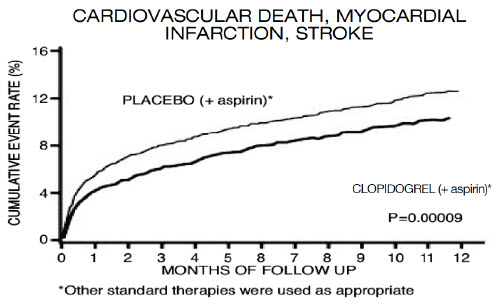
The number of patients experiencing the primary outcome (CV death, MI, or stroke) was 582 (9.3%) in the clopidogrel-treated group and 719 (11.4%) in the placebo-treated group, a 20% relative risk reduction (95% CI of 10% to 28%; p <0.001) for the clopidogrel-treated group (see Table 4).
Table 4: Outcome Events in the CURE Primary Analysis| Outcome | Clopidogrel
(+ aspirin)Other standard therapies were used as appropriate.
(n=6,259) | Placebo
(+ aspirin)
(n=6,303) | Relative Risk Reduction (%)
(95% CI) |
|---|
Primary outcome
(Cardiovascular death, MI, stroke) | 582 (9.3%) | 719 (11.4%) | 20%
(10.3, 27.9)
p <0.001 |
All Individual Outcome Events: The individual components do not represent a breakdown of the primary and coprimary outcomes, but rather the total number of subjects experiencing an event during the course of the study. | | | |
CV death | 318 (5.1%) | 345 (5.5%) | 7% (-7.7, 20.6) |
MI | 324 (5.2%) | 419 (6.6%) | 23% (11.0, 33.4) |
Stroke | 75 (1.2%) | 87 (1.4%) | 14% (-17.7, 36.6) |
Most of the benefit of clopidogrel occurred in the first two months, but the difference from placebo was maintained throughout the course of the trial (up to 12 months) (see Figure 2).
Figure 2: Cardiovascular Death, Myocardial Infarction, and Stroke in the CURE Study
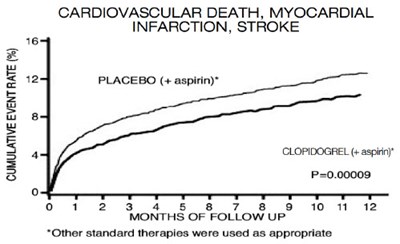
Figure 2 (Clopidogrel 03)
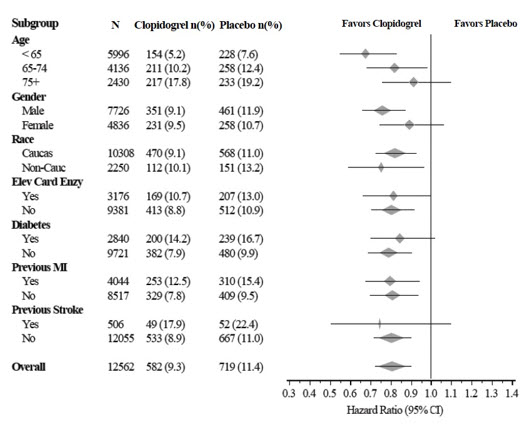
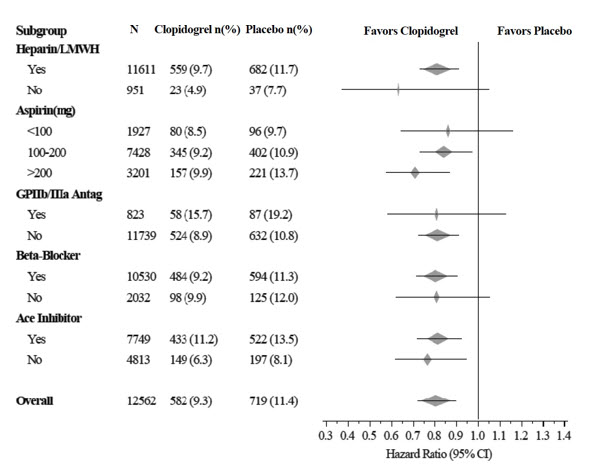
The effect of clopidogrel did not differ significantly in various subgroups, as shown in Figure 3. The benefits associated with clopidogrel were independent of the use of other acute and long-term cardiovascular therapies, including heparin/LMWH, intravenous glycoprotein IIb/IIIa (GPIIb/IIIa) inhibitors, lipid-lowering drugs, beta-blockers, and ACE inhibitors. The efficacy of clopidogrel was observed independently of the dose of aspirin (75 mg to 325 mg once daily). The use of oral anticoagulants, nonstudy antiplatelet drugs, and chronic NSAIDs was not allowed in CURE.
Figure 3: Hazard Ratio for Patient Baseline Characteristics and On-Study Concomitant Medications/Interventions for the CURE Study
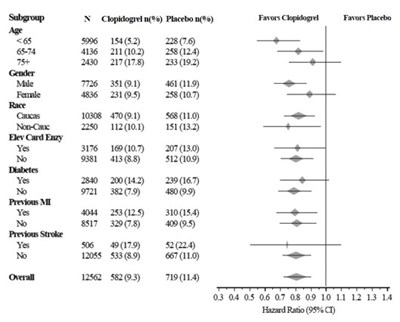
Figure 3 (Clopidogrel 04)
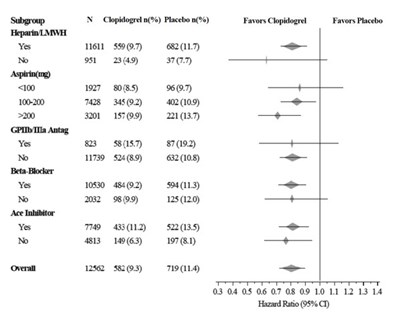
Figure 3 (Clopidogrel 05)
The use of clopidogrel in CURE was associated with a decrease in the use of thrombolytic therapy (71 patients [1.1%] in the clopidogrel group, 126 patients [2.0%] in the placebo group; relative risk reduction of 43%), and GPIIb/IIIa inhibitors (369 patients [5.9%] in the clopidogrel group, 454 patients [7.2%] in the placebo group, relative risk reduction of 18%). The use of clopidogrel in CURE did not affect the number of patients treated with CABG or PCI (with or without stenting) (2,253 patients [36.0%] in the clopidogrel group, 2,324 patients [36.9%] in the placebo group; relative risk reduction of 4.0%).
COMMIT
In patients with STEMI, the safety and efficacy of clopidogrel were evaluated in the randomized, placebo-controlled, double-blind study, COMMIT. COMMIT included 45,852 patients presenting within 24 hours of the onset of the symptoms of myocardial infarction with supporting ECG abnormalities (i.e., ST-elevation, ST-depression or left bundle-branch block). Patients were randomized to receive clopidogrel (75 mg once daily) or placebo, in combination with aspirin (162 mg per day), for 28 days or until hospital discharge, whichever came first.
The primary endpoints were death from any cause and the first occurrence of re-infarction, stroke or death. The patient population was 28% women and 58% age ≥60 years (26% age ≥ 70 years). Fifty-five percent (55%) of patients received thrombolytics and only 3% underwent PCI.
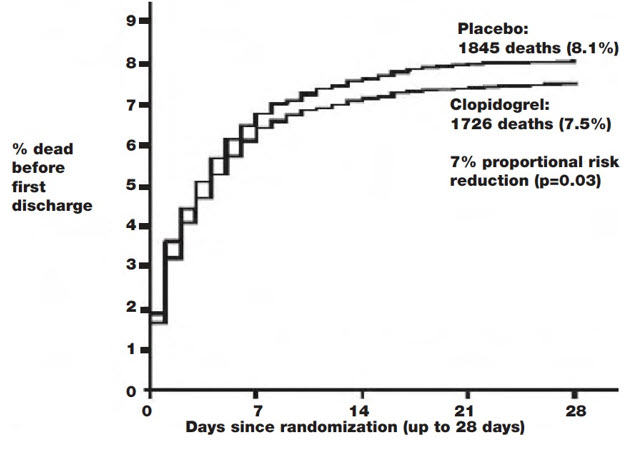
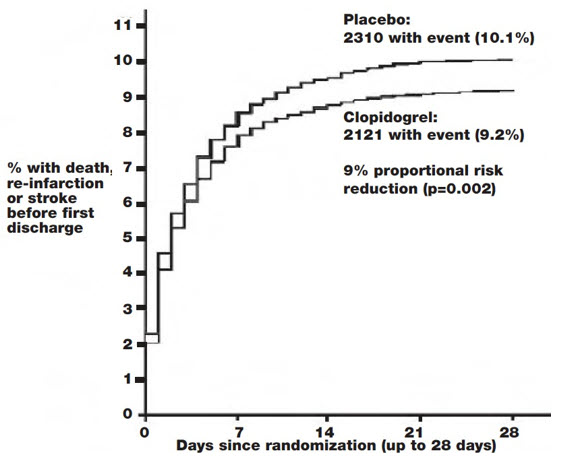
As shown in Table 5 and Figure 4 and Figure 5 below, clopidogrel significantly reduced the relative risk of death from any cause by 7% (p=0.029), and the relative risk of the combination of re- infarction, stroke or death by 9% (p=0.002).
Table 5: Outcome Events in COMMIT| Event | Clopidogrel
(+ aspirin)
(N=22,961) | Placebo
(+ aspirin)
(N=22,891) | Odds ratio
(95% CI) | p-value |
|---|
Composite endpoint: | | | | |
Death, MI, or Stroke 9 patients (2 clopidogrel and 7 placebo) suffered both a nonfatal stroke and a nonfatal MI. | 2,121(9.2%) | 2,310 (10.1%) | 0.91 (0.86, 0.97) | 0.002 |
Death | 1,726 (7.5%) | 1,845 (8.1 %) | 0.93 (0.87, 0.99) | 0.029 |
Non-fatal MI Nonfatal MI and nonfatal stroke exclude patients who died (of any cause). | 270 (1.2%) | 330 (1.4%) | 0.81 (0.69, 0.95) | 0.011 |
Non-fatal Stroke | 127 (0.6%) | 142 (0.6%) | 0.89 (0.70, 1.13) | 0.33 |
Figure 4: Cumulative Event Rates for Death in the COMMIT Study All treated patients received aspirin. |
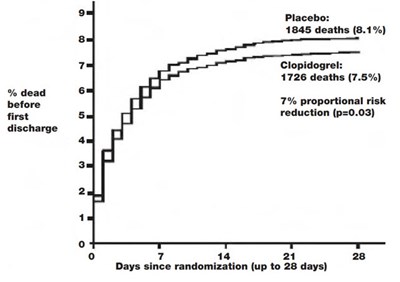 Figure 4 (Clopidogrel 06) |
Figure 5: Cumulative Event Rates for the Combined Endpoint Re-Infarction, Stroke or Death in the COMMIT Study All treated patients received aspirin. |
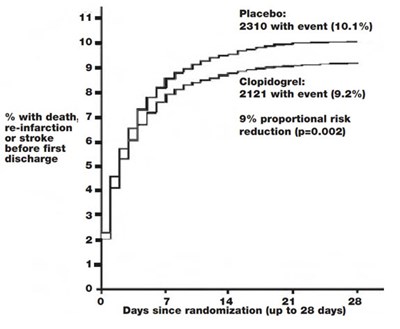 Figure 5 (Clopidogrel 07) |
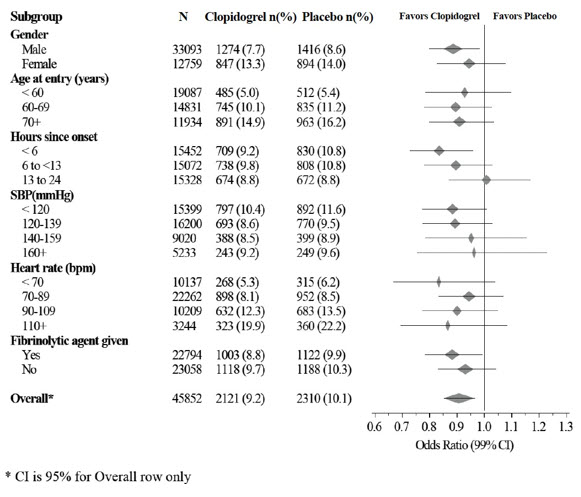
The effect of clopidogrel did not differ significantly in various prespecified subgroups as shown in Figure 6. The effect was also similar in non-prespecified subgroups including those based on infarct location, Killip class or prior MI history. Such subgroup analyses should be interpreted cautiously.
Figure 6: Effects of Adding Clopidogrel to Aspirin on the Combined Primary Endpoint across Baseline and Concomitant Medication Subgroups for the COMMIT Study
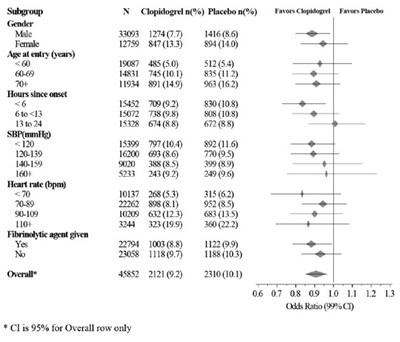
Figure 6 (Clopidogrel 08)
CAPRIE
The CAPRIE trial was a 19,185-patient, 304-center, international, randomized, double-blind, parallel-group study comparing clopidogrel (75 mg daily) to aspirin (325 mg daily). To be eligible to enroll, patients had to have: 1) recent history of myocardial infarction (within 35 days); 2) recent histories of ischemic stroke (within 6 months) with at least a week of residual neurological signs; and/or 3) established peripheral arterial disease (PAD). Patients received randomized treatment for an average of 1.6 years (maximum of 3 years).
The trial's primary outcome was the time to first occurrence of new ischemic stroke (fatal or not), new myocardial infarction (fatal or not), or other vascular death. Deaths not easily attributable to nonvascular causes were all classified as vascular.
Table 6: Outcome Events in the CAPRIE Primary Analysis| Patients | Clopidogrel
n=9,599 | Aspirin
n=9,586 |
|---|
Ischemic stroke (fatal or not) | 438 (4.6%) | 461 (4.8%) |
MI (fatal or not) | 275 (2.9%) | 333 (3.5%) |
Other vascular death | 226 (2.4%) | 226 (2.4%) |
Total | 939 (9.8%) | 1,020 (10.6%) |
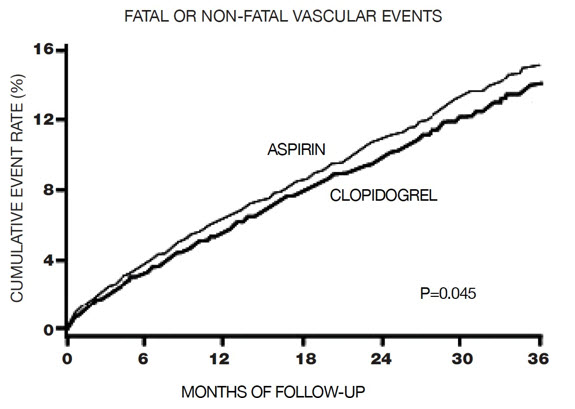
As shown in Table 6, clopidogrel was associated with a lower incidence of outcome events, primarily MI. The overall relative risk reduction (9.8% vs 10.6%) was 8.7%, p=0.045. Similar results were obtained when all-cause mortality and all-cause strokes were counted instead of vascular mortality and ischemic strokes (risk reduction 6.9%). In patients who survived an on-study stroke or myocardial infarction, the incidence of subsequent events was lower in the clopidogrel group.
The curves showing the overall event rate are shown in Figure 7. The event curves separated early and continued to diverge over the 3-year follow-up period.
Figure 7: Fatal or Nonfatal Vascular Events in the CAPRIE Study
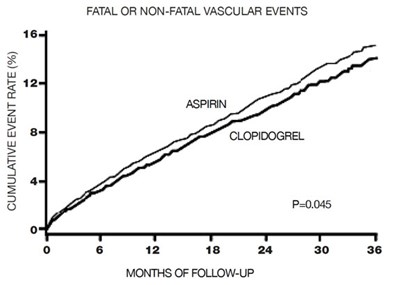
Figure 7 (Clopidogrel 09)
The statistical significance favoring clopidogrel over aspirin was marginal (p=0.045). However, because aspirin is itself effective in reducing cardiovascular events in patients with recent myocardial infarction or stroke, the effect of clopidogrel is substantial.
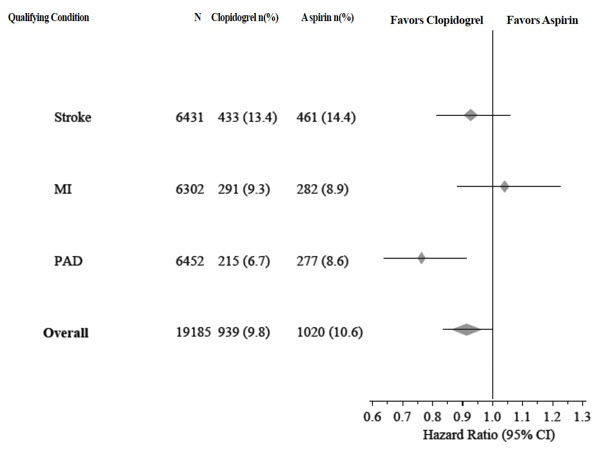
The CAPRIE trial enrolled a population that had recent MI, recent stroke, or PAD. The efficacy of clopidogrel relative to aspirin was heterogeneous across these subgroups (p=0.043) (see Figure 8). Nonetheless, this difference may be a chance occurrence because the CAPRIE trial was not designed to evaluate the relative benefit of clopidogrel over aspirin in the individual patient subgroups. The benefit was most apparent in patients who were enrolled because of peripheral arterial disease and less apparent in stroke patients. In patients who were enrolled in the trial on the sole basis of a recent myocardial infarction, clopidogrel was not numerically superior to aspirin.
Figure 8: Hazard Ratio and 95% CI by Baseline Subgroups in the CAPRIE Study
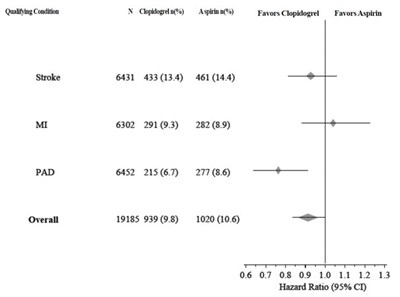
Figure 8 (Clopidogrel 10)
CHARISMA
The CHARISMA trial was a 15,603 subject, randomized, double-blind, parallel group study comparing clopidogrel (75 mg daily) to placebo for prevention of ischemic events in patients with vascular disease or multiple risk factors for atherosclerosis. All subjects were treated with aspirin 75 mg to 162 mg daily. The mean duration of treatment was 23 months. The study failed to demonstrate a reduction in the occurrence of the primary endpoint, a composite of CV death, MI, or stroke. A total of 534 (6.9%) patients in the clopidogrel group versus 573 (7.4%) patients in the placebo group experienced a primary outcome event (p=0.22). Bleeding of all severities was more common in the subjects randomized to clopidogrel.
Discontinuation
Advise patients not to discontinue clopidogrel without first discussing it with the healthcare provider who prescribed it [see Warnings and Precautions (5.3)].
Bleeding
Advise patients that they:
- will bruise and bleed more easily
- will take longer than usual to stop bleeding
- must report any unanticipated, prolonged, or excessive bleeding, or blood in their stool or urine [see Warnings and Precautions (5.2)]
Thrombotic Thrombocytopenic Purpura
Instruct patients to get prompt medical attention if they experience symptoms of TTP that cannot otherwise be explained [see Warnings and Precautions (5.4)].
Invasive Procedures
Advise patients to inform physicians and dentists that they are taking clopidogrel before any surgery or dental procedure [see Warnings and Precautions (5.2, 5.3)].
Proton Pump Inhibitors
Advise patients not to take omeprazole or esomeprazole while taking clopidogrel. Dexlansoprazole, lansoprazole, and pantoprazole had less pronounced effects on the antiplatelet activity of clopidogrel than did omeprazole or esomeprazole [see Drug Interactions (7.1)].
The brands listed are trademarks of their respective owners and are not trademarks of ScieGen Pharmaceuticals, Inc. The makers of these brands are not affiliated with and do not endorse ScieGen Pharmaceuticals, Inc., or its products.
Manufactured by:
ScieGen Pharmaceuticals, Inc.
Hauppauge, NY 11788 USA
Manufactured for:
Westminster Pharmaceuticals, LLC
Nashville, TN 37217 USA
Repackaged and Relabeled by:
Proficient Rx LP
Thousand Oaks, CA 91320
Rev. 7/2023