Other
| FACT SHEET FOR HEALTHCARE PROVIDERS: EMERGENCY USE AUTHORIZATION FOR GOHIBIC | ||
| HIGHLIGHTS OF EMERGENCY USE AUTHORIZATION (EUA) These highlights of the EUA do not include all the information needed to use GOHIBIC under the EUA. See FULL FACT SHEET FOR HEALTHCARE PROVDERS for GOHIBIC. | ---------------------DOSAGE FORMS AND STRENGTHS--------------------- Injection: 200 mg/20 mL (10 mg/mL) in single-dose vials for further dilution. (3) | |
| GOHIBIC (vilobelimab) injection, for intravenous use Original EUA Authorized Date: 04/2023 Revised EUA Authorized Date: 05/2023 | -------------------------------CONTRAINDICATIONS----------------------------- No contraindications have been identified based on limited available data on emergency use of GOHIBIC authorized under this EUA. (4) | |
| ------------------------RECENT MAJOR CHANGES----------------------- Emergency Use Authorization (1): revision to Information Regarding Available Alternatives for the EUA Authorized Use 05/2023 | ||
| --------EMERGENCY USE AUTHORIZATION FOR GOHIBIC------- The U.S. Food and Drug Administration has issued an EUA for the emergency use of GOHIBIC for the treatment of coronavirus disease 19 (COVID-19) in hospitalized adults when initiated within 48 hours of receiving invasive mechanical ventilation (IMV), or extracorporeal membrane oxygenation (ECMO). However, GOHIBIC is not FDA-approved for this use. (1) See Full Fact Sheet for Healthcare Providers for the justification for emergency use of drugs during the COVID-19 pandemic, information on available alternatives, and additional information on COVID-19. | ------------------------WARNINGS AND PRECAUTIONS----------------------- | |
| -------------------------------ADVERSE REACTIONS------------------------------ The most common adverse reactions (incidence ≥3%) are pneumonia, sepsis, delirium, pulmonary embolism, hypertension, pneumothorax, deep vein thrombosis, herpes simplex, enterococcal infection, bronchopulmonary aspergillosis, hepatic enzyme increased, urinary tract infection, hypoxia, thrombocytopenia, pneumomediastinum, respiratory tract infection, supraventricular tachycardia, constipation, and rash. (6.1) | ||
----------------------DOSAGE AND ADMINISTRATION------------------
| You or your designee must report all SERIOUS ADVERSE EVENTS or MEDICATION ERRORS potentially related to GOHIBIC by (1) submitting FDA Form 3500 online, (2) by downloading this form and then submitting by mail or fax, or (3) contacting the FDA at 1-800-FDA-1088 to request this form. Please also provide a copy of this form to InflaRx GmbH at [email protected] (6.3) | |
| Preparation and Administration | --------------------------USE IN SPECIFIC POPULATIONS---------------------
| |
| See PATIENT AND CAREGIVER FACT SHEET. | ||
| FULL PRESCRIBING INFORMATION: CONTENTS* | |
|
|
FULL FACT SHEET FOR HEALTHCARE PROVIDERS
Justification for Emergency Use of Drugs During the COVID-19 Pandemic
There is currently an outbreak of Coronavirus Disease 2019 (COVID-19) caused by SARS-CoV-2, a novel coronavirus. The Secretary of HHS has:
- Determined that there is a public health emergency, or significant potential for a public health emergency, related to COVID-19
See U.S. Department of Health and Human Services, Determination of a Public Health Emergency and Declaration that Circumstances Exist Justifying Authorizations Pursuant to Section 564(b) of the Federal Food, Drug, and Cosmetic Act, 21 U.S.C. § 360bbb-3. February 4, 2020; https://www.federalregister.gov/documents/2020/02/07/2020-02496/determination-of-public-health-emergency. See also U.S. Department of Health and Human Services, Amended Determination of a Public Health Emergency or Significant Potential for a Public Health Emergency Pursuant to Section 564(b) of the Federal Food, Drug, and Cosmetic Act, 21 U.S.C. § 360bbb-3(b). March 15, 2023 ("Amended Determination"); https://www.federalregister.gov/documents/2023/03/20/2023-05609/covid-19-emergency-use-authorization-declaration.
. - Declared that circumstances exist justifying the authorization of emergency use of drugs and biological products for the prevention or treatment of COVID-19
See U.S. Department of Health and Human Services, Declaration that Circumstances Exist Justifying Authorizations Pursuant to Section 564(b) of the Federal Food, Drug, and Cosmetic Act, 21 U.S.C. § 360bbb-3, 85 FR 18250 (April 1, 2020); https://www.federalregister.gov/documents/2020/04/01/2020-06905/emergency-use-authorization-declaration. See also Amended Determination ("The declarations issued pursuant to section 564(b)(1) of the FD&C Act that circumstances exist justifying the authorization of emergency use of certain in vitro diagnostics, personal respiratory protective devices, other medical devices and drugs and biological products, as set forth in those declarations, and that are based on the February 4, 2020 determination, remain in effect until those declarations are terminated in accordance with section 564 of the FD&C Act.").
. - The biological agent(s) can cause a serious or life-threatening disease or condition;
- Based on the totality of the available scientific evidence (including data from adequate and well-controlled clinical trials, if available), it is reasonable to believe that:
- The product may be effective in diagnosing, treating, or preventing the serious or life-threatening disease or condition; and
- The known and potential benefits of the product – when used to diagnose, prevent or treat such disease or condition – outweigh the known and potential risks of the product, taking into consideration the material threat posed by the biological agent(s)
- There is no adequate, approved, and available alternative to the product for diagnosing, preventing, or treating the serious or life-threatening disease or condition.
- For the recommended dose of 800 mg GOHIBIC, dilute 80 mL of GOHIBIC in 170 mL of 0.9% Sodium Chloride at room temperature.
- Use a 250 mL infusion bag of 0.9% Sodium Chloride solution USP and the follow steps below:
- Withdraw 80 mL of 0.9% Sodium Chloride solution USP from the infusion bag and discard.
- Withdraw the 80 mL of GOHIBIC from the vials and add slowly to the 0.9% Sodium Chloride solution USP infusion bag to a final concentration of 3.2 mg/mL.
- To mix the solution, gently invert the bag to avoid foaming.
- Diluted GOHIBIC must be used within 4 hours when stored at room temperature 20°C to 25°C (68°F to 77°F).
- Diluted GOHIBIC stored under refrigeration at 2°C to 8°C (36°F to 46°F) must be used within 24 hours.
- After removal of diluted GOHIBIC from the refrigerator stored at 2°C to 8°C (36°F to 46°F), it must be left to acclimatize to room temperature prior to administration.
- Visually inspect for particulate matter and discoloration prior to administration, whenever solution and container permit. Do not use if discoloration or visible particles are present.
- Administer diluted GOHIBIC via intravenous infusion over 30 - 60 minutes.
- Avoid concomitant administration of GOHIBIC with other drugs in the same intravenous line.
An EUA is a FDA authorization for the emergency use of an unapproved product or unapproved use of an approved product (i.e., drug, biological product, or device) in the United States under certain circumstances, including, but not limited to, when the Secretary of HHS declares that there is a public health emergency, or significant potential for a public health emergency that affects the national security or the health and security of United States citizens living abroad, and that involves biological agent(s) or a disease or condition that may be attributable to such agent(s). Criteria for issuing an EUA include:
Information Regarding Available Alternatives for the EUA Authorized Use This section only describes the uses for which an FDA-approved drug is considered to be an alternative to GOHIBIC. For additional information, including the full indications for the FDA-approved drugs referenced within this section, please refer to the relevant Prescribing Information at: Drugs@FDA: FDA-Approved Drugs. As stated in the Letter of Authorization, the emergency use of GOHIBIC must be consistent with the terms and conditions of its authorization.
Veklury (remdesivir), a SARS-CoV-2 nucleotide analog RNA polymerase inhibitor, is an FDA-approved alternative to GOHIBIC when used for the treatment of COVID-19 in hospitalized adults and when initiated within 48 hours of receiving IMV, or ECMO. Veklury has demonstrated antiviral activity against SARS-CoV-2; whereas GOHIBIC acts by binding to C5a to block its interaction with the C5a receptor, both of which are components of the complement system thought to contribute to inflammation and worsening of COVID-19, offering a different mechanism of action.
Olumiant (baricitinib), a Janus kinase (JAK) inhibitor, is an FDA-approved alternative to GOHIBIC when used for the treatment of COVID-19 in hospitalized adults and when initiated within 48 hours of requiring IMV, or ECMO. As noted, GOHIBIC offers a different mechanism of action. In addition, GOHIBIC has an intravenous route of administration; whereas, Olumiant is available as tablets, offering an alternative route of administration to adult patients who are mechanically ventilated or on ECMO.
Actemra (tocilizumab), an interleukin-6 (IL-6) receptor antagonist, is an FDA-approved alternative to GOHIBIC when used for the treatment of COVID-19 in hospitalized adults and when initiated within 48 hours of receiving IMV, or ECMO. As noted, GOHIBIC offers a different mechanism of action.
Other therapeutics are currently authorized for the same use as GOHIBIC. For additional information on all products authorized for the treatment of COVID-19, please see https://www.fda.gov/emergency-preparedness-and-response/mcm-legal-regulatory-and-policy-framework/emergency-use-authorization.
For information on clinical studies of GOHIBIC and other therapies for the treatment of COVID-19, see www.clinicaltrials.gov.
Preparation
Using aseptic technique, dilute and prepare GOHIBIC for intravenous infusion before administration.
Storage of Diluted GOHIBIC
Administration
Risk Summary
There are no available data on GOHIBIC use in pregnant women to evaluate for a drug-associated risk of major birth defects, miscarriage or other adverse maternal or fetal outcomes. Placental transfer of monoclonal antibodies such as GOHIBIC is greater during the third trimester of pregnancy; therefore, potential effects on a fetus are likely to be greater during the third trimester of pregnancy. In an enhanced pre- and post-natal (ePPND) study conducted in cynomolgus monkeys, placental transport of GOHIBIC was observed but there was no evidence of fetal harm following intravenous administration of GOHIBIC throughout pregnancy at doses 2.5 times the maximum recommended human dose (MRHD) of 800 mg on a mg/kg basis (see Data).
The estimated background risk of major birth defects and miscarriage for the indicated population is unknown. All pregnancies have a background risk of birth defect, loss, or other adverse outcomes. In the U.S. general population, the estimated background risk for major birth defects and miscarriage in clinical recognized pregnancies is 2% - 4% and 15% - 20%, respectively.
Data
Animal Data
In the ePPND study, pregnant cynomolgus monkeys received GOHIBIC from GD20 to GD22 (dependent on pregnancy determination), at the beginning of organogenesis, and once every 7 days until the end of gestation at intravenous doses up to 50.6 mg/kg/wk (2.5 times the MRHD on a mg/kg basis). There were no GOHIBIC-related adverse effects on maternal health, pregnancy outcome, embryo-fetal development, or neonatal growth and development up to 6 months of age (PND183). GOHIBIC crossed the placenta in cynomolgus monkeys and GOHIBIC plasma concentrations were similar in infants relative to maternal animals on PND28 and were 8-12 times higher in infants relative to maternal animals on PND91. GOHIBIC was not detected in infant plasma on PND183.
Risk Summary
There are no available data on the presence of GOHIBIC in either human or animal milk, the effects on the breastfed infant, or the effects on milk production.
Maternal IgG is known to be present in human milk. The effects of local gastrointestinal exposure and limited systemic exposure in the breastfed infant to GOHIBIC are unknown.
The lack of clinical data during lactation precludes clear determination of the risk of GOHIBIC to an infant during lactation. Therefore, the developmental and health benefits of breastfeeding should be considered along with the mother's clinical need for GOHIBIC and any potential adverse effects on the breastfed child from GOHIBIC or from the underlying maternal condition.
Drug Interaction Studies
No drug interaction studies have been conducted with GOHIBIC.
How supplied
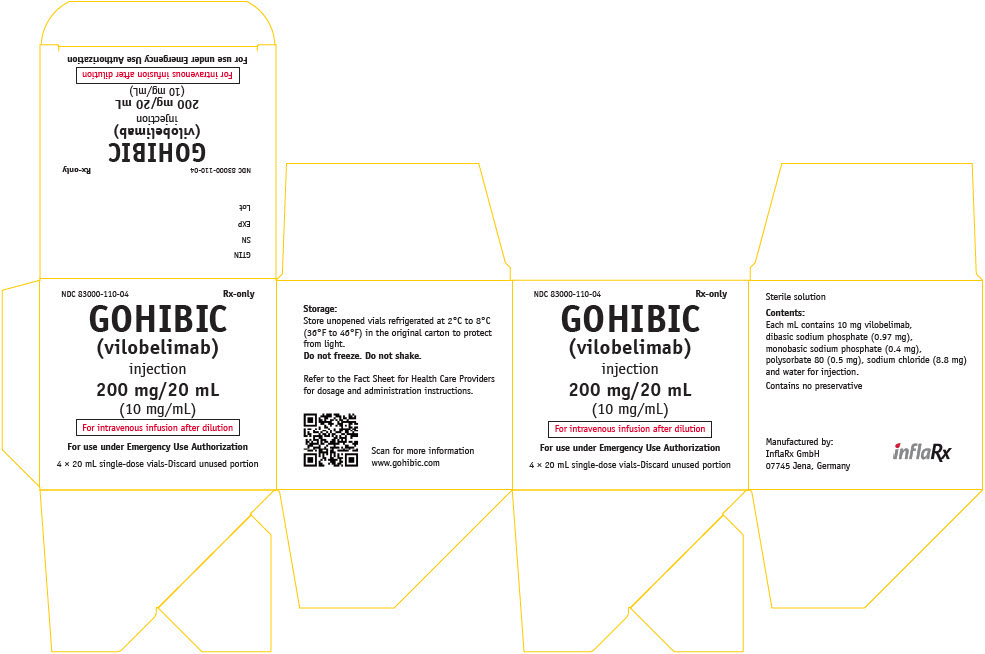
GOHIBIC (vilobelimab) 200 mg/20 mL (10 mg/mL) injection is a clear to slightly opalescent, colorless solution in a single-dose vial (NDC 83000-110-04).