The data below reflect exposure to one-year trastuzumab therapy across three randomized, open-label studies, Studies 1, 2, and 3, with (n = 3678) or without (n = 3363) trastuzumab in the adjuvant treatment of breast cancer.
The data summarized in Table 3 below, from Study 3, reflect exposure to trastuzumab in 1678 patients; the median treatment duration was 51 weeks and median number of infusions was 18. Among the 3386 patients enrolled in the observation and one-year trastuzumab arms of Study 3 at a median duration of follow-up of 12.6 months in the trastuzumab arm, the median age was 49 years (range: 21 to 80 years), 83% of patients were Caucasian, and 13% were Asian.
Table 3 Adverse Reactions for Study 3Median follow-up duration of 12.6 months in the one-year trastuzumab treatment arm.
, All GradesThe incidence of Grade 3 or higher adverse reactions was < 1% in both arms for each listed term.
Adverse Reaction | One year Trastuzumab (n = 1678) | Observation (n = 1708) |
Cardiac | | |
Hypertension | 64 (4%) | 35 (2%) |
Dizziness | 60 (4%) | 29 (2%) |
Ejection Fraction Decreased | 58 (3.5%) | 11 (0.6%) |
Palpitations | 48 (3%) | 12 (0.7%) |
Cardiac Arrhythmias Higher level grouping term. | 40 (3%) | 17 (1%) |
Cardiac Failure Congestive | 30 (2%) | 5 (0.3%) |
Cardiac Failure | 9 (0.5%) | 4 (0.2%) |
Cardiac Disorder | 5 (0.3%) | 0 (0%) |
Ventricular Dysfunction | 4 (0.2%) | 0 (0%) |
Respiratory Thoracic Mediastinal Disorders | | |
Cough | 81 (5%) | 34 (2%) |
Influenza | 70 (4%) | 9 (0.5%) |
Dyspnea | 57 (3%) | 26 (2%) |
URI | 46 (3%) | 20 (1%) |
Rhinitis | 36 (2%) | 6 (0.4%) |
Pharyngolaryngeal Pain | 32 (2%) | 8 (0.5%) |
Sinusitis | 26 (2%) | 5 (0.3%) |
Epistaxis | 25 (2%) | 1 (0.06%) |
Pulmonary Hypertension | 4 (0.2%) | 0 (0%) |
Interstitial Pneumonitis | 4 (0.2%) | 0 (0%) |
Gastrointestinal Disorders | | |
Diarrhea | 123 (7%) | 16 (1%) |
Nausea | 108 (6%) | 19 (1%) |
Vomiting | 58 (3.5%) | 10 (0.6%) |
Constipation | 33 (2%) | 17 (1%) |
Dyspepsia | 30 (2%) | 9 (0.5%) |
Upper Abdominal Pain | 29 (2%) | 15 (1%) |
Musculoskeletal & Connective Tissue Disorders | | |
Arthralgia | 137 (8%) | 98 (6%) |
Back Pain | 91 (5%) | 58 (3%) |
Myalgia | 63 (4%) | 17 (1%) |
Bone Pain | 49 (3%) | 26 (2%) |
Muscle Spasm | 46 (3%) | 3 (0.2%) |
Nervous System Disorders | | |
Headache | 162 (10%) | 49 (3%) |
Paraesthesia | 29 (2%) | 11 (0.6%) |
Skin & Subcutaneous Tissue Disorders | | |
Rash | 70 (4%) | 10 (0.6%) |
Nail Disorders | 43 (2%) | 0 (0%) |
Pruritus | 40 (2%) | 10 (0.6%) |
General Disorders | | |
Pyrexia | 100 (6%) | 6 (0.4%) |
Edema Peripheral | 79 (5%) | 37 (2%) |
Chills | 85 (5%) | 0 (0%) |
Asthenia | 75 (4.5%) | 30 (2%) |
Influenza-like Illness | 40 (2%) | 3 (0.2%) |
Sudden Death | 1 (0.06%) | 0 (0%) |
Infections | | |
Nasopharyngitis | 135 (8%) | |
UTI | 39 (3%) | |
Immune System Disorders | | |
Hypersensitivity | 10 (0.6%) | 1 (0.06%) |
Autoimmune Thyroiditis | 4 (0.3%) | 0 (0%) |
In Study 3, a comparison of 3-weekly trastuzumab treatment for two years versus one year was also performed. The rate of asymptomatic cardiac dysfunction was increased in the 2-year trastuzumab treatment arm (8.1% versus 4.6% in the one-year trastuzumab treatment arm). More patients experienced at least one adverse reaction of Grade 3 or higher in the 2-year trastuzumab treatment arm (20.4%) compared with the one-year trastuzumab treatment arm (16.3%).
The safety data from Studies 1 and 2 were obtained from 3655 patients, of whom 2000 received trastuzumab; the median treatment duration was 51 weeks. The median age was 49 years (range: 24 to 80); 84% of patients were White, 7% Black, 4% Hispanic, and 3% Asian.
In Study 1, only Grade 3 to 5 adverse events, treatment-related Grade 2 events, and Grade 2−5 dyspnea were collected during and for up to 3 months following protocol-specified treatment. The following non-cardiac adverse reactions of Grade 2 to 5 occurred at an incidence of at least 2% greater among patients receiving trastuzumab plus chemotherapy as compared to chemotherapy alone: fatigue (29.5% vs. 22.4%), infection (24.0% vs. 12.8%), hot flashes (17.1% vs. 15.0%), anemia (12.3% vs. 6.7%), dyspnea (11.8% vs. 4.6%), rash/desquamation (10.9% vs. 7.6%), leukopenia (10.5% vs. 8.4%), neutropenia (6.4% vs. 4.3%), headache (6.2% vs. 3.8%), pain (5.5% vs. 3.0%), edema (4.7% vs. 2.7%) and insomnia (4.3% vs. 1.5%). The majority of these events were Grade 2 in severity.
In Study 2, data collection was limited to the following investigator-attributed treatment-related adverse reactions: NCI-CTC Grade 4 and 5 hematologic toxicities, Grade 3 to 5 non-hematologic toxicities, selected Grade 2 to 5 toxicities associated with taxanes (myalgia, arthralgias, nail changes, motor neuropathy, sensory neuropathy) and Grade 1 to 5 cardiac toxicities occurring during chemotherapy and/or trastuzumab treatment. The following non-cardiac adverse reactions of Grade 2 to 5 occurred at an incidence of at least 2% greater among patients receiving trastuzumab plus chemotherapy as compared to chemotherapy alone: arthralgia (12.2% vs. 9.1%), nail changes (11.5% vs.6.8%), dyspnea (2.4% vs. 0.2%), and diarrhea (2.2% vs. 0%). The majority of these events were Grade 2 in severity.
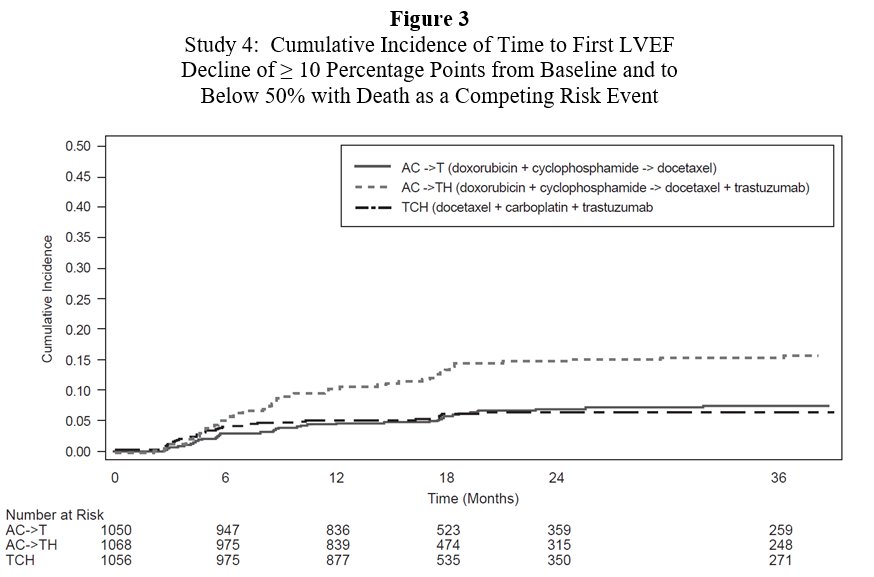
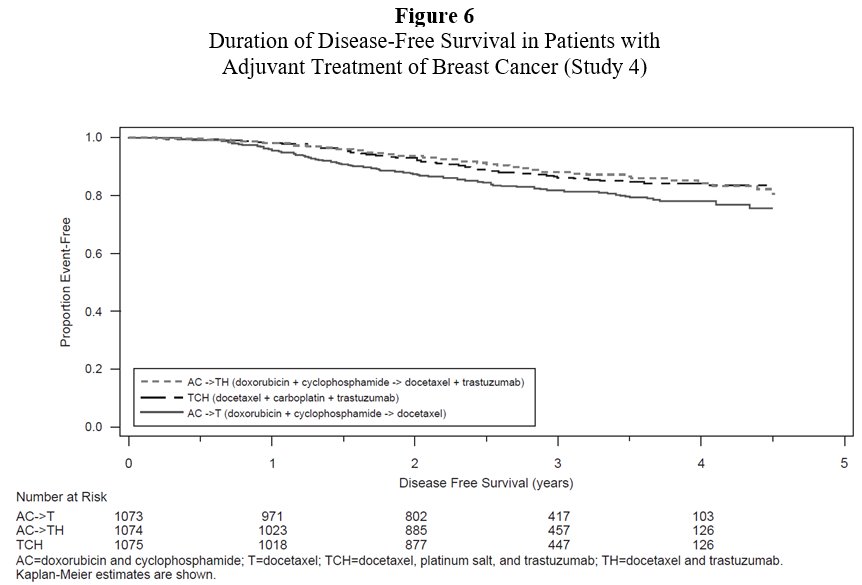
Safety data from Study 4 reflect exposure to trastuzumab as part of an adjuvant treatment regimen from 2124 patients receiving at least one dose of study treatment [AC-TH: n = 1068; TCH: n = 1056]. The overall median treatment duration was 54 weeks in both the AC-TH and TCH arms. The median number of infusions was 26 in the AC-TH arm and 30 in the TCH arm, including weekly infusions during the chemotherapy phase and every three week dosing in the monotherapy period. Among these patients, the median age was 49 years (range 22 to 74 years). In Study 4, the toxicity profile was similar to that reported in Studies 1, 2, and 3 with the exception of a low incidence of CHF in the TCH arm.