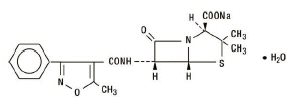
Other
For Intramuscular or Intravenous Injection
Rx only
To reduce the development of drug-resistant bacteria and maintain the effectiveness of oxacillin for injection and other antibacterial drugs, oxacillin for injection should be used only to treat or prevent infections that are proven or strongly suspected to be caused by bacteria.
Oxacillin should generally not be administered to patients with a history of sensitivity to any penicillin. Penicillin should be used with caution in individuals with histories of significant allergies and/or asthma. Whenever allergic reactions occur, penicillin should be withdrawn unless, in the opinion of the physician, the condition being treated is life-threatening and amenable only to penicillin therapy. The use of antibiotics may result in overgrowth of nonsusceptible organisms. If new infections due to bacteria or fungi occur, the drug should be discontinued and appropriate measures taken.
Prescribing Oxacillin for Injection, USP in the absence of a proven or strongly suspected bacterial infection or a prophylactic indication is unlikely to provide benefit to the patient and increases the risk of the development of drug-resistant bacteria.
For Intramuscular Use:Use Sterile Water for Injection, USP. Add 5.7 mL to the 1 gram vial and 11.5 mL to the 2 gram vial. Shake well until a clear solution is obtained. After reconstitution, vials will contain 250 mg of active drug per 1.5 mL of solution. The reconstituted solution is stable for 3 days at 70°F or for one week under refrigeration (40° F)
For Direct Intravenous Use:Use Sterile Water for Injection, USP or Sodium Chloride Injection, USP. Add 10 mL to the 1 gram vial and 20 mL to the 2 gram vial. Withdraw the entire contents and administer slowly over a period of approximately10 minutes.
For Administration by Intravenous Drip:Reconstitute as directed above ( For Direct Intravenous Use) prior to diluting with Intravenous Solution.
STABILITY PERIODS FOR OXACILLIN FOR INJECTION, USP
Concentration mg/mL | Sterile water for Injection | 0.9% sodium chloride Injection, USP | M/6 Molar Sodium Lactate Solution | 5% Dextrose in water | 5% Dextrose in 0.45% sodium chloride | 10% Invert Sugar Injection, USP | Lactated Ringers Solution |
ROOM TEMPERATURE (25° C) | |||||||
10 to100 | 4 Days | 4 Days | |||||
10 to 30 | 24 Hrs | 24 Hrs | |||||
0.5 to 2 | 6 Hrs | 6 Hrs | 6 Hrs | ||||
REFRIGERATION (4° C) | |||||||
10 to 100 | 7 Days | 7 Days | |||||
10 to 30 | 4 Days | 4 Days | 4 Days | 4 days | 4 Days | ||
FROZEN (-15° C) | |||||||
50 to 100 | 30 Days | ||||||
250/1.5 mL | 30 Days | ||||||
100 | 30 Days | ||||||
10 to 100 | 30 Days | 30 Days | 30 Days | 30 Days | 30 Days | ||
Stability studies on oxacillin sodium at concentrations of 0.5 mg/mL and 2 mg/mL in various intravenous solutions listed below indicate the drug will lose less than 10% activity at room temperature (70°F) during a 6-hour period.
IV Solution
5% Dextrose in Normal Saline
10% D-Fructose in Water
10% D-Fructose in Normal Saline
Lactated Potassic Saline Injection
10% Invert Sugar in Normal Saline
10% Invert Sugar Plus 0.3% Potassium Chloride in Water
Travert 10% Electrolyte #1
Travert 10% Electrolyte #2
Travert 10% Electrolyte #3
Only those solutions listed above should be used for the intravenous infusion of oxacillin sodium. The concentration of the antibiotic should fall within the range specified. The drug concentration and the rate and volume of the infusion should be adjusted so that the total dose of oxacillin is administered before the drug loses its stability in the solution in use.
If another agent is used in conjunction with oxacillin therapy, it should not be physically mixedwith oxacillin but should be administered separately.
Parenteral drug products should be inspected visually for particulate matter and discoloration prior to administration whenever solution and container permit.
Do not add supplementary medication to oxacillin for injection, USP.