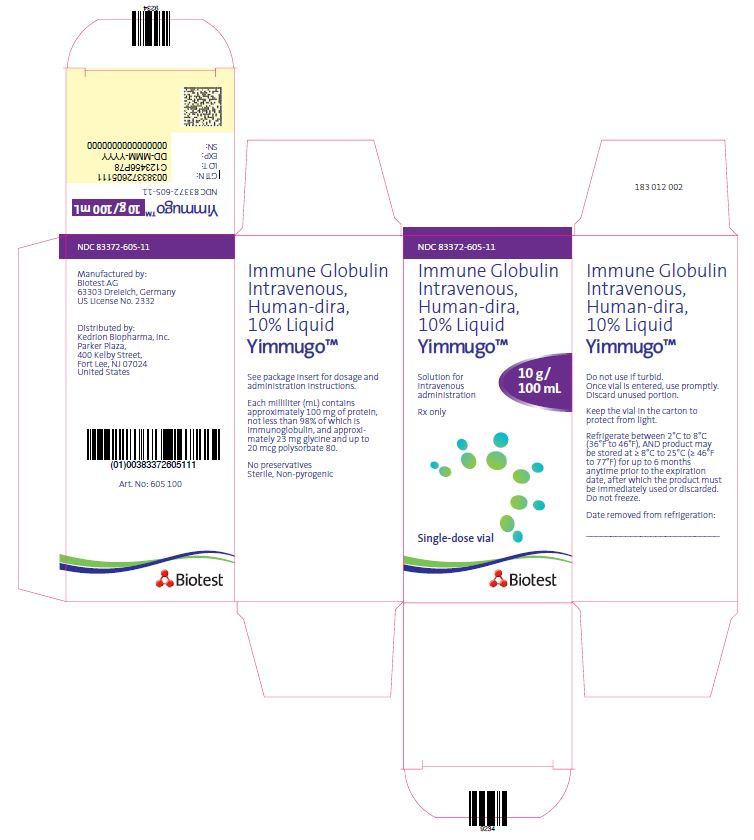
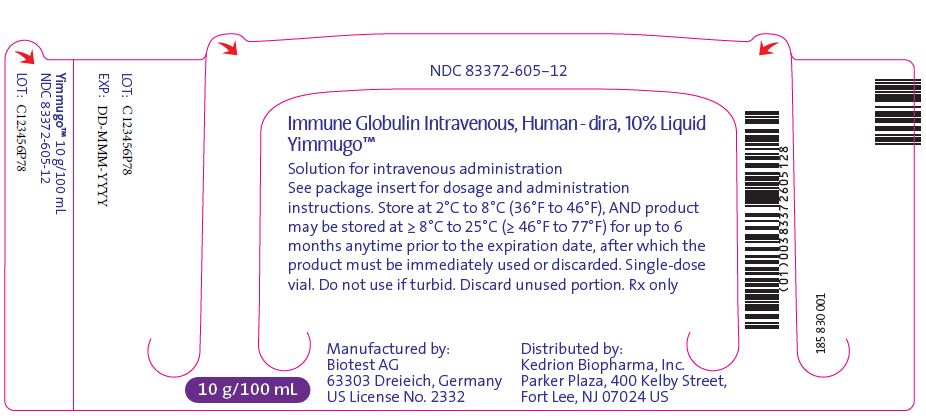
YIMMUGO, immune globulin intravenous, human – dira, is a highly purified, sterile, non-pyrogenic, ready-to-use 10% liquid preparation of concentrated polyclonal human immune globulin G (IgG) antibodies for intravenous administration. The product is a clear to slightly opalescent liquid, which is colorless to pale yellow. The active ingredient is human IgG purified from human Source Plasma and processed using a combination of cold ethanol fractionation, caprylic acid precipitation, as well as anion and cation exchange chromatography. YIMMUGO contains 100 ± 10 mg/mL protein, of which not less than 96% is IgG. The distribution of IgG subclasses is similar to that of normal plasma. YIMMUGO is formulated in water for injection containing 0.27 to 0.33 mmol/mL glycine, 2 to 20 mcg/mL polysorbate 80, with pH 4.4 to 5.2 and osmolality ranges of 280 to 380 mOsmol/kg. YIMMUGO contains not more than 300 mcg/mL of IgA. YIMMUGO does not contain carbohydrate stabilizers (e.g., sucrose, maltose) or preservatives.
YIMMUGO is prepared from pooled plasma obtained from healthy volunteer donors. Each plasma donation used for the manufacture of YIMMUGO is collected from FDA-licensed facilities. Plasma donations must test negative for hepatitis B virus (HBV) surface antigen (HBsAg), antibodies to human immunodeficiency virus (HIV) strains 1 and 2 (anti-HIV-1/2), and antibodies to the hepatitis C virus (anti-HCV) as determined by enzyme immunoassay (EIA). In addition, samples from manufacturing pools must test non-reactive for HIV RNA, HCV RNA, HBV DNA and Hepatitis A Virus (HAV) RNA, by Nucleic Acid Amplification Testing (NAT). Parvovirus B19 (B19V) DNA is also tested by NAT and must not exceed 10
4 IU/mL in the manufacturing pool.
The manufacturing process of YIMMUGO employs several steps to remove/inactivate adventitious viruses to further increase the margins of safety. These steps include caprylic acid, low pH treatment, anion exchange chromatography (AEX) and nanofiltration. Virus clearance studies with a scaled-down process have been performed for these steps to determine their capacity to inactivate or remove both enveloped and non-enveloped viruses. The results are shown in Table 3.
Table 3: Virus Clearance Data (Log
10) for YIMMUGO for enveloped (HIV, BVDV, PRV) and non-enveloped viruses (HAV, EMCV, B19V, PPV, HEV)
Test Virus →
↓ Step
| HIV | BVDV | PRV | HAV | EMCV | B19V* | PPV | HEV* |
Caprylic Acid
Treatment
| ≥ 5.64 | ≥ 5.97 | ≥ 6.21 | ≥ 4.39 | n.d. | 2.48 | 1.01 | ≥ 4.96 |
| Low pH Treatment |
≥ 6.63 | < 1 | n.d. | n.d. | n.d. | n.d. | < 1 | n.d. |
Anion Exchange
Chromatography
| n.d. | 2.62 | n.d. | ≥ 3.95 | n.d. | ≥ 5.86 | 3.21 | n.d. |
| Virus Filtration | ≥ 4.72 | ≥ 4.72 | n.d. | ≥ 4.37 | ≥ 4.93 | ≥ 4.33 | 6.12 | n.d. |
Total Virus
Clearance†
| ≥ 16.99 | ≥ 13.31 | ≥ 6.21 | ≥ 12.71 | ≥ 4.93 | ≥ 12.67 | 10.34 | ≥ 4.96 |
n.d. not determined.
* Polymerase chain reaction (PCR) was used to quantify B19V and HEV genome counts (all other viruses were quantified by in-vitro infectivity assays, using mammalian cell lines).
† Log
10 reduction factors of 1 or smaller were not considered for calculation of total virus clearance.
BVDV, bovine viral diarrhea virus, a model for hepatitis C virus;
PRV, pseudorabies virus, a model for hepatitis B virus;
EMCV, encephalomyocarditis virus, a model for hepatitis A virus;
B19V, parvovirus B19;
PPV, porcine parvovirus, a model for B19V;
HEV, hepatitis E virus.
The manufacturing process was also investigated for its capacity to decrease the infectivity of an experimental agent of transmissible spongiform encephalopathy (TSE), considered a model for CJD and its variant vCJD. Several of the production steps have been shown to decrease TSE infectivity of the experimental model agent. TSE reduction steps include caprylic acid treatment followed by depth filtration (in sequence, a total of ≥ 5.99 log
10). These studies provide reasonable assurance that low levels of vCJD/CJD agent infectivity, if present in the starting material, would be removed.