Because clinical trials are conducted under widely varying conditions, adverse reaction rates observed in the clinical trials of a drug cannot be directly compared with rates in the clinical trials of another drug and may not reflect the rates observed in clinical practice.
Secondary Hyperparathyroidism in Patients with Chronic Kidney Disease on Dialysis
In three double-blind, placebo-controlled clinical trials, 1126 patients with CKD on dialysis received study drug (656 cinacalcet, 470 placebo) for up to 6 months. The most frequently reported adverse reactions are listed in Table 1.
Seizures were observed in 1.4% (13/910) of cinacalcet-treated patients and 0.7% (5/641) of placebo-treated patients across all completed placebo-controlled trials.
Table 1. Adverse Reactions with Frequency ≥5% in Patients on Dialysis in Short-Term Studies for up to 6 Months
| * Included are events that were reported at a greater incidence in the cinacalcet group than in the placebo group. |
Event*:
| Placebo
(n=470)
(%)
| Cinacalcet
(n=656)
(%)
|
Nausea
Vomiting
Diarrhea
Myalgia
Dizziness
Hypertension
Asthenia
Anorexia
Pain Chest, Non-Cardiac
Dialysis Access Site Infection
| 19
15
20
14
8
5
4
4
4
4
| 31
27
21
15
10
7
7
6
6
5
|
In a randomized, double-blind placebo-controlled study of 3883 patients with secondary HPT and CKD receiving dialysis in which patients were treated for up to 64 months (mean duration of treatment was 21 months in the cinacalcet group), the most frequently reported adverse reactions (incidence of ≥ 5% in the cinacalcet group and a difference ≥ 1% compared to placebo) are listed in Table 2.
Table 2. Frequency of Adverse Reactions in Dialysis Patients Treated for up to 64 Months in a Long-Term Study11 Adverse reactions that occurred in ≥ 5% frequency in the cinacalcet group and a difference ≥ 1% compared to the placebo group (Safety Analysis Set).
Crude incidence rate = 100 * Total number of subjects with event/ n
n=Number of subjects receiving at least one dose of study drug.
|
| Placebo (n=1923)
| Cinacalcet (n=1938)
|
3699 subject-years
| 4044 subject-years
|
Percent of subjects reporting Adverse Reactions (%)
| 90.9
| 93.2
|
Nausea
| 15.5
| 29.1
|
Vomiting
| 13.7
| 25.6
|
Diarrhea
| 18.7
| 20.5
|
Dyspnea
| 11.5
| 13.4
|
Cough
| 9.8
| 11.7
|
Hypotension
| 10.5
| 11.6
|
Headache
| 9.6
| 11.5
|
Hypocalcemia
| 1.4
| 11.2
|
Muscle spasms
| 9.2
| 11.1
|
Abdominal pain
| 9.6
| 10.9
|
Abdominal pain upper
| 6.3
| 8.2
|
Hyperkalemia
| 6.1
| 8.1
|
Upper respiratory tract infection
| 6.3
| 7.6
|
Dyspepsia
| 4.6
| 7.4
|
Dizziness
| 4.7
| 7.3
|
Decreased appetite
| 3.5
| 5.9
|
Asthenia
| 3.8
| 5.4
|
Constipation
| 3.8
| 5
|
Additional adverse reaction rates from the long-term, randomized, double-blind placebo-controlled study for cinacalcet versus placebo are as follows: seizure (2.5%, 1.6%), rash (2.2%, 1.9%), hypersensitivity reactions (9.4%, 8.3%).
Patients with Parathyroid Carcinoma and Primary Hyperparathyroidism
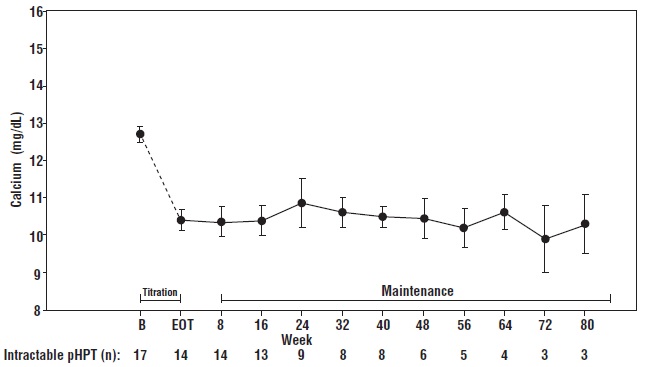
The safety profile of cinacalcet in these patient populations is generally consistent with that seen in patients with CKD on dialysis. Forty six patients were treated with cinacalcet in a single-arm study, 29 with Parathyroid Carcinoma and 17 with intractable pHPT. Nine (20%) of the patients withdrew from the study due to adverse events. The most frequent adverse reactions and the most frequent cause of withdrawal in these patient populations were nausea and vomiting. Severe or prolonged cases of nausea and vomiting can lead to dehydration and worsening hypercalcemia so careful monitoring of electrolytes is recommended in patients with these symptoms.
Eight patients died during treatment with cinacalcet in this study, 7 with Parathyroid Carcinoma (24%) and 1 (6%) with intractable pHPT. Causes of death were cardiovascular (5 patients), multi-organ failure (1 patient), gastrointestinal hemorrhage (1 patient) and metastatic carcinoma (1 patient). Adverse events of hypocalcemia were reported in three patients (7%).
Seizures were observed in 0.7% (1/140) of cinacalcet-treated patients and 0% (0/46) of placebo-treated patients in all clinical studies.
Table 3. Adverse Reactions with Frequency ≥10% in a Single-Arm, Open-Label Study in Patients with Primary Hyperparathyroidism or Parathyroid Carcinoma
n=Number of subjects receiving at least one dose of study drug.
pHPT=primary hyperparathyroidism. |
| Cinacalcet
|
Parathyroid
Carcinoma
(n=29)
| Intractable
pHPT
(n=17)
| Total
(n=46)
|
n (%)
| n (%)
| n (%)
|
Number of Subjects Reporting Adverse Reactions
Nausea
Vomiting
Paresthesia
Fatigue
Fracture
Hypercalcemia
Anorexia
Asthenia
Dehydration
Anemia
Arthralgia
Constipation
Depression
Headache
Infection Upper Respiratory
Pain Limb
| 28 (97)
19 (66)
15 (52)
4 (14)
6 (21)
6 (21)
6 (21)
6 (21)
5 (17)
7 (24)
5 (17)
5 (17)
3 (10)
3 (10)
6 (21)
3 (10)
3 (10)
| 17 (100)
10 (59)
6 (35)
5 (29)
2 (12)
2 (12)
2 (12)
1 (6)
2 (12)
0 (0)
1 (6)
1 (6)
3 (18)
3 (18)
0 (0)
2 (12)
2 (12)
| 45 (98)
29 (63)
21 (46)
9 (20)
8 (17)
8 (17)
8 (17)
7 (15)
7 (15)
7 (15)
6 (13)
6 (13)
6 (13)
6 (13)
6 (13)
5 (11)
5 (11)
|
In a randomized double-blind, placebo-controlled study of 67 patients with primary hyperparathyroidism for whom parathyroidectomy would be indicated on the basis of serum calcium levels, but who are unable to undergo surgery, the most common adverse reactions are listed in Table 4.
Table 4. Adverse Reactions Occurring in ≥ 10% of Subjects in a Double-Blind, Placebo-Controlled Study in Patients with Primary Hyperparathyroidism
| n = Number of subjects receiving at least one dose of study drug Coded using MedDRA version 16.0. |
Adverse Reaction
| Placebo
(n = 34)
n (%)
| Cinacalcet
(n = 33)
n (%)
|
Nausea
| 6 (18)
| 10 (30)
|
Muscle spasms
| 0 (0)
| 6 (18)
|
Headache
| 2 (6)
| 4 (12)
|
Back pain
| 2 (6)
| 4 (12)
|
Hypocalcemia
In 26-week studies of patients with secondary HPT and CKD on dialysis 66% of patients receiving cinacalcet compared with 25% of patients receiving placebo developed at least one serum calcium value less than 8.4 mg/dL, whereas, 29% of patients receiving cinacalcet compared with 11% of patients receiving placebo developed at least one serum calcium value less than 7.5 mg/dL. Less than 1% of patients in each group permanently discontinued study drug due to hypocalcemia.
In a randomized, double-blind, placebo-controlled study in patients with secondary HPT and CKD receiving dialysis in which patients were treated for up to 64 months (mean duration of treatment was 21 months in the cinacalcet group), 75% of patients receiving cinacalcet compared with 29% of patients receiving placebo developed at least one serum calcium value less than 8.4 mg/dL and 33% of cinacalcet patients compared with 12% of patients receiving placebo had at least one serum calcium value less than 7.5 mg/dL. Most of the cases of severe hypocalcemia less than 7.5 mg/dL (21/33 = 64%) occurred during the first 6 months. In this trial, 1.1% of patients receiving cinacalcet and 0.1% of patients receiving placebo permanently discontinued study drug due to hypocalcemia.
During a placebo-controlled part of a 52-week study in patients with primary HPT who met criteria for parathyroidectomy on the basis of corrected total serum calcium (> 11.3 mg/dL [2.82 mmol/L] and ≤ 12.5 mg/dL [3.12 mmol/L]), serum calcium less than 8.4 mg/dL was observed in 6.1% (2/33) of cinacalcet-treated patients and 0% (0/34) of placebo-treated patients.