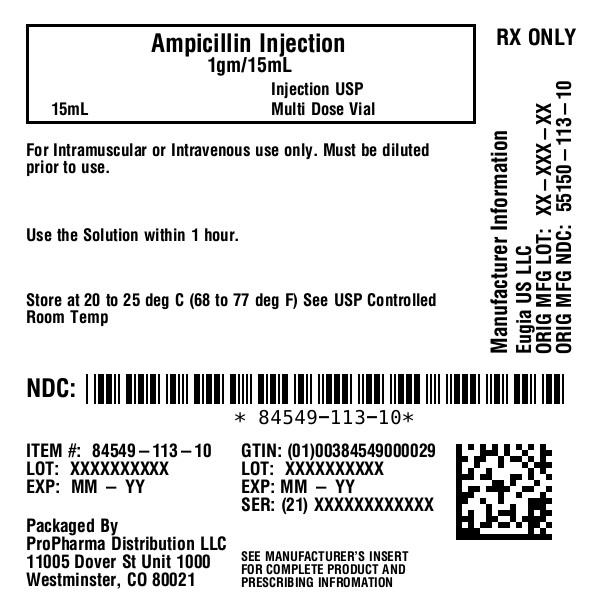
Use only freshly prepared solutions. Intramuscular and intravenous injections should be administered within one hour after preparation since the potency may decrease significantly after this period.
Parenteral drug products should be inspected visually for particulate matter and discoloration prior to administration, whenever solution and container permit.
For Intramuscular Use
–Dissolve contents of a vial with the amount of Sterile Water for Injection, USP, or Bacteriostatic Water for Injection, USP, listed in the table below:
NDC | Label
Claim
| Recommended
Amount of
Diluent
| Withdrawable
Volume
| Concentration
(in mg/mL)
|
|---|
55150-111-10
| 250 mg
| 1 mL
| 1 mL
| 250 mg
|
55150-112-10
| 500 mg
| 1.8 mL
| 2 mL
| 250 mg
|
55150-113-10
| 1 gram
| 3.5 mL
| 4 mL
| 250 mg
|
55150-114-20
| 2 grams
| 6.8 mL
| 8 mL
| 250 mg
|
While ampicillin for injection, USP, 1 g and 2 g, are primarily for intravenous use, they may be administered intramuscularly when the 250 mg or 500 mg vials are unavailable. In such instances, dissolve in 3.5 or 6.8 mL Sterile Water for Injection, USP, or Bacteriostatic Water for Injection, USP, respectively. The resulting solution will provide a concentration of 250 mg per mL.
Bacteriostatic Water for Injection, USP is not to be used as a diluent when the product will be used in newborns.
For Direct Intravenous Use
–Add 5 mL Sterile Water for Injection, USP, or Bacteriostatic Water for Injection, USP to the 250 mg, and 500 mg vials and administer slowly over a 3- to 5-minute period. Ampicillin for injection, USP, 1 g or 2 g may also be given by direct intravenous administration. Dissolve in 7.4 or 14.8 mL Sterile Water for Injection, USP, or Bacteriostatic Water for Injection, USP, respectively, and administer slowly over at least 10 to 15 minutes.
CAUTION: More rapid administration may result in convulsive seizures.
For Administration by Intravenous Drip
–Reconstitute as directed above
(ForDirect Intravenous Use)prior to diluting with Intravenous Solution. Stability studies on ampicillin sodium at several concentrations in various intravenous solutions indicate the drug will lose less than 10% activity at the temperatures noted for the time periods stated.
Room Temperature (25°C)
|
Diluent
| Concentrations
| Stability Periods
|
Sterile Water for Injection
| up to 30 mg/mL
| 8 hours
|
0.9% Sodium Chloride Injection, USP
| up to 30 mg/mL
| 8 hours
|
5% Dextrose Injection, USP
| 10 to 20 mg/mL
| 1 hour
|
5% Dextrose Injection, USP
| up to 2 mg/mL
| 2 hours
|
5% Dextrose and 0.45% Sodium
Chloride Injection, USP
| up to 2 mg/mL
| 2 hours
|
Lactated Ringer’s Injection, USP
| up to 30 mg/mL
| 8 hours
|
Refrigerated (4°C)
|
Diluent
| Concentrations
| Stability Periods
|
Sterile Water for Injection
| 30 mg/mL
| 48 hours
|
Sterile Water for Injection
| up to 20 mg/mL
| 72 hours
|
0.9% Sodium Chloride Injection, USP
| 30 mg/mL
| 24 hours
|
0.9% Sodium Chloride Injection, USP
| up to 20 mg/mL
| 48 hours
|
Lactated Ringer's Injection, USP
| up to 30 mg/mL
| 24 hours
|
5% Dextrose Injection, USP
| up to 20 mg/mL
| 1 hour
|
5% Dextrose and 0.45% Sodium
Chloride Injection, USP
| up to 10 mg/mL
| 1 hour
|
Only those solutions listed above should be used for the intravenous infusion of ampicillin for injection, USP. The concentrations should fall within the range specified. The drug concentration and the rate and volume of the infusion should be adjusted so that the total dose of ampicillin is administered before the drug loses its stability in the solution in use.