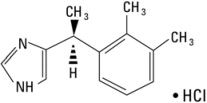
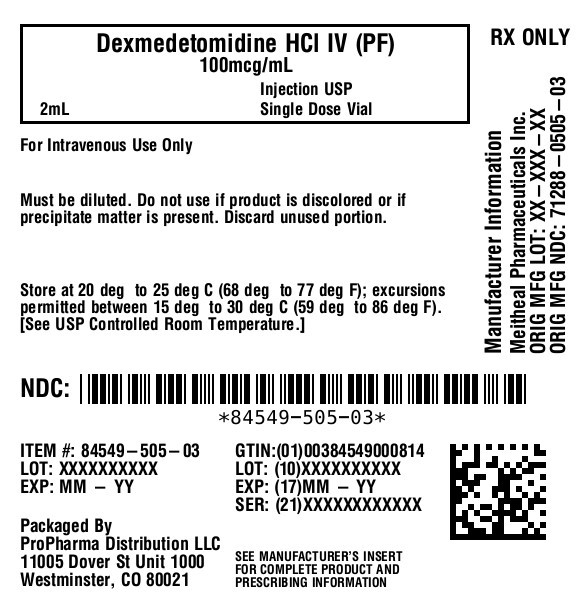
Dexmedetomidine Injection, 200 mcg per 2 mL dexmedetomidine (100 mcg per mL)
Dexmedetomidine injection must be diluted with 0.9% sodium chloride injection to achieve required concentration (4 mcg per mL) prior to administration. Preparation of solutions is the same, whether for the loading dose or maintenance infusion.
To prepare the infusion, withdraw 2 mL of dexmedetomidine injection, and add to 48 mL of 0.9% sodium chloride injection to a total of 50 mL. Shake gently to mix well.
Intensive Care Unit Sedation
With administration up to 7 days, regardless of dose, 12 (5%) dexmedetomidine hydrochloride adult subjects experienced at least 1 event related to withdrawal within the first 24 hours after discontinuing study drug and 7 (3%) dexmedetomidine hydrochloride adult subjects experienced at least 1 event 24 to 48 hours after end of study drug. The most common events were nausea, vomiting, and agitation
[see
Adverse Reactions (6.1)]
.
In adult subjects, tachycardia and hypertension requiring intervention in the 48 hours following study drug discontinuation occurred at frequencies of <5%.
Procedural Sedation
In adult subjects, withdrawal symptoms were not seen after discontinuation of short-term infusions of dexmedetomidine hydrochloride (<6 hours).
In pediatric patients, mild transient withdrawal symptoms of emergence delirium or agitation were seen after discontinuation of short-term infusions of dexmedetomidine hydrochloride (<2 hours).
Pediatric use information is approved for Hospira Inc.’s PRECEDEX
TM(dexmedetomidine hydrochloride) injection and PRECEDEX
TM(dexmedetomidine hydrochloride) in sodium chloride injection. However, due to Hospira Inc.’s marketing exclusivity rights, this drug product is not labeled with that information.
Intensive Care Unit Sedation
Adverse reaction information is derived from the continuous infusion trials of dexmedetomidine hydrochloride for sedation in the Intensive Care Unit setting in which 1,007 adult patients received dexmedetomidine hydrochloride. The mean total dose was 7.4 mcg/kg (range: 0.8 to 84.1), mean dose per hour was 0.5 mcg/kg/hr (range: 0.1 to 6.0) and the mean duration of infusion of 15.9 hours (range: 0.2 to 157.2). The population was between 17 to 88 years of age, 43% ≥65 years of age, 77% male and 93% Caucasian. Treatment-emergent adverse reactions occurring at an incidence of >2% are provided in
Table 3. The most frequent adverse reactions were hypotension, bradycardia and dry mouth
[see Warnings and Precautions (
5.2)]
.
Table 3: Adverse Reactions with an Incidence >2%—Adult Intensive Care Unit Sedation Population <24 hours* |
| Adverse Event | All Dexmedetomidine Hydrochloride
(N = 1007)
(%) | Randomized Dexmedetomidine
Hydrochloride
(N = 798)
(%) |
Placebo
(N = 400)
(%) |
Propofol
(N = 188)
(%) |
| Hypotension | 25% | 24% | 12% | 13% |
| Hypertension | 12% | 13% | 19% | 4% |
| Nausea | 9% | 9% | 9% | 11% |
| Bradycardia | 5% | 5% | 3% | 0 |
| Atrial Fibrillation | 4% | 5% | 3% | 7% |
| Pyrexia | 4% | 4% | 4% | 4% |
| Dry Mouth | 4% | 3% | 1% | 1% |
| Vomiting | 3% | 3% | 5% | 3% |
| Hypovolemia | 3% | 3% | 2% | 5% |
| Atelectasis | 3% | 3% | 3% | 6% |
| Pleural Effusion | 2% | 2% | 1% | 6% |
| Agitation | 2% | 2% | 3% | 1% |
| Tachycardia | 2% | 2% | 4% | 1% |
| Anemia | 2% | 2% | 2% | 2% |
| Hyperthermia | 2% | 2% | 3% | 0 |
| Chills | 2% | 2% | 3% | 2% |
| Hyperglycemia | 2% | 2% | 2% | 3% |
| Hypoxia | 2% | 2% | 2% | 3% |
| Post-procedural Hemorrhage | 2% | 2% | 3% | 4% |
| Pulmonary Edema | 1% | 1% | 1% | 3% |
| Hypocalcemia | 1% | 1% | 0 | 2% |
| Acidosis | 1% | 1% | 1% | 2% |
| Urine Output Decreased | 1% | 1% | 0 | 2% |
| Sinus Tachycardia | 1% | 1% | 1% | 2% |
| Ventricular Tachycardia | <1% | 1% | 1% | 5% |
| Wheezing | <1% | 1% | 0 | 2% |
| Edema Peripheral | <1% | 0 | 1% | 2% |
Adverse reaction information was also derived from the placebo-controlled, continuous infusion trials of dexmedetomidine hydrochloride for sedation in the surgical intensive care unit setting in which 387 adult patients received dexmedetomidine hydrochloride for less than 24 hours. The most frequently observed treatment-emergent adverse events included hypotension, hypertension, nausea, bradycardia, fever, vomiting, hypoxia, tachycardia and anemia (see
Table 4).
Table 4: Treatment-Emergent Adverse Events Occurring in >1% of All Dexmedetomidine Hydrochloride-Treated Adult Patients in the Randomized Placebo-Controlled Continuous Infusion <24 Hours ICU Sedation Studies| Adverse Event | Randomized Dexmedetomidine Hydrochloride
(N = 387) |
Placebo
(N = 379) |
| Hypotension | 28% | 13% |
| Hypertension | 16% | 18% |
| Nausea | 11% | 9% |
| Bradycardia | 7% | 3% |
| Fever | 5% | 4% |
| Vomiting | 4% | 6% |
| Atrial Fibrillation | 4% | 3% |
| Hypoxia | 4% | 4% |
| Tachycardia | 3% | 5% |
| Hemorrhage | 3% | 4% |
| Anemia | 3% | 2% |
| Dry Mouth | 3% | 1% |
| Rigors | 2% | 3% |
| Agitation | 2% | 3% |
| Hyperpyrexia | 2% | 3% |
| Pain | 2% | 2% |
| Hyperglycemia | 2% | 2% |
| Acidosis | 2% | 2% |
| Pleural Effusion | 2% | 1% |
| Oliguria | 2% | <1% |
| Thirst | 2% | <1% |
In a controlled clinical trial, dexmedetomidine hydrochloride was compared to midazolam for ICU sedation exceeding 24 hours duration in adult patients. Key treatment emergent adverse events occurring in dexmedetomidine hydrochloride or midazolam treated adult patients in the randomized active comparator continuous infusion long-term intensive care unit sedation study are provided in
Table 5. The number (%) of adult subjects who had a dose-related increase in treatment-emergent adverse events by maintenance adjusted dose rate range in the dexmedetomidine hydrochloride group is provided in
Table 6.
Table 5: Key Treatment-Emergent Adverse Events Occurring in Dexmedetomidine Hydrochloride- or Midazolam-Treated Adult Patients in the Randomized Active Comparator Continuous Infusion Long-Term Intensive Care Unit Sedation Study |
|
|
|
|
| Adverse Event | Dexmedetomidine Hydrochloride
(N = 244) | Midazolam
(N = 122) |
| Hypotension
1 | 56% | 56% |
| Hypotension Requiring Intervention | 28% | 27% |
| Bradycardia
2 | 42% | 19% |
| Bradycardia Requiring Intervention | 5% | 1% |
| Systolic Hypertension
3 | 28% | 42% |
| Tachycardia
4 | 25% | 44% |
| Tachycardia Requiring Intervention | 10% | 10% |
| Diastolic Hypertension
3 | 12% | 15% |
| Hypertension
3 | 11% | 15% |
| Hypertension Requiring Intervention
† | 19% | 30% |
| Hypokalemia | 9% | 13% |
| Pyrexia | 7% | 2% |
| Agitation | 7% | 6% |
| Hyperglycemia | 7% | 2% |
| Constipation | 6% | 6% |
| Hypoglycemia | 5% | 6% |
| Respiratory Failure | 5% | 3% |
| Renal Failure Acute | 2% | 1% |
| Acute Respiratory Distress Syndrome | 2% | 1% |
| Generalized Edema | 2% | 6% |
| Hypomagnesemia | 1% | 7% |
The following adverse events occurred between 2 and 5% for dexmedetomidine hydrochloride and Midazolam, respectively: renal failure acute (2.5%, 0.8%), acute respiratory distress syndrome (2.5%, 0.8%), and respiratory failure (4.5%, 3.3%).
Table 6: Number (%) of Adult Subjects Who Had a Dose-Related Increase in Treatment Emergent Adverse Events by Maintenance Adjusted Dose Rate Range in the Dexmedetomidine Hydrochloride Group |
| Dexmedetomidine Hydrochloride (mcg/kg/hr) |
| Adverse Event | ≤0.7*
(N = 95) | >0.7 to ≤1.1*
(N = 78) | >1.1*
(N = 71) |
| Constipation | 6% | 5% | 14% |
| Agitation | 5% | 8% | 14% |
| Anxiety | 5% | 5% | 9% |
| Edema Peripheral | 3% | 5% | 7% |
| Atrial Fibrillation | 2% | 4% | 9% |
| Respiratory Failure | 2% | 6% | 10% |
| Acute Respiratory Distress Syndrome | 1% | 3% | 9% |
Adult Procedural Sedation
Adverse reaction information is derived from the two trials for adult procedural sedation
[see Clinical Studies (
14.2)]
in which 318 adult patients received dexmedetomidine hydrochloride. The mean total dose was 1.6 mcg/kg (range: 0.5 to 6.7), mean dose per hour was 1.3 mcg/kg/hr (range: 0.3 to 6.1) and the mean duration of infusion of 1.5 hours (range: 0.1 to 6.2). The population was between 18 to 93 years of age, ASA I-IV, 30% ≥65 years of age, 52% male and 61% Caucasian.
Treatment-emergent adverse reactions occurring in adults at an incidence of >2% are provided in
Table 7. The most frequent adverse reactions were hypotension, bradycardia, and dry mouth
[see Warnings and Precautions (
5.2)]
. Pre-specified criteria for the vital signs to be reported as adverse reactions are footnoted below the table. The decrease in respiratory rate and hypoxia was similar between dexmedetomidine hydrochloride and comparator groups in both studies.
Table 7: Adverse Reactions with an Incidence >2%—Adult Procedural Sedation Population |
|
|
|
|
|
| Adverse Event | Dexmedetomidine Hydrochloride
(N = 318)
(%) | Placebo
(N = 113)
(%) |
| Hypotension
1 | 54% | 30% |
| Respiratory Depression
2 | 37% | 32% |
| Bradycardia
3 | 14% | 4% |
| Hypertension
4 | 13% | 24% |
| Tachycardia
5 | 5% | 17% |
| Nausea | 3% | 2% |
| Dry Mouth | 3% | 1% |
| Hypoxia
6 | 2% | 3% |
| Bradypnea | 2% | 4% |
Pediatric use information is approved for Hospira Inc.’s PRECEDEX
TM(dexmedetomidine hydrochloride) injection and PRECEDEX
TM(dexmedetomidine hydrochloride) in sodium chloride injection. However, due to Hospira Inc.’s marketing exclusivity rights, this drug product is not labeled with that information.
Risk Summary
Available data from published randomized controlled trials and case reports over several decades of use with intravenously administered dexmedetomidine during pregnancy have not identified a drug-associated risk of major birth defects and miscarriage; however, the reported exposures occurred after the first trimester. Most of the available data are based on studies with exposures that occurred at the time of caesarean section delivery, and these studies have not identified an adverse effect on maternal outcomes or infant Apgar scores. Available data indicate that dexmedetomidine crosses the placenta.
In animal reproduction studies, fetal toxicity that lower fetal viability and reduced live fetuses occurred with subcutaneous administration of dexmedetomidine to pregnant rats during organogenesis at doses 1.8 times the maximum recommended human dose (MRHD) of 17.8 mcg/kg/day.
Developmental toxicity (low pup weights and adult offspring weights, decreased F1 grip strength, increased early implantation loss and decreased viability of second-generation offspring) occurred when pregnant rats were subcutaneously administered dexmedetomidine at doses less than the clinical dose from late pregnancy through lactation and weaning
(see Data).
The estimated background risk of major birth defects and miscarriage for the indicated population is unknown. All pregnancies have a background risk of birth defect, loss, or other adverse outcomes. In the U.S. general population, the estimated background risk of major birth defects and miscarriage in clinically recognized pregnancies is 2-4% and 15-20%, respectively.
Data
Animal Data
Increased post-implantation losses and reduced live fetuses in the presence of maternal toxicity (i.e. decreased body weight) were noted in a rat embryo-fetal development study in which pregnant dams were administered subcutaneous doses of dexmedetomidine 200 mcg/kg/day (equivalent to 1.8 times the intravenous MRHD of 17.8 mcg/kg/day based on body surface area [BSA]) during the period of organogenesis (Gestation Day [GD] 6 to 15). No malformations were reported.
No malformations or embryo-fetal toxicity were noted in a rabbit embryo-fetal development study in which pregnant does were administered dexmedetomidine intravenously at doses of up to 96 mcg/kg/day (approximately half the human exposure at the MRHD based on AUC) during the period of organogenesis (GD 6 to 18).
Reduced pup and adult offspring birth weights, and grip strength were reported in a rat developmental toxicology study in which pregnant females were administered dexmedetomidine subcutaneously at doses of 8 mcg/kg/day (0.07 times the MRHD based on BSA) during late pregnancy through lactation and weaning (GD 16 to postnatal day [PND] 25). Decreased viability of second generation offspring and an increase in early implantation loss along with delayed motor development occurred in the 32 mcg/kg/day group (equivalent to less than the clinical dose based on BSA) when first generation offspring were allowed to mate. This study limited dosing to hard palate closure (GD 15 to 18) through weaning instead of dosing from implantation (GD 6 to 7) to weaning (PND 21).
In a study in the pregnant rat, placental transfer of dexmedetomidine was observed when radiolabeled dexmedetomidine was administered subcutaneously.
Intensive Care Unit Sedation
A total of 729 patients in the clinical studies were 65 years of age and over. A total of 200 patients were 75 years of age and over. In patients greater than 65 years of age, a higher incidence of bradycardia and hypotension was observed following administration of dexmedetomidine hydrochloride
[see Warnings and Precautions (
5.2)]
. Therefore, a dose reduction may be considered in patients over 65 years of age
[see Dosage and Administration (
2.2,
2.3), Clinical Pharmacology (
12.3)]
.
Procedural Sedation
A total of 131 patients in the clinical studies were 65 years of age and over. A total of 47 patients were 75 years of age and over. Hypotension occurred in a higher incidence in dexmedetomidine hydrochloride-treated patients 65 years or older (72%) and 75 years or older (74%) as compared to patients <65 years (47%). A reduced loading dose of 0.5 mcg/kg given over 10 minutes is recommended and a reduction in the maintenance infusion should be considered for patients greater than 65 years of age.
Distribution
The steady-state volume of distribution (V
ss) of dexmedetomidine was approximately 118 liters. Dexmedetomidine protein binding was assessed in the plasma of normal healthy male and female subjects. The average protein binding was 94% and was constant across the different plasma concentrations tested. Protein binding was similar in males and females. The fraction of dexmedetomidine hydrochloride that was bound to plasma proteins was significantly decreased in subjects with hepatic impairment compared to healthy subjects.
The potential for protein binding displacement of dexmedetomidine by fentanyl, ketorolac, theophylline, digoxin and lidocaine was explored
in vitro, and negligible changes in the plasma protein binding of dexmedetomidine hydrochloride were observed. The potential for protein binding displacement of phenytoin, warfarin, ibuprofen, propranolol, theophylline and digoxin by dexmedetomidine hydrochloride was explored
in vitroand none of these compounds appeared to be significantly displaced by dexmedetomidine hydrochloride.
Elimination
Metabolism
Dexmedetomidine undergoes almost complete biotransformation with very little unchanged dexmedetomidine excreted in urine and feces. Biotransformation involves both direct glucuronidation as well as cytochrome P450 mediated metabolism. The major metabolic pathways of dexmedetomidine are: direct N-glucuronidation to inactive metabolites; aliphatic hydroxylation (mediated primarily by CYP2A6 with a minor role of CYP1A2, CYP2E1, CYP2D6 and CYP2C19) of dexmedetomidine to generate 3-hydroxy-dexmedetomidine, the glucuronide of 3-hydroxy-dexmedetomidine, and 3-carboxy-dexmedetomidine; and N-methylation of dexmedetomidine to generate 3-hydroxy N-methyl-dexmedetomidine, 3-carboxy N-methyl-dexmedetomidine, and dexmedetomidine-N-methyl O-glucuronide.
Excretion
The terminal elimination half-life (t
1/2) of dexmedetomidine is approximately 2 hours and clearance is estimated to be approximately 39 L/h. A mass balance study demonstrated that after nine days an average of 95% of the radioactivity, following intravenous administration of radiolabeled dexmedetomidine, was recovered in the urine and 4% in the feces. No unchanged dexmedetomidine was detected in the urine. Approximately 85% of the radioactivity recovered in the urine was excreted within 24 hours after the infusion. Fractionation of the radioactivity excreted in urine demonstrated that products of N-glucuronidation accounted for approximately 34% of the cumulative urinary excretion. In addition, aliphatic hydroxylation of parent drug to form 3-hydroxy-dexmedetomidine, the glucuronide of 3-hydroxy-dexmedetomidine, and 3-carboxylic acid-dexmedetomidine together represented approximately 14% of the dose in urine. N-methylation of dexmedetomidine to form 3-hydroxy N-methyl dexmedetomidine, 3-carboxy N-methyl dexmedetomidine, and N-methyl O-glucuronide dexmedetomidine accounted for approximately 18% of the dose in urine. The N-Methyl metabolite itself was a minor circulating component and was undetected in urine. Approximately 28% of the urinary metabolites have not been identified.
Specific Populations
Male and Female Patients
There was no observed difference in dexmedetomidine hydrochloride pharmacokinetics due to sex.
Geriatric Patients
The pharmacokinetic profile of dexmedetomidine hydrochloride was not altered by age. There were no differences in the pharmacokinetics of dexmedetomidine hydrochloride in young (18 to 40 years), middle age (41 to 65 years), and elderly (>65 years) subjects.
Pediatric Patients
Pediatric use information is approved for Hospira Inc.’s PRECEDEX
TM(dexmedetomidine hydrochloride) injection and PRECEDEX
TM(dexmedetomidine hydrochloride) in sodium chloride injection. However, due to Hospira Inc.’s marketing exclusivity rights, this drug product is not labeled with that information.
Patients with Hepatic Impairment
In adult subjects with varying degrees of hepatic impairment (Child-Pugh Class A, B, or C), clearance values for dexmedetomidine hydrochloride were lower than in healthy subjects. The mean clearance values for patients with mild, moderate, and severe hepatic impairment were 74%, 64% and 53% of those observed in the normal healthy adult subjects, respectively. Mean clearances for free drug were 59%, 51% and 32% of those observed in the normal healthy adult subjects, respectively.
Although dexmedetomidine hydrochloride is dosed to effect, it may be necessary to consider dose reduction in subjects with hepatic impairment
[see Dosage and Administration (
2.2), Warnings and Precautions (
5.8)].
Patients with Renal Impairment
Dexmedetomidine pharmacokinetics (C
max, T
max, AUC, t
1/2, CL, and V
ss) were not significantly different in patients with severe renal impairment (creatinine clearance: <30 mL/min) compared to healthy subjects.
Drug Interaction Studies
In vitrostudies:
In vitrostudies in human liver microsomes demonstrated no evidence of cytochrome P450 mediated drug interactions that are likely to be of clinical relevance.
Carcinogenesis
Animal carcinogenicity studies have not been performed with dexmedetomidine.
Mutagenesis
Dexmedetomidine was not mutagenic
in vitro, in either the bacterial reverse mutation assay (
E. coliand
Salmonella typhimurium) or the mammalian cell forward mutation assay (mouse lymphoma). Dexmedetomidine was clastogenic in the
in vitrohuman lymphocyte chromosome aberration test with, but not without, rat S9 metabolic activation. In contrast, dexmedetomidine was not clastogenic in the
in vitrohuman lymphocyte chromosome aberration test with or without human S9 metabolic activation. Although dexmedetomidine was clastogenic in an
in vivomouse micronucleus test in NMRI mice, there was no evidence of clastogenicity in CD-1 mice.
Impairment of Fertility
Fertility in male or female rats was not affected after daily subcutaneous injections of dexmedetomidine at doses up to 54 mcg/kg (less than the maximum recommended human intravenous dose on a mcg/m
2basis) administered from 10 weeks prior to mating in males, and 3 weeks prior to mating and during mating in females.
Pediatric use information is approved for Hospira Inc.’s PRECEDEX
TM(dexmedetomidine hydrochloride) injection and PRECEDEX
TM(dexmedetomidine hydrochloride) in sodium chloride injection. However, due to Hospira Inc.’s marketing exclusivity rights, this drug product is not labeled with that information.