1 Indications And Usage
Dextrose (50%) Injection is indicated for the treatment of insulin-induced hypoglycemia (e.g., hyperinsulinemia, insulin shock) in adults and pediatric patients 2 years of age and older.
The following Structured Product Label (SPL) was submitted to the FDA by Propharma Distribution for the product Dextrose (NDC 84549-648). This document serves as the official prescribing information, containing essential scientific data and clinical materials required for healthcare providers and patients.
This specific version of the label includes detailed information regarding 1 indications and usage, 2.1 important preparation and administration instructions, 2.2 recommended dosage and administration, 3 dosage forms and strengths, 4 contraindications, 5.1 hyperglycemia and hyperosmolar hyperglycemic state, 5.2 hypersensitivity reactions, 5.3 phlebitis and thrombosis, and other regulatory disclosures. Use the navigation below to review specific sections of the FDA submission.
Dextrose (50%) Injection is indicated for the treatment of insulin-induced hypoglycemia (e.g., hyperinsulinemia, insulin shock) in adults and pediatric patients 2 years of age and older.
Adults and Pediatric Patients 12 Years of Age and Older
When possible, administer Dextrose Injection (50%) into a central vein or large peripheral vein because Dextrose Injection (50%) has an osmolarity greater than 900 mOsm/L and can cause venous irritation.
The recommended dosage of Dextrose Injection (50%) is 10 to 25 grams (20 to 50 mL) of Dextrose Injection (50%), administered once via intravenous infusion. Repeated doses may be administered as clinically appropriate.
Slowly infuse Dextrose Injection (50%) to reduce the risk of developing hyperglycemia and to minimize venous irritation [see Warnings and Precautions (5.1, 5.3)] . The maximum rate at which Dextrose Injection (50%) can be infused without producing hyperglycemia is 0.5 g/kg of body weight/hour.
Pediatric Patients 2 to 11 Years of Age
Administer Dextrose Injection (50%) into a central vein. Avoid administration of Dextrose Injection (50%) into a peripheral vein because Dextrose Injection (50%) has an osmolarity greater than 900 mOsm/L and can cause venous irritation [ Warnings and Precautions (5.3)] . If central venous access cannot be obtained, consider using an alternative commercially available dextrose product with a lower concentration.
The appropriate dosage of Dextrose Injection (50%) depends on the age, weight, clinical and metabolic conditions of the patient, and concomitant therapy.
Slowly infuse Dextrose Injection (50%) to reduce the risk of developing hyperglycemia and to minimize venous irritation [see Warnings and Precautions (5.1, 5.3)] . The maximum rate at which Dextrose Injection (50%) can be infused without producing hyperglycemia is 0.5 g/kg of body weight/hour.
Injection: 50% (25 g/50 mL) (500 mg/mL) of dextrose hydrous in a clear, colorless solution supplied as:
Dextrose Injection (50%) is contraindicated in patients with:
Significant hyperglycemia and hyperosmolar hyperglycemic state may result from too rapid administration of Dextrose Injection (50%). Symptoms of hyperosmolar hyperglycemic state include mental confusion and loss of consciousness. To minimize these risks, slowly infuse Dextrose Injection (50%) and monitor blood and urine glucose during treatment with Dextrose Injection (50%).
If Dextrose Injection (50%) is abruptly discontinued, patients should receive 5% or 10% dextrose injection to avoid rebound hypoglycemia.
Hypersensitivity reactions, including anaphylaxis, have been reported with Dextrose Injection (50%) administration [see Adverse Reactions (6)] . Stop administration of Dextrose Injection (50%) immediately if signs or symptoms of a hypersensitivity reaction develop. Initiate appropriate treatment as clinically indicated.
Dextrose Injection (50%) is hypertonic (has an osmolarity greater than 900 mOsm/L) and may cause phlebitis and thrombosis at the site of injection. If thrombophlebitis occurs, remove the catheter as soon as possible.
Administer Dextrose Injection (50%) via slow intravenous infusion into a central vein (when possible) to reduce the risk of phlebitis and thrombosis. Ensure that the needle is well within the lumen of the vein and that extravasation does not occur. If thrombosis occurs, stop administration of Dextrose Injection (50%) and initiate corrective measures.Avoid administration of Dextrose Injection (50%) into a peripheral vein in pediatric patients 2 to 11 years old. If central venous access cannot be obtained in these pediatric patients, consider using an alternative commercially available dextrose product with a lower concentration.
Do not administer Dextrose Injection (50%) subcutaneously or intramuscularly.
Electrolyte deficits, particularly serum potassium and phosphate, may occur during prolonged use of Dextrose Injection (50%).
Depending on the administered volume and the infusion rate, administration of Dextrose Injection (50%) can cause fluid overload including pulmonary edema.
Avoid Dextrose Injection (50%) in patients at risk for fluid and/or solute overload. If use cannot be avoided in these patients, monitor fluid balance, electrolyte concentrations, and acid base balance, especially during prolonged use. Additional monitoring is recommended for patients with water and electrolyte disturbances that could be aggravated by increased glucose, insulin administration, and/or free water load.
Dextrose Injection (50%) may cause hyponatremia. Hyponatremia can lead to acute hyponatremic encephalopathy characterized by headache, nausea, seizures, lethargy and vomiting. The risk of hospital-acquired hyponatremia is increased in pediatric patients, geriatric patients, patients treated with diuretics, and patients with cardiac or pulmonary failure or with the syndrome of inappropriate antidiuretic hormone (SIADH) (e.g., postoperative patients, patients concomitantly treated with arginine vasopressin analogs or certain antiepileptic, psychotropic, and cytotoxic drugs) [see Drug Interactions (7.1)and Use in Specific Populations (8.4)] .
Avoid Dextrose Injection (50%) in patients with or at risk for hyponatremia. If use cannot be avoided, closely monitor serum sodium concentrations, chloride concentrations, fluid status, acid-base balance, and neurologic status [see Warnings and Precautions (5.4)] .
Dextrose Injection (50%) contains up to 600 mcg/L of aluminum. Prolonged administration of Dextrose Injection (50%) may lead to toxic levels of aluminum in pediatric patients with immature renal function. Due to the potential for excessive aluminum exposure, Dextrose Injection (50%) is not approved for pediatric patients younger than 2 years of age. Parenteral aluminum exposure greater than 4 to 5 mcg/kg/day has been associated with central nervous system and bone toxicity in this age group.
Prolonged administration of Dextrose Injection (50%) may also lead to toxic levels of aluminum in adults and pediatric patients with renal impairment.
The following clinically significant adverse reactions are also described elsewhere in the labeling:
The following adverse reactions associated with the use of Dextrose Injection were identified in clinical trials or postmarketing reports. Because some of these reactions were reported voluntarily from a population of uncertain size, it is not always possible to reliably estimate their frequency or establish a causal relationship to drug exposure.
Administration site conditions:blister, extravasation, phlebitis, erythema, pain, vein damage, thrombosis
Immune system disorders:anaphylaxis, angioedema, bronchospasm, chills, hypotension, pruritis, pyrexia, rash
Cardiovascular disorders:cyanosis, volume overload
Dextrose Injection (50%) can affect glycemic control, vasopressin, and fluid and/or electrolyte balance [see Warnings and Precautions (5.1, 5.4, 5.5)] . Monitor patients’ blood glucose concentrations, fluid balance, serum electrolyte concentrations, and acid-base balance.
Concomitant administration of Dextrose Injection (50%) with drugs associated with hyponatremia may increase the risk of developing hyponatremia. Drugs associated with hyponatremia include diuretics and those that cause SIADH (e.g., selective serotonin reuptake inhibitors (SSRIs), serotonin and norepinephrine reuptake inhibitors (SNRIs), arginine vasopressin analogs, certain antiepileptic, psychotropic, and cytotoxic drugs). Avoid use of Dextrose Injection (50%) in patients receiving drugs associated with hyponatremia. If use cannot be avoided, closely monitor serum sodium concentrations during concomitant use [see Warnings and Precautions (5.5)] .
Risk Summary
Appropriate administration of Dextrose Injection (50%) during pregnancy is not expected to cause adverse developmental outcomes, including congenital malformations. However, maternal hyperglycemia secondary to infusion of glucose-containing products at the time of delivery has been associated with adverse neonatal outcomes such as neonatal hypoglycemia. Animal reproduction studies have not been conducted with dextrose.
The background risk of major birth defects and miscarriage in patients with insulin-induced hypoglycemia (e.g., hyperinsulinemia, insulin shock) is unknown. All pregnancies have a background risk of birth defect, loss, or other adverse outcomes. In the U.S. general population, the estimated background risk of major birth defects and miscarriage in clinically recognized pregnancies is 2 to 4% and 15 to 20%, respectively.
Risk Summary
There are no data on the effects of Dextrose Injection (50%) on levels of glucose in human milk, on the breastfed infant, or on milk production. The developmental and health benefits of breastfeeding should be considered along with the mother’s clinical need for Dextrose Injection (50%) and any potential adverse effects on the breastfed infant from Dextrose Injection (50%) or from the underlying maternal condition.
Dextrose Injection (50%) is indicated in pediatric patients aged 2 years and older for the treatment of insulin-induced hypoglycemia (e.g., hyperinsulinemia, or insulin shock).
Monitor plasma electrolyte concentrations closely in pediatric patients who may have impaired ability to regulate fluids and electrolytes [see Warnings and Precautions (5.4)] . Pediatric patients treated with Dextrose Injection (50%) are at increased risk of developing hyponatremia and hyponatremic encephalopathy [see Warnings and Precautions (5.5)] .
Dextrose Injection (50%) is not indicated for use in neonates. Dextrose Injection (50%) can increase the risk of developing hypo- or hyperglycemia in neonates, especially preterm neonates with low birth weight. Excessive or rapid administration of Dextrose Injection (50%) may also result in increased serum osmolality and risk of intracerebral hemorrhage in very low birth weight neonates.
Dextrose Injection (50%) is not indicated for use in pediatric patients younger than 2 years old due to the potential for excessive aluminum exposure. If treatment with Dextrose Injection (50%) is necessary in a pediatric patient younger than 2 years old, use a different dextrose product [see Indications and Usage (1)and Warnings and Precautions (5.6)] .
Dextrose Injection (50%) has not been studied in a sufficient number of patients aged 65 and over to determine whether they respond differently from younger adult patients. Geriatric patients are at increased risk of developing hyponatremia and hyponatremic encephalopathy [see Warnings and Precautions (5.5)] . Other reported clinical experience has not identified differences in responses between the geriatric and younger adult patients. In general, the infusion rate for geriatric patients should start low and be titrated up cautiously, reflecting the greater risk for electrolyte abnormalities and fluid overload.
Dextrose is known to be substantially excreted by the kidney, and the risk of adverse reactions to Dextrose Injection (50%) may be greater in patients with impaired renal function. Because geriatric patients are more likely to have impaired renal function, care should be taken in selection of the infusion rate, and patients should be closely monitored during Dextrose Injection (50%) treatment.
A medication error resulting in a high infusion rate of Dextrose Injection (50%) can cause hyperglycemia, hyperosmolality, and adverse effects on fluid and electrolyte balance [see Warnings and Precautions (5.1, 5.4)] .
Severe hyperglycemia and severe dilutional hyponatremia, and their complications, can be fatal. In the event of overdosage (overhydration or solute overload) during Dextrose Injection (50%) treatment, discontinue the infusion. Institute corrective measures such as administration of exogenous insulin, and treat adverse effects on the CNS, respiratory, and cardiovascular systems [see Warnings and Precautions (5.1, 5.4)] .
Dextrose, USP is chemically designated C 6H 12O 6• H 2O (D-glucose monohydrate), a hexose sugar freely soluble in water.
Dextrose, hydrous has the following structural formula:
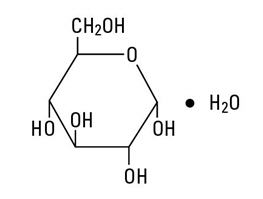
Chemical Structure (Dextrose 01)
Water for Injection, USP is chemically designated H 2O. The molecular weight of dextrose (D-glucose) monohydrate is 198.17.
Dextrose Injection, USP (50%) is a sterile, nonpyrogenic, hypertonic solution of dextrose in water for injection for intravenous injection.
Each milliliter (mL) of fluid contains 0.5 grams of dextrose, hydrous which delivers 3.4 kcal/gram (0.85 kcal/mL). The solution has an osmolarity of 2.53 mOsmol/mL (calculation) and the pH range is 3.2 to 6.5. May contain sodium hydroxide and/or hydrochloric acid for pH adjustment.
The Dextrose Injection (50%) vial contains no more than 600 mcg/L of aluminum.
The solution contains no bacteriostatic, antimicrobial agent or added buffer (except for pH adjustment) and is supplied as single-dose containers.
Dextrose is derived from corn.
Dextrose restores blood glucose levels and provides a source of carbohydrate calories.
The exposure-response relationship and time course of pharmacodynamic response for the safety and effectiveness of dextrose have not been fully characterized.
Dextrose is oxidized to carbon dioxide and water.
Studies with dextrose to evaluate the drug’s carcinogenic potential, mutagenic potential, or effects on fertility have not been performed.
How Supplied
Dextrose Injection, USP (50%) is supplied as a clear, colorless solution in single-dose containers as follows:
50 mL Single-Dose Fliptop Vial
50% (25 g/50 mL)
(0.5 g/mL)
84549-648-02
Storage and Handling
Minimize exposure of Dextrose Injection (50%) to heat. Avoid excessive heat. Protect from freezing. Store at 20°C to 25°C (68°F to 77°F) [See USP Controlled Room Temperature.]
Dextrose IV Solution
Injection USP
0.5g/mL
50 mL
Single-Dose Vial
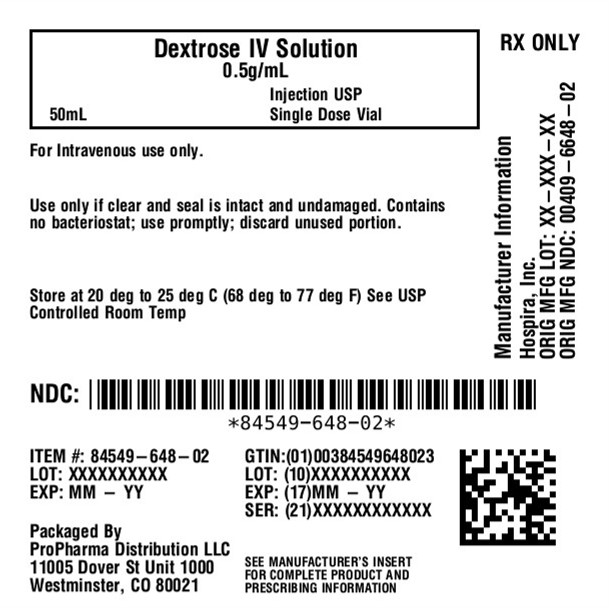
Bottle (84549 648)
* Please review the disclaimer below.
