Interactions related to the sodium content of the solution: - In patients using drugs such as corticosteroids that may increase the risk of sodium and fluid overload (with edema and hypertension), TURKFLEKS LACTATED RINGER is recommended to be administered with caution. Interactions related to the potassium content of the solution: Since TURKFLEKS LACTATED RINGER contains potassium, it is recommended to be administered with caution when used with the following drugs known to cause or increase the risk of hyperkalemia: - Potassium-sparing diuretics (amiloride, spironolactone, triamterene, alone or in combination). - Angiotensin converting enzyme inhibitors and angiotensin II receptor antagonists. - Tacrolimus, cyclosporine. In patients receiving such drugs, especially in cases of severe renal impairment, the administration of potassium may result in a severe and potentially fatal hyperkalemia.
Interactions related to the calcium contained in the solution: Administering calcium may increase the effects of digitalis and may cause serious or potentially fatal arrhythmias in the heart. Therefore, in patients receiving treatment with digitalis group drugs, large volumes and rapid infusion of the solution is not recommended. It is recommended that TURKFLEKS LACTATED RINGER be administered with caution if it is to be used with thiazide group diuretics or vitamin D, which may increase the risk of hypercalcemia.
Bisphosphonates, fluoride, some fluoroquinolones and tetracyclines have reduced absorption (reduced bioavailability) when administered with calcium. Interactions related to the lactate contained in the solution (metabolized to bicarbonate): It is recommended that TURKFLEKS LACTATED RINGER be administered with caution if used with drugs whose renal elimination is pH-dependent: Since bicarbonate formed as a result of lactate metabolism alkalinizes the urine, TURKFLEKS LACTATED RINGER may affect the elimination of such drugs: - Since bicarbonate formed as a result of lactate metabolism alkalinizes the urine, renal excretion of acidic drugs such as salicylates, barbiturates and lithium increases. - The renal elimination of alkaline drugs such as sympathomimetic drugs (e.g. ephedrine, pseudoephedrine) and stimulant drugs (e.g. dexamphetamine sulfate, fenfluramine hydrochloride) is slowed down.
SPECIFICATIONS
Incompatibilities
Ceftriaxone should not be mixed with calcium-containing solutions, including TURKFLEKS LACTATED RINGER. Please see Sections 4.3 and 4.4 on this subject.
As with all solutions administered parenterally, additional drugs added to the solution may be incompatible. The compatibility of the drug to be added to the solution with TURKFLEKS LACTATED RINGER and its bag should be evaluated before adding the drug. Incompatibility can be understood by looking at whether there is a color change and/or precipitation, insoluble compounds or crystallization after the drug is added.
For drug addition, the Summary of Product Characteristics of the drug to be added and the relevant literature should be consulted.
Before adding any substance or drug to the solution, it should be confirmed that TURKFLEKS LACTATED RINGER is soluble and stable at its pH (pH: 6-7.5).
Adding drugs to TURKFLEKS LACTATED RINGER should be done with aseptic technique. The solution should be mixed thoroughly after adding drugs. Solutions containing additional drugs should not be stored.
As a guide, some of the drugs that are incompatible with TURKFLEKS LACTATED RINGER are given below (not an exhaustive list showing all incompatibilities):
Some of the drugs that are incompatible with TURKFLEKS LACTATED RINGER:
- Amino caproic acid
- Amphotericin B
- Metaraminol tartrate
- Cefamandole
- Ceftriaxone
- Cortisone acetate
-Diethylstilbestrol
-Etamivan
-Ethyl alcohol
-Phosphate and carbonate containing solutions
-Oxytetracycline
-Thiopental sodium
-Versenate disodium
Some of the drugs that are partially incompatible with TURKFLEKS LACTATED RINGER:
-Tetracycline is stable for 12 hours.
-Ampicillin sodium concentrations of 2% - 3% are stable for 4 hours, and concentrations higher than 3% are stable for 1 hour.
-Minocycline is stable for 12 hours.
-Doxycycline is stable for 6 hours.
Additional drugs that are known or determined to be incompatible should not be used.
Shelf life
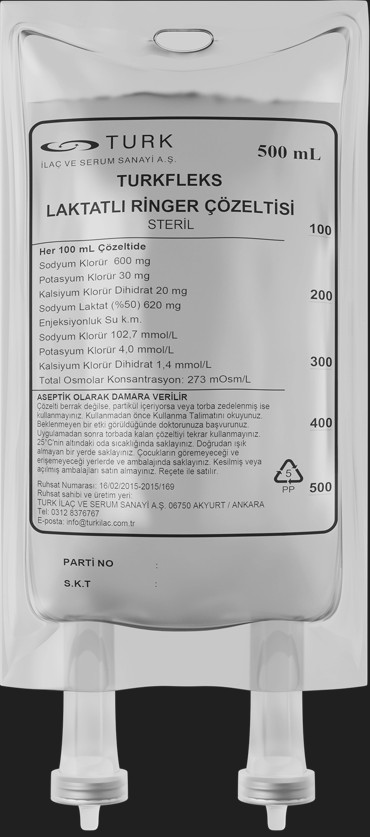
36 months. Shelf life during use: In microbiological terms, if the preparation for application is not carried out under controlled and validated aseptic conditions, it should be used immediately after preparation. In cases where it is not used immediately, the person who adds/dilutes the drug is responsible for determining the storage conditions and duration. 6.4. Special precautions for storage There are no special storage conditions, it should be stored at room temperature below 25 ° C. 6.5. Nature and content of packaging In 500 and 1000 ml Turkfleks (polypropylene) bags. The product has two forms: with and without a set.
Send feedback
Side panels
History
Saved