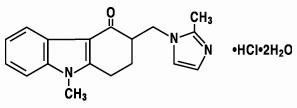
In normal adult volunteers, the following mean pharmacokinetic data have been determined following a single 0.15-mg/kg intravenous dose.
Table 4: Pharmacokinetics in Normal Adult Volunteers
| Age-group (years) |
n | Peak Plasma Concentration
(ng/mL) |
Mean Elimination Half-life (h) |
Plasma Clearance (L/h/kg) |
19 to 40 |
11 |
102 |
3.5 |
0.381 |
61 to 74 |
12 |
106 |
4.7 |
0.319 |
≥ 75 |
11 |
170 |
5.5 |
0.262 |
Absorption
A trial was performed in normal volunteers (n = 56) to evaluate the pharmacokinetics of a single 4-mg dose administered as a 5-minute infusion compared with a single intramuscular injection. Systemic exposure as measured by mean area under curve (AUC) were equivalent, with values of 156 [95% CI 136, 180] and 161 [95% CI 137, 190] ng•h/mL for intravenous and intramuscular groups, respectively. Mean peak plasma concentrations were 42.9 [95% CI 33.8, 54.4] ng/mL at 10 minutes after intravenous infusion and 31.9 [95% CI 26.3, 38.6] ng/mL at 41 minutes after intramuscular injection.
Distribution
Plasma protein binding of ondansetron as measured in vitro was 70% to 76%, over the pharmacologic concentration range of 10 to 500 ng/mL. Circulating drug also distributes into erythrocytes.
Elimination
Metabolism: Ondansetron is extensively metabolized in humans, with approximately 5% of a radiolabeled dose recovered as the parent compound from the urine. The primary metabolic pathway is hydroxylation on the indole ring followed by subsequent glucuronide or sulfate conjugation.
Although some nonconjugated metabolites have pharmacologic activity, these are not found in plasma at concentrations likely to significantly contribute to the biological activity of ondansetron. The metabolites are observed in the urine.
In vitro metabolism studies have shown that ondansetron is a substrate for multiple human hepatic cytochrome P-450 enzymes, including CYP1A2, CYP2D6, and CYP3A4. In terms of overall ondansetron turnover, CYP3A4 plays a predominant role while formation of the major in vivo metabolites is apparently mediated by CYP1A2. The role of CYP2D6 in ondansetron in vivo metabolism is relatively minor.
The pharmacokinetics of intravenous ondansetron did not differ between subjects who were poor metabolizers of CYP2D6 and those who were extensive metabolizers of CYP2D6, further supporting the limited role of CYP2D6 in ondansetron disposition in vivo.
Excretion: In adult cancer patients, the mean ondansetron elimination half-life was 4.0 hours, and there was no difference in the multidose pharmacokinetics over a 4-day period. In a dose-proportionality trial, systemic exposure to 32 mg of ondansetron was not proportional to dose as measured by comparing dose-normalized AUC values with an 8-mg dose. This is consistent with a small decrease in systemic clearance with increasing plasma concentrations.
Specific Populations
Geriatric Patients: A reduction in clearance and increase in elimination half-life are seen in patients older than 75 years of age [see Use in Specific Populations (8.5)].
Pediatric Patients: Pharmacokinetic samples were collected from 74 cancer patients aged 6 to 48 months, who received a dose of 0.15 mg/kg of intravenous ondansetron every 4 hours for 3 doses during a safety and efficacy trial. These data were combined with sequential pharmacokinetics data from 41 surgery patients aged 1 month to 24 months, who received a single dose of 0.1 mg/kg of intravenous ondansetron prior to surgery with general anesthesia, and a population pharmacokinetic analysis was performed on the combined data set. The results of this analysis are included in Table 5 and are compared with the pharmacokinetic results in cancer patients aged 4 to 18 years.
Table 5: Pharmacokinetics in Pediatric Cancer Patients Aged 1 Month to 18 Years
| Subjects and Age-group | N | CL
(L/h/kg) | Vdss
(L/kg) | t½
(h) |
| | Geometric Mean | Mean |
Pediatric Cancer Patients
4 to 18 years | N = 21 | 0.599 | 1.9 | 2.8 |
Population PK Patients1
1 month to 48 months | N = 115 | 0.582 | 3.65 | 4.9 |
1. Population PK (Pharmacokinetic) Patients: 64% cancer patients and 36% surgery patients.
Based on the population pharmacokinetic analysis, cancer patients aged 6 to 48 months who receive a dose of 0.15 mg/kg of intravenous ondansetron every 4 hours for 3 doses would be expected to achieve a systemic exposure (AUC) consistent with the exposure achieved in previous pediatric trials in cancer patients (4 to 18 years) at similar doses.
In a trial of 21 pediatric patients (3 to 12 years) who were undergoing surgery requiring anesthesia for a duration of 45 minutes to 2 hours, a single intravenous dose of ondansetron, 2 mg (3 to 7 years) or 4 mg (8 to 12 years), was administered immediately prior to anesthesia induction. Mean weight-normalized clearance and volume of distribution values in these pediatric surgical patients were similar to those previously reported for young adults. Mean terminal half-life was slightly reduced in pediatric patients (range, 2.5 to 3 hours) in comparison with adults (range, 3 to 3.5 hours).
In a trial of 51 pediatric patients (aged 1 month to 24 months) who were undergoing surgery requiring general anesthesia, a single intravenous dose of ondansetron, 0.1 or 0.2 mg/kg, was administered prior to surgery. As shown in Table 6, the 41 patients with pharmacokinetic data were divided into 2 groups, patients aged 1 month to 4 months and patients aged 5 to 24 months, and are compared with pediatric patients aged 3 to 12 years.
Table 6: Pharmacokinetics in Pediatric Surgery Patients Aged 1 Month to 12 Years
| Subjects and Age-group | N | CL
(L/h/kg) | Vdss
(L/kg) | t½
(h) |
| | Geometric Mean | Mean |
Pediatric Surgery Patients
3 to 12 years | N = 21 | 0.439 | 1.65 | 2.9 |
Pediatric Surgery Patients
5 to 24 months | N = 22 | 0.581 | 2.3 | 2.9 |
Pediatric Surgery Patients
1 month to 4 months | N = 19 | 0.401 | 3.5 | 6.7 |
In general, surgical and cancer pediatric patients younger than 18 years tend to have a higher ondansetron clearance compared with adults leading to a shorter half-life in most pediatric patients. In patients aged 1 month to 4 months, a longer half-life was observed due to the higher volume of distribution in this age-group.
In a trial of 21 pediatric cancer patients (aged 4 to 18 years) who received three intravenous doses of 0.15 mg/kg of ondansetron at 4-hour intervals, patients older than 15 years exhibited ondansetron pharmacokinetic parameters similar to those of adults.
Patients with Renal Impairment: Due to the very small contribution (5%) of renal clearance to the overall clearance, renal impairment was not expected to significantly influence the total clearance of ondansetron. However, ondansetron mean plasma clearance was reduced by about 41% in patients with severe renal impairment (creatinine clearance < 30 mL/min). This reduction in clearance is variable and was not consistent with an increase in half-life [see Use in Specific Populations (8.7)].
Patients with Hepatic Impairment: In patients with mild-to-moderate hepatic impairment, clearance is reduced 2-fold and mean half-life is increased to 11.6 hours compared with 5.7 hours in those without hepatic impairment. In patients with severe hepatic impairment (Child-Pugh score of 10 or greater), clearance is reduced 2-fold to 3-fold and apparent volume of distribution is increased with a resultant increase in half-life to 20 hours [see Dosage and Administration (2.3), Use in Specific Populations (8.6)].
Drug Interaction Studies
CYP3A4 Inducers: Ondansetron elimination may be affected by cytochrome P-450 inducers. In a pharmacokinetic trial of 16 epileptic patients maintained chronically on CYP3A4 inducers, carbamazepine, or phenytoin, a reduction in AUC, Cmax, and t½ of ondansetron was observed. This resulted in a significant increase in the clearance of ondansetron. In a pharmacokinetic study of 10 healthy subjects receiving a single-dose intravenous dose of ondansetron 8 mg after 600 mg rifampin once daily for five days, the AUC and the t½ of ondansetron were reduced by 48% and 46%, respectively. These changes in ondansetron exposure with CYP3A4 inducers are not thought to be clinically relevant [see Drug Interactions (7.3)].
Chemotherapeutic Agents: Carmustine, etoposide, and cisplatin do not affect the pharmacokinetics of ondansetron [see Drug Interactions (7.6)].