Other
FOR DIAGNOSTIC USE
For the Production of Sodium Pertechnetate Tc 99m Injection
The following Structured Product Label (SPL) was submitted to the FDA by Shine Spect Usa, Llc for the product Technelite (NDC 87333-090). This document serves as the official prescribing information, containing essential scientific data and clinical materials required for healthcare providers and patients.
This specific version of the label includes detailed information regarding other, physical characteristics, external radiation, indications and usage:, general, carcinogenesis, mutagenesis, impairment of fertility, pregnancy, nursing mothers, and other regulatory disclosures. Use the navigation below to review specific sections of the FDA submission.
FOR DIAGNOSTIC USE
For the Production of Sodium Pertechnetate Tc 99m Injection
Technetium Tc 99m decays by isomeric transition with a physical half-life of 6.02 hours. Photons that are useful for imaging studies are listed in Table 1.
| Radiation | Mean %/Disintegration | Mean Energy (keV) |
| Gamma-2 | 89.07 | 140.5 |
The specific gamma ray constant for Technetium Tc 99m is 5.4 micro-coulombs/Kg-MBq-hr (0.795 R/mCi-hr) at 1cm. The first half-value thickness is 0.023 cm of lead (Pb). To facilitate control of radiation exposure from millicurie amounts of Technetium Tc 99m, for example, the use of a 0.27 cm thick standard radiation elution lead shield will attenuate the radiation emitted by a factor of about 1000. A range of values for the relative attenuation of the radiation emitted by this radionuclide that results from interposition of various thicknesses of lead is shown in Table 2.
NOTE: Because the generator is well contained and essentially dry, there is little likelihood of contamination due to damage in transit.
| Shield Thickness lead (Pb) cm | Coefficient of Attenuation |
| 0.023 | 0.5 |
| 0.09 | 10-1 |
| 0.18 | 10-2 |
| 0.27 | 10-3 |
| 0.33 | 10-4 |
Molybdenum Mo99 decays to Technetium Tc 99m with a Molybdenum Mo99 half-life of 66 hours. This means that only 78% of the activity remains after 24 hours; 60% remains after 48 hours, etc. (see Table 3). All units have a minimum of 38 mm, 1.5 inches. (~ 6 half-value layers) of lead surrounding the activity. (See Table 3.)
| Days | Percent Remaining | Days | Percent Remaining |
| 0 | 100 | 10 | 8 |
| 1 | 78 | 11 | 6 |
| 2 | 60 | 12 | 5 |
| 3 | 47 | 13 | 4 |
| 4 | 37 | 14 | 3 |
| 5 | 28 | 15 | 2 |
| 6 | 22 | 20 | 0.6 |
| 7 | 17 | 25 | 0.2 |
| 8 | 13 | 30 | 0.05 |
| 9 | 10 |
The physical decay characteristics of Molybdenum Mo99 are such that approximately 88% of the decaying Molybdenum Mo99 atoms form Technetium Tc 99m. Since the Molybdenum Mo99 is constantly decaying to fresh Technetium Tc 99m, it is possible to elute the generator at any time. However, the total amount of Technetium Tc 99m available will depend on the time interval from the previous elution, the quantity of Molydenum Mo99 remaining and the efficiency of the elution. Approximately 47% of maximum Technetium Tc 99m is reached after 6 hours and 95% after 23 hours.
The elution vial shield has a wall thickness of 7.9 mm, 0.31 inches, and reduces transmitted Technetium Tc 99m radiation essentially to zero. To correct for physical decay of Tc 99m, the fractions that remain at selected intervals of time are shown in Table 4.
| *Calibration Time | |||
| Hours | Percent Remaining | Hours | Percent Remaining |
| 0* | 100.0 | 9 | 35 |
| 1 | 89 | 10 | 32 |
| 2 | 79 | 11 | 28 |
| 3 | 71 | 12 | 25 |
| 4 | 63 | 14 | 20 |
| 5 | 56 | 16 | 16 |
| 6 | 50 | 18 | 13 |
| 7 | 45 | 24 | 6 |
| 8 | 40 | ||
The Technelite generator is a source of sodium pertechnetate Tc 99m for use in the preparation of FDA-approved diagnostic radiopharmaceuticals, as described in the labeling of these diagnostic radiopharmaceutical kits.
Sodium Pertechnetate Tc 99m Injection is used IN ADULTS as an agent for:
Thyroid Imaging
Salivary Gland Imaging
Urinary Bladder Imaging (direct isotopic cystography) for the detection of vesico-ureteral reflux.
Nasolacrimal Drainage System Imaging
Sodium Pertechnetate Tc 99m Injection is used IN CHILDREN as an agent for:
Thyroid Imaging
Urinary Bladder Imaging (direct isotopic cystography) for the detection of vesico-ureteral reflux.
As in the use of any radioactive material, care should be taken to minimize radiation exposure to the patient consistent with proper patient management and to ensure minimum radiation exposure to occupational workers.
Since the eluate does not contain an antimicrobial agent, it should not be used after 12 hours from the time of TECHNELITE®, Technetium Tc 99m Generator elution.
After the termination of the nasolacrimal imaging procedure, blowing the nose and washing the eyes with sterile distilled water or an isotonic sodium chloride solution will further minimize the radiation dose.
Radiopharmaceuticals should be used only by physicians who are qualified by training and experience in the safe handling of radionuclides and whose experience and training have been approved by the appropriate government agency authorized to license the use of radionuclides.
No animal studies have been performed to evaluate carcinogenic potential or whether Sodium Pertechnetate Tc 99m affects fertility in males or females.
Animal reproductive studies have not been conducted with Sodium Pertechnetate Tc 99m. It is also not known whether Sodium Pertechnetate Tc 99m can cause fetal harm when administered to a pregnant woman or can affect reproduction capacity. Sodium Pertechnetate Tc 99m Injection should be given to a pregnant woman only if clearly needed.
Ideally examinations using radiopharmaceuticals, especially those elective in nature, of a woman of childbearing capability should be performed during the first few (approximately 10) days following the onset of menses.
Sodium Pertechnetate Tc 99m is excreted in human milk during lactation; therefore formula feedings should be substituted for breast feeding.
This radiopharmaceutical preparation should not be administered to pregnant or lactating women unless expected benefits to be gained outweigh the potential risks.
See INDICATIONS and DOSAGE AND ADMINISTRATION sections. Also see the description of additional risks under WARNINGS.
Clinical studies of TechneLite® did not include sufficient numbers of subjects aged 65 and over to determine whether they respond differently from younger subjects. Other reported clinical experience has not identified differences in responses between the elderly and younger patients. In general, dose selection for an elderly patient should be cautious, usually starting at the low end of the dosing range, reflecting the greater frequency of decreased hepatic, renal, or cardiac function, and of concomitant disease or other drug therapy.
The estimated absorbed radiation doses to an average ADULT and Pediatric patient from an intravenous injection of a maximum dose of 1110MBq (30 millicuries) of Sodium Pertechnetate Tc 99m Injection distributed uniformly in the total body are shown in Tables 5 and 6.
| Organ | Absorbed Radiation Dose (mGy) for a 1110 MBq (30mCi) dose |
|---|---|
| To obtain radiation absorbed dose in rads (30 mCi dose) from the above table, divide individual organ values by a factor of 10 (does not apply for effective dose). | |
| Adrenals | 4.1 |
| Urinary Bladder Wall | 20 |
| Bone Surfaces | 6.2 |
| Brain | 2.2 |
| Breasts | 2 |
| Gallbladder Wall | 8.3 |
| Stomach Wall | 29 |
| Small Intestines | 18 |
| ULI Wall | 63 |
| LLI Wall | 23 |
| Heart Wall | 3.5 |
| Kidneys | 6 |
| Liver | 4.7 |
| Lungs | 2.9 |
| Muscle | 3.6 |
| Ovaries | 11 |
| Pancreas | 6.3 |
| Red Marrow | 4.1 |
| Skin | 2 |
| Spleen | 4.8 |
| Testes | 3.1 |
| Thymus | 2.7 |
| Thyroid | 24 |
| Uterus | 9 |
| Remaining Tissues | 3.9 |
| Effective Dose (mSv) | 14 |
| Age | 15 years | 10 years | 5 years | 1 year |
|---|---|---|---|---|
| To obtain radiation absorbed dose in rads (30 mCi dose) from the above table, divide individual organ values by a factor of 10 (does not apply for effective dose). | ||||
| Administered activity in MBq (mCi) | 1110 (30) | 740 (20) | 555 (15) | 370 (10) |
| Organ | ||||
| Adrenals | 5.3 | 5.4 | 6.2 | 7.1 |
| Urinary Bladder Wall | 26 | 22 | 18 | 22 |
| Bone Surfaces | 7.6 | 7.5 | 8.1 | 10 |
| Brain | 2.8 | 3.1 | 3.7 | 4.5 |
| Breasts | 2.6 | 2.6 | 3.2 | 4.1 |
| Gallbladder Wall | 11 | 12 | 13 | 13 |
| Stomach Wall | 38 | 36 | 43 | 59 |
| Small Intestine | 22 | 23 | 26 | 30 |
| ULI Wall | 81 | 89 | 110 | 140 |
| LLI Wall | 31 | 33 | 40 | 48 |
| Heart Wall | 4.5 | 4.6 | 5.2 | 6.4 |
| Kidneys | 7.2 | 6.9 | 7.8 | 8.5 |
| Liver | 6 | 6.7 | 8 | 9.1 |
| Lungs | 3.8 | 3.8 | 4.4 | 5.3 |
| Muscle | 4.5 | 4.5 | 5 | 6 |
| Ovaries | 14 | 13 | 14 | 17 |
| Pancreas | 8.1 | 8.2 | 8.9 | 10 |
| Red Marrow | 5.1 | 5 | 5.2 | 6 |
| Skin | 2.5 | 2.6 | 3.2 | 3.8 |
| Spleen | 6 | 6 | 6.7 | 7.8 |
| Testes | 4.1 | 4.3 | 4.9 | 6 |
| Thymus | 3.6 | 3.5 | 4.2 | 5.3 |
| Thyroid | 40 | 41 | 67 | 81 |
| Uterus | 11 | 11 | 12 | 14 |
| Remaining Tissues | 4.8 | 4.8 | 5.4 | 6.4 |
| Effective Dose (mSv) | 19 | 19 | 23 | 29 |
The estimated absorbed radiation doses to an average ADULT from the instillation of Sodium Pertechnetate Tc 99m Injection for imaging the nasolacrimal drainage system are shown in Table 7.
| Absorbed Dose | ||
|---|---|---|
| Target Organ | mGy/ 3.7MBq | (rad/ 100µCi) |
| * Assuming no blockage of drainage system | ||
| Eye Lens: If lacrimal fluid turnover is 16%/min If lacrimal fluid turnover is 100%/min If drainage system is blocked Total Body* Ovaries* Testes* Thyroid* | 0.140 0.022 4.020 0.011 0.030 0.009 0.130 | 0.014 0.002 0.402 0.001 0.003 0.001 0.013 |
In pediatric patients, an average 30 minute exposure to 37MBq (1 millicurie) of Sodium Pertechnetate Tc 99m Injection following instillation for direct cystography, results in an estimated absorbed radiation dose shown in Table 8.
| Age |
Bladder wall dose, mGy (rad) | Gonadal dose, mGy (rad) |
|---|---|---|
| 1 year | 3.6 (0.36) | 0.15 (0.015) |
| 5 years | 2.0 (0.2) | 0.095 (0.0095) |
| 10 years | 1.3 (0.13) | 0.066 (0.0066) |
| 15 years | 0.92 (0.092) | 0.046 (0.0046) |
The TECHNELITE®, Technetium Tc 99m Generator Eluate may be assayed using an ionization chamber dose calibrator. The manufacturer's instructions for operation of the dose calibrator should be followed for measurement of Technetium Tc 99m and Molybdenum Mo99 activity in the generator eluate. The Molybdenum 99/Technetium 99m ratio is to be determined at the time of each elution prior to administration, and from that ratio, the expiration time (up to 12 hours) of the eluate mathematically determined. Each eluate must meet or exceed the purity requirements of the current United States Pharmacopeia; that is, not more than 0.0056MBq (0.15 microcurie) of Molybdenum 99 per 37MBq (1 millicurie) of Technetium 99m per administered dose at the time of administration.
This method is based on the fact that most Technetium Tc 99m radiation can be readily shielded and only the more energetic gamma rays from Molybdenum Mo99 (739KeV and 778KeV) are counted in the 550-850KeV energy range. The entire eluate may be assayed for Molybdenum Mo99 activity as follows:
Divide this number by the mCi of Technetium Tc 99m. This result (µCi Mo99/mCi Tc 99m) can be converted to MBq Mo99/MBq Tc 99m by multiplying by 10-3. The U.S. Pharmacopeia and the U.S. Nuclear Regulatory Commission or equivalent Agreement State regulations specify a limit of 0.00015MBq Molybdenum Mo99 per MBq of Technetium Tc 99m (0.15µCi Mo99/mCi Tc 99m) at the time of administration to each patient. If this limit is exceeded, the eluate should not be used. Discard the eluate and contact SHINE SPECT USA, LLC.
Obtain an aluminum ion indicator kit and determine the aluminum ion concentration of the eluate per the manufacturer's instructions. The concentration must not exceed 10 micrograms per milliliter of eluate.
Sterile, Non-Pyrogenic Diagnostic Agent for Intravenous Injection
TechneLite®
Technetium Tc 99m Generator
for the Production of Sodium Pertechnetate Tc 99m Injection
Rx only.
See Package Insert for dosing information.
DIN 02328550 AUSTR R 130301
Store at 20° to 25°C (68° to 77°F) [see USP Controlled Room Temperature]. Eluate must be used within 12 hours of elution.
CAUTION: This generator should not be dismantled.
Manufacturer:
SHINE™
N. Billerica, Massachusetts 01862 USA
Canadian License Holder:
SHINE SPECT Medical Products, Ltd
Montréal, Canada H4M 2X6
Australian Sponsor:
Global Medical Solutions Australia Pty Ltd.
515128-0126
CAUTION:
RADIOACTIVE MATERIAL
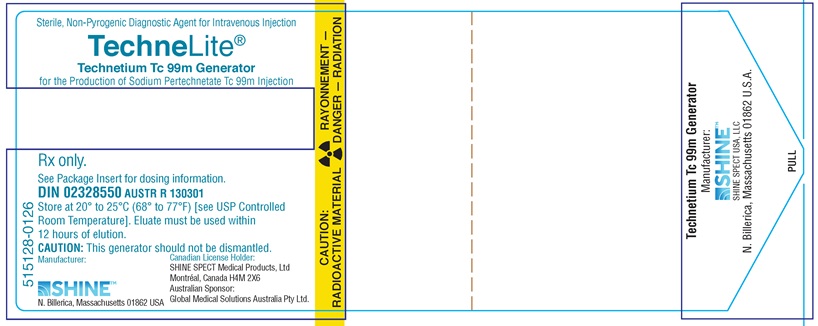
Principal Display Panel (Generator Label)
Canister Label
SHINE™
TechneLite®
Technetium Tc99m Generator
For the Production of Sodium Pertechnetate Tc 99m Injection
Caution: Rx only. Must be administered only by qualified personnel in conformity with applicable regulations of appropriate governmental agencies.
Store at 20° to 25°C (68° to 77°F) [see USP Controlled Room Temperature]. Avoid Freezing.
The parent molybdenum Mo 99 has been prepared from uranium fission material. For the generation of sterile, non-pyrogenic sodium pertechnetate Tc 99m, when eluted aseptically in compliance with manufacturer's directions.
See enclosed package insert.
WARNING:
Radiopharmaceuticals should be used only by persons who are qualified by specific training in the safe use and handling of radionuclides produced by nuclear reactor or particle accelerator and whose experience and training have been approved by the appropriate governmental agency authorized to license the use of radioactive isotopes.
Supplied in non-reusable multidose container.
Manufactured in U.S.A.
SHINE™
SHINE SPECT USA, LLC
N. Billerica, Massachusetts 01862 USA
For Mass. & International: 1-978-330-9548
Patent: 8,569,713; 8,822,950
Canadian License Holder:
SHINE SPECT Medical Products, Ltd
Montréal, Canada H4M 2X6
DIN 02328550
For ordering telephone toll free: 1-800-657-5426
Global Medical Solutions Australia Pty Ltd.
AUST R 130301
Caution: Radioactive Material
513056-0126
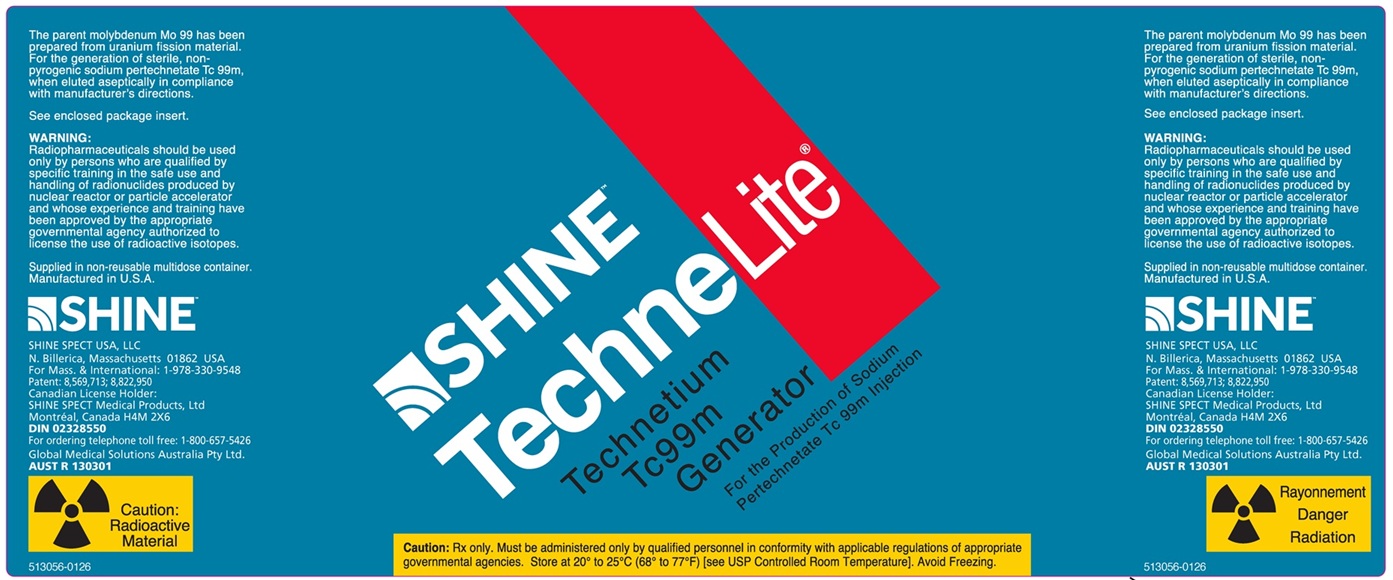
Can-label (Can Label)
Sterile, Non-Pyrogenic Diagnostic Agent for Intravenous Injection
TechneLite®
Technetium Tc 99m Generator
for the Production of Sodium Pertechnetate Tc 99m Injection
Rx only.
See Package Insert for dosing information.
DIN 02328550 AUSTR R 130301
Store at 20° to 25°C (68° to 77°F) [see USP Controlled Room Temperature]. Eluate must be used within 12 hours of elution.
CAUTION: This generator should not be dismantled.
Manufacturer:
SHINE™
SHINE SPECT USA, LLC
N. Billerica, Massachusetts 01862 USA
Canadian License Holder:
SHINE SPECT Medical Products, Ltd
Montréal, Canada H4M 2X6
Australian Sponsor:
Global Medical Solutions Australia Pty Ltd.
516184-0126
CAUTION:
RADIOACTIVE MATERIAL
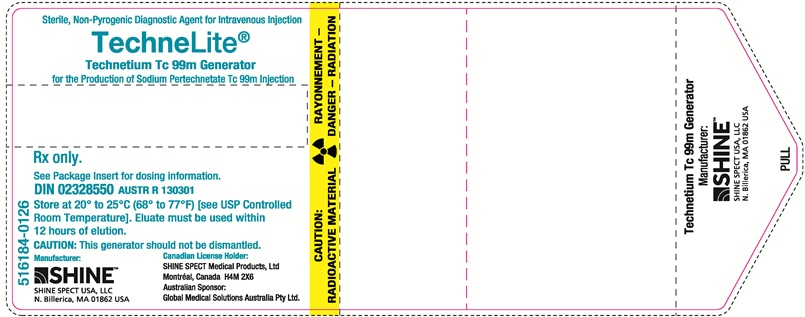
Principal Display Panel (Generator Label)
Canister Label
SHINE™
TechneLite®
Technetium Tc99m Generator
For the Production of Sodium Pertechnetate Tc 99m Injection
Caution: Rx only. Must be administered only by qualified personnel in conformity with applicable regulations of appropriate governmental agencies.
Store at 20° to 25°C (68° to 77°F) [see USP Controlled Room Temperature]. Avoid Freezing.
The parent molybdenum Mo 99 has been prepared from uranium fission material. For the generation of sterile, non-pyrogenic sodium pertechnetate Tc 99m, when eluted aseptically in compliance with manufacturer's directions.
See enclosed package insert.
WARNING:
Radiopharmaceuticals should be used only by persons who are qualified by specific training in the safe use and handling of radionuclides produced by nuclear reactor or particle accelerator and whose experience and training have been approved by the appropriate governmental agency authorized to license the use of radioactive isotopes.
Supplied in non-reusable multidose container.
Manufactured in U.S.A.
SHINE™
SHINE SPECT USA, LLC
N. Billerica, Massachusetts 01862 USA
For Mass. & International: 1-978-330-9548
Patent: 8,569,713; 8,822,950
Canadian License Holder:
SHINE SPECT Medical Products, Ltd
Montréal, Canada H4M 2X6
DIN 02328550
For ordering telephone toll free: 1-800-657-5426
Global Medical Solutions Australia Pty Ltd.
AUST R 130301
Caution: Radioactive Material
513056-0126
Can-label (Can Label)
* Please review the disclaimer below.
