CHECKMATE-214
The safety of intravenous nivolumab with ipilimumab was evaluated in CHECKMATE-214, a randomized open-label trial in 1082 patients with previously untreated advanced RCC; patients received intravenous nivolumab 3 mg/kg over 60 minutes with ipilimumab 1 mg/kg intravenously every 3 weeks for 4 doses followed by intravenous nivolumab as a single agent at a dose of 3 mg/kg by intravenous infusion every 2 weeks (n=547) or sunitinib 50 mg orally daily for the first 4 weeks of a 6-week cycle (n=535) [see Clinical Studies (14.1)]. The median duration of treatment was 7.9 months (range: 1 day to 21.4+ months) in intravenous nivolumab and ipilimumab-treated patients and 7.8 months (range: 1 day to 20.2+ months) in sunitinib-treated patients. In this trial, 57% of patients in the intravenous nivolumab and ipilimumab arm were exposed to treatment for >6 months and 38% of patients were exposed to treatment for >1 year.
Serious adverse reactions occurred in 59% of patients receiving intravenous nivolumab and ipilimumab. Study therapy was discontinued for adverse reactions in 31% of intravenous nivolumab and ipilimumab patients. Fifty-four percent (54%) of patients receiving intravenous nivolumab and ipilimumab had a dose interruption for an adverse reaction.
The most frequent serious adverse reactions reported in ≥2% of patients treated with intravenous nivolumab and ipilimumab were diarrhea, pyrexia, pneumonia, pneumonitis, hypophysitis, acute kidney injury, dyspnea, adrenal insufficiency, and colitis; in patients treated with sunitinib, they were pneumonia, pleural effusion, and dyspnea. The most common adverse reactions (reported in ≥20% of patients) were fatigue, rash, diarrhea, musculoskeletal pain, pruritus, nausea, cough, pyrexia, arthralgia, and decreased appetite. The most common laboratory abnormalities which have worsened compared to baseline in ≥30% of intravenous nivolumab and ipilimumab-treated patients include increased lipase, anemia, increased creatinine, increased ALT, increased AST, hyponatremia, increased amylase, and lymphopenia.
Tables 7 and 8 summarize adverse reactions and laboratory abnormalities, respectively, that occurred in >15% of intravenous nivolumab and ipilimumab‑treated patients in CHECKMATE-214.
Table 7: Adverse Reactions in >15% of Patients Receiving Intravenous Nivolumab and Ipilimumab - CHECKMATE-214Toxicity was graded per NCI CTCAE v4.
a Includes asthenia.
b Includes peripheral edema, peripheral swelling.
c Includes dermatitis described as acneiform, bullous, and exfoliative, drug eruption, rash described as exfoliative, erythematous, follicular, generalized, macular, maculopapular, papular, pruritic, and pustular, fixed-drug eruption.
d Includes back pain, bone pain, musculoskeletal chest pain, musculoskeletal discomfort, myalgia, neck pain, pain in extremity, spinal pain. |
Adverse Reaction | Intravenous Nivolumab and Ipilimumab
(n=547) | Sunitinib
(n=535) |
Grades 1-4 (%) | Grades 3-4 (%) | Grades 1-4 (%) | Grades 3-4 (%) |
Adverse Reaction | 99 | 65 | 99 | 76 |
General |
Fatiguea | 58 | 8 | 69 | 13 |
Pyrexia | 25 | 0.7 | 17 | 0.6 |
Edemab | 16 | 0.5 | 17 | 0.6 |
Skin and Subcutaneous Tissue |
Rashc | 39 | 3.7 | 25 | 1.1 |
Pruritus/generalized pruritus | 33 | 0.5 | 11 | 0 |
Gastrointestinal |
Diarrhea | 38 | 4.6 | 58 | 6 |
Nausea | 30 | 2 | 43 | 1.5 |
Vomiting | 20 | 0.9 | 28 | 2.1 |
Abdominal pain | 19 | 1.6 | 24 | 1.9 |
Constipation | 17 | 0.4 | 18 | 0 |
Musculoskeletal and Connective Tissue |
Musculoskeletal paind | 37 | 4 | 40 | 2.6 |
Arthralgia | 23 | 1.3 | 16 | 0 |
Respiratory, Thoracic and Mediastinal |
Cough/productive cough | 28 | 0.2 | 25 | 0.4 |
Dyspnea/exertional dyspnea | 20 | 2.4 | 21 | 2.1 |
Metabolism and Nutrition |
Decreased appetite | 21 | 1.8 | 29 | 0.9 |
Nervous System |
Headache | 19 | 0.9 | 23 | 0.9 |
Endocrine |
Hypothyroidism | 18 | 0.4 | 27 | 0.2 |
Table 8: Laboratory Values Worsening from Baselinea Occurring in >15% of Patients on Intravenous Nivolumab and Ipilimumab - CHECKMATE-214| a Each test incidence is based on the number of patients who had both baseline and at least one on-study laboratory measurement available: intravenous nivolumab and ipilimumab group (range: 490 to 538 patients) and sunitinib group (range: 485 to 523 patients). |
Laboratory Abnormality | Intravenous Nivolumab and Ipilimumab | Sunitinib |
Grades 1-4 (%) | Grades 3-4 (%) | Grades 1-4 (%) | Grades 3-4 (%) |
Chemistry |
Increased lipase | 48 | 20 | 51 | 20 |
Increased creatinine | 42 | 2.1 | 46 | 1.7 |
Increased ALT | 41 | 7 | 44 | 2.7 |
Increased AST | 40 | 4.8 | 60 | 2.1 |
Increased amylase | 39 | 12 | 33 | 7 |
Hyponatremia | 39 | 10 | 36 | 7 |
Increased alkaline phosphatase | 29 | 2 | 32 | 1 |
Hyperkalemia | 29 | 2.4 | 28 | 2.9 |
Hypocalcemia | 21 | 0.4 | 35 | 0.6 |
Hypomagnesemia | 16 | 0.4 | 26 | 1.6 |
Hematology |
Anemia | 43 | 3 | 64 | 9 |
Lymphopenia | 36 | 5 | 63 | 14 |
In addition, among patients with TSH ≤ ULN at baseline, a lower proportion of patients experienced a treatment-emergent elevation of TSH > ULN in the intravenous nivolumab and ipilimumab group compared to the sunitinib group (31% and 61%, respectively).
CHECKMATE-9ER
The safety of intravenous nivolumab with cabozantinib was evaluated in CHECKMATE-9ER, a randomized, open-label study in patients with previously untreated advanced RCC. Patients received intravenous nivolumab 240 mg over 30 minutes every 2 weeks with cabozantinib 40 mg orally once daily (n=320) or sunitinib 50 mg daily, administered orally for 4 weeks on treatment followed by 2 weeks off (n=320) [see Clinical Studies (14.1)]. Cabozantinib could be interrupted or reduced to 20 mg daily or 20 mg every other day. The median duration of treatment was 14 months (range: 0.2 to 27 months) in intravenous nivolumab and cabozantinib-treated patients. In this trial, 82% of patients in the intravenous nivolumab and cabozantinib arm were exposed to treatment for >6 months and 60% of patients were exposed to treatment for >1 year.
Serious adverse reactions occurred in 48% of patients receiving intravenous nivolumab and cabozantinib. The most frequent (≥2%) serious adverse reactions were diarrhea, pneumonia, pneumonitis, pulmonary embolism, urinary tract infection, and hyponatremia. Fatal intestinal perforations occurred in 3 (0.9%) patients.
Adverse reactions leading to discontinuation of either intravenous nivolumab or cabozantinib occurred in 20% of patients: 7% intravenous nivolumab only, 8% cabozantinib only, and 6% both drugs due to same adverse reaction at the same time. Adverse reaction leading to dose interruption or reduction of either intravenous nivolumab or cabozantinib occurred in 83% of patients: 3% intravenous nivolumab only, 46% cabozantinib only, and 21% both drugs due to same adverse reaction at the same time, and 6% both drugs sequentially.
The most common adverse reactions reported in ≥20% of patients treated with intravenous nivolumab and cabozantinib were diarrhea, fatigue, hepatotoxicity, palmar-plantar erythrodysesthesia syndrome, stomatitis, rash, hypertension, hypothyroidism, musculoskeletal pain, decreased appetite, nausea, dysgeusia, abdominal pain, cough, and upper respiratory tract infection.
Tables 9 and 10 summarize adverse reactions and laboratory abnormalities, respectively, in CHECKMATE-9ER.
Table 9: Adverse Reactions in >15% of Patients Receiving Intravenous Nivolumab and Cabozantinib - CHECKMATE-9ERToxicity was graded per NCI CTCAE v4.
a Includes abdominal discomfort, abdominal pain lower, abdominal pain upper.
b Includes gastroesophageal reflux disease.
c Includes asthenia.
d Includes hepatotoxicity, ALT increased, AST increased, blood alkaline phosphatase increased, gamma-glutamyl transferase increased, autoimmune hepatitis, blood bilirubin increased, drug induced liver injury, hepatic enzyme increased, hepatitis, hyperbilirubinemia, liver function test increased, liver function test abnormal, transaminases increased, hepatic failure.
e Includes mucosal inflammation, aphthous ulcer, mouth ulceration.
f Includes dermatitis, dermatitis acneiform, dermatitis bullous, exfoliative rash, rash erythematous, rash follicular, rash macular, rash maculo-papular, rash papular, rash pruritic. |
g Includes blood pressure increased, blood pressure systolic increased.
h Includes primary hypothyroidism.
i Includes back pain, bone pain, musculoskeletal chest pain, musculoskeletal discomfort, myalgia, neck pain, pain in extremity, spinal pain. |
j Includes productive cough.
k Includes nasopharyngitis, pharyngitis, rhinitis. |
Adverse Reaction | Intravenous Nivolumab and Cabozantinib
(n=320) | Sunitinib
(n=320) |
Grades 1-4 (%) | Grades 3-4 (%) | Grades 1-4 (%) | Grades 3-4 (%) |
Gastrointestinal |
Diarrhea | 64 | 7 | 47 | 4.4 |
Nausea | 27 | 0.6 | 31 | 0.3 |
Abdominal paina | 22 | 1.9 | 15 | 0.3 |
Vomiting | 17 | 1.9 | 21 | 0.3 |
Dyspepsiab | 15 | 0 | 22 | 0.3 |
General |
Fatiguec | 51 | 8 | 50 | 8 |
Hepatobiliary |
Hepatotoxicityd | 44 | 11 | 26 | 5 |
Skin and Subcutaneous Tissue |
Palmar-plantar erythrodysesthesia syndrome | 40 | 8 | 41 | 8 |
Stomatitise | 37 | 3.4 | 46 | 4.4 |
Rashf | 36 | 3.1 | 14 | 0 |
Pruritus | 19 | 0.3 | 4.4 | 0 |
Vascular |
Hypertensiong | 36 | 13 | 39 | 14 |
Endocrine |
Hypothyroidismh | 34 | 0.3 | 30 | 0.3 |
Musculoskeletal and Connective Tissue |
Musculoskeletal paini | 33 | 3.8 | 29 | 3.1 |
Arthralgia | 18 | 0.3 | 9 | 0.3 |
Metabolism and Nutrition |
Decreased appetite | 28 | 1.9 | 20 | 1.3 |
Nervous System |
Dysgeusia | 24 | 0 | 22 | 0 |
Headache | 16 | 0 | 12 | 0.6 |
Respiratory, Thoracic and Mediastinal |
Coughj | 20 | 0.3 | 17 | 0 |
Dysphonia | 17 | 0.3 | 3.4 | 0 |
Infections and Infestations |
Upper respiratory tract infectionk | 20 | 0.3 | 8 | 0.3 |
Table 10: Laboratory Values Worsening from Baselinea Occurring in >20% of Patients on Intravenous Nivolumab and Cabozantinib - CHECKMATE-9ER| a Each test incidence is based on the number of patients who had both baseline and at least one on-study laboratory measurement available: intravenous nivolumab and cabozantinib group (range: 170 to 317 patients) and sunitinib group (range: 173 to 311 patients). |
Laboratory Abnormality | Intravenous Nivolumab and Cabozantinib | Sunitinib |
Grades 1-4 (%) | Grades 3-4 (%) | Grades 1-4 (%) | Grades 3-4 (%) |
Chemistry |
Increased ALT | 79 | 9.8 | 39 | 3.5 |
Increased AST | 77 | 7.9 | 57 | 2.6 |
Hypophosphatemia | 69 | 28 | 48 | 10 |
Hypocalcemia | 54 | 1.9 | 24 | 0.6 |
Hypomagnesemia | 47 | 1.3 | 25 | 0.3 |
Hyperglycemia | 44 | 3.5 | 44 | 1.7 |
Hyponatremia | 43 | 11 | 36 | 12 |
Increased lipase | 41 | 14 | 38 | 13 |
Increased amylase | 41 | 10 | 28 | 6 |
Increased alkaline phosphatase | 41 | 2.8 | 37 | 1.6 |
Increased creatinine | 39 | 1.3 | 42 | 0.6 |
Hyperkalemia | 35 | 4.7 | 27 | 1 |
Hypoglycemia | 26 | 0.8 | 14 | 0.4 |
Hematology |
Lymphopenia | 42 | 6.6 | 45 | 10 |
Thrombocytopenia | 41 | 0.3 | 70 | 9.7 |
Anemia | 37 | 2.5 | 61 | 4.8 |
Leukopenia | 37 | 0.3 | 66 | 5.1 |
Neutropenia | 35 | 3.2 | 67 | 12 |
CHECKMATE-214
CHECKMATE-214 (NCT02231749) was a randomized (1:1), open-label trial in patients with previously untreated advanced RCC. Patients were included regardless of their PD-L1 status. CHECKMATE-214 excluded patients with any history of or concurrent brain metastases, active autoimmune disease, or medical conditions requiring systemic immunosuppression. Patients were stratified by International Metastatic RCC Database Consortium (IMDC) prognostic score and region.
Efficacy was evaluated in intermediate/poor risk patients with at least 1 or more of 6 prognostic risk factors as per the IMDC criteria (less than one year from time of initial renal cell carcinoma diagnosis to randomization, Karnofsky performance status <80%, hemoglobin less than the lower limit of normal, corrected calcium of >10 mg/dL, platelet count greater than the upper limit of normal, and absolute neutrophil count greater than the upper limit of normal).
Patients were randomized to nivolumab 3 mg/kg and ipilimumab 1 mg/kg intravenously every 3 weeks for 4 doses followed by nivolumab 3 mg/kg intravenously every two weeks (n=425), or sunitinib 50 mg orally daily for the first 4 weeks of a 6-week cycle (n=422). Treatment continued until disease progression or unacceptable toxicity.
The trial population characteristics were: median age was 61 years (range: 21 to 85) with 38% ≥65 years of age and 8% ≥75 years of age. The majority of patients were male (73%) and White (87%) and 26% and 74% of patients had a baseline KPS of 70% to 80% and 90% to 100%, respectively.
The major efficacy outcome measures were OS, PFS (independent radiographic review committee [IRRC]-assessed) and confirmed ORR (IRRC-assessed) in intermediate/poor risk patients. In this population, the trial demonstrated statistically significant improvement in OS and ORR for patients randomized to intravenous nivolumab and ipilimumab as compared with sunitinib (Table 46 and Figure 1). OS benefit was observed regardless of PD-L1 expression level. The trial did not demonstrate a statistically significant improvement in PFS. Efficacy results are shown in Table 46 and Figure 1.
Table 46: Efficacy Results - CHECKMATE-214| a Not Reached |
| b Based on a stratified proportional hazards model. |
| c Based on a stratified log-rank test. |
| d p-value is compared to alpha 0.002 in order to achieve statistical significance. |
| e Based on the stratified DerSimonian-Laird test. |
| f p-value is compared to alpha 0.001 in order to achieve statistical significance. |
| g Not Significant at alpha level of 0.009. |
| Intermediate/Poor-Risk |
Intravenous Nivolumab and Ipilimumab
(n=425) | Sunitinib
(n=422) |
Overall Survival |
Deaths (%) | 140 (32.9) | 188 (44.5) |
Median survival (months) | NRa | 25.9 |
Hazard ratio (99.8% CI)b | 0.63 (0.44, 0.89) |
p-valuec,d | <0.0001 |
Confirmed Overall Response Rate (95% CI) | 41.6% (36.9, 46.5) | 26.5% (22.4, 31.0) |
p-valuee,f | <0.0001 |
Complete response (CR) | 40 (9.4) | 5 (1.2) |
Partial response (PR) | 137 (32.2) | 107 (25.4) |
Median duration of response (months) (95% CI) | NRa (21.8, NRa) | 18.2 (14.8, NRa) |
Progression-free Survival |
Disease progression or death (%) | 228 (53.6) | 228 (54.0) |
Median (months) | 11.6 | 8.4 |
Hazard ratio (99.1% CI)a | 0.82 (0.64, 1.05) |
p-valuec | NSg |
Figure 1: Overall Survival (Intermediate/Poor Risk Population) - CHECKMATE-214

Oq-os-checkmate-214 (Oq Os Checkmate 214)
CHECKMATE-214 also randomized 249 favorable risk patients as per IMDC criteria to intravenous nivolumab and ipilimumab (n=125) or to sunitinib (n=124). These patients were not evaluated as part of the efficacy analysis population. OS in favorable risk patients receiving intravenous nivolumab and ipilimumab compared to sunitinib has a hazard ratio of 1.45 (95% CI: 0.75, 2.81). The efficacy of intravenous nivolumab and ipilimumab in previously untreated renal cell carcinoma with favorable-risk disease has not been established.
CHECKMATE-9ER
CHECKMATE-9ER (NCT03141177) was a randomized, open-label study of intravenous nivolumab combined with cabozantinib versus sunitinib in patients with previously untreated advanced RCC. CHECKMATE-9ER excluded patients with autoimmune disease or other medical conditions requiring systemic immunosuppression. Patients were stratified by IMDC prognostic score (favorable vs. intermediate vs. poor), PD-L1 tumor expression (≥1% vs. <1% or indeterminate), and region (US/Canada/Western Europe/Northern Europe vs. Rest of World).
Patients were randomized to nivolumab 240 mg intravenously every 2 weeks and cabozantinib 40 mg orally daily (n=323), or sunitinib 50 mg orally daily for the first 4 weeks of a 6-week cycle (4 weeks on treatment followed by 2 weeks off) (n=328). Treatment continued until disease progression per RECIST v1.1 or unacceptable toxicity. Treatment beyond RECIST‑defined disease progression was permitted if the patient was clinically stable and considered to be deriving clinical benefit by the investigator. Tumor assessments were performed at baseline, after randomization at Week 12, then every 6 weeks until Week 60, and then every 12 weeks thereafter.
The trial population characteristics were: median age 61 years (range: 28 to 90) with 38% ≥65 years of age and 10% ≥75 years of age. The majority of patients were male (74%) and White (82%) and 23% and 77% of patients had a baseline KPS of 70% to 80% and 90% to 100%, respectively. Patient distribution by IMDC risk categories was 22% favorable, 58% intermediate, and 20% poor.
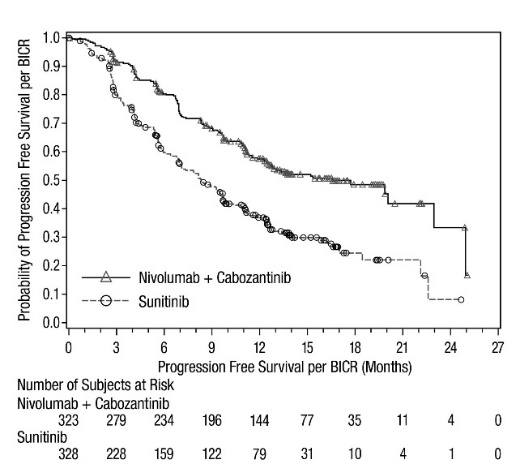
The major efficacy outcome measure was PFS (BICR assessed). Additional efficacy outcome measures were OS and ORR (BICR assessed). The trial demonstrated a statistically significant improvement in PFS, OS, and ORR for patients randomized to intravenous nivolumab and cabozantinib compared with sunitinib. Consistent results for PFS were observed across pre-specified subgroups of IMDC risk categories and PD-L1 tumor expression status. An updated OS analysis was conducted when 271 deaths were observed based on the pre-specified number of deaths for the pre-planned final analysis of OS. Efficacy results are shown in Table 47 and Figures 2 and 3.
Table 47: Efficacy Results - CHECKMATE-9ER| a Based on Kaplan-Meier estimates. |
| b Stratified Cox proportional hazards model. |
| c Based on stratified log-rank test |
| d 2-sided p-values from stratified log-rank test. |
| e Not Reached |
| f p-value is compared with the allocated alpha of 0.0111 for this interim analysis |
| g CI based on the Clopper-Pearson method. |
| h 2-sided p-value from Cochran-Mantel-Haenszel test. |
| Intravenous Nivolumab and Cabozantinib
(n=323) | Sunitinib
(n=328) |
Progression-free Survival |
Disease progression or death (%) | 144 (45) | 191 (58) |
Median PFS (months)a (95% CI) | 16.6 (12.5, 24.9) | 8.3 (7.0, 9.7) |
Hazard ratio (95% CI)b | 0.51 (0.41, 0.64) |
p-valuec,d | <0.0001 |
Overall Survival |
Deaths (%) | 67 (21) | 99 (30) |
Median OS (months)a (95% CI) | NRe | NR (22.6, NRe) |
Hazard ratio (98.89% CI)b | 0.60 (0.40, 0.89) |
p-valuec,d,f | 0.0010 |
Updated Overall Survival |
Deaths (%) | 121 (37) | 150 (46) |
Median OS (months)a (95% CI) | 37.7 (35.5, NR) | 34.3 (29.0, NR) |
Hazard ratio (95% CI)b | 0.70 (0.55, 0.90) |
Confirmed Objective Response Rate (95% CI)g | 55.7% (50.1, 61.2) | 27.1% (22.4, 32.3) |
p-valueh | <0.0001 |
Complete Response | 26 (8%) | 15 (4.6%) |
Partial Response | 154 (48%) | 74 (23%) |
Median duration of response in months (95% CI)a | 20.2 (17.3, NRe) | 11.5 (8.3, 18.4) |
Figure 2: Progression-free Survival - CHECKMATE-9ER

Oq-pfs-checkmate-9er (Oq Pfs Checkmate 9er)
Figure 3: Updated Overall Survival - CHECKMATE-9ER
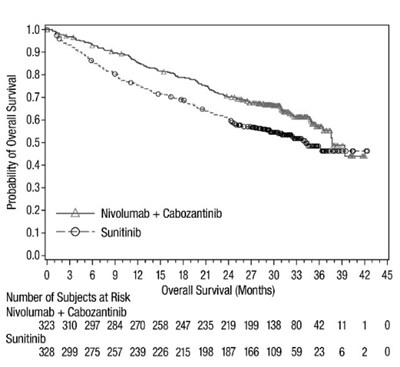
Oq-updated-os-checkmate-9er (Oq Updated Os Checkmate 9er)
In an exploratory analysis, the updated analysis of OS in patients with IMDC favorable, intermediate, intermediate/poor, and poor risk demonstrated a HR (95% CI) of 1.03 (0.55, 1.92), 0.74 (0.54, 1.01), 0.65 (0.50, 0.85), and 0.49 (0.31, 0.79), respectively.