Fatal and other serious complications can occur in patients who receive allogeneic hematopoietic stem cell transplantation (HSCT) before or after being treated with a PD-1/PD-L1 blocking antibody. Transplant-related complications include hyperacute graft-versus-host-disease (GVHD), acute GVHD, chronic GVHD, hepatic veno-occlusive disease (VOD) after reduced intensity conditioning, and steroid-requiring febrile syndrome (without an identified infectious cause). These complications may occur despite intervening therapy between PD-1/PD-L1 blockade and allogeneic HSCT.
Follow patients closely for evidence of transplant-related complications and intervene promptly. Consider the benefit versus risks of treatment with a PD-1/PD-L1 blocking antibody prior to or after an allogeneic HSCT.
Melanoma
Ipilimumab-Naive Melanoma
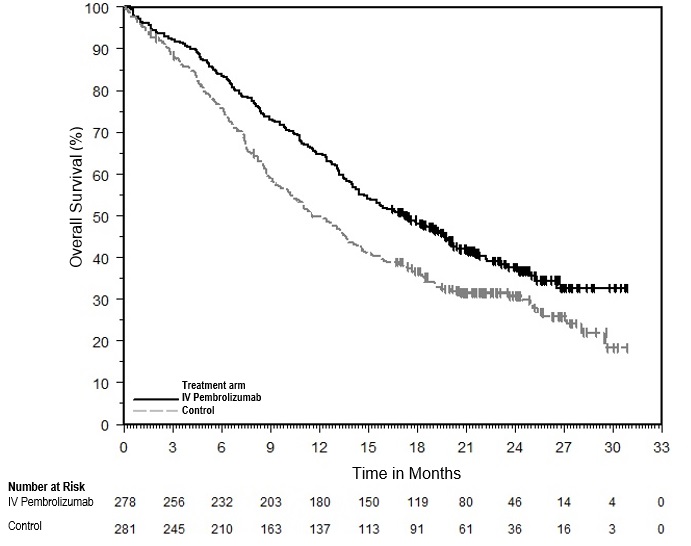
The safety of intravenous pembrolizumab for the treatment of patients with unresectable or metastatic melanoma who had not received prior ipilimumab and who had received no more than one prior systemic therapy was investigated in KEYNOTE-006. KEYNOTE-006 was a multicenter, open-label, active-controlled trial where patients were randomized (1:1:1) and received intravenous pembrolizumab 10 mg/kg every 2 weeks (n=278) or intravenous pembrolizumab 10 mg/kg every 3 weeks (n=277) until disease progression or unacceptable toxicity or ipilimumab 3 mg/kg every 3 weeks for 4 doses unless discontinued earlier for disease progression or unacceptable toxicity (n=256) [see Clinical Studies (14.2)]. Patients with autoimmune disease, a medical condition that required systemic corticosteroids or other immunosuppressive medication; a history of interstitial lung disease; or active infection requiring therapy, including HIV or hepatitis B or C, were ineligible.
The median duration of exposure was 5.6 months (range: 1 day to 11.0 months) for intravenous pembrolizumab and similar in both treatment arms. Fifty-one and 46% of patients received intravenous pembrolizumab 10 mg/kg every 2 or 3 weeks, respectively, for ≥6 months. No patients in either arm received treatment for more than one year.
The study population characteristics were: median age of 62 years (range: 18 to 89); 60% male; 98% White; 32% had an elevated lactate dehydrogenase (LDH) value at baseline; 65% had M1c stage disease; 9% with history of brain metastasis; and approximately 36% had been previously treated with systemic therapy which included a BRAF inhibitor (15%), chemotherapy (13%), and immunotherapy (6%).
In KEYNOTE-006, the adverse reaction profile was similar for the every 2 week and every 3 week schedule, therefore summary safety results are provided in a pooled analysis (n=555) of both intravenous pembrolizumab arms. Adverse reactions leading to permanent discontinuation of intravenous pembrolizumab occurred in 9% of patients. Adverse reactions leading to discontinuation of intravenous pembrolizumab in more than one patient were colitis (1.4%), autoimmune hepatitis (0.7%), allergic reaction (0.4%), polyneuropathy (0.4%), and cardiac failure (0.4%). Adverse reactions leading to interruption of intravenous pembrolizumab occurred in 21% of patients; the most common (≥1%) was diarrhea (2.5%). Tables 6 and 7 summarize selected adverse reactions and laboratory abnormalities, respectively, in patients on intravenous pembrolizumab in KEYNOTE-006.
Table 6: SelectedAdverse reactions occurring at same or higher incidence than in the ipilimumab arm
Adverse Reactions Occurring in ≥10% of Patients Receiving Intravenous Pembrolizumab in KEYNOTE-006| Adverse Reaction | Intravenous Pembrolizumab
10 mg/kg every 2 or 3 weeks | Ipilimumab |
|---|
| n=555 | n=256 |
|---|
| All Grades Graded per NCI CTCAE v4.0
(%) | Grades 3-4
(%) | All Grades
(%) | Grades 3-4
(%) |
|---|
| General |
| Fatigue | 28 | 0.9 | 28 | 3.1 |
| Skin and Subcutaneous Tissue |
| Rash Includes rash, rash erythematous, rash follicular, rash generalized, rash macular, rash maculo-papular, rash papular, rash pruritic, and exfoliative rash. | 24 | 0.2 | 23 | 1.2 |
| Vitiligo Includes skin hypopigmentation | 13 | 0 | 2 | 0 |
| Musculoskeletal and Connective Tissue |
| Arthralgia | 18 | 0.4 | 10 | 1.2 |
| Back pain | 12 | 0.9 | 7 | 0.8 |
| Respiratory, Thoracic and Mediastinal |
| Cough | 17 | 0 | 7 | 0.4 |
| Dyspnea | 11 | 0.9 | 7 | 0.8 |
| Metabolism and Nutrition |
| Decreased appetite | 16 | 0.5 | 14 | 0.8 |
| Nervous System |
| Headache | 14 | 0.2 | 14 | 0.8 |
Other clinically important adverse reactions occurring in ≥10% of patients receiving intravenous pembrolizumab were diarrhea (26%), nausea (21%), and pruritus (17%).
Table 7: SelectedLaboratory abnormalities occurring at same or higher incidence than in ipilimumab arm
Laboratory Abnormalities Worsened from Baseline Occurring in ≥20% of Melanoma Patients Receiving Intravenous Pembrolizumab in KEYNOTE-006| Laboratory Test Each test incidence is based on the number of patients who had both baseline and at least one on-study laboratory measurement available: intravenous pembrolizumab (520 to 546 patients) and ipilimumab (237 to 247 patients); hypertriglyceridemia: intravenous pembrolizumab n=429 and ipilimumab n=183; hypercholesterolemia: intravenous pembrolizumab n=484 and ipilimumab n=205. | Intravenous Pembrolizumab
10 mg/kg every 2 or 3 weeks | Ipilimumab |
|---|
| All Grades Graded per NCI CTCAE v4.0
% | Grades 3-4
% | All Grades
% | Grades 3-4
% |
|---|
| Chemistry | |
| Hyperglycemia | 45 | 4.2 | 45 | 3.8 |
| Hypertriglyceridemia | 43 | 2.6 | 31 | 1.1 |
| Hyponatremia | 28 | 4.6 | 26 | 7 |
| Increased AST | 27 | 2.6 | 25 | 2.5 |
| Hypercholesterolemia | 20 | 1.2 | 13 | 0 |
| Hematology | |
| Anemia | 35 | 3.8 | 33 | 4.0 |
| Lymphopenia | 33 | 7 | 25 | 6 |
Other laboratory abnormalities occurring in ≥20% of patients receiving intravenous pembrolizumab were increased hypoalbuminemia (27% all Grades; 2.4% Grades 3-4), increased ALT (23% all Grades; 3.1% Grades 3-4), and increased alkaline phosphatase (21% all Grades, 2% Grades 3-4).
Ipilimumab-Refractory Melanoma
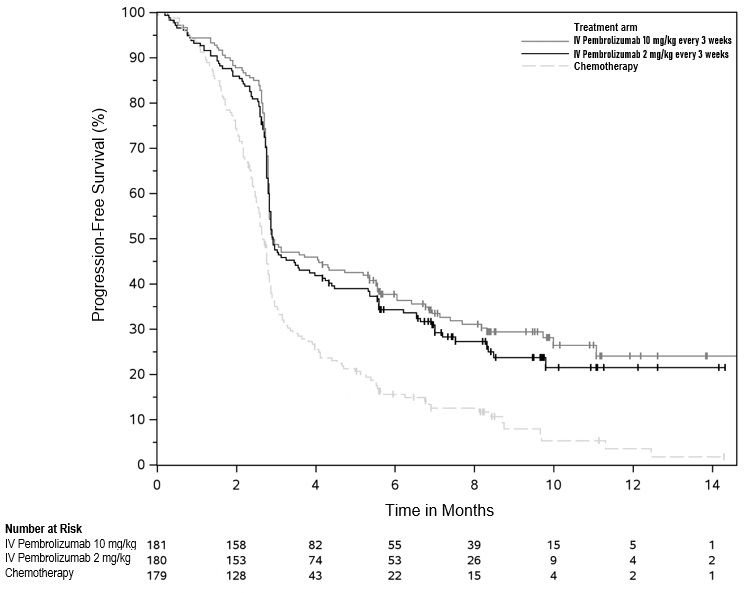
The safety of intravenous pembrolizumab in patients with unresectable or metastatic melanoma with disease progression following ipilimumab and, if BRAF V600 mutation positive, a BRAF inhibitor, was investigated in KEYNOTE-002. KEYNOTE-002 was a multicenter, partially blinded (intravenous pembrolizumab dose), randomized (1:1:1), active-controlled trial in which 528 patients received intravenous pembrolizumab 2 mg/kg (n=178) or 10 mg/kg (n=179) every 3 weeks or investigator's choice of chemotherapy (n=171), consisting of dacarbazine (26%), temozolomide (25%), paclitaxel and carboplatin (25%), paclitaxel (16%), or carboplatin (8%) [see Clinical Studies (14.2)]. Patients with autoimmune disease, severe immune-related toxicity related to ipilimumab, defined as any Grade 4 toxicity or Grade 3 toxicity requiring corticosteroid treatment (greater than 10 mg/day prednisone or equivalent dose) for greater than 12 weeks; medical conditions that required systemic corticosteroids or other immunosuppressive medication; a history of interstitial lung disease; or an active infection requiring therapy, including HIV or hepatitis B or C, were ineligible.
The median duration of exposure to intravenous pembrolizumab 2 mg/kg every 3 weeks was 3.7 months (range: 1 day to 16.6 months) and to intravenous pembrolizumab 10 mg/kg every 3 weeks was 4.8 months (range: 1 day to 16.8 months). In the intravenous pembrolizumab 2 mg/kg arm, 36% of patients were exposed to intravenous pembrolizumab for ≥6 months and 4% were exposed for ≥12 months. In the 10 mg/kg arm, 41% of patients were exposed to intravenous pembrolizumab for ≥6 months and 6% of patients were exposed to intravenous pembrolizumab for ≥12 months.
The study population characteristics were: median age of 62 years (range: 15 to 89); 61% male; 98% White; 41% had an elevated LDH value at baseline; 83% had M1c stage disease; 73% received two or more prior therapies for advanced or metastatic disease (100% received ipilimumab and 25% a BRAF inhibitor); and 15% with history of brain metastasis.
In KEYNOTE-002, the adverse reaction profile was similar for the 2 mg/kg dose and 10 mg/kg dose, therefore summary safety results are provided in a pooled analysis (n=357) of both intravenous pembrolizumab arms. Adverse reactions resulting in permanent discontinuation occurred in 12% of patients receiving intravenous pembrolizumab; the most common (≥1%) were general physical health deterioration (1%), asthenia (1%), dyspnea (1%), pneumonitis (1%), and generalized edema (1%). Adverse reactions leading to interruption of intravenous pembrolizumab occurred in 14% of patients; the most common (≥1%) were dyspnea (1%), diarrhea (1%), and maculo-papular rash (1%). Tables 8 and 9 summarize adverse reactions and laboratory abnormalities, respectively, in patients on intravenous pembrolizumab in KEYNOTE-002.
Table 8: SelectedAdverse reactions occurring at same or higher incidence than in chemotherapy arm
Adverse Reactions Occurring in ≥10% of Patients Receiving Intravenous Pembrolizumab in KEYNOTE-002| Adverse Reaction | Intravenous Pembrolizumab
2 mg/kg or 10 mg/kg every 3 weeks | Chemotherapy Chemotherapy: dacarbazine, temozolomide, carboplatin plus paclitaxel, paclitaxel, or carboplatin |
|---|
| n=357 | n=171 |
|---|
| All Grades Graded per NCI CTCAE v4.0
(%) | Grades 3-4
(%) | All Grades
(%) | Grades 3-4
(%) |
|---|
| Skin and Subcutaneous Tissue |
| Pruritus | 28 | 0 | 8 | 0 |
| Rash Includes rash, rash erythematous, rash generalized, rash macular, rash maculo-papular, rash papular, and rash pruritic | 24 | 0.6 | 8 | 0 |
| Gastrointestinal |
| Constipation | 22 | 0.3 | 20 | 2.3 |
| Diarrhea | 20 | 0.8 | 20 | 2.3 |
| Abdominal pain | 13 | 1.7 | 8 | 1.2 |
| Respiratory, Thoracic and Mediastinal |
| Cough | 18 | 0 | 16 | 0 |
| General |
| Pyrexia | 14 | 0.3 | 9 | 0.6 |
| Asthenia | 10 | 2.0 | 9 | 1.8 |
| Musculoskeletal and Connective Tissue |
| Arthralgia | 14 | 0.6 | 10 | 1.2 |
Other clinically important adverse reactions occurring in patients receiving intravenous pembrolizumab were fatigue (43%), nausea (22%), decreased appetite (20%), vomiting (13%), and peripheral neuropathy (1.7%).
Table 9: SelectedLaboratory abnormalities occurring at same or higher incidence than in chemotherapy arm.
Laboratory Abnormalities Worsened from Baseline Occurring in ≥20% of Melanoma Patients Receiving Intravenous Pembrolizumab in KEYNOTE-002| Laboratory Test Each test incidence is based on the number of patients who had both baseline and at least one on-study laboratory measurement available: intravenous pembrolizumab (range: 320 to 325 patients) and chemotherapy (range: 154 to 161 patients); hypertriglyceridemia: intravenous pembrolizumab n=247 and chemotherapy n=116; decreased bicarbonate: intravenous pembrolizumab n=263 and chemotherapy n=123. | Intravenous Pembrolizumab
2 mg/kg or 10 mg/kg every 3 weeks | Chemotherapy |
|---|
| All Grades Graded per NCI CTCAE v4.0
% | Grades 3-4
% | All Grades
% | Grades 3-4
% |
|---|
| Chemistry |
| Hyperglycemia | 49 | 6 | 44 | 6 |
| Hypoalbuminemia | 37 | 1.9 | 33 | 0.6 |
| Hyponatremia | 37 | 7 | 24 | 3.8 |
| Hypertriglyceridemia | 33 | 0 | 32 | 0.9 |
| Increased alkaline phosphatase | 26 | 3.1 | 18 | 1.9 |
| Increased AST | 24 | 2.2 | 16 | 0.6 |
| Decreased bicarbonate | 22 | 0.4 | 13 | 0 |
| Hypocalcemia | 21 | 0.3 | 18 | 1.9 |
| Increased ALT | 21 | 1.8 | 16 | 0.6 |
Other laboratory abnormalities occurring in ≥20% of patients receiving intravenous pembrolizumab were anemia (44% all Grades; 10% Grades 3-4) and lymphopenia (40% all Grades; 9% Grades 3-4).
Adjuvant Treatment of Resected Stage IIB or IIC Melanoma
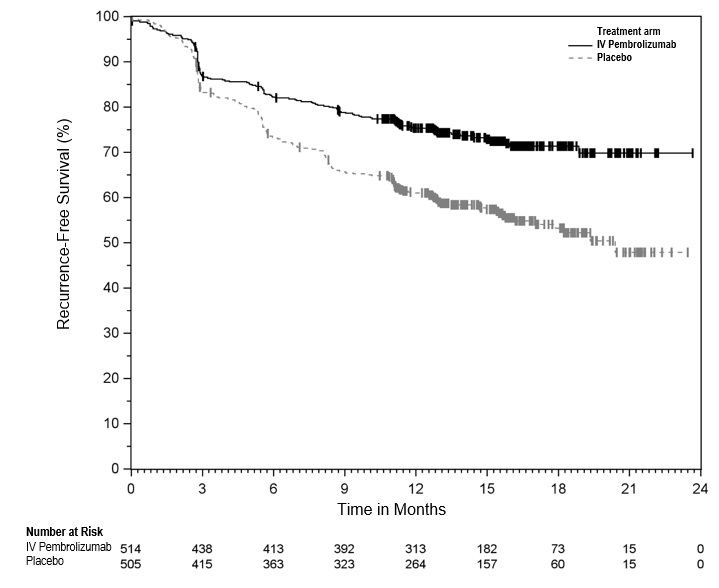
Among the 969 patients with Stage IIB or IIC melanoma enrolled in KEYNOTE-716 [see Clinical Studies (14.2)] treated with intravenous pembrolizumab, the median duration of exposure to intravenous pembrolizumab was 9.9 months (range: 0 to 15.4 months). Patients with autoimmune disease or a medical condition that required immunosuppression or mucosal or ocular melanoma were ineligible. Adverse reactions occurring in patients with Stage IIB or IIC melanoma were similar to those occurring in 1011 patients with Stage III melanoma from KEYNOTE-054 or the 2799 patients with melanoma or NSCLC treated with intravenous pembrolizumab as a single agent.
Adjuvant Treatment of Stage III Resected Melanoma
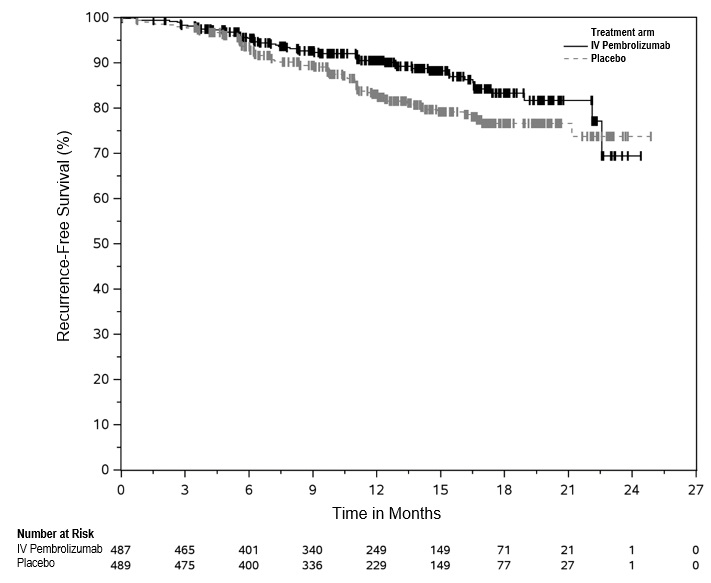
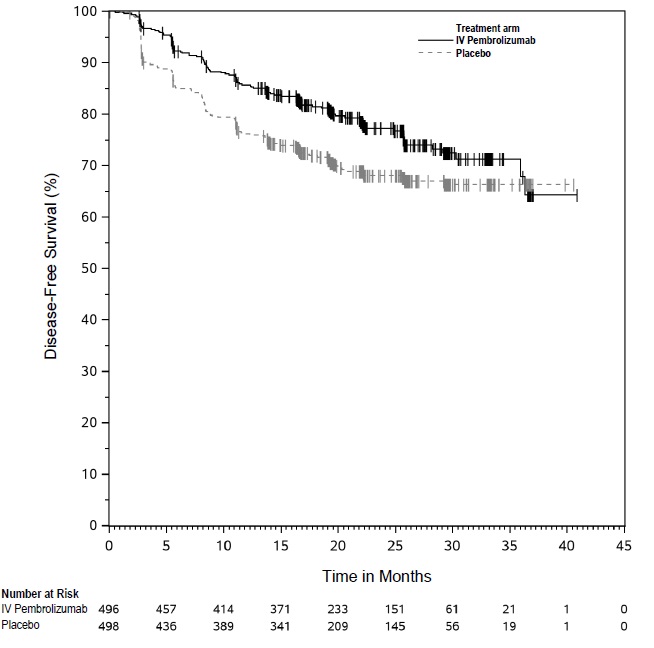
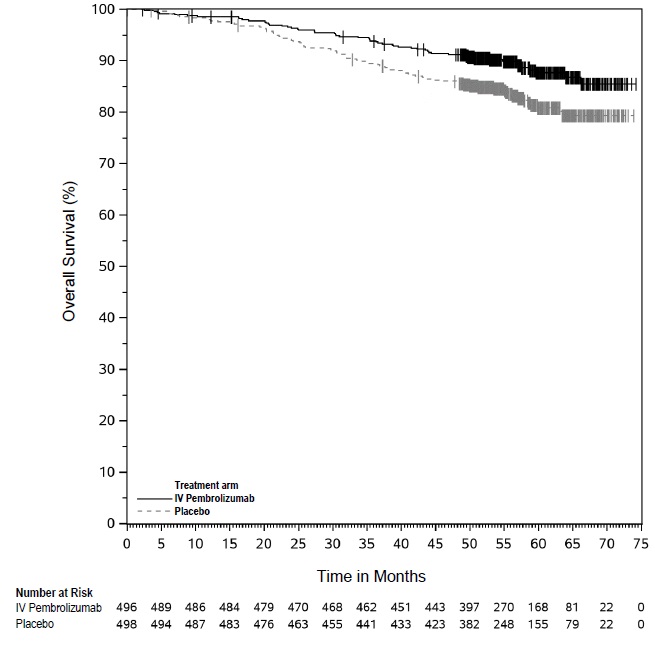
The safety of intravenous pembrolizumab as a single agent was investigated in KEYNOTE-054, a randomized (1:1) double-blind trial in which 1019 patients with completely resected Stage IIIA (>1 mm lymph node metastasis), IIIB or IIIC melanoma received 200 mg of intravenous pembrolizumab by intravenous infusion every 3 weeks (n=509) or placebo (n=502) for up to one year [see Clinical Studies (14.2)]. Patients with active autoimmune disease or a medical condition that required immunosuppression or mucosal or ocular melanoma were ineligible. Seventy-six percent of patients received intravenous pembrolizumab for 6 months or longer.
The study population characteristics were: median age of 54 years (range: 19 to 88), 25% age 65 or older; 62% male; and 94% ECOG PS of 0 and 6% ECOG PS of 1. Sixteen percent had Stage IIIA, 46% had Stage IIIB, 18% had Stage IIIC (1-3 positive lymph nodes), and 20% had Stage IIIC (≥4 positive lymph nodes).
Two patients treated with intravenous pembrolizumab died from causes other than disease progression; causes of death were drug reaction with eosinophilia and systemic symptoms and autoimmune myositis with respiratory failure. Serious adverse reactions occurred in 25% of patients receiving intravenous pembrolizumab. Adverse reactions leading to permanent discontinuation occurred in 14% of patients receiving intravenous pembrolizumab; the most common (≥1%) were pneumonitis (1.4%), colitis (1.2%), and diarrhea (1%). Adverse reactions leading to interruption of intravenous pembrolizumab occurred in 19% of patients; the most common (≥1%) were diarrhea (2.4%), pneumonitis (2%), increased ALT (1.4%), arthralgia (1.4%), increased AST (1.4%), dyspnea (1%), and fatigue (1%). Tables 10 and 11 summarize adverse reactions and laboratory abnormalities, respectively, in patients on intravenous pembrolizumab in KEYNOTE-054.
Table 10: SelectedAdverse reactions occurring at same or higher incidence than in placebo arm
Adverse Reactions Occurring in ≥10% of Patients Receiving Intravenous Pembrolizumab in KEYNOTE-054| Adverse Reaction | Intravenous Pembrolizumab
200 mg every 3 weeks
n=509 | Placebo
n=502 |
|---|
| All Grades Graded per NCI CTCAE v4.03
(%) | Grades 3-4
(%) | All Grades
(%) | Grades 3-4
(%) |
|---|
| Gastrointestinal |
| Diarrhea | 28 | 1.2 | 26 | 1.2 |
| Nausea | 17 | 0.2 | 15 | 0 |
| Skin and Subcutaneous Tissue |
| Pruritus | 19 | 0 | 12 | 0 |
| Rash | 13 | 0.2 | 9 | 0 |
| Musculoskeletal and Connective Tissue |
| Arthralgia | 16 | 1.2 | 14 | 0 |
| Endocrine |
| Hypothyroidism | 15 | 0 | 2.8 | 0 |
| Hyperthyroidism | 10 | 0.2 | 1.2 | 0 |
| Respiratory, Thoracic and Mediastinal |
| Cough | 14 | 0 | 11 | 0 |
| General |
| Asthenia | 11 | 0.2 | 8 | 0 |
| Influenza like illness | 11 | 0 | 8 | 0 |
| Investigations |
| Weight loss | 11 | 0 | 8 | 0 |
Table 11: SelectedLaboratory abnormalities occurring at same or higher incidence than placebo.
Laboratory Abnormalities Worsened from Baseline Occurring in ≥20% of Melanoma Patients Receiving Intravenous Pembrolizumab in KEYNOTE-054| Laboratory Test Each test incidence is based on the number of patients who had both baseline and at least one on-study laboratory measurement available: intravenous pembrolizumab (range: 502 to 505 patients) and placebo (range: 491 to 497 patients). | Intravenous Pembrolizumab
200 mg every 3 weeks | Placebo |
|---|
| All Grades Graded per NCI CTCAE v4.03
% | Grades 3-4
% | All Grades
% | Grades 3-4
% |
|---|
| Chemistry |
| Increased ALT | 25 | 2.4 | 15 | 0.2 |
| Increased AST | 22 | 1.8 | 14 | 0.4 |
| Hematology |
| Lymphopenia | 22 | 1 | 15 | 1.2 |
NSCLC
First-line treatment of metastatic nonsquamous NSCLC with pemetrexed and platinum chemotherapy
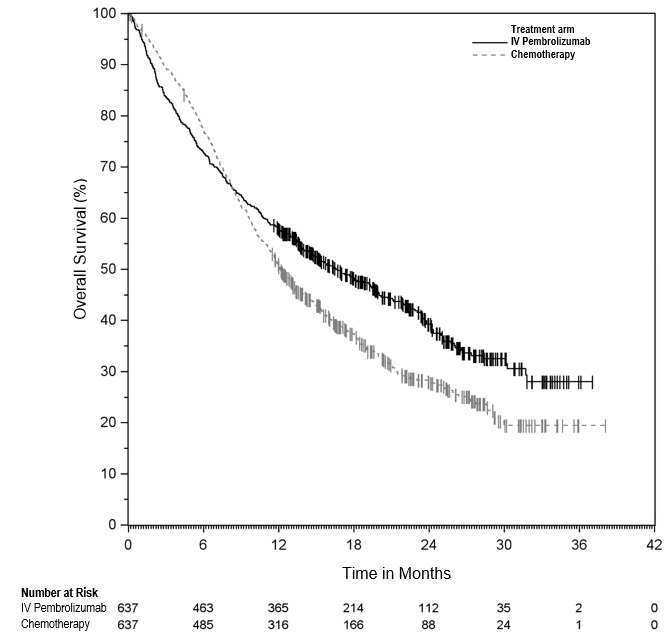
The safety of intravenous pembrolizumab in combination with pemetrexed and investigator's choice of platinum (either carboplatin or cisplatin) was investigated in KEYNOTE-189, a multicenter, double-blind, randomized (2:1), active-controlled trial in patients with previously untreated, metastatic nonsquamous NSCLC with no EGFR or ALK genomic tumor aberrations [see Clinical Studies (14.3)]. A total of 607 patients received intravenous pembrolizumab 200 mg, pemetrexed and platinum every 3 weeks for 4 cycles followed by intravenous pembrolizumab and pemetrexed (n=405) or placebo, pemetrexed, and platinum every 3 weeks for 4 cycles followed by placebo and pemetrexed (n=202). Patients with autoimmune disease that required systemic therapy within 2 years of treatment; a medical condition that required immunosuppression; or who had received more than 30 Gy of thoracic radiation within the prior 26 weeks were ineligible.
The median duration of exposure to intravenous pembrolizumab 200 mg every 3 weeks was 7.2 months (range: 1 day to 20.1 months). Sixty percent of patients in the intravenous pembrolizumab arm were exposed to intravenous pembrolizumab for ≥6 months. Seventy-two percent of patients received carboplatin.
The study population characteristics were: median age of 64 years (range: 34 to 84), 49% age 65 or older; 59% male; 94% White and 3% Asian; and 18% with history of brain metastases at baseline.
Intravenous pembrolizumab was discontinued for adverse reactions in 20% of patients. The most common adverse reactions resulting in permanent discontinuation of intravenous pembrolizumab were pneumonitis (3%) and acute kidney injury (2%). Adverse reactions leading to the interruption of intravenous pembrolizumab occurred in 53% of patients; the most common adverse reactions or laboratory abnormalities leading to interruption of intravenous pembrolizumab (≥2%) were neutropenia (13%), asthenia/fatigue (7%), anemia (7%), thrombocytopenia (5%), diarrhea (4%), pneumonia (4%), increased blood creatinine (3%), dyspnea (2%), febrile neutropenia (2%), upper respiratory tract infection (2%), increased ALT (2%), and pyrexia (2%). Tables 12 and 13 summarize adverse reactions and laboratory abnormalities, respectively, in patients on intravenous pembrolizumab in KEYNOTE-189.
Table 12: Adverse Reactions Occurring in ≥20% of Patients in KEYNOTE-189| Adverse Reaction | Intravenous Pembrolizumab
200 mg every 3 weeks
Pemetrexed
Platinum Chemotherapy
n=405 | Placebo
Pemetrexed
Platinum Chemotherapy
n=202 |
|---|
| All Grades Graded per NCI CTCAE v4.03
(%) | Grades 3-4
(%) | All Grades
(%) | Grades 3-4
(%) |
|---|
| Gastrointestinal |
| Nausea | 56 | 3.5 | 52 | 3.5 |
| Constipation | 35 | 1.0 | 32 | 0.5 |
| Diarrhea | 31 | 5 | 21 | 3.0 |
| Vomiting | 24 | 3.7 | 23 | 3.0 |
| General |
| Fatigue Includes asthenia and fatigue | 56 | 12 | 58 | 6 |
| Pyrexia | 20 | 0.2 | 15 | 0 |
| Metabolism and Nutrition |
| Decreased appetite | 28 | 1.5 | 30 | 0.5 |
| Skin and Subcutaneous Tissue |
| Rash Includes genital rash, rash, rash generalized, rash macular, rash maculo-papular, rash papular, rash pruritic, and rash pustular. | 25 | 2.0 | 17 | 2.5 |
| Respiratory, Thoracic and Mediastinal |
| Cough | 21 | 0 | 28 | 0 |
| Dyspnea | 21 | 3.7 | 26 | 5 |
Table 13: Laboratory Abnormalities Worsened from Baseline Occurring in ≥20% of Patients in KEYNOTE-189| Laboratory Test Each test incidence is based on the number of patients who had both baseline and at least one on-study laboratory measurement available: intravenous pembrolizumab /pemetrexed/platinum chemotherapy (range: 381 to 401 patients) and placebo/pemetrexed/platinum chemotherapy (range: 184 to 197 patients). | Intravenous Pembrolizumab
200 mg every 3 weeks
Pemetrexed
Platinum Chemotherapy | Placebo
Pemetrexed
Platinum Chemotherapy |
|---|
| All Grades Graded per NCI CTCAE v4.03
% | Grades 3-4
% | All Grades
% | Grades 3-4
% |
|---|
| Hematology |
| Anemia | 85 | 17 | 81 | 18 |
| Lymphopenia | 65 | 22 | 64 | 25 |
| Neutropenia | 50 | 21 | 41 | 19 |
| Thrombocytopenia | 30 | 12 | 29 | 8 |
| Chemistry | |
| Hyperglycemia | 63 | 9 | 60 | 7 |
| Increased ALT | 47 | 3.8 | 42 | 2.6 |
| Increased AST | 47 | 2.8 | 40 | 1.0 |
| Hypoalbuminemia | 39 | 2.8 | 39 | 1.1 |
| Increased creatinine | 37 | 4.2 | 25 | 1.0 |
| Hyponatremia | 32 | 7 | 23 | 6 |
| Hypophosphatemia | 30 | 10 | 28 | 14 |
| Increased alkaline phosphatase | 26 | 1.8 | 29 | 2.1 |
| Hypocalcemia | 24 | 2.8 | 17 | 0.5 |
| Hyperkalemia | 24 | 2.8 | 19 | 3.1 |
| Hypokalemia | 21 | 5 | 20 | 5 |
First-line treatment of metastatic squamous NSCLC with carboplatin and either paclitaxel or paclitaxel protein-bound chemotherapy
The safety of intravenous pembrolizumab in combination with carboplatin and investigator's choice of either paclitaxel or paclitaxel protein-bound was investigated in KEYNOTE-407, a multicenter, double-blind, randomized (1:1), placebo-controlled trial in 558 patients with previously untreated, metastatic squamous NSCLC [see Clinical Studies (14.3)]. Safety data are available for the first 203 patients who received intravenous pembrolizumab and chemotherapy (n=101) or placebo and chemotherapy (n=102). Patients with autoimmune disease that required systemic therapy within 2 years of treatment; a medical condition that required immunosuppression; or who had received more than 30 Gy of thoracic radiation within the prior 26 weeks were ineligible.
The median duration of exposure to intravenous pembrolizumab was 7 months (range: 1 day to 12 months). Sixty-one percent of patients in the intravenous pembrolizumab arm were exposed to intravenous pembrolizumab for ≥6 months. A total of 139 of 203 patients (68%) received paclitaxel and 64 patients (32%) received paclitaxel protein-bound in combination with carboplatin.
The study population characteristics were: median age of 65 years (range: 40 to 83), 52% age 65 or older; 78% male; 83% White; and 9% with history of brain metastases.
Intravenous pembrolizumab was discontinued for adverse reactions in 15% of patients, with no single type of adverse reaction accounting for the majority. Adverse reactions leading to interruption of intravenous pembrolizumab occurred in 43% of patients; the most common (≥2%) were thrombocytopenia (20%), neutropenia (11%), anemia (6%), asthenia (2%), and diarrhea (2%). The most frequent (≥2%) serious adverse reactions were febrile neutropenia (6%), pneumonia (6%), and urinary tract infection (3%).
The adverse reactions observed in KEYNOTE-407 were similar to those observed in KEYNOTE-189 with the exception that increased incidences of alopecia (47% vs. 36%) and peripheral neuropathy (31% vs. 25%) were observed in the intravenous pembrolizumab and chemotherapy arm compared to the placebo and chemotherapy arm in KEYNOTE-407.
Previously Untreated NSCLC
The safety of intravenous pembrolizumab was investigated in KEYNOTE-042, a multicenter, open-label, randomized (1:1), active-controlled trial in 1251 patients with PD-L1 expressing, previously untreated Stage III NSCLC who were not candidates for surgical resection or definitive chemoradiation or metastatic NSCLC [see Clinical Studies (14.3)]. Patients received intravenous pembrolizumab 200 mg every 3 weeks (n=636) or investigator's choice of chemotherapy (n=615), consisting of pemetrexed and carboplatin followed by optional pemetrexed (n=312) or paclitaxel and carboplatin followed by optional pemetrexed (n=303) every 3 weeks. Patients with EGFR or ALK genomic tumor aberrations; autoimmune disease that required systemic therapy within 2 years of treatment; a medical condition that required immunosuppression; or who had received more than 30 Gy of thoracic radiation within the prior 26 weeks were ineligible.
The median duration of exposure to intravenous pembrolizumab was 5.6 months (range: 1 day to 27.3 months). Forty-eight percent of patients in the intravenous pembrolizumab arm were exposed to intravenous pembrolizumab 200 mg for ≥6 months.
The study population characteristics were: median age of 63 years (range: 25 to 90), 45% age 65 or older; 71% male; and 64% White, 30% Asian, and 2% Black. Nineteen percent were Hispanic or Latino. Eighty-seven percent had metastatic disease (Stage IV), 13% had Stage III disease (2% Stage IIIA and 11% Stage IIIB), and 5% had treated brain metastases at baseline.
Intravenous pembrolizumab was discontinued for adverse reactions in 19% of patients. The most common adverse reactions resulting in permanent discontinuation of intravenous pembrolizumab were pneumonitis (3.0%), death due to unknown cause (1.6%), and pneumonia (1.4%). Adverse reactions leading to interruption of intravenous pembrolizumab occurred in 33% of patients; the most common adverse reactions or laboratory abnormalities leading to interruption of intravenous pembrolizumab (≥2%) were pneumonitis (3.1%), pneumonia (3.0%), hypothyroidism (2.2%), and increased ALT (2.0%). The most frequent (≥2%) serious adverse reactions were pneumonia (7%), pneumonitis (3.9%), pulmonary embolism (2.4%), and pleural effusion (2.2%).
Tables 14 and 15 summarize the adverse reactions and laboratory abnormalities, respectively, in patients treated with intravenous pembrolizumab in KEYNOTE-042.
Table 14: Adverse Reactions Occurring in ≥10% of Patients in KEYNOTE-042| Adverse Reaction | Intravenous Pembrolizumab
200 mg every 3 weeks
n=636 | Chemotherapy
n=615 |
|---|
| All Grades Graded per NCI CTCAE v4.03
(%) | Grades 3-5
(%) | All Grades
(%) | Grades 3-5
(%) |
|---|
| General |
| Fatigue Includes fatigue and asthenia | 25 | 3.1 | 33 | 3.9 |
| Pyrexia | 10 | 0.3 | 8 | 0 |
| Metabolism and Nutrition |
| Decreased appetite | 17 | 1.7 | 21 | 1.5 |
| Respiratory, Thoracic and Mediastinal |
| Dyspnea | 17 | 2.0 | 11 | 0.8 |
| Cough | 16 | 0.2 | 11 | 0.3 |
| Skin and Subcutaneous Tissue |
| Rash Includes rash, rash generalized, rash macular, rash maculo-papular, rash papular, rash pruritic, and rash pustular. | 15 | 1.3 | 8 | 0.2 |
| Gastrointestinal |
| Constipation | 12 | 0 | 21 | 0.2 |
| Diarrhea | 12 | 0.8 | 12 | 0.5 |
| Nausea | 12 | 0.5 | 32 | 1.1 |
| Endocrine |
| Hypothyroidism | 12 | 0.2 | 1.5 | 0 |
| Infections |
| Pneumonia | 12 | 7 | 9 | 6 |
| Investigations |
| Weight loss | 10 | 0.9 | 7 | 0.2 |
Table 15: Laboratory Abnormalities Worsened from Baseline in ≥20% of Patients in KEYNOTE-042| Laboratory Test Each test incidence is based on the number of patients who had both baseline and at least one on-study laboratory measurement available: intravenous pembrolizumab (range: 598 to 610 patients) and chemotherapy (range: 585 to 598 patients); increased prothrombin INR: intravenous pembrolizumab n=203 and chemotherapy n=173. | Intravenous Pembrolizumab
200 mg every 3 weeks | Chemotherapy |
|---|
| All Grades Graded per NCI CTCAE v4.03
% | Grades 3-4
% | All Grades
% | Grades 3-4
% |
|---|
| Chemistry |
| Hyperglycemia | 52 | 4.7 | 51 | 5 |
| Increased ALT | 33 | 4.8 | 34 | 2.9 |
| Hypoalbuminemia | 33 | 2.2 | 29 | 1.0 |
| Increased AST | 31 | 3.6 | 32 | 1.7 |
| Hyponatremia | 31 | 9 | 32 | 8 |
| Increased alkaline phosphatase | 29 | 2.3 | 29 | 0.3 |
| Hypocalcemia | 25 | 2.5 | 19 | 0.7 |
| Hyperkalemia | 23 | 3.0 | 20 | 2.2 |
| Increased prothrombin INR | 21 | 2.0 | 15 | 2.9 |
| Hypophosphatemia | 20 | 4.7 | 17 | 4.3 |
| Hematology |
| Anemia | 43 | 4.4 | 79 | 19 |
| Lymphopenia | 30 | 7 | 42 | 13 |
Previously Treated NSCLC
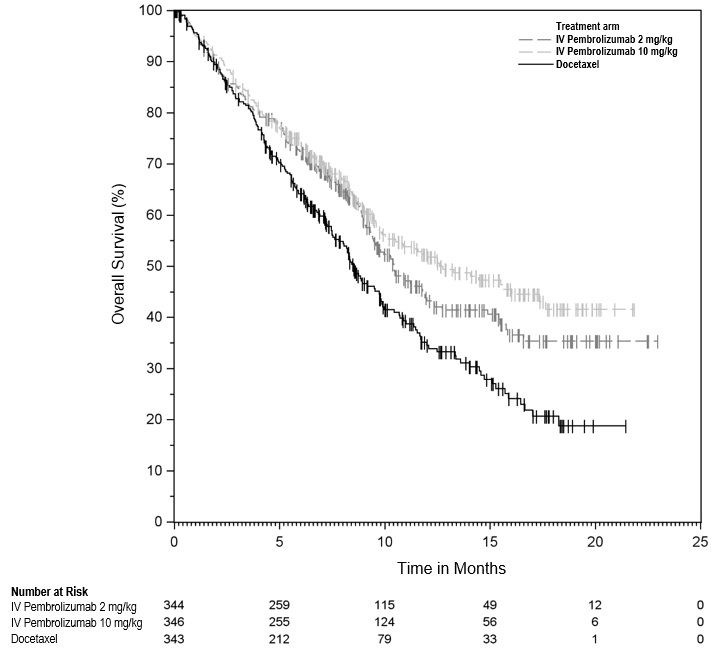
The safety of intravenous pembrolizumab was investigated in KEYNOTE-010, a multicenter, open-label, randomized (1:1:1), active-controlled trial, in patients with advanced NSCLC who had documented disease progression following treatment with platinum-based chemotherapy and, if positive for EGFR or ALK genetic aberrations, appropriate therapy for these aberrations [see Clinical Studies (14.3)]. A total of 991 patients received intravenous pembrolizumab 2 mg/kg (n=339) or 10 mg/kg (n=343) every 3 weeks or docetaxel (n=309) at 75 mg/m2 every 3 weeks. Patients with autoimmune disease, medical conditions that required systemic corticosteroids or other immunosuppressive medication, or who had received more than 30 Gy of thoracic radiation within the prior 26 weeks were ineligible.
The median duration of exposure to intravenous pembrolizumab 2 mg/kg every 3 weeks was 3.5 months (range: 1 day to 22.4 months) and to intravenous pembrolizumab 10 mg/kg every 3 weeks was 3.5 months (range 1 day to 20.8 months). The data described below reflect exposure to intravenous pembrolizumab 2 mg/kg in 31% of patients exposed to intravenous pembrolizumab for ≥6 months. In the intravenous pembrolizumab 10 mg/kg arm, 34% of patients were exposed to intravenous pembrolizumab for ≥6 months.
The study population characteristics were: median age of 63 years (range: 20 to 88), 42% age 65 or older; 61% male; 72% White and 21% Asian; and 8% with advanced localized disease, 91% with metastatic disease, and 15% with history of brain metastases. Twenty-nine percent received two or more prior systemic treatments for advanced or metastatic disease.
In KEYNOTE-010, the adverse reaction profile was similar for the 2 mg/kg and 10 mg/kg dose, therefore summary safety results are provided in a pooled analysis (n=682). Treatment was discontinued for adverse reactions in 8% of patients receiving. The most common adverse events resulting in permanent discontinuation of intravenous pembrolizumab was pneumonitis (1.8%). Adverse reactions leading to interruption of intravenous pembrolizumab occurred in 23% of patients; the most common (≥1%) were diarrhea (1%), fatigue (1.3%), pneumonia (1%), liver enzyme elevation (1.2%), decreased appetite (1.3%), and pneumonitis (1%). Tables 16 and 17 summarize adverse reactions and laboratory abnormalities, respectively, in patients on intravenous pembrolizumab in KEYNOTE-010.
Table 16: SelectedAdverse reactions occurring at same or higher incidence than in docetaxel arm
Adverse Reactions Occurring in ≥10% of Patients Receiving Intravenous Pembrolizumab in KEYNOTE-010| Adverse Reaction | Intravenous Pembrolizumab
2 or 10 mg/kg every 3 weeks
n=682 | Docetaxel
75 mg/m2 every 3 weeks
n=309 |
|---|
| All Grades Graded per NCI CTCAE v4.0
(%) | Grades 3-4
(%) | All Grades
(%) | Grades 3-4
(%) |
|---|
| Metabolism and Nutrition |
| Decreased appetite | 25 | 1.5 | 23 | 2.6 |
| Respiratory, Thoracic and Mediastinal |
| Dyspnea | 23 | 3.7 | 20 | 2.6 |
| Cough | 19 | 0.6 | 14 | 0 |
| Gastrointestinal |
| Nausea | 20 | 1.3 | 18 | 0.6 |
| Constipation | 15 | 0.6 | 12 | 0.6 |
| Vomiting | 13 | 0.9 | 10 | 0.6 |
| Skin and Subcutaneous Tissue |
| Rash Includes rash, rash erythematous, rash macular, rash maculo-papular, rash papular, and rash pruritic | 17 | 0.4 | 8 | 0 |
| Pruritus | 11 | 0 | 3 | 0.3 |
| Musculoskeletal and Connective Tissue |
| Arthralgia | 11 | 1.0 | 9 | 0.3 |
| Back pain | 11 | 1.5 | 8 | 0.3 |
Other clinically important adverse reactions occurring in patients receiving intravenous pembrolizumab were fatigue (25%), diarrhea (14%), asthenia (11%) and pyrexia (11%).
Table 17: SelectedLaboratory abnormalities occurring at same or higher incidence than in docetaxel arm.
Laboratory Abnormalities Worsened from Baseline Occurring in ≥20% of NSCLC Patients Receiving Intravenous Pembrolizumab in KEYNOTE-010| Laboratory Test Each test incidence is based on the number of patients who had both baseline and at least one on-study laboratory measurement available: intravenous pembrolizumab (range: 631 to 638 patients) and docetaxel (range: 271 to 277 patients). | Intravenous Pembrolizumab
2 or 10 mg/kg every 3 weeks | Docetaxel
75 mg/m2 every 3 weeks |
|---|
| All Grades Graded per NCI CTCAE v4.0
% | Grades 3-4
% | All Grades
% | Grades 3-4
% |
|---|
| Chemistry | |
| Hyponatremia | 32 | 8 | 27 | 2.9 |
| Increased alkaline phosphatase | 28 | 3.0 | 16 | 0.7 |
| Increased AST | 26 | 1.6 | 12 | 0.7 |
| Increased ALT | 22 | 2.7 | 9 | 0.4 |
| Hypocalcemia | 20 | 0.9 | 20 | 1.8 |
Other laboratory abnormalities occurring in ≥20% of patients receiving intravenous pembrolizumab were hyperglycemia (44% all Grades; 4.1% Grades 3-4), anemia (37% all Grades; 3.8% Grades 3-4), hypertriglyceridemia (36% all Grades; 1.8% Grades 3-4), lymphopenia (32% all Grades; 9% Grades 3-4), hypoalbuminemia (34% all Grades; 1.6% Grades 3-4), and hypercholesterolemia (20% all Grades; 0.7% Grades 3-4).
Neoadjuvant and Adjuvant Treatment of Resectable NSCLC
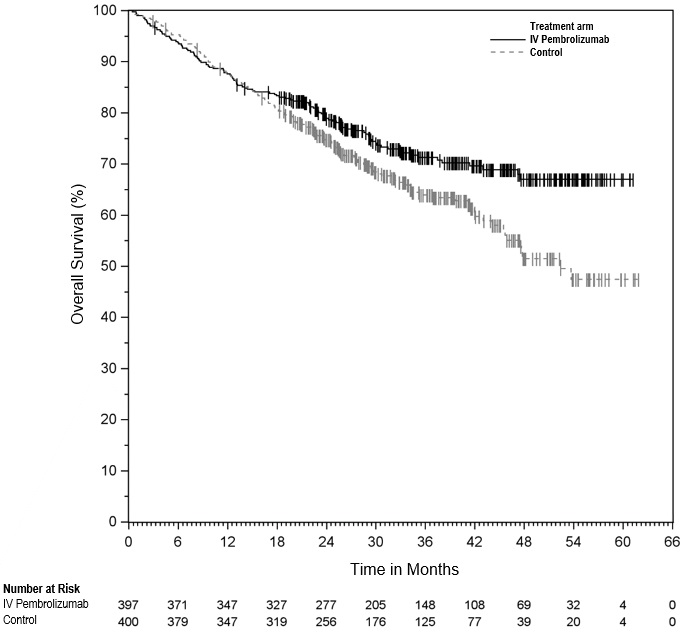
The safety of intravenous pembrolizumab in combination with neoadjuvant platinum-containing chemotherapy followed by surgery and continued adjuvant treatment with intravenous pembrolizumab as a single agent after surgery was investigated in KEYNOTE-671, a multicenter, randomized (1:1), double-blind, placebo-controlled trial in patients with previously untreated and resectable Stage II, IIIA, or IIIB (N2) NSCLC by AJCC 8th edition [see Clinical Studies (14.3)]. Patients with active autoimmune disease that required systemic therapy within 2 years of treatment or a medical condition that required immunosuppression were ineligible.
The median duration of exposure to intravenous pembrolizumab 200 mg every 3 weeks was 10.9 months (range: 1 day to 18.6 months). The study population characteristics were: median age of 64 years (range: 26 to 83), 45% age 65 or older, 7% age 75 or older; 71% male; 61% White, 31% Asian, 2% Black, 4% race not reported; 9% Hispanic or Latino.
Adverse reactions occurring in patients with resectable NSCLC receiving intravenous pembrolizumab in combination with platinum containing chemotherapy, given as neoadjuvant treatment and continued as single agent adjuvant treatment, were generally similar to those occurring in patients in other clinical trials across tumor types receiving intravenous pembrolizumab in combination with chemotherapy.
Neoadjuvant Phase of KEYNOTE-671
A total of 396 patients received at least 1 dose of intravenous pembrolizumab in combination with platinum-containing chemotherapy as neoadjuvant treatment and 399 patients received at least 1 dose of placebo in combination with platinum-containing chemotherapy as neoadjuvant treatment.
Serious adverse reactions occurred in 34% of patients who received intravenous pembrolizumab in combination with platinum-containing chemotherapy as neoadjuvant treatment; the most frequent (≥2%) serious adverse reactions were pneumonia (4.8%), venous thromboembolism (3.3%), and anemia (2%). Fatal adverse reactions occurred in 1.3% of patients, including death due to unknown cause (0.8%), sepsis (0.3%), and immune-mediated lung disease (0.3%).
Permanent discontinuation of any study drug due to an adverse reaction occurred in 18% of patients who received intravenous pembrolizumab in combination with platinum-containing chemotherapy as neoadjuvant treatment; the most frequent (≥1%) adverse reactions that led to permanent discontinuation of any study drug were acute kidney injury (1.8%), interstitial lung disease (1.8%), anemia (1.5%), neutropenia (1.5%), and pneumonia (1.3%).
Of the 396 intravenous pembrolizumab-treated patients and 399 placebo-treated patients who received neoadjuvant treatment, 6% (n=25) and 4.3% (n=17), respectively, did not receive surgery due to adverse reactions. The most frequent (≥1%) adverse reactions that led to cancellation of surgery in the intravenous pembrolizumab arm was interstitial lung disease (1%).
Of the 325 intravenous pembrolizumab-treated patients who received surgery, 3.1% (n=10) experienced delay of surgery (surgery more than 8 weeks from last neoadjuvant treatment if patient received less than 4 cycles of neoadjuvant therapy or more than 20 weeks after first dose of neoadjuvant treatment if patient received 4 cycles of neoadjuvant therapy) due to adverse reactions. Of the 317 placebo-treated patients who received surgery, 2.5% (n=8) experienced delay of surgery due to adverse reactions.
Of the 325 intravenous pembrolizumab-treated patients who received surgery, 7% (n=22) did not receive adjuvant treatment due to adverse reactions. Of the 317 placebo-treated patients who received surgery, 3.2% (n=10) did not receive adjuvant treatment due to adverse reactions.
Adjuvant Phase of KEYNOTE-671
A total of 290 patients in the intravenous pembrolizumab arm and 267 patients in the placebo arm received at least 1 dose of adjuvant treatment.
Of the patients who received single agent intravenous pembrolizumab as adjuvant treatment, 14% experienced serious adverse reactions; the most frequent serious adverse reaction was pneumonia (3.4%). One fatal adverse reaction of pulmonary hemorrhage occurred. Permanent discontinuation of adjuvant intravenous pembrolizumab due to an adverse reaction occurred in 12% of patients; the most frequent (≥1%) adverse reactions that led to permanent discontinuation of adjuvant intravenous pembrolizumab were diarrhea (1.7%), interstitial lung disease (1.4%), AST increased (1%), and musculoskeletal pain (1%).
Adjuvant Treatment of Resected NSCLC
The safety of intravenous pembrolizumab as a single agent was investigated in KEYNOTE-091, a multicenter, randomized (1:1), triple-blind, placebo-controlled trial in patients with completely resected Stage IB (T2a ≥4 cm), II, or IIIA NSCLC; adjuvant chemotherapy up to 4 cycles was optional [see Clinical Studies (14.3)]. A total of 1161 patients received intravenous pembrolizumab 200 mg (n=580) or placebo (n=581) every 3 weeks. Patients were ineligible if they had active autoimmune disease, were on chronic immunosuppressive agents, or had a history of interstitial lung disease or pneumonitis.
The median duration of exposure to intravenous pembrolizumab was 11.7 months (range: 1 day to 18.9 months). Sixty-eight percent of patients in the intravenous pembrolizumab arm were exposed to intravenous pembrolizumab for ≥6 months.
The adverse reactions observed in KEYNOTE-091 were generally similar to those occurring in other patients with NSCLC receiving intravenous pembrolizumab as a single agent, with the exception of hypothyroidism (22%), hyperthyroidism (11%), and pneumonitis (7%). Two fatal adverse reactions of myocarditis occurred.
Malignant Pleural Mesothelioma (MPM)
First-line treatment of unresectable advanced or metastatic MPM with pemetrexed and platinum chemotherapy
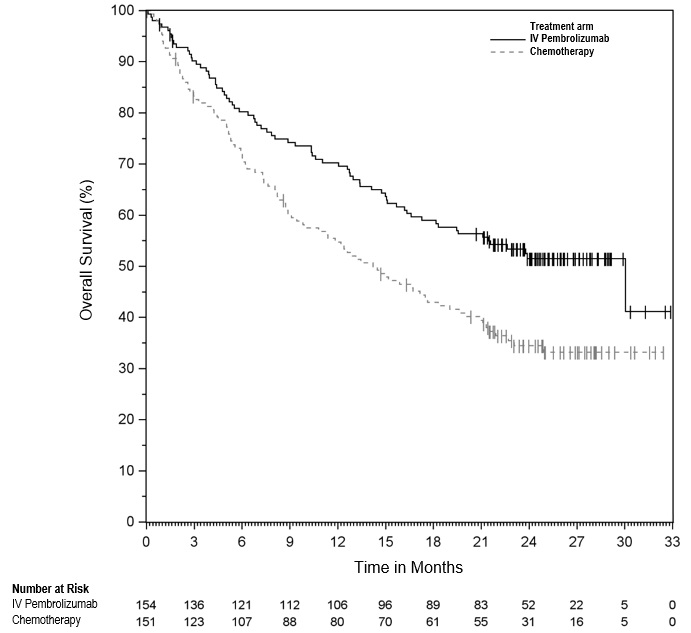
The safety of intravenous pembrolizumab in combination with pemetrexed and platinum chemotherapy (either carboplatin or cisplatin) was investigated in KEYNOTE-483, a multicenter, open-label, randomized (1:1), active-controlled trial in patients with previously untreated, unresectable advanced or metastatic MPM [see Clinical Studies (14.4)]. A total of 473 patients received intravenous pembrolizumab 200 mg, pemetrexed, and platinum every 3 weeks for up to 6 cycles followed by intravenous pembrolizumab (n=241), or pemetrexed and platinum chemotherapy every 3 weeks for up to 6 cycles (n=232). Patients with autoimmune disease that required systemic therapy within 3 years of treatment or a medical condition that required immunosuppression were ineligible.
The median duration of exposure to intravenous pembrolizumab 200 mg every 3 weeks was 6.9 months (range: 1 day to 25.2 months). Sixty-one percent of patients in the intravenous pembrolizumab arm were exposed to intravenous pembrolizumab for ≥6 months.
Adverse reactions occurring in patients with MPM were generally similar to those in other patients receiving intravenous pembrolizumab in combination with pemetrexed and platinum chemotherapy.
HNSCC
First-line treatment of metastatic or unresectable, recurrent HNSCC
The safety of intravenous pembrolizumab, as a single agent and in combination with platinum (cisplatin or carboplatin) and FU chemotherapy, was investigated in KEYNOTE-048, a multicenter, open-label, randomized (1:1:1), active-controlled trial in patients with previously untreated, recurrent or metastatic HNSCC [see Clinical Studies (14.5)]. Patients with autoimmune disease that required systemic therapy within 2 years of treatment or a medical condition that required immunosuppression were ineligible. A total of 576 patients received intravenous pembrolizumab 200 mg every 3 weeks either as a single agent (n=300) or in combination with platinum and FU (n=276) every 3 weeks for 6 cycles followed by intravenous pembrolizumab, compared to 287 patients who received cetuximab weekly in combination with platinum and FU every 3 weeks for 6 cycles followed by cetuximab.
The median duration of exposure to intravenous pembrolizumab was 3.5 months (range: 1 day to 24.2 months) in the intravenous pembrolizumab single agent arm and was 5.8 months (range: 3 days to 24.2 months) in the combination arm. Seventeen percent of patients in the intravenous pembrolizumab single agent arm and 18% of patients in the combination arm were exposed to intravenous pembrolizumab for ≥12 months. Fifty-seven percent of patients receiving intravenous pembrolizumab in combination with chemotherapy started treatment with carboplatin.
Intravenous pembrolizumab was discontinued for adverse reactions in 12% of patients in the intravenous pembrolizumab single agent arm. The most common adverse reactions resulting in permanent discontinuation of intravenous pembrolizumab were sepsis (1.7%) and pneumonia (1.3%). Adverse reactions leading to the interruption of intravenous pembrolizumab occurred in 31% of patients; the most common adverse reactions leading to interruption of intravenous pembrolizumab (≥2%) were pneumonia (2.3%), pneumonitis (2.3%), and hyponatremia (2%).
Intravenous pembrolizumab was discontinued for adverse reactions in 16% of patients in the combination arm. The most common adverse reactions resulting in permanent discontinuation of intravenous pembrolizumab were pneumonia (2.5%), pneumonitis (1.8%), and septic shock (1.4%). Adverse reactions leading to the interruption of intravenous pembrolizumab occurred in 45% of patients; the most common adverse reactions leading to interruption of intravenous pembrolizumab (≥2%) were neutropenia (14%), thrombocytopenia (10%), anemia (6%), pneumonia (4.7%), and febrile neutropenia (2.9%).
Tables 18 and 19 summarize adverse reactions and laboratory abnormalities, respectively, in patients on intravenous pembrolizumab in KEYNOTE-048.
Table 18: Adverse Reactions Occurring in ≥10% of Patients Receiving Intravenous Pembrolizumab in KEYNOTE-048| | Intravenous Pembrolizumab
200 mg every 3 weeks | Intravenous Pembrolizumab
200 mg every 3 weeks
Platinum
FU | Cetuximab
Platinum
FU |
|---|
| Adverse Reaction | n=300 | n=276 | n=287 |
|---|
| | All Grades Graded per NCI CTCAE v4.0
(%) | Grades 3-4
(%) | All Grades
(%) | Grades 3-4
(%) | All Grades
(%) | Grades 3-4
(%) |
|---|
| General |
| Fatigue Includes fatigue, asthenia | 33 | 4 | 49 | 11 | 48 | 8 |
| Pyrexia | 13 | 0.7 | 16 | 0.7 | 12 | 0 |
| Mucosal inflammation | 4.3 | 1.3 | 31 | 10 | 28 | 5 |
| Gastrointestinal |
| Constipation | 20 | 0.3 | 37 | 0 | 33 | 1.4 |
| Nausea | 17 | 0 | 51 | 6 | 51 | 6 |
| Diarrhea Includes diarrhea, colitis, hemorrhagic diarrhea, microscopic colitis | 16 | 0.7 | 29 | 3.3 | 35 | 3.1 |
| Vomiting | 11 | 0.3 | 32 | 3.6 | 28 | 2.8 |
| Dysphagia | 8 | 2.3 | 12 | 2.9 | 10 | 2.1 |
| Stomatitis | 3 | 0 | 26 | 8 | 28 | 3.5 |
| Skin |
| Rash Includes dermatitis, dermatitis acneiform, dermatitis allergic, dermatitis bullous, dermatitis contact, dermatitis exfoliative, drug eruption, erythema, erythema multiforme, rash, erythematous rash, generalized rash, macular rash, maculo-papular rash, pruritic rash, seborrheic dermatitis | 20 | 2.3 | 17 | 0.7 | 70 | 8 |
| Pruritus | 11 | 0 | 8 | 0 | 10 | 0.3 |
| Respiratory, Thoracic and Mediastinal |
| Cough Includes cough, productive cough | 18 | 0.3 | 22 | 0 | 15 | 0 |
| Dyspnea Includes dyspnea, exertional dyspnea | 14 | 2.0 | 10 | 1.8 | 8 | 1.0 |
| Endocrine |
| Hypothyroidism | 18 | 0 | 15 | 0 | 6 | 0 |
| Metabolism and Nutrition |
| Decreased appetite | 15 | 1.0 | 29 | 4.7 | 30 | 3.5 |
| Weight loss | 15 | 2 | 16 | 2.9 | 21 | 1.4 |
| Infections |
| Pneumonia Includes pneumonia, atypical pneumonia, bacterial pneumonia, staphylococcal pneumonia, aspiration pneumonia, lower respiratory tract infection, lung infection, lung infection pseudomonal | 12 | 7 | 19 | 11 | 13 | 6 |
| Nervous System |
| Headache | 12 | 0.3 | 11 | 0.7 | 8 | 0.3 |
| Dizziness | 5 | 0.3 | 10 | 0.4 | 13 | 0.3 |
| Peripheral sensory neuropathy Includes peripheral sensory neuropathy, peripheral neuropathy, hypoesthesia, dysesthesia | 1 | 0 | 14 | 1.1 | 7 | 1 |
| Musculoskeletal |
| Myalgia Includes back pain, musculoskeletal chest pain, musculoskeletal pain, myalgia | 12 | 1.0 | 13 | 0.4 | 11 | 0.3 |
| Neck pain | 6 | 0.7 | 10 | 1.1 | 7 | 0.7 |
| Psychiatric |
| Insomnia | 7 | 0.7 | 10 | 0 | 8 | 0 |
Table 19: Laboratory Abnormalities Worsened from Baseline Occurring in ≥20% of Patients Receiving Intravenous Pembrolizumab in KEYNOTE-048| Laboratory Test Each test incidence is based on the number of patients who had both baseline and at least one on-study laboratory measurement available: intravenous pembrolizumab/chemotherapy (range: 240 to 267 patients), intravenous pembrolizumab (range: 245 to 292 patients), cetuximab/chemotherapy (range: 249 to 282 patients). | Intravenous Pembrolizumab
200 mg every 3 weeks | Intravenous Pembrolizumab
200 mg every 3 weeks
Platinum
FU | Cetuximab
Platinum
FU |
|---|
| All Grades Graded per NCI CTCAE v4.0
(%) | Grades 3-4
(%) | All Grades
(%) | Grades 3-4
(%) | All Grades
(%) | Grades 3-4
(%) |
|---|
| Hematology |
| Lymphopenia | 54 | 25 | 70 | 35 | 75 | 46 |
| Anemia | 52 | 7 | 89 | 29 | 79 | 20 |
| Thrombocytopenia | 12 | 3.8 | 73 | 18 | 76 | 18 |
| Neutropenia | 8 | 1.4 | 68 | 37 | 73 | 43 |
| Chemistry |
| Hyperglycemia | 47 | 3.8 | 54 | 6 | 65 | 4.7 |
| Hyponatremia | 46 | 18 | 55 | 20 | 59 | 20 |
| Hypoalbuminemia | 44 | 3.5 | 46 | 3.9 | 49 | 1.1 |
| Increased AST | 28 | 3.1 | 25 | 1.9 | 37 | 3.6 |
| Increased ALT | 25 | 2.1 | 22 | 1.5 | 38 | 1.8 |
Increased alkaline
phosphatase | 25 | 2.1 | 26 | 1.1 | 33 | 1.1 |
| Hypercalcemia | 22 | 4.5 | 16 | 4.2 | 13 | 2.5 |
| Hypocalcemia | 22 | 1.0 | 32 | 3.8 | 58 | 6 |
| Hyperkalemia | 21 | 2.8 | 28 | 4.2 | 29 | 4.6 |
| Hypophosphatemia | 20 | 5 | 34 | 12 | 49 | 20 |
| Hypokalemia | 19 | 5 | 33 | 12 | 47 | 15 |
| Increased creatinine | 17 | 1.0 | 36 | 2.3 | 27 | 2.1 |
| Hypomagnesemia | 15 | 0.4 | 40 | 1.7 | 76 | 9 |
Previously treated recurrent or metastatic HNSCC
Among the 192 patients with HNSCC enrolled in KEYNOTE-012 [see Clinical Studies (14.5)], the median duration of exposure to intravenous pembrolizumab was 3.3 months (range: 1 day to 27.9 months). Patients with autoimmune disease or a medical condition that required immunosuppression were ineligible for KEYNOTE-012.
The study population characteristics were: median age of 60 years (range: 20 to 84), 35% age 65 or older; 83% male; and 77% White, 15% Asian, and 5% Black. Sixty-one percent of patients had two or more lines of therapy in the recurrent or metastatic setting, and 95% had prior radiation therapy. Baseline ECOG PS was 0 (30%) or 1 (70%) and 86% had M1 disease.
Intravenous pembrolizumab was discontinued due to adverse reactions in 17% of patients. Serious adverse reactions occurred in 45% of patients receiving intravenous pembrolizumab. The most frequent serious adverse reactions reported in at least 2% of patients were pneumonia, dyspnea, confusional state, vomiting, pleural effusion, and respiratory failure. The incidence of adverse reactions, including serious adverse reactions, was similar between dosage regimens (10 mg/kg every 2 weeks or 200 mg every 3 weeks); therefore, summary safety results are provided in a pooled analysis. The most common adverse reactions (occurring in ≥20% of patients) were fatigue, decreased appetite, and dyspnea. Adverse reactions occurring in patients with HNSCC were generally similar to those occurring in 2799 patients with melanoma or NSCLC treated with intravenous pembrolizumab as a single agent, with the exception of increased incidences of facial edema (10% all Grades; 2.1% Grades 3-4) and new or worsening hypothyroidism [see Warnings and Precautions (5.1)].
Urothelial Cancer
Patients with urothelial cancer in combination with enfortumab vedotin
The safety of intravenous pembrolizumab in combination with enfortumab vedotin was investigated in KEYNOTE-A39 in patients with locally advanced or metastatic urothelial cancer [see Clinical Studies (14.6)]. A total of 440 patients received intravenous pembrolizumab 200 mg on Day 1 and enfortumab vedotin 1.25 mg/kg on Days 1 and 8 of each 21-day cycle compared to 433 patients who received gemcitabine on Days 1 and 8 and investigator’s choice of cisplatin or carboplatin on Day 1 of each 21-day cycle. Among patients who received intravenous pembrolizumab and enfortumab vedotin, the median duration of exposure to intravenous pembrolizumab was 8.5 months (range: 9 days to 28.5 months).
Fatal adverse reactions occurred in 3.9% of patients treated with intravenous pembrolizumab in combination with enfortumab vedotin including acute respiratory failure (0.7%), pneumonia (0.5%), and pneumonitis/ILD (0.2%).
Serious adverse reactions occurred in 50% of patients receiving intravenous pembrolizumab in combination with enfortumab vedotin. Serious adverse reactions in ≥2% of patients receiving intravenous pembrolizumab in combination with enfortumab vedotin were rash (6%), acute kidney injury (5%), pneumonitis/ILD (4.5%), urinary tract infection (3.6%), diarrhea (3.2%), pneumonia (2.3%), pyrexia (2%), and hyperglycemia (2%).
Permanent discontinuation of intravenous pembrolizumab occurred in 27% of patients. The most common adverse reactions (≥2%) resulting in permanent discontinuation of intravenous pembrolizumab were pneumonitis/ILD (4.8%) and rash (3.4%).
Dose interruptions of intravenous pembrolizumab occurred in 61% of patients. The most common adverse reactions (≥2%) resulting in interruption of intravenous pembrolizumab were rash (17%), peripheral neuropathy (7%), COVID-19 (5%), diarrhea (4.3%), pneumonitis/ILD (3.6%), neutropenia (3.4%), fatigue (3%), alanine aminotransferase increased (2.7%), hyperglycemia (2.5%), pneumonia (2%), and pruritus (2%).
Tables 20 and 21 summarize adverse reactions and laboratory abnormalities, respectively, in patients on intravenous pembrolizumab in combination with enfortumab vedotin in KEYNOTE-A39.
Table 20: Adverse Reactions ≥20% (All Grades) in Patients Treated with Intravenous Pembrolizumab in Combination with Enfortumab Vedotin in KEYNOTE-A39| Adverse Reaction | Intravenous Pembrolizumab in combination with Enfortumab Vedotin
n=440 | Chemotherapy
n=433
|
|---|
| All Grades Graded per NCI CTCAE v4.03
% | Grades 3-4
% | All Grades
% | Grades 3-4
% |
|---|
| Skin and subcutaneous tissue disorders |
| Rash Includes multiple terms | 68 | 15 | 15 | 0 |
| Pruritus | 41 | 1.1 | 7 | 0 |
| Alopecia | 35 | 0.5 | 8 | 0.2 |
| General disorders and administration site conditions |
| Fatigue | 51 | 6 | 57 | 7 |
| Nervous system disorders |
| Peripheral neuropathy | 67 | 8 | 14 | 0 |
| Dysgeusia
| 21 | 0 | 9 | 0 |
| Metabolism and nutrition disorders |
| Decreased appetite | 33 | 1.8 | 26 | 1.8 |
| Gastrointestinal disorders |
| Diarrhea | 38 | 4.5 | 16 | 1.4 |
| Nausea
| 26 | 1.6 | 41 | 2.8 |
| Constipation | 26 | 0 | 34 | 0.7 |
| Investigations |
| Weight loss | 33 | 3.6 | 9 | 0.2 |
| Eye disorders |
| Dry eye | 24 | 0 | 2.1 | 0 |
| Infections and infestations |
| Urinary tract infection | 21 | 5 | 19 | 8 |
Clinically relevant adverse reactions (<20%) include pyrexia (18%), dry skin (17%), vomiting (12%), pneumonitis/ILD (10%), hypothyroidism (10%), blurred vision (6%), infusion site extravasation (2%), and myositis (0.5%).
Table 21: Selected Laboratory Abnormalities Worsened from Baseline Occurring in ≥20% of Patients in KEYNOTE-A39| Laboratory Test Each test incidence is based on the number of patients who had both baseline and at least one on-study laboratory measurement available: intravenous pembrolizumab (range: 407 to 439 patients) | Intravenous Pembrolizumab
200 mg every 3 weeks and
Enfortumab Vedotin | Chemotherapy |
|---|
| All Grades Graded per NCI CTCAE v4.03
% | Grades 3-4
% | All Grades
% | Grades 3-4
% |
|---|
| Chemistry |
| Increased aspartate aminotransferase | 75 | 4.6 | 39 | 3.3 |
| Increased creatinine | 71 | 3.2 | 68 | 2.6 |
| Hyperglycemia | 66 | 14 | 54 | 4.7 |
| Increased alanine aminotransferase | 59 | 5 | 49 | 3.3 |
| Hyponatremia | 46 | 13 | 47 | 13 |
| Hypophosphatemia | 44 | 9 | 36 | 9 |
| Hypoalbuminemia | 39 | 1.8 | 35 | 0.5 |
| Hypokalemia | 26 | 5 | 16 | 3.1 |
| Hyperkalemia | 24 | 1.4 | 36 | 4.0 |
| Hypercalcemia | 21 | 1.2 | 14 | 0.2 |
| Hematology |
| Lymphopenia | 58 | 15 | 59 | 17 |
| Anemia | 53 | 7 | 89 | 33 |
| Neutropenia | 30 | 9 | 80 | 50 |
Cisplatin-ineligible patients with urothelial cancer in combination with enfortumab vedotin
The safety of intravenous pembrolizumab in combination with enfortumab vedotin was investigated in KEYNOTE-869 in patients with locally advanced or metastatic urothelial cancer and who are not eligible for cisplatin-based chemotherapy [see Clinical Studies (14.6)]. A total of 121 patients received intravenous pembrolizumab 200 mg on Day 1, and enfortumab vedotin 1.25 mg/kg on days 1 and 8 of each 21-day cycle. The median duration of exposure to intravenous pembrolizumab was 6.9 months (range 1 day to 29.6 months).
Fatal adverse reactions occurred in 5% of patients treated with intravenous pembrolizumab in combination with enfortumab vedotin, including sepsis (1.6%), bullous dermatitis (0.8%), myasthenia gravis (0.8%), and pneumonitis (0.8%).
Serious adverse reactions occurred in 50% of patients receiving intravenous pembrolizumab and enfortumab vedotin. Serious adverse reactions in ≥2% of patients receiving intravenous pembrolizumab in combination with enfortumab vedotin were acute kidney injury (7%), urinary tract infection (7%), urosepsis (5%), hematuria (3.3%), pneumonia (3.3%), pneumonitis (3.3%), sepsis (3.3%), anemia (2.5%), diarrhea (2.5%), hypotension (2.5%), myasthenia gravis (2.5%), myositis (2.5%), and urinary retention (2.5%).
Permanent discontinuation of intravenous pembrolizumab occurred in 32% of patients. The most common adverse reactions (≥2%) resulting in permanent discontinuation of intravenous pembrolizumab were pneumonitis (5%), peripheral neuropathy (5%), rash (3.3%), and myasthenia gravis (2.5%).
Dose interruptions of intravenous pembrolizumab occurred in 69% of patients. The most common adverse reactions (≥2%) resulting in interruption of intravenous pembrolizumab were peripheral neuropathy (22%), rash (17%), neutropenia (7%), fatigue (6%), diarrhea (5%), lipase increased (5%), acute kidney injury (3.3%), ALT increased (2.5%), and COVID-19 (2.5%).
Tables 22 and 23 summarize adverse reactions and laboratory abnormalities, respectively, in patients on intravenous pembrolizumab in combination with enfortumab vedotin in KEYNOTE-869.
Table 22: Adverse Reactions Occurring in ≥20% of Patients Treated with Intravenous Pembrolizumab in Combination with Enfortumab Vedotin in KEYNOTE-869| Adverse Reaction | Intravenous Pembrolizumab in combination with Enfortumab Vedotin
n=121 |
|---|
| All Grades Graded per NCI CTCAE v4.03
% | Grade 3-4
% |
|---|
| Skin and subcutaneous tissue disorders |
| Rash Includes: blister, conjunctivitis, dermatitis, dermatitis bullous, dermatitis exfoliative generalized, erythema, erythema multiforme, exfoliative rash, palmar-plantar erythrodysesthesia syndrome, pemphigoid, rash, rash erythematous, rash macular, rash maculo-papular, rash papular, rash pruritic, rash vesicular, skin exfoliation, and stomatitis | 71 | 21 |
| Alopecia | 52 | 0 |
| Pruritus | 40 | 3.3 |
| Dry skin | 21 | 0.8 |
| Nervous system disorders |
| Peripheral neuropathy Includes: dysesthesia, hypoesthesia, muscular weakness, paresthesia, peripheral motor neuropathy, peripheral sensorimotor neuropathy, peripheral sensory neuropathy, and gait disturbance | 65 | 3.3 |
| Dysgeusia | 35 | 0 |
| Dizziness | 23 | 0 |
| General disorders and administration site conditions |
| Fatigue | 60 | 11 |
| Peripheral edema | 26 | 0 |
| Investigations |
| Weight loss | 48 | 5 |
| Gastrointestinal disorders |
| Diarrhea
| 45 | 7 |
| Nausea | 36 | 0.8 |
| Constipation
| 27 | 0 |
| Metabolism and nutrition disorders |
| Decreased appetite | 38 | 0.8 |
| Infections and infestations |
| Urinary tract infection | 30 | 12 |
| Eye disorders |
| Dry eye | 25 | 0 |
| Musculoskeletal and connective tissue disorders |
| Arthralgia | 23 | 1.7 |
Clinically relevant adverse reactions (<20%) include vomiting (19.8%), fever (18%), hypothyroidism (11%), pneumonitis/ILD (10%), myositis (3.3%), myasthenia gravis (2.5%), and infusion site extravasation (0.8%).
Table 23: Selected Laboratory Abnormalities Worsened from Baseline Occurring in ≥20% of Patients in KEYNOTE-869| Laboratory Test Each test incidence is based on the number of patients who had both baseline and at least one on-study laboratory measurement available: intravenous pembrolizumab (range: 114 to 121 patients) | Intravenous Pembrolizumab
200 mg every 3 weeks and
Enfortumab Vedotin |
|---|
| All Grades Graded per NCI CTCAE v4.03
% | Grades 3-4
% |
|---|
| Chemistry |
| Hyperglycemia | 74 | 13 |
| Increased aspartate aminotransferase | 73 | 9 |
| Increased creatinine | 69 | 3.3 |
| Hyponatremia | 60 | 19 |
| Increased alanine aminotransferase | 60 | 7 |
| Increased lipase | 59 | 32 |
| Hypoalbuminemia | 59 | 4.2 |
| Hypophosphatemia | 51 | 15 |
| Hypokalemia | 35 | 8 |
| Increased potassium | 27 | 1.7 |
| Increased calcium | 27 | 4.2 |
| Hematology |
| Anemia | 69 | 15 |
| Lymphopenia | 64 | 17 |
| Neutropenia | 32 | 12 |
Platinum-Ineligible Patients with Urothelial Carcinoma
The safety of intravenous pembrolizumab was investigated in KEYNOTE-052, a single-arm trial that enrolled 370 patients with locally advanced or metastatic urothelial carcinoma who had one or more comorbidities. Patients with autoimmune disease or medical conditions that required systemic corticosteroids or other immunosuppressive medications were ineligible [see Clinical Studies (14.6)]. Patients received intravenous pembrolizumab 200 mg every 3 weeks until unacceptable toxicity or either radiographic or clinical disease progression.
The median duration of exposure to intravenous pembrolizumab was 2.8 months (range: 1 day to 15.8 months).
Intravenous pembrolizumab was discontinued due to adverse reactions in 11% of patients. Eighteen patients (5%) died from causes other than disease progression. Five patients (1.4%) who were treated with intravenous pembrolizumab experienced sepsis which led to death, and three patients (0.8%) experienced pneumonia which led to death. Adverse reactions leading to interruption of intravenous pembrolizumab occurred in 22% of patients; the most common (≥1%) were liver enzyme increase, diarrhea, urinary tract infection, acute kidney injury, fatigue, joint pain, and pneumonia. Serious adverse reactions occurred in 42% of patients. The most frequent serious adverse reactions (≥2%) were urinary tract infection, hematuria, acute kidney injury, pneumonia, and urosepsis.
Immune-related adverse reactions that required systemic glucocorticoids occurred in 8% of patients, use of hormonal supplementation due to an immune-related adverse reaction occurred in 8% of patients, and 5% of patients required at least one steroid dose ≥40 mg oral prednisone equivalent.
Table 24 summarizes adverse reactions in patients on intravenous pembrolizumab in KEYNOTE-052.
Table 24: Adverse Reactions Occurring in ≥10% of Patients Receiving Intravenous Pembrolizumab in KEYNOTE-052| Adverse Reaction | Intravenous Pembrolizumab
200 mg every 3 weeks
N=370 |
|---|
| All Grades Graded per NCI CTCAE v4.0
(%) | Grades 3–4
(%) |
|---|
| General |
| Fatigue Includes fatigue, asthenia | 38 | 6 |
| Pyrexia | 11 | 0.5 |
| Weight loss | 10 | 0 |
| Musculoskeletal and Connective Tissue |
| Musculoskeletal pain Includes back pain, bone pain, musculoskeletal chest pain, musculoskeletal pain, myalgia, neck pain, pain in extremity, spinal pain | 24 | 4.9 |
| Arthralgia | 10 | 1.1 |
| Metabolism and Nutrition |
| Decreased appetite | 22 | 1.6 |
| Hyponatremia | 10 | 4.1 |
| Gastrointestinal |
| Constipation | 21 | 1.1 |
| Diarrhea Includes diarrhea, colitis, enterocolitis, gastroenteritis, frequent bowel movements | 20 | 2.4 |
| Nausea | 18 | 1.1 |
| Abdominal pain Includes abdominal pain, pelvic pain, flank pain, abdominal pain lower, tumor pain, bladder pain, hepatic pain, suprapubic pain, abdominal discomfort, abdominal pain upper | 18 | 2.7 |
| Elevated LFTs Includes autoimmune hepatitis, hepatitis, hepatitis toxic, liver injury, increased transaminases, hyperbilirubinemia, increased blood bilirubin, increased alanine aminotransferase, increased aspartate aminotransferase, increased hepatic enzymes, increased liver function tests | 13 | 3.5 |
| Vomiting | 12 | 0 |
| Skin and Subcutaneous Tissue |
| Rash Includes dermatitis, dermatitis bullous, eczema, erythema, rash, rash macular, rash maculo-papular, rash pruritic, rash pustular, skin reaction, dermatitis acneiform, seborrheic dermatitis, palmar-plantar erythrodysesthesia syndrome, rash generalized | 21 | 0.5 |
| Pruritus | 19 | 0.3 |
| Edema peripheral Includes edema peripheral, peripheral swelling | 14 | 1.1 |
| Infections |
| Urinary tract infection | 19 | 9 |
| Blood and Lymphatic System |
| Anemia | 17 | 7 |
| Respiratory, Thoracic, and Mediastinal | | |
| Cough | 14 | 0 |
| Dyspnea | 11 | 0.5 |
| Renal and Urinary |
| Increased blood creatinine | 11 | 1.1 |
| Hematuria | 13 | 3.0 |
Previously Treated Urothelial Carcinoma
The safety of intravenous pembrolizumab for the treatment of patients with locally advanced or metastatic urothelial carcinoma with disease progression following platinum-containing chemotherapy was investigated in KEYNOTE-045. KEYNOTE-045 was a multicenter, open-label, randomized (1:1), active-controlled trial in which 266 patients received intravenous pembrolizumab 200 mg every 3 weeks or investigator's choice of chemotherapy (n=255), consisting of paclitaxel (n=84), docetaxel (n=84) or vinflunine (n=87) [see Clinical Studies (14.6)]. Patients with autoimmune disease or a medical condition that required systemic corticosteroids or other immunosuppressive medications were ineligible.
The median duration of exposure was 3.5 months (range: 1 day to 20 months) in patients who received intravenous pembrolizumab and 1.5 months (range: 1 day to 14 months) in patients who received chemotherapy.
Intravenous pembrolizumab was discontinued due to adverse reactions in 8% of patients. The most common adverse reaction resulting in permanent discontinuation of intravenous pembrolizumab was pneumonitis (1.9%). Adverse reactions leading to interruption of intravenous pembrolizumab occurred in 20% of patients; the most common (≥1%) were urinary tract infection (1.5%), diarrhea (1.5%), and colitis (1.1%). Serious adverse reactions occurred in 39% of intravenous pembrolizumab-treated patients. The most frequent serious adverse reactions (≥2%) in intravenous pembrolizumab-treated patients were urinary tract infection, pneumonia, anemia, and pneumonitis. Tables 25 and 26 summarize adverse reactions and laboratory abnormalities, respectively, in patients on intravenous pembrolizumab in KEYNOTE-045.
Table 25: Adverse Reactions Occurring in ≥10% of Patients Receiving Intravenous Pembrolizumab in KEYNOTE-045| Adverse Reaction | Intravenous Pembrolizumab
200 mg every 3 weeks
n=266 | Chemotherapy Chemotherapy: paclitaxel, docetaxel, or vinflunine
n=255
|
|---|
| All Grades Graded per NCI CTCAE v4.0
(%) | Grades 3-4
(%) | All Grades
(%) | Grades 3-4
(%) |
|---|
| General |
| Fatigue Includes asthenia, fatigue, malaise, lethargy | 38 | 4.5 | 56 | 11 |
| Pyrexia | 14 | 0.8 | 13 | 1.2 |
| Musculoskeletal and Connective Tissue |
| Musculoskeletal pain Includes back pain, myalgia, bone pain, musculoskeletal pain, pain in extremity, musculoskeletal chest pain, musculoskeletal discomfort, neck pain | 32 | 3.0 | 27 | 2.0 |
| Skin and Subcutaneous Tissue |
| Pruritus | 23 | 0 | 6 | 0.4 |
| Rash Includes rash maculo-papular, rash, genital rash, rash erythematous, rash papular, rash pruritic, rash pustular, erythema, drug eruption, eczema, eczema asteatotic, dermatitis contact, dermatitis acneiform, dermatitis, seborrheic keratosis, lichenoid keratosis | 20 | 0.4 | 13 | 0.4 |
| Gastrointestinal |
| Nausea | 21 | 1.1 | 29 | 1.6 |
| Constipation | 19 | 1.1 | 32 | 3.1 |
| Diarrhea Includes diarrhea, gastroenteritis, colitis, enterocolitis | 18 | 2.3 | 19 | 1.6 |
| Vomiting | 15 | 0.4 | 13 | 0.4 |
| Abdominal pain | 13 | 1.1 | 13 | 2.7 |
| Metabolism and Nutrition |
| Decreased appetite | 21 | 3.8 | 21 | 1.2 |
| Infections |
| Urinary tract infection | 15 | 4.9 | 14 | 4.3 |
| Respiratory, Thoracic and Mediastinal |
| Cough Includes cough, productive cough | 15 | 0.4 | 9 | 0 |
| Dyspnea Includes dyspnea, dyspnea exertional, wheezing | 14 | 1.9 | 12 | 1.2 |
| Renal and Urinary |
| Hematuria Includes blood urine present, hematuria, chromaturia | 12 | 2.3 | 8 | 1.6 |
Table 26: Laboratory Abnormalities Worsened from Baseline Occurring in ≥20% of Urothelial Carcinoma Patients Receiving Intravenous Pembrolizumab in KEYNOTE-045| Laboratory Test Each test incidence is based on the number of patients who had both baseline and at least one on-study laboratory measurement available: intravenous pembrolizumab (range: 240 to 248 patients) and chemotherapy (range: 238 to 244 patients); phosphate decreased: intravenous pembrolizumab n=232 and chemotherapy n=222. | Intravenous Pembrolizumab
200 mg every 3 weeks | Chemotherapy |
|---|
| All Grades Graded per NCI CTCAE v4.0
% | Grades 3-4
% | All Grades
% | Grades 3-4
% |
|---|
| Chemistry | |
| Hyperglycemia | 52 | 8 | 60 | 7 |
| Anemia | 52 | 13 | 68 | 18 |
| Lymphopenia | 45 | 15 | 55 | 26 |
| Hypoalbuminemia | 43 | 1.7 | 50 | 3.8 |
| Hyponatremia | 37 | 9 | 47 | 13 |
| Increased alkaline phosphatase | 37 | 7 | 33 | 4.9 |
| Increased creatinine | 35 | 4.4 | 28 | 2.9 |
| Hypophosphatemia | 29 | 8 | 34 | 14 |
| Increased AST | 28 | 4.1 | 20 | 2.5 |
| Hyperkalemia | 28 | 0.8 | 27 | 6 |
| Hypocalcemia | 26 | 1.6 | 34 | 2.1 |
BCG-unresponsive High-risk NMIBC
The safety of intravenous pembrolizumab was investigated in KEYNOTE-057, a multicenter, open-label, single-arm trial that enrolled 148 patients with high-risk non-muscle invasive bladder cancer (NMIBC), 96 of whom had BCG-unresponsive carcinoma in situ (CIS) with or without papillary tumors. Patients received intravenous pembrolizumab 200 mg every 3 weeks until unacceptable toxicity, persistent or recurrent high-risk NMIBC or progressive disease, or up to 24 months of therapy without disease progression.
The median duration of exposure to intravenous pembrolizumab was 4.3 months (range: 1 day to 25.6 months).
Intravenous pembrolizumab was discontinued due to adverse reactions in 11% of patients. The most common adverse (>1%) reaction resulting in permanent discontinuation of intravenous pembrolizumab was pneumonitis (1.4%). Adverse reactions leading to interruption of intravenous pembrolizumab occurred in 22% of patients; the most common (≥2%) were diarrhea (4%) and urinary tract infection (2%). Serious adverse reactions occurred in 28% of intravenous pembrolizumab-treated patients. The most frequent serious adverse reactions (≥2%) in intravenous pembrolizumab-treated patients were pneumonia (3%), cardiac ischemia (2%), colitis (2%), pulmonary embolism (2%), sepsis (2%), and urinary tract infection (2%). Tables 27 and 28 summarize adverse reactions and laboratory abnormalities, respectively, in patients on intravenous pembrolizumab in KEYNOTE-057.
Table 27: Adverse Reactions Occurring in ≥10% of Patients Receiving Intravenous Pembrolizumab in KEYNOTE-057| Adverse Reaction | Intravenous Pembrolizumab
200 mg every 3 weeks
N=148 |
|---|
| All Grades Graded per NCI CTCAE v4.03
(%) | Grades 3–4
(%) |
|---|
| General |
| Fatigue Includes asthenia, fatigue, malaise | 29 | 0.7 |
| Peripheral edema Includes edema peripheral, peripheral swelling | 11 | 0 |
| Gastrointestinal |
| Diarrhea Includes diarrhea, gastroenteritis, colitis | 24 | 2.0 |
| Nausea | 13 | 0 |
| Constipation | 12 | 0 |
| Skin and Subcutaneous Tissue |
| Rash Includes rash maculo-papular, rash, rash erythematous, rash pruritic, rash pustular, erythema, eczema, eczema asteatotic, lichenoid keratosis, urticaria, dermatitis | 24 | 0.7 |
| Pruritus | 19 | 0.7 |
| Musculoskeletal and Connective Tissue |
| Musculoskeletal pain Includes back pain, myalgia, musculoskeletal pain, pain in extremity, musculoskeletal chest pain, neck pain | 19 | 0 |
| Arthralgia | 14 | 1.4 |
| Renal and Urinary |
| Hematuria | 19 | 1.4 |
| Respiratory, Thoracic, and Mediastinal |
| Cough Includes cough, productive cough | 19 | 0 |
| Infections |
| Urinary tract infection | 12 | 2.0 |
| Nasopharyngitis | 10 | 0 |
| Endocrine |
| Hypothyroidism | 11 | 0 |
Table 28: Laboratory Abnormalities Worsened from Baseline Occurring in ≥20% of BCG-unresponsive NMIBC Patients Receiving Intravenous Pembrolizumab in KEYNOTE-057| Laboratory Test Each test incidence is based on the number of patients who had both baseline and at least one on-study laboratory measurement available: intravenous pembrolizumab (range: 124 to 147 patients) | Intravenous Pembrolizumab
200 mg every 3 weeks |
|---|
| All Grades Graded per NCI CTCAE v4.03
(%) | Grades 3-4
(%) |
|---|
| Chemistry |
| Hyperglycemia | 59 | 7 |
| Increased ALT | 25 | 2.7 |
| Hyponatremia | 24 | 7 |
| Hypophosphatemia | 24 | 6 |
| Hypoalbuminemia | 24 | 1.4 |
| Hyperkalemia | 23 | 1.4 |
| Hypocalcemia | 22 | 0.7 |
| Increased AST | 20 | 2.7 |
| Increased creatinine | 20 | 0.7 |
| Hematology |
| Anemia | 35 | 1.4 |
| Lymphopenia | 29 | 1.6 |
Microsatellite Instability-High or Mismatch Repair Deficient Cancer
The safety of intravenous pembrolizumab was investigated in 504 patients with MSI-H or dMMR cancer enrolled in KEYNOTE-158, KEYNOTE-164, and KEYNOTE-051 [see Clinical Studies (14.7)]. The median duration of exposure to intravenous pembrolizumab was 6.2 months (range: 1 day to 53.5 months). Adverse reactions occurring in patients with MSI-H or dMMR cancer were similar to those occurring in patients with other solid tumors who received intravenous pembrolizumab as a single agent.
Microsatellite Instability-High or Mismatch Repair Deficient Colorectal Cancer
Among the 153 patients with MSI-H or dMMR CRC enrolled in KEYNOTE-177 [see Clinical Studies (14.8)] treated with intravenous pembrolizumab, the median duration of exposure to intravenous pembrolizumab was 11.1 months (range: 1 day to 30.6 months). Patients with autoimmune disease or a medical condition that required immunosuppression were ineligible. Adverse reactions occurring in patients with MSI-H or dMMR CRC were similar to those occurring in 2799 patients with melanoma or NSCLC treated with intravenous pembrolizumab as a single agent.
Gastric Cancer
First-line Treatment of Locally Advanced Unresectable or Metastatic HER2-Positive Gastric or Gastroesophageal Junction Adenocarcinoma
The safety of intravenous pembrolizumab was evaluated in 696 patients with HER2-positive gastric or GEJ cancer enrolled in KEYNOTE-811, which included 350 patients treated with intravenous pembrolizumab 200 mg, trastuzumab, and CAPOX (n=297) or FP (n=53) every 3 weeks, compared to 346 patients treated with placebo, trastuzumab, and CAPOX (n=298) or FP (n=48) every 3 weeks [see Clinical Studies (14.10)].
The median duration of exposure to intravenous pembrolizumab was 9.2 months (range: 1 day to 33.6 months).
Fatal adverse reactions occurred in 3 patients who received intravenous pembrolizumab in combination with trastuzumab and CAPOX or FP and included pneumonitis in 2 patients and hepatitis in 1 patient.
Intravenous pembrolizumab was discontinued due to adverse reactions in 13% of patients. Adverse reactions resulting in permanent discontinuation of intravenous pembrolizumab in ≥1% of patients were pneumonitis (2.0%) and pneumonia (1.1%).
Adverse reactions leading to interruption of intravenous pembrolizumab occurred in 71% of patients; the most common adverse reactions or laboratory abnormalities leading to interruption of intravenous pembrolizumab (≥2%) were neutropenia (21%), thrombocytopenia (13%), diarrhea (7%), pneumonia (5%), anemia (4.9%), COVID-19 (3.1%), hypokalemia (3.1%), fatigue/asthenia (4.9%), decreased appetite (4%), increased AST (3.7%), increased blood bilirubin (4.6%), increased ALT (2.9%), vomiting (2.6%), pneumonitis (2.3%), pyrexia (2.3%), increased blood creatinine (2%), and colitis (2%).
In the intravenous pembrolizumab arm versus placebo, there was a difference of ≥5% incidence between patients treated with intravenous pembrolizumab versus standard of care for diarrhea (53% vs. 47%), rash (35% vs. 28%), hypothyroidism (11% vs. 5%), and pneumonia (11% vs. 5%). There were no clinically meaningful differences in incidence of Grade 3-4 toxicity between arms.
There was a difference of ≥5% incidence between patients treated with intravenous pembrolizumab versus standard of care for decreased leukocytes (60% vs. 54%), decreased calcium (56% vs. 46%), decreased lymphocytes (59% vs. 51%), decreased potassium (41% vs. 36%), increased bilirubin (33% vs. 25%), increased creatinine (28% vs. 18%), and decreased glucose (17% vs. 11%). There were no clinically meaningful differences in incidence of Grade 3-4 toxicity between arms.
First-line Treatment of Locally Advanced Unresectable or Metastatic HER2-Negative Gastric or Gastroesophageal Junction Adenocarcinoma
The safety of intravenous pembrolizumab was evaluated in 1572 patients with HER2-negative gastric or GEJ cancer enrolled in KEYNOTE-859, which included 785 patients treated with intravenous pembrolizumab 200 mg and FP (n=106) or CAPOX (n=674) every 3 weeks, compared to 787 patients who received placebo and FP (n=107) or CAPOX (n=679) every 3 weeks [see Clinical Studies (14.9)].
The median duration of exposure to intravenous pembrolizumab was 6.2 months (range: 1 day to 33.7 months).
Serious adverse reactions occurred in 45% of patients receiving intravenous pembrolizumab. Serious adverse reactions in >2% of patients included pneumonia (4.1%), diarrhea (3.9%), hemorrhage (3.9%), and vomiting (2.4%). Fatal adverse reactions occurred in 8% of patients who received intravenous pembrolizumab, including infection (2.3%) and thromboembolism (1.3%).
Permanent discontinuation of intravenous pembrolizumab due to adverse reactions occurred in 15% of patients. Adverse reaction resulting in permanent discontinuation of intravenous pembrolizumab in ≥1% were infections (1.8%) and diarrhea (1.0%).
Dosage interruptions of intravenous pembrolizumab due to an adverse reaction occurred in 65% of patients. Adverse reactions or laboratory abnormalities leading to interruption of intravenous pembrolizumab (≥2%) were neutropenia (21%), thrombocytopenia (13%), diarrhea (5.5%), fatigue (4.8%), infection (4.8%), anemia (4.5%), increased AST (4.3%), increased ALT (3.8%), increased blood bilirubin (3.3%), white blood cell count decreased (2.2%), nausea (2%), palmar-plantar erythrodysesthesia syndrome (2%), and vomiting (2%).
Tables 29 and 30 summarize adverse reactions and laboratory abnormalities, respectively, in patients on intravenous pembrolizumab in KEYNOTE-859.
Table 29: Adverse Reactions Occurring in ≥20% of Patients Receiving Intravenous Pembrolizumab in KEYNOTE-859| Adverse Reaction | Intravenous Pembrolizumab
200 mg every 3 weeks
and FP or CAPOX
n=785 | Placebo
and FP or CAPOX
n=787 |
|---|
| All Grades Graded per NCI CTCAE v4.03
(%) | Grades 3-4
(%) | All Grades
(%) | Grades 3-4
(%) |
|---|
| Nervous System |
| Peripheral neuropathy Includes dysesthesia, hyperesthesia, hypoesthesia, neuralgia, neuropathy peripheral, paresthesia, peripheral sensory neuropathy, peripheral motor neuropathy, polyneuropathy | 47 | 5 | 48 | 6 |
| Gastrointestinal |
| Nausea | 46 | 3.7 | 46 | 4.4 |
| Diarrhea | 36 | 6 | 32 | 5 |
| Vomiting | 34 | 5 | 27 | 5 |
| Abdominal Pain Includes abdominal discomfort, abdominal pain, abdominal pain lower, abdominal tenderness, abdominal pain upper, epigastric discomfort, gastrointestinal pain | 26 | 2.8 | 24 | 2.9 |
| Constipation | 22 | 0.5 | 21 | 0.8 |
| General |
| Fatigue Includes asthenia, fatigue | 40 | 8 | 39 | 9 |
| Metabolism and Nutrition |
| Decreased appetite | 29 | 3.3 | 29 | 2.5 |
| Skin and Subcutaneous Tissue |
| Palmar-plantar erythrodysesthesia syndrome | 25 | 3.1 | 22 | 1.8 |
| Investigations |
| Weight loss | 20 | 2.8 | 19 | 2.7 |
Table 30: Laboratory Abnormalities Worsened from Baseline Occurring in ≥20% of Patients Receiving Intravenous Pembrolizumab in KEYNOTE-859| Laboratory Test Each test incidence is based on the number of patients who had both baseline and at least one on-study laboratory measurement available: intravenous pembrolizumab/FP or CAPOX (range: 210 to 766 patients) and placebo/FP or CAPOX (range: 190 to 762 patients) | Intravenous Pembrolizumab
200 mg every 3 weeks
and FP or CAPOX | Placebo
and FP or CAPOX
|
|---|
| All Grades Graded per NCI CTCAE v4.03
% | Grades 3-4
% | All Grades
% | Grades 3-4
% |
|---|
| Hematology |
| Anemia | 65 | 15 | 69 | 13 |
| Thrombocytopenia | 64 | 12 | 62 | 10 |
| Neutropenia | 63 | 25 | 58 | 20 |
| Leukopenia | 59 | 7 | 56 | 6 |
| Lymphopenia | 57 | 20 | 51 | 16 |
| Chemistry |
| Increased AST | 57 | 4.7 | 48 | 3.6 |
| Hypoalbuminemia | 55 | 4.1 | 52 | 2.9 |
| Hyperglycemia | 53 | 6 | 52 | 4.6 |
| Hypocalcemia | 49 | 3.6 | 45 | 3.3 |
| Increased alkaline phosphatase | 48 | 6 | 41 | 5 |
| Hyponatremia | 40 | 13 | 40 | 12 |
| Increased ALT | 40 | 4.2 | 29 | 2.9 |
| Hypokalemia | 35 | 10 | 27 | 9 |
| Bilirubin increased | 32 | 5 | 30 | 5 |
| Hypophosphatemia | 30 | 10 | 27 | 8 |
| Hypomagnesemia | 29 | 0.3 | 22 | 0.7 |
| Increased creatinine | 21 | 3.5 | 18 | 1.7 |
| Hyperkalemia | 20 | 3.7 | 18 | 2.9 |
| Increased INR | 20 | 1.4 | 22 | 0 |
Esophageal Cancer
First-line Treatment of Locally Advanced Unresectable or Metastatic Esophageal Cancer/Gastroesophageal Junction
The safety of intravenous pembrolizumab, in combination with cisplatin and FU chemotherapy was investigated in KEYNOTE-590, a multicenter, double-blind, randomized (1:1), placebo-controlled trial for the first-line treatment in patients with metastatic or locally advanced esophageal or gastroesophageal junction (tumors with epicenter 1 to 5 centimeters above the GEJ) carcinoma who were not candidates for surgical resection or definitive chemoradiation [see Clinical Studies (14.10)]. A total of 740 patients received either intravenous pembrolizumab 200 mg (n=370) or placebo (n=370) every 3 weeks for up to 35 cycles, both in combination with up to 6 cycles of cisplatin and up to 35 cycles of FU.
The median duration of exposure was 5.7 months (range: 1 day to 26 months) in the intravenous pembrolizumab combination arm and 5.1 months (range: 3 days to 27 months) in the chemotherapy arm.
Intravenous pembrolizumab was discontinued for adverse reactions in 15% of patients. The most common adverse reactions resulting in permanent discontinuation of intravenous pembrolizumab (≥1%) were pneumonitis (1.6%), acute kidney injury (1.1%), and pneumonia (1.1%). Adverse reactions leading to interruption of intravenous pembrolizumab occurred in 67% of patients. The most common adverse reactions leading to interruption of intravenous pembrolizumab (≥2%) were neutropenia (19%), fatigue/asthenia (8%), decreased white blood cell count (5%), pneumonia (5%), decreased appetite (4.3%), anemia (3.2%), increased blood creatinine (3.2%), stomatitis (3.2%), malaise (3.0%), thrombocytopenia (3%), pneumonitis (2.7%), diarrhea (2.4%), dysphagia (2.2%), and nausea (2.2%).
Tables 31 and 32 summarize adverse reactions and laboratory abnormalities, respectively, in patients on intravenous pembrolizumab in KEYNOTE-590.
Table 31: Adverse Reactions Occurring in ≥20% of Patients Receiving Intravenous Pembrolizumab in KEYNOTE-590| Adverse Reaction | Intravenous Pembrolizumab
200 mg every 3 weeks
Cisplatin
FU
n=370 | Placebo
Cisplatin
FU
n=370 |
|---|
| All Grades Graded per NCI CTCAE v4.03
(%) | Grades 3-4 One fatal event of diarrhea was reported in each arm.
(%) | All Grades
(%) | Grades 3-4
(%) |
|---|
| Gastrointestinal |
| Nausea | 67 | 7 | 63 | 7 |
| Constipation | 40 | 0 | 40 | 0 |
| Diarrhea | 36 | 4.1 | 33 | 3 |
| Vomiting | 34 | 7 | 32 | 5 |
| Stomatitis | 27 | 6 | 26 | 3.8 |
| General |
| Fatigue Includes asthenia, fatigue | 57 | 12 | 46 | 9 |
| Metabolism and Nutrition |
| Decreased appetite | 44 | 4.1 | 38 | 5 |
| Investigations |
| Weight loss | 24 | 3.0 | 24 | 5 |
Table 32: Laboratory Abnormalities Worsened from Baseline Occurring in ≥20% of Esophageal Cancer Patients Receiving Intravenous Pembrolizumab in KEYNOTE-590| Laboratory Test Each test incidence is based on the number of patients who had both baseline and at least one on-study laboratory measurement available: intravenous pembrolizumab/cisplatin/FU (range: 353 to 365 patients) and placebo/cisplatin/FU (range: 347 to 359 patients) | Intravenous Pembrolizumab
200 mg every 3 weeks
Cisplatin
FU | Chemotherapy
(Cisplatin and FU)
|
|---|
| All Grades Graded per NCI CTCAE v4.03
% | Grades 3-4
% | All Grades
% | Grades 3-4
% |
|---|
| Hematology |
| Anemia | 84 | 21 | 87 | 25 |
| Neutropenia | 77 | 44 | 73 | 41 |
| Leukopenia | 73 | 21 | 73 | 17 |
| Lymphopenia | 57 | 23 | 53 | 18 |
| Thrombocytopenia | 43 | 5 | 46 | 8 |
| Chemistry |
| Hyperglycemia | 56 | 7 | 55 | 6 |
| Hyponatremia | 53 | 19 | 53 | 19 |
| Hypoalbuminemia | 53 | 2.8 | 52 | 2.3 |
| Increased creatinine | 45 | 2.5 | 42 | 2.5 |
| Hypocalcemia | 44 | 3.9 | 37 | 2 |
| Hypophosphatemia | 37 | 9 | 31 | 10 |
| Hypokalemia | 30 | 12 | 34 | 15 |
| Increased alkaline phosphatase | 29 | 1.9 | 29 | 1.7 |
| Hyperkalemia | 28 | 3.6 | 28 | 2.5 |
| Increased AST | 25 | 4.4 | 22 | 2.8 |
| Increased ALT | 23 | 3.6 | 18 | 1.7 |
Previously Treated Recurrent Locally Advanced or Metastatic Esophageal Cancer
Among the 314 patients with esophageal cancer enrolled in KEYNOTE-181 [see Clinical Studies (14.10)] treated with intravenous pembrolizumab, the median duration of exposure to intravenous pembrolizumab was 2.1 months (range: 1 day to 24.4 months). Patients with autoimmune disease or a medical condition that required immunosuppression were ineligible. Adverse reactions occurring in patients with esophageal cancer were similar to those occurring in 2799 patients with melanoma or NSCLC treated with intravenous pembrolizumab as a single agent.
Cervical Cancer
FIGO 2014 Stage III-IVA Cervical Cancer with Chemoradiotherapy
The safety of intravenous pembrolizumab in combination with CRT (cisplatin plus external beam radiation therapy [EBRT] followed by brachytherapy [BT]) was investigated in KEYNOTE-A18, a placebo-controlled, randomized (1:1), multicenter, double-blind trial including 597 patients with FIGO 2014 Stage III-IVA cervical cancer [see Clinical Studies (14.11)]. Two hundred ninety-four patients received intravenous pembrolizumab in combination with chemoradiotherapy and 303 patients received placebo in combination with chemoradiotherapy.
The median duration of exposure to intravenous pembrolizumab was 20 months (range: 1 day to 32 months).
Fatal adverse reactions occurred in 1.4% of patients receiving intravenous pembrolizumab in combination with chemoradiotherapy, including 1 case each (0.3%) of large intestinal perforation, urosepsis, sepsis, and vaginal hemorrhage.
Serious adverse reactions occurred in 34% of patients receiving intravenous pembrolizumab in combination with chemoradiotherapy. Serious adverse reactions occurring in ≥1% of patients included urinary tract infection (3.1%), urosepsis (1.4%), and sepsis (1%).
Intravenous pembrolizumab was discontinued for adverse reactions in 9% of patients. The most common adverse reaction (≥1%) resulting in permanent discontinuation was diarrhea (1%).
Adverse reactions leading to interruption of intravenous pembrolizumab occurred in 47% of patients; the most common adverse reactions leading to interruption of intravenous pembrolizumab (≥2%) were anemia (7%), COVID-19 (7%), SARS-CoV-2 test positive (4.8%), diarrhea (4.1%), increased ALT (4.1%), increased AST (3.4%) decreased neutrophil count (3.1%), and urinary tract infection (2.7%).
Table 33 and Table 34 summarize adverse reactions and laboratory abnormalities, respectively, in patients on intravenous pembrolizumab in KEYNOTE-A18.
Table 33: Adverse Reactions Occurring in ≥10% of Patients with FIGO 2014 Stage III-IVA Cervical Cancer Receiving Intravenous Pembrolizumab in KEYNOTE-A18| Adverse Reaction | Intravenous Pembrolizumab
200 mg every 3 weeks and 400 mg
every 6 weeks
with chemoradiotherapy
n=294 | Placebo
with chemoradiotherapy
n=303 |
|---|
| All Grades Graded per NCI CTCAE v5.0
(%) | Grades 3-4
(%) | All Grades
(%) | Grades 3-4
(%) |
|---|
| Gastrointestinal |
| Nausea | 56 | 0 | 62 | 2.3 |
| Diarrhea | 51 | 4.4 | 50 | 4.3 |
| Vomiting | 34 | 1.0 | 35 | 1.7 |
| Constipation | 20 | 0 | 19 | 0.7 |
| Abdominal pain | 13 | 1.0 | 14 | 1.7 |
| Infections |
| Urinary tract infection Includes urinary tract infection, urinary tract infection pseudomonal, pyelonephritis acute, cystitis, Escherichia urinary tract infection | 35 | 4.8 | 34 | 5 |
| COVID-19 | 10 | 0 | 7 | 1.0 |
| General |
| Fatigue Includes fatigue, asthenia | 28 | 1.0 | 28 | 1.3 |
| Pyrexia | 14 | 0.7 | 15 | 0 |
| Endocrine |
| Hypothyroidism Includes hypothyroidism, autoimmune hypothyroidism | 23 | 0.7 | 8 | 0 |
| Hyperthyroidism | 13 | 0.3 | 3.3 | 0 |
| Investigations |
| Weight loss | 19 | 2.4 | 19 | 1.0 |
| Metabolism and Nutrition |
| Decreased appetite | 18 | 0.7 | 17 | 0.3 |
| Renal and Urinary |
| Dysuria | 12 | 0.3 | 12 | 0 |
| Skin and Subcutaneous Tissue Disorders |
| Rash Includes erythema multiforme, dermatitis, drug eruption, eczema, rash, skin exfoliation, dermatitis bullous, rash maculo-papular, lichen planus, dyshidrotic eczema, dermatitis acneiform | 12 | 1.0 | 8 | 0.3 |
| Musculoskeletal and Connective Tissues Disorders |
| Back pain | 11 | 0.7 | 11 | 0.7 |
| Reproductive System |
| Pelvic pain | 11 | 1.0 | 14 | 1.7 |
Table 34: Laboratory Abnormalities Worsened from Baseline Occurring in ≥20% of Patients with FIGO 2014 Stage III-IVA Cervical Cancer Receiving Intravenous Pembrolizumab in KEYNOTE-A18| Laboratory Test Laboratory abnormality percentage is based on the number of patients who had both baseline and at least one post-baseline laboratory measurement for each parameter: Intravenous pembrolizumab + chemoradiotherapy (range: 288 to 293 patients) and placebo + chemoradiotherapy (range: 299 to 301 patients) | Intravenous Pembrolizumab
200 mg every 3 weeks and
400 mg every 6 weeks
with chemoradiotherapy | Placebo
with chemoradiotherapy |
|---|
| All Grades Graded per NCI CTCAE v5.0
(%) | Grades 3-4
(%) | All Grades
(%) | Grades 3-4
(%) |
|---|
| Hematology |
| Lymphopenia | 99 | 96 | 99 | 92 |
| Leukopenia | 96 | 48 | 94 | 49 |
| Anemia | 87 | 33 | 82 | 27 |
| Neutropenia | 76 | 33 | 76 | 33 |
| Thrombocytopenia | 64 | 9 | 62 | 7 |
| Chemistry |
| Hypomagnesemia | 61 | 4.2 | 63 | 3.7 |
| Hyponatremia | 56 | 4.8 | 50 | 4.7 |
| Increased AST | 50 | 1.7 | 44 | 2.3 |
| Increased ALT | 49 | 3.1 | 46 | 1 |
| Hypocalcemia | 45 | 5 | 43 | 5 |
| Hypokalemia | 44 | 15 | 41 | 11 |
| Increased creatinine | 44 | 7 | 46 | 6 |
| Hypoalbuminemia | 38 | 2.4 | 37 | 2.3 |
| Increased alkaline phosphatase | 38 | 0.3 | 35 | 0.3 |
| Hyperkalemia | 21 | 2.0 | 16 | 1 |
Persistent, Recurrent, or Metastatic Cervical Cancer
The safety of intravenous pembrolizumab in combination with paclitaxel and cisplatin or paclitaxel and carboplatin, with or without bevacizumab, was investigated in KEYNOTE-826, a multicenter, double-blind, randomized (1:1), placebo-controlled trial in patients with persistent, recurrent, or first-line metastatic cervical cancer who had not been treated with chemotherapy except when used concurrently as a radio-sensitizing agent [see Clinical Studies (14.11)]. A total of 616 patients, regardless of tumor PD-L1 expression, received intravenous pembrolizumab 200 mg and chemotherapy with or without bevacizumab (n=307) every 3 weeks or placebo and chemotherapy with or without bevacizumab (n=309) every 3 weeks.
The median duration of exposure to intravenous pembrolizumab was 9.9 months (range: 1 day to 26 months).
Fatal adverse reactions occurred in 4.6% of patients receiving intravenous pembrolizumab in combination with chemotherapy with or without bevacizumab, including 3 cases of hemorrhage, 2 cases of sepsis, 2 cases due to unknown causes, and 1 case each of acute myocardial infarction, autoimmune encephalitis, cardiac arrest, cerebrovascular accident, femur fracture with perioperative pulmonary embolus, intestinal perforation, and pelvic infection.
Serious adverse reactions occurred in 50% of patients receiving intravenous pembrolizumab in combination with chemotherapy with or without bevacizumab. Serious adverse reactions in ≥3% of patients included febrile neutropenia (6.8%), urinary tract infection (5.2%), anemia (4.6%), acute kidney injury (3.3%), and sepsis (3.3%).
Intravenous pembrolizumab was discontinued for adverse reactions in 15% of patients. The most common adverse reaction resulting in permanent discontinuation of intravenous pembrolizumab (≥1%) was colitis (1%).
Adverse reactions leading to interruption of intravenous pembrolizumab occurred in 66% of patients; the most common adverse reactions or laboratory abnormalities leading to interruption of intravenous pembrolizumab (≥2%) were thrombocytopenia (15%), neutropenia (14%), anemia (11%), increased ALT (6%), leukopenia (5%), fatigue/asthenia (4.2%), urinary tract infection (3.6%), increased AST (3.3%), pyrexia (3.3%), diarrhea (2.6%), acute kidney injury (2.6%), increased blood creatinine (2.6%), colitis (2.3%), decreased appetite (2%), and cough (2%).
For patients treated with intravenous pembrolizumab, chemotherapy, and bevacizumab (n=196), the most common (≥20%) adverse reactions were peripheral neuropathy (62%), alopecia (58%), anemia (55%), fatigue/asthenia (53%), nausea (41%), neutropenia (41%), diarrhea (39%), hypertension (35%), thrombocytopenia (35%), constipation (31%), arthralgia (31%), vomiting (30%), urinary tract infection (27%), rash (26%), leukopenia (24%), hypothyroidism (22%), and decreased appetite (21%).
Table 35 and Table 36 summarize adverse reactions and laboratory abnormalities, respectively, in patients on intravenous pembrolizumab in KEYNOTE-826.
Table 35: Adverse Reactions Occurring in ≥20% of Patients Receiving Intravenous Pembrolizumab in KEYNOTE-826| Adverse Reaction | Intravenous Pembrolizumab
200 mg every 3 weeks
and chemotherapyChemotherapy (paclitaxel and cisplatin or paclitaxel and carboplatin) with or without bevacizumab
n=307 | Placebo
and chemotherapy with or without bevacizumab
n=309 |
|---|
| All Grades Graded per NCI CTCAE v4.0
(%) | Grades 3-4
(%) | All Grades
(%) | Grades 3-4
(%) |
|---|
| Nervous System |
| Peripheral neuropathy Includes neuropathy peripheral, peripheral sensory neuropathy, peripheral motor neuropathy, peripheral sensorimotor neuropathy, paresthesia | 58 | 4.2 | 57 | 6 |
| Skin and Subcutaneous Tissue |
| Alopecia | 56 | 0 | 58 | 0 |
| Rash Includes rash, rash maculo-papular, rash erythematous, rash macular, rash papular, rash pruritic, rash pustular | 22 | 3.6 | 15 | 0.3 |
| General |
| Fatigue Includes fatigue, asthenia | 47 | 7 | 46 | 6 |
| Gastrointestinal |
| Nausea | 40 | 2 | 44 | 1.6 |
| Diarrhea | 36 | 2 | 30 | 2.6 |
| Constipation | 28 | 0.3 | 33 | 1 |
| Vomiting | 26 | 2.6 | 27 | 1.9 |
| Musculoskeletal and Connective Tissue |
| Arthralgia | 27 | 0.7 | 26 | 1.3 |
| Vascular |
| Hypertension | 24 | 9 | 23 | 11 |
| Infections |
| Urinary tract infection | 24 | 9 | 26 | 8 |
Table 36: Laboratory Abnormalities Worsened from Baseline Occurring in ≥20% of Patients Receiving Intravenous Pembrolizumab in KEYNOTE-826| Laboratory Test Each test incidence is based on the number of patients who had both baseline and at least one on-study laboratory measurement available: intravenous pembrolizumab plus chemotherapy (range: 296 to 301 patients) and placebo plus chemotherapy (range: 299 to 302 patients) | Intravenous Pembrolizumab
200 mg every 3 weeks
and chemotherapyChemotherapy (paclitaxel and cisplatin or paclitaxel and carboplatin) with or without bevacizumab
n=307 | Placebo
and chemotherapy with or without bevacizumab
n=309 |
|---|
| All Grades Graded per NCI CTCAE v4.0
(%) | Grades 3-4
(%) | All Grades
(%) | Grades 3-4
(%) |
|---|
| Hematology |
| Anemia | 80 | 35 | 77 | 33 |
| Leukopenia | 76 | 27 | 69 | 19 |
| Neutropenia | 73 | 43 | 62 | 32 |
| Lymphopenia | 64 | 35 | 59 | 35 |
| Thrombocytopenia | 57 | 19 | 53 | 15 |
| Chemistry |
| Hyperglycemia | 51 | 4.7 | 46 | 2.3 |
| Hypoalbuminemia | 46 | 1.4 | 37 | 5 |
| Hyponatremia | 39 | 14 | 38 | 11 |
| Increased ALT | 40 | 7 | 38 | 6 |
| Increased AST | 40 | 6 | 36 | 3.0 |
| Increased alkaline phosphatase | 38 | 3.4 | 40 | 2.3 |
| Hypocalcemia | 37 | 4.1 | 31 | 5 |
| Increased creatinine | 34 | 5 | 32 | 6 |
| Hypokalemia | 29 | 7 | 26 | 7 |
| Hyperkalemia | 23 | 3.7 | 27 | 4.7 |
| Hypercalcemia | 21 | 1.0 | 20 | 1.3 |
Previously Treated Recurrent or Metastatic Cervical Cancer
Among the 98 patients with cervical cancer enrolled in Cohort E of KEYNOTE-158 [see Clinical Studies (14.11)], the median duration of exposure to intravenous pembrolizumab was 2.9 months (range: 1 day to 22.1 months). Patients with autoimmune disease or a medical condition that required immunosuppression were ineligible.
Intravenous pembrolizumab was discontinued due to adverse reactions in 8% of patients. Serious adverse reactions occurred in 39% of patients receiving intravenous pembrolizumab. The most frequent serious adverse reactions reported included anemia (7%), fistula (4.1%), hemorrhage (4.1%), and infections [except UTIs] (4.1%). Tables 37 and 38 summarize adverse reactions and laboratory abnormalities, respectively, in patients on intravenous pembrolizumab in KEYNOTE-158.
Table 37: Adverse Reactions Occurring in ≥10% of Patients with Cervical Cancer in KEYNOTE-158| Adverse Reaction | Intravenous Pembrolizumab
200 mg every 3 weeks
N=98 |
|---|
| All Grades Graded per NCI CTCAE v4.0
(%) | Grades 3–4
(%) |
|---|
| General |
| Fatigue Includes asthenia, fatigue, lethargy, malaise | 43 | 5 |
| Pain Includes breast pain, cancer pain, dysesthesia, dysuria, ear pain, gingival pain, groin pain, lymph node pain, oropharyngeal pain, pain, pain of skin, pelvic pain, radicular pain, stoma site pain, toothache | 22 | 2.0 |
| Pyrexia | 19 | 1.0 |
| Edema peripheral Includes edema peripheral, peripheral swelling | 15 | 2.0 |
| Musculoskeletal and Connective Tissue |
| Musculoskeletal pain Includes arthralgia, back pain, musculoskeletal chest pain, musculoskeletal pain, myalgia, myositis, neck pain, non-cardiac chest pain, pain in extremity | 27 | 5 |
| Gastrointestinal |
| Diarrhea Includes colitis, diarrhea, gastroenteritis | 23 | 2.0 |
| Abdominal pain Includes abdominal discomfort, abdominal distension, abdominal pain, abdominal pain lower, abdominal pain upper | 22 | 3.1 |
| Nausea | 19 | 0 |
| Vomiting | 19 | 1.0 |
| Constipation | 14 | 0 |
| Metabolism and Nutrition |
| Decreased appetite | 21 | 0 |
| Vascular |
| Hemorrhage Includes epistaxis, hematuria, hemoptysis, metrorrhagia, rectal hemorrhage, uterine hemorrhage, vaginal hemorrhage | 19 | 5 |
| Infections |
| UTI Includes bacterial pyelonephritis, pyelonephritis acute, urinary tract infection, urinary tract infection bacterial, urinary tract infection pseudomonal, urosepsis | 18 | 6 |
| Infection (except UTI) Includes cellulitis, clostridium difficile infection, device-related infection, empyema, erysipelas, herpes virus infection, infected neoplasm, infection, influenza, lower respiratory tract congestion, lung infection, oral candidiasis, oral fungal infection, osteomyelitis, pseudomonas infection, respiratory tract infection, tooth abscess, upper respiratory tract infection, uterine abscess, vulvovaginal candidiasis | 16 | 4.1 |
| Skin and Subcutaneous Tissue |
| Rash Includes dermatitis, drug eruption, eczema, erythema, palmar-plantar erythrodysesthesia syndrome, rash, rash generalized, rash maculo-papular | 17 | 2.0 |
| Endocrine |
| Hypothyroidism | 11 | 0 |
| Nervous System |
| Headache | 11 | 2.0 |
| Respiratory, Thoracic and Mediastinal |
| Dyspnea | 10 | 1.0 |
Table 38: Laboratory Abnormalities Worsened from Baseline Occurring in ≥20% of Patients with Cervical Cancer in KEYNOTE-158| Laboratory Test Each test incidence is based on the number of patients who had both baseline and at least one on-study laboratory measurement available: intravenous pembrolizumab (range: 76 to 79 patients) | Intravenous Pembrolizumab
200 mg every 3 weeks |
|---|
| All Grades Graded per NCI CTCAE v4.0
(%) | Grades 3-4
(%) |
|---|
| Hematology |
| Anemia | 54 | 24 |
| Lymphopenia | 45 | 9 |
| Chemistry |
| Hypoalbuminemia | 44 | 5 |
| Increased alkaline phosphatase | 40 | 1.3 |
| Hyponatremia | 38 | 13 |
| Hyperglycemia | 38 | 1.3 |
| Increased AST | 34 | 3.9 |
| Increased creatinine | 32 | 5 |
| Hypocalcemia | 27 | 0 |
| Increased ALT | 21 | 3.9 |
| Hypokalemia | 20 | 6 |
Other laboratory abnormalities occurring in ≥10% of patients receiving intravenous pembrolizumab were hypophosphatemia (19% all Grades; 6% Grades 3-4), increased INR (17% all Grades; 0% Grades 3-4), hypercalcemia (14% all Grades; 2.6% Grades 3-4), platelet count decreased (14% all Grades; 1.3% Grades 3-4), activated partial thromboplastin time prolonged (10% all Grades; 0% Grades 3-4), hypoglycemia (13% all Grades; 1.3% Grades 3-4), white blood cell decreased (13% all Grades; 2.6% Grades 3-4), and hyperkalemia (13% all Grades; 1.3% Grades 3-4).
HCC
Previously Treated HCC
The safety of intravenous pembrolizumab was investigated in KEYNOTE-394, a multicenter, double-blind, randomized, placebo-controlled trial that enrolled patients with previously treated HCC. Patients were randomized (2:1) and received intravenous pembrolizumab 200 mg (n=299) or placebo (n=153) intravenously every 3 weeks for up to 35 cycles [see Clinical Studies (14.12)].
The median duration of exposure was 3.3 months (range: 1 day to 27.3 months) in the intravenous pembrolizumab arm and 2.2 months (range: 1 day to 15.5 months) in the placebo arm. Intravenous pembrolizumab was discontinued due to adverse reactions in 13% of patients. The most common adverse reaction resulting in permanent discontinuation of intravenous pembrolizumab was ascites (2.3%). Adverse reactions leading to interruption of intravenous pembrolizumab occurred in 26% of patients; the most common adverse reactions or laboratory abnormalities leading to interruption of intravenous pembrolizumab (≥2%) were increased blood bilirubin (9%), increased AST (5%), and increased ALT (2%).
Tables 39 and 40 summarize adverse reactions and laboratory abnormalities, respectively, in patients on intravenous pembrolizumab in KEYNOTE-394.
Table 39: Adverse Reactions Occurring in ≥10% of Patients with HCC Receiving Intravenous Pembrolizumab in KEYNOTE-394| Adverse Reaction | Intravenous Pembrolizumab
200 mg every 3 weeks
n=299 | Placebo
n=153 |
|---|
| All Grades Graded per NCI CTCAE v4.03
(%) | Grades 3-5
(%) | All Grades
(%) | Grades 3-5
(%) |
|---|
| General |
| Pyrexia | 18 | 0.7 | 14 | 0 |
| Skin and Subcutaneous Tissue |
| Rash Includes dermatitis, dermatitis allergic, dermatitis bullous, rash, rash erythematous, rash maculo-papular, rash pustular, and blister. | 18 | 0.7 | 7 | 0 |
| Pruritus | 12 | 0 | 4 | 0 |
| Gastrointestinal |
| Diarrhea | 16 | 1.7 | 9 | 0 |
| Metabolism and Nutrition |
| Decreased appetite | 15 | 0.3 | 9 | 0 |
| Infections |
| Upper respiratory tract infection | 11 | 1.0 | 7 | 0.7 |
| Respiratory, Thoracic, and Mediastinal |
| Cough | 11 | 0 | 9 | 0 |
| Endocrine |
| Hypothyroidism | 10 | 0 | 7 | 0 |
Table 40: Laboratory Abnormalities Worsened from Baseline Occurring in ≥20% of Patients with HCC Receiving Intravenous Pembrolizumab in KEYNOTE-394| Laboratory Test Each test incidence is based on the number of patients who had both baseline and at least one on-study laboratory measurement available: intravenous pembrolizumab (range: 223 to 297 patients) and placebo (range: 144 to 151 patients). | Intravenous Pembrolizumab | Placebo |
|---|
| All Grades Graded per NCI CTCAE v4.03
% | Grades 3-4
% | All Grades
% | Grades 3-4
% |
|---|
| Chemistry |
| Increased AST | 54 | 14 | 44 | 12 |
| Increased bilirubin | 47 | 11 | 36 | 7 |
| Increased ALT | 47 | 7 | 32 | 4.6 |
| Increased gamma-glutamyl transferase (GGT) | 40 | 20 | 39 | 15 |
| Hypoalbuminemia | 40 | 0.7 | 20 | 0.7 |
| Increased alkaline phosphatase | 39 | 4.1 | 34 | 4 |
| Hyperglycemia | 36 | 3.3 | 26 | 1.4 |
| Hyponatremia | 36 | 11 | 28 | 5 |
| Hypophosphatemia | 30 | 6 | 17 | 4 |
| Hypocalcemia | 24 | 1.4 | 15 | 0.7 |
| Hematology |
| Lymphopenia | 44 | 11 | 34 | 4.6 |
| Anemia | 36 | 7 | 30 | 3.3 |
| Decreased platelets | 32 | 4.7 | 29 | 2 |
| Leukopenia | 30 | 1.3 | 21 | 0.7 |
| Neutropenia | 25 | 4.4 | 21 | 2 |
BTC
The safety of intravenous pembrolizumab in combination with gemcitabine and cisplatin, was investigated in KEYNOTE-966, a multicenter, double-blind, randomized, placebo-controlled trial in patients with locally advanced unresectable or metastatic BTC who had not received prior systemic therapy in the advanced disease setting [see Clinical Studies (14.13)]. A total of 1063 patients received either intravenous pembrolizumab 200 mg plus gemcitabine and cisplatin chemotherapy (n=529) or placebo plus gemcitabine and cisplatin chemotherapy (n=534) every 3 weeks.
The median duration of exposure to intravenous pembrolizumab was 6 months (range: 1 day to 28 months).
Intravenous pembrolizumab was discontinued for adverse reactions in 15% of patients. The most common adverse reaction resulting in permanent discontinuation of intravenous pembrolizumab (≥1%) was pneumonitis (1.3%).
Adverse reactions leading to the interruption of intravenous pembrolizumab occurred in 55% of patients. The most common adverse reactions or laboratory abnormalities leading to interruption of intravenous pembrolizumab (≥2%) were decreased neutrophil count (18%), decreased platelet count (10%), anemia (6%), decreased white blood count (4%), pyrexia (3.8%), fatigue (3.0%), cholangitis (2.8%), increased ALT (2.6%), increased AST (2.5%), and biliary obstruction (2.3%).
In the intravenous pembrolizumab plus chemotherapy versus placebo plus chemotherapy arms, there was a difference of ≥5% incidence in adverse reactions between patients treated with intravenous pembrolizumab versus placebo for pyrexia (26% vs 20%), rash (21% vs 13%), pruritus (15% vs 10%), and hypothyroidism (9% vs. 2.6%). There were no clinically meaningful differences in incidence of Grade 3-4 toxicity between arms.
There was a difference of ≥5% incidence in laboratory abnormalities between patients treated with intravenous pembrolizumab plus chemotherapy versus placebo plus chemotherapy for decreased lymphocytes (69% vs 61%). There were no clinically meaningful differences in incidence of Grade 3-4 toxicity between arms.
MCC
Among the 105 patients with MCC enrolled in KEYNOTE-017 and KEYNOTE-913 [see Clinical Studies (14.14)], the median duration of exposure to intravenous pembrolizumab was 6.3 months (range 1 day to 28 months). Patients with autoimmune disease or a medical condition that required immunosuppression were ineligible. Adverse reactions occurring in patients with MCC were similar to those occurring in 2799 patients with melanoma or NSCLC treated with intravenous pembrolizumab as a single agent. Laboratory abnormalities (Grades 3-4) that occurred at a higher incidence included increased lipase (17%).
RCC
In combination with axitinib in the first-line treatment of advanced RCC (KEYNOTE-426)
The safety of intravenous pembrolizumab in combination with axitinib was investigated in KEYNOTE-426 [see Clinical Studies (14.15)]. Patients with medical conditions that required systemic corticosteroids or other immunosuppressive medications or had a history of severe autoimmune disease other than type 1 diabetes, vitiligo, Sjogren's syndrome, and hypothyroidism stable on hormone replacement were ineligible. Patients received intravenous pembrolizumab 200 mg intravenously every 3 weeks and axitinib 5 mg orally twice daily, or sunitinib 50 mg once daily for 4 weeks and then off treatment for 2 weeks. The median duration of exposure to the combination therapy of intravenous pembrolizumab and axitinib was 10.4 months (range: 1 day to 21.2 months).
The study population characteristics were: median age of 62 years (range: 30 to 89), 40% age 65 or older; 71% male; 80% White; and 80% Karnofsky Performance Status (KPS) of 90-100 and 20% KPS of 70-80.
Fatal adverse reactions occurred in 3.3% of patients receiving intravenous pembrolizumab in combination with axitinib. These included 3 cases of cardiac arrest, 2 cases of pulmonary embolism and 1 case each of cardiac failure, death due to unknown cause, myasthenia gravis, myocarditis, Fournier's gangrene, plasma cell myeloma, pleural effusion, pneumonitis, and respiratory failure.
Serious adverse reactions occurred in 40% of patients receiving intravenous pembrolizumab in combination with axitinib. Serious adverse reactions in ≥1% of patients receiving intravenous pembrolizumab in combination with axitinib included hepatotoxicity (7%), diarrhea (4.2%), acute kidney injury (2.3%), dehydration (1%), and pneumonitis (1%).
Permanent discontinuation due to an adverse reaction of either intravenous pembrolizumab or axitinib occurred in 31% of patients; 13% intravenous pembrolizumab only, 13% axitinib only, and 8% both drugs. The most common adverse reaction (>1%) resulting in permanent discontinuation of intravenous pembrolizumab, axitinib, or the combination was hepatotoxicity (13%), diarrhea/colitis (1.9%), acute kidney injury (1.6%), and cerebrovascular accident (1.2%).
Dose interruptions or reductions due to an adverse reaction, excluding temporary interruptions of intravenous pembrolizumab infusions due to infusion-related reactions, occurred in 76% of patients receiving intravenous pembrolizumab in combination with axitinib. This includes interruption of intravenous pembrolizumab in 50% of patients. Axitinib was interrupted in 64% of patients and dose reduced in 22% of patients. The most common adverse reactions (>10%) resulting in interruption of intravenous pembrolizumab were hepatotoxicity (14%) and diarrhea (11%), and the most common adverse reactions (>10%) resulting in either interruption or reduction of axitinib were hepatotoxicity (21%), diarrhea (19%), and hypertension (18%).
The most common adverse reactions (≥20%) in patients receiving intravenous pembrolizumab and axitinib were diarrhea, fatigue/asthenia, hypertension, hypothyroidism, decreased appetite, hepatotoxicity, palmar-plantar erythrodysesthesia, nausea, stomatitis/mucosal inflammation, dysphonia, rash, cough, and constipation.
Twenty-seven percent (27%) of patients treated with intravenous pembrolizumab in combination with axitinib received an oral prednisone dose equivalent to ≥40 mg daily for an immune-mediated adverse reaction.
Tables 41 and 42 summarize the adverse reactions and laboratory abnormalities, respectively, that occurred in at least 20% of patients treated with intravenous pembrolizumab and axitinib in KEYNOTE-426.
Table 41: Adverse Reactions Occurring in ≥20% of Patients Receiving Intravenous Pembrolizumab with Axitinib in KEYNOTE-426| Adverse Reaction | Intravenous Pembrolizumab
200 mg every 3 weeks
and Axitinib
n=429 | Sunitinib
n=425
|
|---|
| All Grades Graded per NCI CTCAE v4.03
(%) | Grades 3-4
(%) | All Grades
(%) | Grades 3-4
(%) |
|---|
| Gastrointestinal |
| Diarrhea Includes diarrhea, colitis, enterocolitis, gastroenteritis, enteritis, enterocolitis hemorrhagic | 56 | 11 | 45 | 5 |
| Nausea | 28 | 0.9 | 32 | 0.9 |
| Constipation | 21 | 0 | 15 | 0.2 |
| General |
| Fatigue/Asthenia | 52 | 5 | 51 | 10 |
| Vascular |
| Hypertension Includes hypertension, blood pressure increased, hypertensive crisis, labile hypertension | 48 | 24 | 48 | 20 |
| Hepatobiliary |
| Hepatotoxicity Includes ALT increased, AST increased, autoimmune hepatitis, blood bilirubin increased, drug-induced liver injury, hepatic enzyme increased, hepatic function abnormal, hepatitis, hepatitis fulminant, hepatocellular injury, hepatotoxicity, hyperbilirubinemia, immune-mediated hepatitis, liver function test increased, liver injury, transaminases increased | 39 | 20 | 25 | 4.9 |
| Endocrine |
| Hypothyroidism | 35 | 0.2 | 32 | 0.2 |
| Metabolism and Nutrition |
| Decreased appetite | 30 | 2.8 | 29 | 0.7 |
| Skin and Subcutaneous Tissue |
| Palmar-plantar erythrodysesthesia syndrome | 28 | 5 | 40 | 3.8 |
| Stomatitis/Mucosal inflammation | 27 | 1.6 | 41 | 4 |
| Rash Includes rash, butterfly rash, dermatitis, dermatitis acneform, dermatitis atopic, dermatitis bullous, dermatitis contact, exfoliative rash, genital rash, rash erythematous, rash generalized, rash macular, rash maculopapular, rash papular, rash pruritic, seborrheic dermatitis, skin discoloration, skin exfoliation, perineal rash | 25 | 1.4 | 21 | 0.7 |
| Respiratory, Thoracic and Mediastinal |
| Dysphonia | 25 | 0.2 | 3.3 | 0 |
| Cough | 21 | 0.2 | 14 | 0.5 |
Table 42: Laboratory Abnormalities Worsened from Baseline Occurring in ≥20% of Patients Receiving Intravenous Pembrolizumab with Axitinib in KEYNOTE-426| Laboratory Test Each test incidence is based on the number of patients who had both baseline and at least one on-study laboratory measurement available: intravenous pembrolizumab/axitinib (range: 342 to 425 patients) and sunitinib (range: 345 to 421 patients). | Intravenous Pembrolizumab
200 mg every 3 weeks
and Axitinib | Sunitinib |
|---|
| All Grades Graded per NCI CTCAE v4.03
% | Grades 3-4
% | All Grades
% | Grades 3-4
% |
|---|
| Chemistry | |
| Hyperglycemia | 62 | 9 | 54 | 3.2 |
| Increased ALT | 60 | 20 | 44 | 5 |
| Increased AST | 57 | 13 | 56 | 5 |
| Increased creatinine | 43 | 4.3 | 40 | 2.4 |
| Hyponatremia | 35 | 8 | 29 | 8 |
| Hyperkalemia | 34 | 6 | 22 | 1.7 |
| Hypoalbuminemia | 32 | 0.5 | 34 | 1.7 |
| Hypercalcemia | 27 | 0.7 | 15 | 1.9 |
| Hypophosphatemia | 26 | 6 | 49 | 17 |
| Increased alkaline phosphatase | 26 | 1.7 | 30 | 2.7 |
| Hypocalcemia Corrected for albumin | 22 | 0.2 | 29 | 0.7 |
| Blood bilirubin increased | 22 | 2.1 | 21 | 1.9 |
| Activated partial thromboplastin time prolonged Two patients with a Grade 3 elevated activated partial thromboplastin time prolonged (aPTT) were also reported as having an adverse reaction of hepatotoxicity. | 22 | 1.2 | 14 | 0 |
| Hematology | |
| Lymphopenia | 33 | 11 | 47 | 9 |
| Anemia | 29 | 2.1 | 65 | 8 |
| Thrombocytopenia | 27 | 1.4 | 78 | 14 |
In combination with lenvatinib in the first-line treatment of advanced RCC (KEYNOTE-581)
The safety of intravenous pembrolizumab was evaluated in KEYNOTE-581 [see Clinical Studies (14.15)]. Patients received intravenous pembrolizumab 200 mg intravenously every 3 weeks in combination with lenvatinib 20 mg orally once daily (n=352), or lenvatinib 18 mg orally once daily in combination with everolimus 5 mg orally once daily (n=355), or sunitinib 50 mg orally once daily for 4 weeks then off treatment for 2 weeks (n=340). The median duration of exposure to the combination therapy of intravenous pembrolizumab and lenvatinib was 17 months (range: 0.1 to 39).
Fatal adverse reactions occurred in 4.3% of patients treated with intravenous pembrolizumab in combination with lenvatinib, including cardio-respiratory arrest (0.9%), sepsis (0.9%), and one case (0.3%) each of arrhythmia, autoimmune hepatitis, dyspnea, hypertensive crisis, increased blood creatinine, multiple organ dysfunction syndrome, myasthenic syndrome, myocarditis, nephritis, pneumonitis, ruptured aneurysm, and subarachnoid hemorrhage.
Serious adverse reactions occurred in 51% of patients receiving intravenous pembrolizumab and lenvatinib. Serious adverse reactions in ≥2% of patients were hemorrhagic events (5%), diarrhea (4%), hypertension (3%), myocardial infarction (3%), pneumonitis (3%), vomiting (3%), acute kidney injury (2%), adrenal insufficiency (2%), dyspnea (2%), and pneumonia (2%).
Permanent discontinuation of either of intravenous pembrolizumab, lenvatinib or both due to an adverse reaction occurred in 37% of patients receiving intravenous pembrolizumab in combination with lenvatinib; 29% intravenous pembrolizumab only, 26% lenvatinib only, and 13% both. The most common adverse reactions (≥2%) resulting in permanent discontinuation of intravenous pembrolizumab, lenvatinib, or the combination were pneumonitis (3%), myocardial infarction (3%), hepatotoxicity (3%), acute kidney injury (3%), rash (3%), and diarrhea (2%).
Dose interruptions of intravenous pembrolizumab, lenvatinib, or both due to an adverse reaction occurred in 78% of patients receiving intravenous pembrolizumab in combination with lenvatinib. Intravenous pembrolizumab was interrupted in 55% of patients and both drugs were interrupted in 39% of patients. The most common adverse reactions (≥3%) resulting in interruption of intravenous pembrolizumab were diarrhea (10%), hepatotoxicity (8%), fatigue (7%), lipase increased (5%), amylase increased (4%), musculoskeletal pain (3%), hypertension (3%), rash (3%), acute kidney injury (3%), and decreased appetite (3%).
Fifteen percent (15%) of patients treated with intravenous pembrolizumab in combination with lenvatinib received an oral prednisone equivalent to ≥40 mg daily for an immune-mediated adverse reaction.
Tables 43 and 44 summarize the adverse reactions and laboratory abnormalities, respectively, that occurred in ≥20% of patients treated with intravenous pembrolizumab and lenvatinib in KEYNOTE-581.
Table 43: Adverse Reactions Occurring in ≥20% of Patients Receiving Intravenous Pembrolizumab with Lenvatinib in KEYNOTE-581| Adverse Reaction | Intravenous Pembrolizumab
200 mg every 3 weeks
with Lenvatinib
N=352 | Sunitinib 50 mg
N=340 |
|---|
All Grades
(%) | Grades 3-4
(%) | All Grades
(%) | Grades 3-4
(%) |
|---|
| General | | |
| Fatigue Includes asthenia, fatigue, lethargy, malaise | 63 | 9 | 56 | 8 |
| Gastrointestinal |
| Diarrhea Includes diarrhea, gastroenteritis | 62 | 10 | 50 | 6 |
| Stomatitis Includes aphthous ulcer, gingival pain, glossitis, glossodynia, mouth ulceration, mucosal inflammation, oral discomfort, oral mucosal blistering, oral pain, oropharyngeal pain, pharyngeal inflammation, stomatitis | 43 | 2 | 43 | 2 |
| Nausea | 36 | 3 | 33 | 1 |
| Abdominal pain Includes abdominal discomfort, abdominal pain, abdominal rigidity, abdominal tenderness, epigastric discomfort, lower abdominal pain, upper abdominal pain | 27 | 2 | 18 | 1 |
| Vomiting | 26 | 3 | 20 | 1 |
| Constipation | 25 | 1 | 19 | 0 |
| Musculoskeletal and Connective Tissue |
| Musculoskeletal disorders Includes arthralgia, arthritis, back pain, bone pain, breast pain, musculoskeletal chest pain, musculoskeletal discomfort, musculoskeletal pain, musculoskeletal stiffness, myalgia, neck pain, non-cardiac chest pain, pain in extremity, pain in jaw | 58 | 4 | 41 | 3 |
| Endocrine | | |
| Hypothyroidism Includes hypothyroidism, increased blood thyroid stimulating hormone, secondary hypothyroidism | 57 | 1 | 32 | 0 |
| Vascular |
| Hypertension Includes essential hypertension, increased blood pressure, increased diastolic blood pressure, hypertension, hypertensive crisis, hypertensive retinopathy, labile blood pressure | 56 | 29 | 43 | 20 |
| Hemorrhagic events Includes all hemorrhage terms. Hemorrhage terms that occurred in 1 or more subjects in either treatment group include Anal hemorrhage, aneurysm ruptured, blood blister, blood loss anemia, blood urine present, catheter site hematoma, cerebral microhemorrhage, conjunctival hemorrhage, contusion, diarrhea hemorrhagic, disseminated intravascular coagulation, ecchymosis, epistaxis, eye hemorrhage, gastric hemorrhage, gastritis hemorrhagic, gingival bleeding, hemorrhage urinary tract, hemothorax, hematemesis, hematoma, hematochezia, hematuria, hemoptysis, hemorrhoidal hemorrhage, increased tendency to bruise, injection site hematoma, injection site hemorrhage, intra-abdominal hemorrhage, lower gastrointestinal hemorrhage, Mallory-Weiss syndrome, melaena, petechiae, rectal hemorrhage, renal hemorrhage, retroperitoneal hemorrhage, small intestinal hemorrhage, splinter hemorrhages, subcutaneous hematoma, subdural hematoma, subarachnoid hemorrhage, thrombotic thrombocytopenic purpura, tumor hemorrhage, traumatic hematoma, upper gastrointestinal hemorrhage | 27 | 5 | 26 | 4 |
| Metabolism |
| Decreased appetite Includes decreased appetite, early satiety | 41 | 4 | 31 | 1 |
| Skin and Subcutaneous Tissue |
| Rash Includes genital rash, infusion site rash, penile rash, perineal rash, rash, rash erythematous, rash macular, rash maculo-papular, rash papular, rash pruritic, rash pustular | 37 | 5 | 17 | 1 |
| Palmar-plantar erythrodysesthesia syndrome Includes palmar erythema, palmar-plantar erythrodysesthesia syndrome, plantar erythema | 29 | 4 | 38 | 4 |
| Investigations |
| Weight loss | 30 | 8 | 9 | 0.3 |
| Respiratory, Thoracic and Mediastinal |
| Dysphonia | 30 | 0 | 4 | 0 |
| Renal and Urinary |
| Proteinuria Includes hemoglobinuria, nephrotic syndrome, proteinuria | 30 | 8 | 13 | 3 |
| Acute kidney injury Includes acute kidney injury, azotemia, blood creatinine increased, creatinine renal clearance decreased, hypercreatininemia, renal failure, renal impairment, oliguria, glomerular filtration rate decreased, and nephropathy toxic | 21 | 5 | 16 | 2 |
| Hepatobiliary |
| Hepatotoxicity Includes alanine aminotransferase increased, aspartate aminotransferase increased, blood bilirubin increased, drug-induced liver injury, hepatic enzyme increased, hepatic failure, hepatic function abnormal, hepatocellular injury, hepatotoxicity, hyperbilirubinemia, hypertransaminasemia, immune-mediated hepatitis, liver function test increased, liver injury, transaminases increased, gamma-glutamyltransferase increased | 25 | 9 | 21 | 5 |
| Nervous System |
| Headache | 23 | 1 | 16 | 1 |
Clinically relevant adverse reactions (<20%) that occurred in patients receiving intravenous pembrolizumab with lenvatinib were myocardial infarction (3%) and angina pectoris (1%).
Table 44: Laboratory Abnormalities Worsened from Baseline Occurring in ≥20% (All Grades) of Patients Receiving Intravenous Pembrolizumab with Lenvatinib in KEYNOTE-581| Laboratory Test With at least one Grade increase from baseline | Intravenous Pembrolizumab
200 mg every 3 weeks
with Lenvatinib | Sunitinib 50 mg |
|---|
All Grades
%Laboratory abnormality percentage is based on the number of patients who had both baseline and at least one post-baseline laboratory measurement for each parameter: intravenous pembrolizumab with lenvatinib (range: 343 to 349 patients) and sunitinib (range: 329 to 335 patients). | Grade 3-4
% | All Grades
% | Grade 3-4
% |
|---|
| Chemistry |
| Hypertriglyceridemia | 80 | 15 | 71 | 15 |
| Hypercholesterolemia | 64 | 5 | 43 | 1 |
| Increased lipase | 61 | 34 | 59 | 28 |
| Increased creatinine | 61 | 5 | 61 | 2 |
| Increased amylase | 59 | 17 | 41 | 9 |
| Increased AST | 58 | 7 | 57 | 3 |
| Hyperglycemia | 55 | 7 | 48 | 3 |
| Increased ALT | 52 | 7 | 49 | 4 |
| Hyperkalemia | 44 | 9 | 28 | 6 |
| Hypoglycemia | 44 | 2 | 27 | 1 |
| Hyponatremia | 41 | 12 | 28 | 9 |
| Decreased albumin | 34 | 0.3 | 22 | 0 |
| Increased alkaline phosphatase | 32 | 4 | 32 | 1 |
| Hypocalcemia | 30 | 2 | 22 | 1 |
| Hypophosphatemia | 29 | 7 | 50 | 8 |
| Hypomagnesemia | 25 | 2 | 15 | 3 |
| Increased creatine phosphokinase | 24 | 6 | 36 | 5 |
| Hypermagnesemia | 23 | 2 | 22 | 3 |
| Hypercalcemia | 21 | 1 | 11 | 1 |
| Hematology |
| Lymphopenia | 54 | 9 | 66 | 15 |
| Thrombocytopenia | 39 | 2 | 73 | 13 |
| Anemia | 38 | 3 | 66 | 8 |
| Leukopenia | 34 | 1 | 77 | 8 |
| Neutropenia | 31 | 4 | 72 | 16 |
Grade 3 and 4 increased ALT or AST was seen in 9% of patients. Grade ≥2 increased ALT or AST was reported in 64 (18%) patients, of whom 20 (31%) received ≥40 mg daily oral prednisone equivalent. Recurrence of Grade ≥2 increased ALT or AST was observed on rechallenge in 10 patients receiving both intravenous pembrolizumab and lenvatinib (n=38) and was not observed on rechallenge with intravenous pembrolizumab alone (n=3).
Adjuvant treatment of RCC
The safety of intravenous pembrolizumab as a single agent was investigated in KEYNOTE-564, a randomized (1:1) double-blind placebo-controlled trial in which 984 patients who had undergone nephrectomy for RCC received 200 mg of intravenous pembrolizumab by intravenous infusion every 3 weeks (n=488) or placebo (n=496) for up to one year [see Clinical Studies (14.15)]. The median duration of exposure to intravenous pembrolizumab was 11.1 months (range: 1 day to 14.3 months). Patients with active autoimmune disease or a medical condition that required immunosuppression were ineligible.
Serious adverse reactions occurred in 20% of these patients receiving intravenous pembrolizumab. Serious adverse reactions (≥1%) were acute kidney injury, adrenal insufficiency, pneumonia, colitis, and diabetic ketoacidosis (1% each). Fatal adverse reactions occurred in 0.2% of those treated with intravenous pembrolizumab, including one case of pneumonia.
Discontinuation of intravenous pembrolizumab due to an adverse reaction occurred in 21% of patients; the most common (≥1%) were increased ALT (1.6%), colitis (1%), and adrenal insufficiency (1%).
Dose interruptions of intravenous pembrolizumab due to an adverse reaction occurred in 26% of patients; the most common (≥1%) were increased AST (2.3%), arthralgia (1.6%), hypothyroidism (1.6%), diarrhea (1.4%), increased ALT (1.4%), fatigue (1.4%), rash, decreased appetite, and vomiting (1% each).
Tables 45 and 46 summarize adverse reactions and laboratory abnormalities, respectively, in patients on intravenous pembrolizumab in KEYNOTE-564.
Table 45: SelectedAdverse reactions occurring at same or higher incidence than in placebo arm
Adverse Reactions Occurring in ≥10% of Patients Receiving Intravenous Pembrolizumab in KEYNOTE-564| Adverse Reaction | Intravenous Pembrolizumab
200 mg every 3 weeks
n=488 | Placebo
n=496 |
|---|
| All Grades Graded per NCI CTCAE v4.0
(%) | Grades 3-4
(%) | All Grades
(%) | Grades 3-4
(%) |
|---|
| Musculoskeletal and Connective Tissue |
| Musculoskeletal pain Includes arthralgia, back pain, myalgia, arthritis, pain in extremity, neck pain, musculoskeletal pain, musculoskeletal stiffness, spinal pain, musculoskeletal chest pain, bone pain, musculoskeletal discomfort | 41 | 1.2 | 36 | 0.6 |
| General |
| Fatigue Includes asthenia, fatigue | 40 | 1.2 | 31 | 0.2 |
| Skin and Subcutaneous Tissue |
| Rash Includes rash, rash maculo-papular, rash papular, skin exfoliation, lichen planus, rash erythematous, eczema, rash macular, dermatitis acneiform, dermatitis, rash pruritic, Stevens-Johnson Syndrome, eczema asteatotic, palmar-plantar erythrodysesthesia syndrome | 30 | 1.4 | 15 | 0.4 |
| Pruritus | 23 | 0.2 | 13 | 0 |
| Gastrointestinal |
| Diarrhea Includes diarrhea, colitis, enterocolitis, frequent bowel movements, enteritis | 27 | 2.7 | 23 | 0.2 |
| Nausea | 16 | 0.4 | 10 | 0 |
| Abdominal pain Includes abdominal pain, abdominal pain lower, abdominal pain upper, abdominal discomfort, gastrointestinal pain | 11 | 0.4 | 13 | 0.2 |
| Endocrine |
| Hypothyroidism | 21 | 0.2 | 3.6 | 0 |
| Hyperthyroidism | 12 | 0.2 | 0.2 | 0 |
| Respiratory, Thoracic and Mediastinal |
| Cough Includes upper-airway cough syndrome, productive cough, cough | 17 | 0 | 12 | 0 |
| Nervous System |
| Headache Includes tension headache, headache, sinus headache, migraine with aura | 15 | 0.2 | 13 | 0 |
| Hepatobiliary |
| Hepatotoxicity Includes alanine aminotransferase increased, aspartate aminotransferase increased, blood bilirubin increased, drug-induced liver injury, hepatic enzyme increased, hepatic function abnormal, hepatocellular injury, hepatotoxicity, hyperbilirubinemia, immune-mediated hepatitis, liver function test increased, transaminases increased, gamma-glutamyltransferase increased, bilirubin conjugated increased | 14 | 3.7 | 7 | 0.6 |
| Renal and Urinary |
| Acute kidney injury Includes acute kidney injury, blood creatinine increased, renal failure, renal impairment, oliguria, glomerular filtration rate decreased, nephropathy toxic | 13 | 1.2 | 10 | 0.2 |
Table 46: SelectedLaboratory abnormalities occurring at same or higher incidence than placebo
Laboratory Abnormalities Worsened from Baseline Occurring in ≥20% of Patients Receiving Intravenous Pembrolizumab in KEYNOTE-564| Laboratory Test Each test incidence is based on the number of patients who had both baseline and at least one on-study laboratory measurement available: intravenous pembrolizumab (range: 440 to 449 patients) and placebo (range: 461 to 469 patients); increased INR: intravenous pembrolizumab n=199 and placebo n=224. | Intravenous Pembrolizumab
200 mg every 3 weeks | Placebo |
|---|
| All Grades Graded per NCI CTCAE v4.03
% | Grades 3-4
% | All Grades
% | Grades 3-4
% |
|---|
| Chemistry |
| Hyperglycemia | 48 | 8 | 45 | 4.5 |
| Increased creatinine | 39 | 1.1 | 28 | 0.2 |
| Increased INR | 29 | 1.0 | 20 | 0.9 |
| Hyponatremia | 21 | 3.3 | 13 | 1.9 |
| Increased ALT | 20 | 3.6 | 11 | 0.2 |
| Hematology |
| Anemia | 28 | 0.5 | 20 | 0.4 |
Endometrial Carcinoma
Primary Advanced or Recurrent Endometrial Carcinoma
The safety of intravenous pembrolizumab in combination with chemotherapy (paclitaxel and carboplatin) was investigated in KEYNOTE-868, a randomized (1:1), multicenter, double-blind, placebo-controlled trial that enrolled patients with advanced or recurrent endometrial carcinoma [see Clinical Studies (14.16)]. A total of 759 patients received intravenous pembrolizumab 200 mg every 3 weeks and chemotherapy for 6 cycles followed by intravenous pembrolizumab 400 mg every 6 weeks for up to 14 cycles (n=382) or placebo and chemotherapy for 6 cycles followed by placebo for up to 14 cycles (n=377). The median duration of exposure to intravenous pembrolizumab was 5.6 months (range: 1 day to 24.0 months).
Serious adverse reactions occurred in 35% of patients receiving intravenous pembrolizumab in combination with chemotherapy, compared to 19% of patients receiving placebo in combination with chemotherapy.
Fatal adverse reactions occurred in 1.6% of patients receiving intravenous pembrolizumab in combination with chemotherapy, including COVID-19 (0.5%), and cardiac arrest (0.3%).
Intravenous pembrolizumab was discontinued for an adverse reaction in 14% of patients. Chemotherapy dose reduction was required in 29% of patients receiving intravenous pembrolizumab in combination with chemotherapy, compared to 23% of patients receiving placebo in combination with chemotherapy. There were no clinically meaningful differences in chemotherapy discontinuations or interruptions between arms.
Adverse reactions occurring in patients treated with intravenous pembrolizumab and chemotherapy were generally similar to those observed with intravenous pembrolizumab alone or chemotherapy alone with the exception of rash (33% all Grades; 2.9% Grades 3-4).
In Combination with Lenvatinib for the Treatment of Advanced Endometrial Carcinoma That Is pMMR or Not MSI-H.
The safety of intravenous pembrolizumab in combination with lenvatinib was investigated in KEYNOTE-775, a multicenter, open-label, randomized (1:1), active-controlled trial in patients with advanced endometrial carcinoma previously treated with at least one prior platinum-based chemotherapy regimen in any setting, including in the neoadjuvant and adjuvant settings [see Clinical Studies (14.16)]. Patients with endometrial carcinoma that is pMMR or not MSI-H received intravenous pembrolizumab 200 mg every 3 weeks in combination with lenvatinib 20mg orally once daily (n=342) or received doxorubicin or paclitaxel (n=325).
For patients with pMMR or not MSI-H tumor status, the median duration of study treatment was 7.2 months (range 1 day to 26.8 months) and the median duration of exposure to intravenous pembrolizumab was 6.8 months (range: 1 day to 25.8 months).
Fatal adverse reactions among these patients occurred in 4.7% of those treated with intravenous pembrolizumab and lenvatinib, including 2 cases of pneumonia, and 1 case of the following: acute kidney injury, acute myocardial infarction, colitis, decreased appetite, intestinal perforation, lower gastrointestinal hemorrhage, malignant gastrointestinal obstruction, multiple organ dysfunction syndrome, myelodysplastic syndrome, pulmonary embolism, and right ventricular dysfunction.
Serious adverse reactions occurred in 50% of these patients receiving intravenous pembrolizumab and lenvatinib. Serious adverse reactions (≥3%) were hypertension (4.4%) and urinary tract infections (3.2%).
Discontinuation of intravenous pembrolizumab due to an adverse reaction occurred in 15% of these patients. The most common adverse reaction leading to discontinuation of intravenous pembrolizumab (≥1%) was increased ALT (1.2%).
Dose interruptions of intravenous pembrolizumab due to an adverse reaction occurred in 48% of these patients. The most common adverse reactions leading to interruption of intravenous pembrolizumab (≥3%) were diarrhea (8%), increased ALT (4.4%), increased AST (3.8%), and hypertension (3.5%).
Tables 47 and 48 summarize adverse reactions and laboratory abnormalities, respectively, in patients on intravenous pembrolizumab in combination with lenvatinib in KEYNOTE-775.
Table 47: Adverse Reactions Occurring in ≥20% of Patients with Endometrial Carcinoma in KEYNOTE-775 | Endometrial Carcinoma (pMMR or not MSI-H) |
|---|
| Adverse Reaction | Intravenous Pembrolizumab
200 mg every 3 weeks
and Lenvatinib
n=342 | Doxorubicin or
Paclitaxel
n=325 |
|---|
| All Grades Graded per NCI CTCAE v4.03
(%) | Grades 3-4
(%) | All Grades
(%) | Grades 3-4
(%) |
|---|
| Endocrine |
| Hypothyroidism Includes hypothyroidism, blood thyroid stimulating hormone increased, thyroiditis, secondary hypothyroidism | 67 | 0.9 | 0.9 | 0 |
| Vascular |
| Hypertension Includes hypertension, blood pressure increased, secondary hypertension, blood pressure abnormal, hypertensive encephalopathy, blood pressure fluctuation | 67 | 39 | 6 | 2.5 |
| Hemorrhagic events Includes epistaxis, vaginal hemorrhage, hematuria, gingival bleeding, metrorrhagia, rectal hemorrhage, contusion, hematochezia, cerebral hemorrhage, conjunctival hemorrhage, gastrointestinal hemorrhage, hemoptysis, hemorrhage urinary tract, lower gastrointestinal hemorrhage, mouth hemorrhage, petechiae, uterine hemorrhage, anal hemorrhage, blood blister, eye hemorrhage, hematoma, hemorrhage intracranial, hemorrhagic stroke, melena, stoma site hemorrhage, upper gastrointestinal hemorrhage, wound hemorrhage, blood urine present, ecchymosis, hematemesis, hemorrhage subcutaneous, hepatic hematoma, injection site bruising, intestinal hemorrhage, laryngeal hemorrhage, pulmonary hemorrhage, subdural hematoma, umbilical hemorrhage, vessel puncture site bruise | 25 | 2.6 | 15 | 0.9 |
| General |
| Fatigue Includes fatigue, asthenia, malaise, lethargy | 58 | 11 | 54 | 6 |
| Gastrointestinal |
| Diarrhea Includes diarrhea, gastroenteritis | 55 | 8 | 20 | 2.8 |
| Nausea | 49 | 2.9 | 47 | 1.5 |
| Vomiting | 37 | 2.3 | 21 | 2.2 |
| Stomatitis Includes stomatitis, mucosal inflammation, oropharyngeal pain, aphthous ulcer, mouth ulceration, cheilitis, oral mucosal erythema, tongue ulceration | 35 | 2.6 | 26 | 1.2 |
| Abdominal pain Includes abdominal pain, abdominal pain upper, abdominal pain lower, abdominal discomfort, gastrointestinal pain, abdominal tenderness, epigastric discomfort | 34 | 2.6 | 21 | 1.2 |
| Constipation | 27 | 0 | 25 | 0.6 |
| Musculoskeletal and Connective Tissue |
| Musculoskeletal disorders Includes arthralgia, myalgia, back pain, pain in extremity, bone pain, neck pain, musculoskeletal pain, arthritis, musculoskeletal chest pain, musculoskeletal stiffness, non-cardiac chest pain, pain in jaw | 53 | 5 | 27 | 0.6 |
| Metabolism |
| Decreased appetite Includes decreased appetite, early satiety | 44 | 7 | 21 | 0 |
| Investigations |
| Weight loss | 34 | 10 | 6 | 0.3 |
| Renal and Urinary |
| Proteinuria Includes proteinuria, protein urine present, hemoglobinuria | 29 | 6 | 3.4 | 0.3 |
| Infections |
| Urinary tract infection Includes urinary tract infection, cystitis, pyelonephritis | 31 | 5 | 13 | 1.2 |
| Nervous System |
| Headache | 26 | 0.6 | 9 | 0.3 |
| Respiratory, Thoracic and Mediastinal |
| Dysphonia | 22 | 0 | 0.6 | 0 |
| Skin and Subcutaneous Tissue |
| Palmar-plantar erythrodysesthesia Includes palmar-plantar erythrodysesthesia syndrome, palmar erythema, plantar erythema | 23 | 2.9 | 0.9 | 0 |
| Rash Includes rash, rash maculo-papular, rash pruritic, rash erythematous, rash macular, rash pustular, rash papular, rash vesicular, application site rash | 20 | 2.3 | 4.9 | 0 |
Table 48: Laboratory Abnormalities Worsened from BaselineWith at least one grade increase from baseline
Occurring in ≥20% (All Grades) or ≥3% (Grades 3-4) of Patients with Endometrial Carcinoma in KEYNOTE-775 | Endometrial Carcinoma (pMMR or not MSI-H) |
|---|
| Laboratory Test Laboratory abnormality percentage is based on the number of patients who had both baseline and at least one post-baseline laboratory measurement for each parameter: intravenous pembrolizumab and lenvatinib (range: 263 to 340 patients) and doxorubicin or paclitaxel (range: 240 to 322 patients). | Intravenous Pembrolizumab
200 mg every 3 weeks
and Lenvatinib | Doxorubicin or
Paclitaxel |
|---|
| All Grades Graded per NCI CTCAE v4.03
% | Grades 3-4
% | All Grades
% | Grades 3-4
% |
|---|
| Chemistry |
| Hypertriglyceridemia | 70 | 6 | 45 | 1.7 |
| Hypoalbuminemia | 60 | 2.7 | 42 | 1.6 |
| Increased aspartate aminotransferase | 58 | 9 | 23 | 1.6 |
| Hyperglycemia | 58 | 8 | 45 | 4.4 |
| Hypomagnesemia | 46 | 0 | 27 | 1.3 |
| Increased alanine aminotransferase | 55 | 9 | 21 | 1.2 |
| Hypercholesterolemia | 53 | 3.2 | 23 | 0.7 |
| Hyponatremia | 46 | 15 | 28 | 7 |
| Increased alkaline phosphatase | 43 | 4.7 | 18 | 0.9 |
| Hypocalcemia | 40 | 4.7 | 21 | 1.9 |
| Increased lipase | 36 | 14 | 13 | 3.9 |
| Increased creatinine | 35 | 4.7 | 18 | 1.9 |
| Hypokalemia | 34 | 10 | 24 | 5 |
| Hypophosphatemia | 26 | 8 | 17 | 3.2 |
| Increased amylase | 25 | 7 | 8 | 1 |
| Hyperkalemia | 23 | 2.4 | 12 | 1.2 |
| Increased creatine kinase | 19 | 3.7 | 7 | 0 |
| Increased bilirubin | 18 | 3.6 | 6 | 1.6 |
| Hematology |
| Lymphopenia | 51 | 18 | 66 | 23 |
| Thrombocytopenia | 50 | 8 | 30 | 4.7 |
| Anemia | 49 | 8 | 84 | 14 |
| Leukopenia | 43 | 3.5 | 83 | 43 |
| Neutropenia | 34 | 8 | 80 | 60 |
As a Single Agent for the Treatment of Advanced MSI-H or dMMR Endometrial Carcinoma
Among the 90 patients with MSI-H or dMMR endometrial carcinoma enrolled in KEYNOTE-158 [see Clinical Studies (14.16)] treated with intravenous pembrolizumab as a single agent, the median duration of exposure to intravenous pembrolizumab was 8.3 months (range: 1 day to 26.9 months). Adverse reactions occurring in patients with endometrial carcinoma were similar to those occurring in 2799 patients with melanoma or NSCLC treated with intravenous pembrolizumab as a single agent.
TMB-H Cancer
The safety of intravenous pembrolizumab was investigated in 105 patients with TMB-H cancer enrolled in KEYNOTE-158 [see Clinical Studies (14.17)]. The median duration of exposure to intravenous pembrolizumab was 4.9 months (range: 0.03 to 35.2 months). Adverse reactions occurring in patients with TMB-H cancer were similar to those occurring in patients with other solid tumors who received intravenous pembrolizumab as a single agent.
cSCC
Among the 159 patients with advanced cSCC (recurrent or metastatic or locally advanced disease) enrolled in KEYNOTE-629 [see Clinical Studies (14.18)], the median duration of exposure to intravenous pembrolizumab was 6.9 months (range 1 day to 28.9 months). Patients with autoimmune disease or a medical condition that required systemic corticosteroids or other immunosuppressive medications were ineligible. Adverse reactions occurring in patients with recurrent or metastatic cSCC or locally advanced cSCC were similar to those occurring in 2799 patients with melanoma or NSCLC treated with intravenous pembrolizumab as a single agent. Laboratory abnormalities (Grades 3-4) that occurred at a higher incidence included lymphopenia (10%) and decreased sodium (10%).
TNBC
Neoadjuvant and Adjuvant Treatment of High-Risk Early-Stage TNBC
The safety of intravenous pembrolizumab in combination with neoadjuvant chemotherapy (carboplatin and paclitaxel followed by doxorubicin or epirubicin and cyclophosphamide) followed by surgery and continued adjuvant treatment with intravenous pembrolizumab as a single agent was investigated in KEYNOTE-522, a randomized (2:1), multicenter, double-blind, placebo-controlled trial in patients with newly diagnosed, previously untreated, high-risk early-stage TNBC.
A total of 778 patients on the intravenous pembrolizumab arm received at least 1 dose of intravenous pembrolizumab in combination with neoadjuvant chemotherapy followed by intravenous pembrolizumab as adjuvant treatment after surgery, compared to 389 patients who received at least 1 dose of placebo in combination with neoadjuvant chemotherapy followed by placebo as adjuvant treatment after surgery [see Clinical Studies (14.19)].
The median duration of exposure to intravenous pembrolizumab 200 mg every 3 weeks was 13.3 months (range: 1 day to 21.9 months).
Fatal adverse reactions occurred in 0.9% of patients receiving intravenous pembrolizumab, including 1 each of adrenal crisis, autoimmune encephalitis, hepatitis, pneumonia, pneumonitis, pulmonary embolism, and sepsis in association with multiple organ dysfunction syndrome and myocardial infarction.
Serious adverse reactions occurred in 44% of patients receiving intravenous pembrolizumab. Serious adverse reactions in ≥2% of patients who received intravenous pembrolizumab included febrile neutropenia (15%), pyrexia (3.7%), anemia (2.6%), and neutropenia (2.2%).
Intravenous pembrolizumab was discontinued for adverse reactions in 20% of patients. The most common adverse reactions (≥1%) resulting in permanent discontinuation of intravenous pembrolizumab were increased ALT (2.7%), increased AST (1.5%), and rash (1%). Adverse reactions leading to the interruption of intravenous pembrolizumab occurred in 57% of patients. The most common adverse reactions leading to interruption of intravenous pembrolizumab (≥2%) were neutropenia (26%), thrombocytopenia (6%), increased ALT (6%), increased AST (3.7%), anemia (3.5%), rash (3.2%), febrile neutropenia (2.8%), leukopenia (2.8%), upper respiratory tract infection (2.6%), pyrexia (2.2%), and fatigue (2.1%).
Tables 49 and 50 summarize the adverse reactions and laboratory abnormalities, respectively, in patients treated with intravenous pembrolizumab in KEYNOTE-522.
Table 49: Adverse Reactions Occurring in ≥20% of Patients Receiving Intravenous Pembrolizumab in KEYNOTE-522| Adverse Reaction | Intravenous Pembrolizumab
200 mg every 3 weeks
with chemotherapyChemotherapy: carboplatin and paclitaxel followed by doxorubicin or epirubicin and cyclophosphamide / Intravenous Pembrolizumab
n=778 | Placebo
with chemotherapy/Placebo
n=389 |
|---|
| All Grades Graded per NCI CTCAE v4.0
(%) | Grades 3-4
(%) | All Grades
(%) | Grades 3-4
(%) |
|---|
| General |
| Fatigue Includes asthenia, fatigue | 70 | 8 | 66 | 3.9 |
| Pyrexia | 28 | 1.3 | 19 | 0.3 |
| Gastrointestinal |
| Nausea | 67 | 3.7 | 66 | 1.8 |
| Constipation | 42 | 0 | 39 | 0.3 |
| Diarrhea | 41 | 3.2 | 34 | 1.8 |
| Stomatitis Includes aphthous ulcer, cheilitis, lip pain, lip ulceration, mouth ulceration, mucosal inflammation, oral mucosal eruption, oral pain, stomatitis, tongue blistering, tongue ulceration | 34 | 2.7 | 29 | 1 |
| Vomiting | 31 | 2.7 | 28 | 1.5 |
| Abdominal pain Includes abdominal discomfort, abdominal pain, abdominal pain lower, abdominal pain upper, abdominal tenderness | 24 | 0.5 | 23 | 0.8 |
| Skin and Subcutaneous Tissue |
| Alopecia | 61 | 0 | 58 | 0 |
| Rash Includes dermatitis, dermatitis acneiform, dermatitis allergic, dermatitis bullous, dermatitis exfoliative generalized, drug eruption, eczema, incision site rash, injection site rash, rash, rash erythematous, rash follicular, rash macular, rash maculo-papular, rash morbilliform, rash papular, rash pruritic, rash pustular, rash rubelliform, skin exfoliation, skin toxicity, toxic skin eruption, urticaria, vasculitic rash, viral rash | 52 | 5 | 41 | 0.5 |
| Nervous System |
| Peripheral neuropathy Includes neuropathy peripheral, peripheral motor neuropathy, peripheral sensorimotor neuropathy, peripheral sensory neuropathy | 41 | 3.3 | 42 | 2.3 |
| Headache | 30 | 0.5 | 29 | 1 |
| Musculoskeletal and Connective Tissue |
| Arthralgia | 29 | 0.5 | 31 | 0.3 |
| Myalgia | 20 | 0.5 | 19 | 0 |
| Respiratory, Thoracic and Mediastinal |
| Cough Includes cough, productive cough, upper-airway cough syndrome | 26 | 0.1 | 24 | 0 |
| Metabolism and Nutrition |
| Decreased appetite | 23 | 0.9 | 17 | 0.3 |
| Psychiatric |
| Insomnia | 21 | 0.5 | 19 | 0 |
Table 50: Laboratory Abnormalities Worsened from Baseline Occurring in ≥20% of Patients Receiving Intravenous Pembrolizumab in KEYNOTE-522| Laboratory Test Each test incidence is based on the number of patients who had both baseline and at least one on-study laboratory measurement available: intravenous pembrolizumab in combination with chemotherapy followed by intravenous pembrolizumab as a single agent (range: 762 to 777 patients) and placebo in combination with chemotherapy followed by placebo (range: 381 to 389 patients). | Intravenous Pembrolizumab
200 mg every 3 weeks
with chemotherapyChemotherapy: carboplatin and paclitaxel followed by doxorubicin or epirubicin and cyclophosphamide /Intravenous Pembrolizumab | Placebo
with chemotherapy/Placebo |
|---|
| All Grades Graded per NCI CTCAE v4.0
% | Grades 3-4
% | All Grades
% | Grades 3-4
% |
|---|
| Hematology | |
| Anemia | 97 | 22 | 96 | 19 |
| Leukopenia | 93 | 41 | 91 | 32 |
| Neutropenia | 88 | 62 | 89 | 62 |
| Lymphopenia | 79 | 28 | 74 | 22 |
| Thrombocytopenia | 57 | 10 | 56 | 8 |
| Chemistry | |
| Increased ALT | 70 | 9 | 67 | 3.9 |
| Increased AST | 65 | 6 | 56 | 1.5 |
| Hyperglycemia | 63 | 4.3 | 61 | 2.8 |
| Increased alkaline phosphatase | 37 | 1 | 35 | 0.5 |
| Hyponatremia | 35 | 9 | 25 | 4.6 |
| Hypoalbuminemia | 34 | 1.0 | 30 | 1.3 |
| Hypocalcemia | 31 | 2.2 | 28 | 3.1 |
| Hypokalemia | 31 | 6 | 22 | 2.8 |
| Hypophosphatemia | 20 | 6 | 15 | 4.2 |
Locally Recurrent Unresectable or Metastatic TNBC
The safety of intravenous pembrolizumab in combination with paclitaxel, paclitaxel protein-bound, or gemcitabine and carboplatin was investigated in KEYNOTE-355, a multicenter, double-blind, randomized (2:1), placebo-controlled trial in patients with locally recurrent unresectable or metastatic TNBC who had not been previously treated with chemotherapy in the metastatic setting [see Clinical Studies (14.19)]. A total of 596 patients (including 34 patients from a safety run-in) received intravenous pembrolizumab 200 mg every 3 weeks in combination with paclitaxel, paclitaxel protein-bound, or gemcitabine and carboplatin.
The median duration of exposure to intravenous pembrolizumab was 5.7 months (range: 1 day to 33.0 months).
Fatal adverse reactions occurred in 2.5% of patients receiving intravenous pembrolizumab in combination with chemotherapy, including cardio-respiratory arrest (0.7%) and septic shock (0.3%).
Serious adverse reactions occurred in 30% of patients receiving intravenous pembrolizumab in combination with paclitaxel, paclitaxel protein-bound, or gemcitabine and carboplatin. Serious adverse reactions in ≥2% of patients were pneumonia (2.9%), anemia (2.2%), and thrombocytopenia (2%).
Intravenous pembrolizumab was discontinued for adverse reactions in 11% of patients. The most common adverse reactions resulting in permanent discontinuation of intravenous pembrolizumab (≥1%) were increased ALT (2.2%), increased AST (1.5%), and pneumonitis (1.2%). Adverse reactions leading to the interruption of intravenous pembrolizumab occurred in 50% of patients. The most common adverse reactions leading to interruption of intravenous pembrolizumab (≥2%) were neutropenia (22%), thrombocytopenia (14%), anemia (7%), increased ALT (6%), leukopenia (5%), increased AST (5%), decreased white blood cell count (3.9%), and diarrhea (2%).
Tables 51 and 52 summarize the adverse reactions and laboratory abnormalities in patients on intravenous pembrolizumab in KEYNOTE-355.
Table 51: Adverse Reactions Occurring in ≥20% of Patients Receiving Intravenous Pembrolizumab with Chemotherapy in KEYNOTE-355| Adverse Reaction | Intravenous Pembrolizumab
200 mg every 3 weeks
with chemotherapy
n=596 | Placebo
every 3 weeks
with chemotherapy
n=281 |
|---|
| All Grades Graded per NCI CTCAE v4.03
(%) | Grades 3-4
(%) | All Grades
(%) | Grades 3-4
(%) |
|---|
| General |
| Fatigue Includes fatigue and asthenia | 48 | 5 | 49 | 4.3 |
| Gastrointestinal |
| Nausea | 44 | 1.7 | 47 | 1.8 |
| Diarrhea | 28 | 1.8 | 23 | 1.8 |
| Constipation | 28 | 0.5 | 27 | 0.4 |
| Vomiting | 26 | 2.7 | 22 | 3.2 |
| Skin and Subcutaneous Tissue |
| Alopecia | 34 | 0.8 | 35 | 1.1 |
| Rash Includes rash, rash maculo-papular, rash pruritic, rash pustular, rash macular, rash papular, butterfly rash, rash erythematous, eyelid rash | 26 | 2 | 16 | 0 |
| Respiratory, Thoracic and Mediastinal |
| Cough Includes cough, productive cough, upper-airway cough syndrome | 23 | 0 | 20 | 0.4 |
| Metabolism and Nutrition |
| Decreased appetite | 21 | 0.8 | 14 | 0.4 |
| Nervous System |
| Headache Includes headache, migraine, tension headache | 20 | 0.7 | 23 | 0.7 |
Table 52: Laboratory Abnormalities Worsened from Baseline Occurring in ≥20% of Patients Receiving Intravenous Pembrolizumab with Chemotherapy in KEYNOTE-355| Laboratory Test Each test incidence is based on the number of patients who had both baseline and at least one on-study laboratory measurement available: intravenous pembrolizumab + chemotherapy (range: 566 to 592 patients) and placebo + chemotherapy (range: 269 to 280 patients). | Intravenous Pembrolizumab
200 mg every 3 weeks
with chemotherapy | Placebo
every 3 weeks
with chemotherapy |
|---|
| All Grades Graded per NCI CTCAE v4.03
% | Grades 3-4
% | All Grades
% | Grades 3-4
% |
|---|
| Hematology |
| Anemia | 90 | 20 | 85 | 19 |
| Leukopenia | 85 | 39 | 86 | 39 |
| Neutropenia | 78 | 50 | 79 | 53 |
| Lymphopenia | 73 | 28 | 71 | 19 |
| Thrombocytopenia | 54 | 19 | 53 | 21 |
| Chemistry |
| Increased ALT | 60 | 11 | 58 | 8 |
| Increased AST | 57 | 9 | 55 | 6 |
| Hyperglycemia | 52 | 4.4 | 51 | 2.2 |
| Hypoalbuminemia | 36 | 2.0 | 32 | 2.2 |
| Increased alkaline phosphatase | 35 | 3.9 | 39 | 2.2 |
| Hypocalcemia | 29 | 3.3 | 27 | 1.8 |
| Hyponatremia | 28 | 5 | 26 | 6 |
| Hypophosphatemia | 21 | 7 | 18 | 4.8 |
| Hypokalemia | 20 | 4.4 | 18 | 4.0 |
Risk Summary
Based on its mechanism of action [see Clinical Pharmacology (12.1)], KEYTRUDA QLEX can cause fetal harm when administered to a pregnant woman. There are no available human data informing the risk of embryo-fetal toxicity. In animal models, the PD-1/PD-L1 signaling pathway is important in the maintenance of pregnancy through induction of maternal immune tolerance to fetal tissue (see Data). Human IgG4 (immunoglobulins) are known to cross the placenta; therefore, pembrolizumab has the potential to be transmitted from the mother to the developing fetus. Advise pregnant women of the potential risk to a fetus.
In the U.S. general population, the estimated background risk of major birth defects and miscarriage in clinically recognized pregnancies is 2 to 4% and 15 to 20%, respectively.
Data
Animal Data
KEYTRUDA QLEX for subcutaneous injection contains pembrolizumab and berahyaluronidase alfa [see Description (11)].
Pembrolizumab:
Animal reproduction studies have not been conducted with pembrolizumab to evaluate its effect on reproduction and fetal development. A literature-based assessment of the effects of the PD-1 pathway on reproduction demonstrated that a central function of the PD-1/PD-L1 pathway is to preserve pregnancy by maintaining maternal immune tolerance to the fetus. Blockade of PD-L1 signaling has been shown in murine models of pregnancy to disrupt tolerance to the fetus and to result in an increase in fetal loss; therefore, potential risks of administering pembrolizumab during pregnancy include increased rates of abortion or stillbirth. As reported in the literature, there were no malformations related to the blockade of PD-1 signaling in the offspring of these animals; however, immune-mediated disorders occurred in PD-1 knockout mice. Based on its mechanism of action, fetal exposure to pembrolizumab may increase the risk of developing immune-mediated disorders or of altering the normal immune response.
Berahyaluronidase alfa:
In an embryo-fetal development study, pregnant rabbits were administered daily subcutaneous injections of 138,600, 403,200, or 1,209,600 U/kg berahyaluronidase alfa during the period of organogenesis (gestation days 6 to 19). Berahyaluronidase alfa caused delayed fetal development at doses ≥403,200 U/kg, which is >2,500 times higher than the human dose (U/kg basis). Increased post-implantation loss and visceral malformations (supernumerary fissure lung lobe) were observed at 1,209,600 U/kg, which is >7,500 times higher than the human dose. In an embryo-fetal development study in rats, there were no adverse embryo-fetal findings in pregnant animals administered daily subcutaneous injections of berahyaluronidase alfa at doses up to 2,520,000 U/kg (>15,000 times higher than the human dose) during the period of organogenesis (gestation days 6 to 17).
In a pre- and post-natal development study in rats, pregnant animals were administered daily subcutaneous injections of 280,000, 840,000, or 2,520,000 U/kg berahyaluronidase alfa from implantation through lactation and weaning (gestation day 6 to lactation day 21). There were no adverse effects on sexual maturation, learning and memory, or fertility of the offspring at doses up to 2,520,000 U/kg, which is >15,000 times higher than the human dose.
Risk Summary
There are no data on the presence of pembrolizumab or berahyaluronidase alfa in either animal or human milk or its effects on the breastfed child or on milk production. Maternal IgG is known to be present in human milk.
The effects of local gastrointestinal exposure and limited systemic exposure in the breastfed child to KEYTRUDA QLEX are unknown. Because of the potential for serious adverse reactions in breastfed children, advise women not to breastfeed during treatment with KEYTRUDA QLEX and for 4 months after the last dose.
Based on its mechanism of action, KEYTRUDA QLEX can cause fetal harm when administered to a pregnant woman [see Use in Specific Populations (8.1)].
Pregnancy Testing
Verify pregnancy status in females of reproductive potential prior to initiating KEYTRUDA QLEX [see Use in Specific Populations (8.1)].
Contraception
Advise females of reproductive potential to use effective contraception during treatment with KEYTRUDA QLEX and for 4 months after the last dose.
Ipilimumab-Naive Melanoma
The efficacy of intravenous pembrolizumab was investigated in KEYNOTE-006 (NCT01866319), a randomized (1:1:1), open-label, multicenter, active-controlled trial in 834 patients. Patients were randomized to receive intravenous pembrolizumab at a dose of 10 mg/kg intravenously every 2 weeks or 10 mg/kg intravenously every 3 weeks until disease progression or unacceptable toxicity or to ipilimumab 3 mg/kg intravenously every 3 weeks for 4 doses unless discontinued earlier for disease progression or unacceptable toxicity. Patients with disease progression could receive additional doses of treatment unless disease progression was symptomatic, was rapidly progressive, required urgent intervention, occurred with a decline in performance status, or was confirmed at 4 to 6 weeks with repeat imaging. Randomization was stratified by line of therapy (0 vs. 1), ECOG PS (0 vs. 1), and PD-L1 expression (≥1% of tumor cells [positive] vs. <1% of tumor cells [negative]) according to an investigational use only (IUO) assay. Key eligibility criteria were unresectable or metastatic melanoma; no prior ipilimumab; and no more than one prior systemic treatment for metastatic melanoma. Patients with BRAF V600E mutation-positive melanoma were not required to have received prior BRAF inhibitor therapy. Patients with autoimmune disease; a medical condition that required immunosuppression; previous severe hypersensitivity to other monoclonal antibodies; and HIV, hepatitis B or hepatitis C infection, were ineligible. Assessment of tumor status was performed at 12 weeks, then every 6 weeks through Week 48, followed by every 12 weeks thereafter. The major efficacy outcome measures were overall survival (OS) and progression-free survival (PFS; as assessed by blinded independent central review [BICR] using Response Evaluation Criteria in Solid Tumors [RECIST v1.1, modified to follow a maximum of 10 target lesions and a maximum of 5 target lesions per organ]). Additional efficacy outcome measures were objective response rate (ORR) and duration of response (DoR).
The study population characteristics were: median age of 62 years (range: 18 to 89); 60% male; 98% White; 66% had no prior systemic therapy for metastatic disease; 69% ECOG PS of 0; 80% had PD-L1 positive melanoma, 18% had PD-L1 negative melanoma, and 2% had unknown PD-L1 status using the IUO assay; 65% had M1c stage disease; 68% with normal LDH; 36% with reported BRAF mutation-positive melanoma; and 9% with a history of brain metastases. Among patients with BRAF mutation-positive melanoma, 139 (46%) were previously treated with a BRAF inhibitor.
The study demonstrated statistically significant improvements in OS and PFS for patients randomized to intravenous pembrolizumab as compared to ipilimumab. Among the 91 patients randomized to intravenous pembrolizumab 10 mg/kg every 3 weeks with an objective response, response durations ranged from 1.4+ to 8.1+ months. Among the 94 patients randomized to intravenous pembrolizumab 10 mg/kg every 2 weeks with an objective response, response durations ranged from 1.4+ to 8.2 months. Efficacy results are summarized in Table 53 and Figure 1.
Table 53: Efficacy Results in KEYNOTE-006| Endpoint | Intravenous Pembrolizumab
10 mg/kg every 3 weeks
n=277 | Intravenous Pembrolizumab
10 mg/kg every 2 weeks
n=279 | Ipilimumab
3 mg/kg every 3 weeks
n=278 |
|---|
| OS | | | |
| Deaths (%) | 92 (33%) | 85 (30%) | 112 (40%) |
| Hazard ratio Hazard ratio (intravenous pembrolizumab compared to ipilimumab) based on the stratified Cox proportional hazard model (95% CI) | 0.69 (0.52, 0.90) | 0.63 (0.47, 0.83) | --- |
| p-Value (stratified log-rank) | 0.004 | <0.001 | --- |
| PFS by BICR | | | |
| Events (%) | 157 (57%) | 157 (56%) | 188 (68%) |
| Median in months (95% CI) | 4.1 (2.9, 6.9) | 5.5 (3.4, 6.9) | 2.8 (2.8, 2.9) |
| Hazard ratio (95% CI) | 0.58 (0.47, 0.72) | 0.58 (0.46, 0.72) | --- |
| p-Value (stratified log-rank) | <0.001 | <0.001 | --- |
| Best objective response by BICR | | | |
| ORR (95% CI) | 33% (27, 39) | 34% (28, 40) | 12% (8, 16) |
| Complete response rate | 6% | 5% | 1% |
| Partial response rate | 27% | 29% | 10% |
Figure 1: Kaplan-Meier Curve for Overall Survival in KEYNOTE-006
Based on the final analysis with an additional follow-up of 9 months (total of 383 deaths as pre-specified in the protocol)
 Figure 1 (Keytruda Qlex 01) |
Ipilimumab-Refractory Melanoma
The efficacy of intravenous pembrolizumab was investigated in KEYNOTE-002 (NCT01704287), a multicenter, randomized (1:1:1), active-controlled trial in 540 patients randomized to receive one of two doses of intravenous pembrolizumab in a blinded fashion or investigator's choice chemotherapy. The treatment arms consisted of intravenous pembrolizumab 2 mg/kg or 10 mg/kg intravenously every 3 weeks or investigator's choice of any of the following chemotherapy regimens: dacarbazine 1000 mg/m2 intravenously every 3 weeks (26%), temozolomide 200 mg/m2 orally once daily for 5 days every 28 days (25%), carboplatin AUC 6 mg/mL/min intravenously plus paclitaxel 225 mg/m2 intravenously every 3 weeks for four cycles then carboplatin AUC of 5 mg/mL/min plus paclitaxel 175 mg/m2 every 3 weeks (25%), paclitaxel 175 mg/m2 intravenously every 3 weeks (16%), or carboplatin AUC 5 or 6 mg/mL/min intravenously every 3 weeks (8%). Randomization was stratified by ECOG PS (0 vs. 1), LDH levels (normal vs. elevated [≥110% ULN]) and BRAF V600 mutation status (wild-type [WT] or V600E). The trial included patients with unresectable or metastatic melanoma with progression of disease; refractory to two or more doses of ipilimumab (3 mg/kg or higher) and, if BRAF V600 mutation-positive, a BRAF or MEK inhibitor; and disease progression within 24 weeks following the last dose of ipilimumab. The trial excluded patients with uveal melanoma and active brain metastasis. Patients received intravenous pembrolizumab until unacceptable toxicity; disease progression that was symptomatic, was rapidly progressive, required urgent intervention, occurred with a decline in performance status, or was confirmed at 4 to 6 weeks with repeat imaging; withdrawal of consent; or physician's decision to stop therapy for the patient. Assessment of tumor status was performed at 12 weeks after randomization, then every 6 weeks through week 48, followed by every 12 weeks thereafter. Patients on chemotherapy who experienced progression of disease were offered intravenous pembrolizumab. The major efficacy outcomes were PFS as assessed by BICR per RECIST v1.1, modified to follow a maximum of 10 target lesions and a maximum of 5 target lesions per organ, and OS. Additional efficacy outcome measures were confirmed ORR as assessed by BICR per RECIST v1.1, modified to follow a maximum of 10 target lesions and a maximum of 5 target lesions per organ, and DoR.
The study population characteristics were: median age of 62 years (range: 15 to 89), 43% age 65 or older; 61% male; 98% White; and 55% ECOG PS of 0 and 45% ECOG PS of 1. Twenty-three percent of patients were BRAF V600 mutation positive, 40% had elevated LDH at baseline, 82% had M1c disease, and 73% had two or more prior therapies for advanced or metastatic disease.
The study demonstrated a statistically significant improvement in PFS for patients randomized to intravenous pembrolizumab as compared to control arm. There was no statistically significant difference between intravenous pembrolizumab 2 mg/kg and chemotherapy or between intravenous pembrolizumab 10 mg/kg and chemotherapy in the OS analysis in which 55% of the patients who had been randomized to receive chemotherapy had crossed over to receive intravenous pembrolizumab. Among the 38 patients randomized to intravenous pembrolizumab 2 mg/kg with an objective response, response durations ranged from 1.3+ to 11.5+ months. Among the 46 patients randomized to intravenous pembrolizumab 10 mg/kg with an objective response, response durations ranged from 1.1+ to 11.1+ months. Efficacy results are summarized in Table 54 and Figure 2.
Table 54: Efficacy Results in KEYNOTE-002| Endpoint | Intravenous Pembrolizumab
2 mg/kg every 3 weeks | Intravenous Pembrolizumab
10 mg/kg every 3 weeks | Chemotherapy |
|---|
| n=180 | n=181 | n=179 |
|---|
| PFS | | | |
| Number of Events, n (%) | 129 (72%) | 126 (70%) | 155 (87%) |
| Progression, n (%) | 105 (58%) | 107 (59%) | 134 (75%) |
| Death, n (%) | 24 (13%) | 19 (10%) | 21 (12%) |
| Median in months (95% CI) | 2.9 (2.8, 3.8) | 2.9 (2.8, 4.7) | 2.7 (2.5, 2.8) |
| p-Value (stratified log-rank) | <0.001 | <0.001 | --- |
| Hazard ratio Hazard ratio (intravenous pembrolizumab compared to chemotherapy) based on the stratified Cox proportional hazard model (95% CI) | 0.57 (0.45, 0.73) | 0.50 (0.39, 0.64) | --- |
| OS With additional follow-up of 18 months after the PFS analysis | | | |
| Deaths (%) | 123 (68%) | 117 (65%) | 128 (72%) |
| Hazard ratio (95% CI) | 0.86 (0.67, 1.10) | 0.74 (0.57, 0.96) | --- |
| p-Value (stratified log-rank) | 0.117 | 0.011 Not statistically significant compared to multiplicity adjusted significance level of 0.01 | --- |
| Median in months (95% CI) | 13.4 (11.0, 16.4) | 14.7 (11.3, 19.5) | 11.0 (8.9, 13.8) |
| Objective Response Rate | | | |
| ORR (95% CI) | 21% (15, 28) | 25% (19, 32) | 4% (2, 9) |
| Complete response rate | 2% | 3% | 0% |
| Partial response rate | 19% | 23% | 4% |
Figure 2: Kaplan-Meier Curve for Progression-Free Survival in KEYNOTE-002 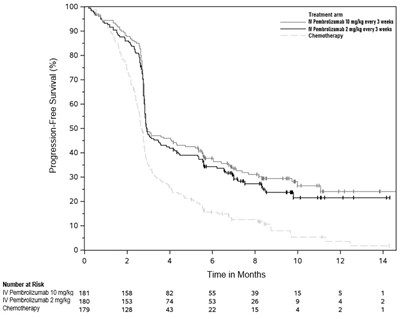 Figure 2 (Keytruda Qlex 02) |
Adjuvant Treatment of Resected Stage IIB or IIC Melanoma
The efficacy of intravenous pembrolizumab was investigated in KEYNOTE-716 (NCT03553836), a multicenter, randomized (1:1), double-blind, placebo-controlled trial in patients with completely resected Stage IIB or IIC melanoma. Patients were randomized to intravenous pembrolizumab 200 mg or the pediatric (≥12 years old) dose of intravenous pembrolizumab 2 mg/kg intravenously (up to a maximum of 200 mg) every three weeks or placebo for up to one year until disease recurrence or unacceptable toxicity. Randomization was stratified by AJCC 8th edition T Stage (>2.0-4.0 mm with ulceration vs. >4.0 mm without ulceration vs. >4.0 mm with ulceration). Patients must not have been previously treated for melanoma beyond complete surgical resection for their melanoma prior to study entry. The major efficacy outcome measure was investigator-assessed recurrence-free survival (RFS) (defined as the time between the date of randomization and the date of first recurrence [local, in-transit or regional lymph nodes or distant recurrence] or death, whichever occurred first). New primary melanomas were excluded from the definition of RFS. Distant metastasis-free survival (DMFS), defined as a spread of tumor to distant organs or distant lymph nodes, was an additional efficacy outcome measure. Patients underwent imaging every six months for one year from randomization, every 6 months from years 2 to 4, and then once in year 5 from randomization or until recurrence, whichever came first.
The study population characteristics were: median age of 61 years (range: 16 to 87), 39% age 65 or older; 60% male; 98% White; and 93% ECOG PS of 0 and 7% ECOG PS of 1. Sixty-four percent had Stage IIB and 35% had Stage IIC.
The trial demonstrated a statistically significant improvement in RFS and DMFS for patients randomized to the intravenous pembrolizumab arm compared with placebo. Efficacy results are summarized in Table 55 and Figure 3.
Table 55: Efficacy Results in KEYNOTE-716| Endpoint | Intravenous Pembrolizumab
200 mg every 3 weeks
n=487 | Placebo
n=489 |
|---|
| NR = not reached |
| RFS | |
| Number (%) of patients with event | 54 (11%) | 82 (17%) |
| Median in months (95% CI) | NR (22.6, NR) | NR (NR, NR) |
| Hazard ratio Based on the stratified Cox proportional hazard model ,Based on a log-rank test stratified by American Joint Committee on Cancer 8th edition (AJCC) stage (95% CI) | 0.65 (0.46, 0.92) |
| p-Value | 0.0132 p-Value is compared with 0.0202 of the allocated alpha for this interim analysis. |
| DMFS | |
| Number (%) of patients with event | 63 (13%) | 95 (19%) |
| Median in months (95% CI) | NR (NR, NR) | NR (NR, NR) |
| Hazard ratio, (95% CI) | 0.64 (0.47, 0.88) |
| p-Value | 0.0058 p-Value is compared with 0.0256 of the allocated alpha for this interim analysis. |
Figure 3: Kaplan-Meier Curve for Recurrence-Free Survival in KEYNOTE-716 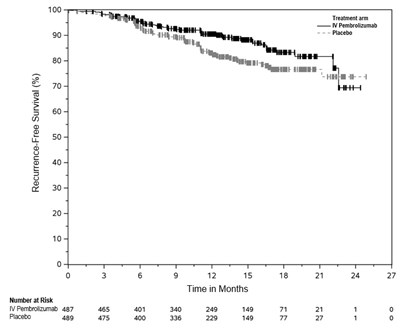 Figure 3 (Keytruda Qlex 03) |
Adjuvant Treatment of Stage III Resected Melanoma
The efficacy of intravenous pembrolizumab was investigated in KEYNOTE-054 (NCT02362594), a multicenter, randomized (1:1), double-blind, placebo-controlled trial in patients with completely resected Stage IIIA (>1 mm lymph node metastasis), IIIB, or IIIC melanoma. Patients were randomized to intravenous pembrolizumab 200 mg intravenously every three weeks or placebo for up to one year until disease recurrence or unacceptable toxicity. Randomization was stratified by American Joint Committee on Cancer 7th edition (AJCC) stage (IIIA vs. IIIB vs. IIIC 1-3 positive lymph nodes vs. IIIC ≥4 positive lymph nodes) and geographic region (North America, European countries, Australia, and other countries as designated). Patients must have undergone lymph node dissection and, if indicated, radiotherapy within 13 weeks prior to starting treatment. The major efficacy outcome measure was investigator-assessed recurrence-free survival (RFS) in the whole population and in the population with PD-L1 positive tumors where RFS was defined as the time between the date of randomization and the date of first recurrence (local, regional, or distant metastasis) or death, whichever occurs first. New primary melanomas were excluded from the definition of RFS. DMFS in the whole population and in the population with PD-L1 positive tumors were additional efficacy outcome measures. DMFS was defined as a spread of tumor to distant organs or distant lymph nodes. Patients underwent imaging every 12 weeks after the first dose of intravenous pembrolizumab for the first two years, then every 6 months from year 3 to 5, and then annually.
The study population characteristics were: median age of 54 years (range: 19 to 88), 25% age 65 or older; 62% male; and 94% ECOG PS of 0 and 6% ECOG PS of 1. Sixteen percent had Stage IIIA, 46% had Stage IIIB, 18% had Stage IIIC (1-3 positive lymph nodes), and 20% had Stage IIIC (≥4 positive lymph nodes); 50% were BRAF V600 mutation positive and 44% were BRAF wild-type; and 84% had PD-L1 positive melanoma with TPS ≥1% according to an IUO assay.
The trial demonstrated a statistically significant improvement in RFS and DMFS for patients randomized to the intravenous pembrolizumab arm compared with placebo. Efficacy results are summarized in Table 56 and Figure 4.
Table 56: Efficacy Results in KEYNOTE-054| Endpoint | Intravenous Pembrolizumab
200 mg every 3 weeks
n=514 | Placebo
n=505 |
|---|
| NR = not reached |
| RFS | |
| Number (%) of patients with event | 135 (26%) | 216 (43%) |
| Median in months (95% CI) | NR | 20.4 (16.2, NR) |
| Hazard ratio Based on the stratified Cox proportional hazard model ,Stratified by American Joint Committee on Cancer 7th edition (AJCC) stage (95% CI) | 0.57 (0.46, 0.70) |
| p-Value (log-rank) | <0.001 p-Value is compared with 0.016 of the allocated alpha for this interim analysis. |
| DMFS | |
| Number (%) of patients with event | 173 (34%) | 245 (49%) |
| Median in months (95% CI) | NR (49.6, NR) | 40.0 (27.7, NR) |
| Hazard ratio, (95% CI) | 0.60 (0.49, 0.73) |
| p-Value (log-rank) | <0.0001 p-Value is compared with 0.028 of the allocated alpha for this analysis. |
For patients with PD-L1 positive tumors, the RFS HR was 0.54 (95% CI: 0.42, 0.69); p<0.0001. For patients with PD-L1 positive tumors, the DMFS HR was 0.61 (95% CI: 0.49, 0.76); p<0.0001. The RFS and DMFS benefit for intravenous pembrolizumab compared to placebo was observed regardless of tumor PD-L1 expression.
Figure 4: Kaplan-Meier Curve for Recurrence-Free Survival in KEYNOTE-054 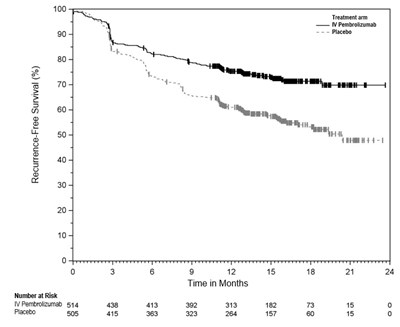 Figure 4 (Keytruda Qlex 04) |
First-line treatment of metastatic nonsquamous NSCLC with pemetrexed and platinum chemotherapy
The efficacy of intravenous pembrolizumab in combination with pemetrexed and platinum chemotherapy was investigated in KEYNOTE-189 (NCT02578680), a randomized, multicenter, double-blind, active-controlled trial conducted in 616 patients with metastatic nonsquamous NSCLC, regardless of PD-L1 tumor expression status, who had not previously received systemic therapy for metastatic disease and in whom there were no EGFR or ALK genomic tumor aberrations. Patients with autoimmune disease that required systemic therapy within 2 years of treatment; a medical condition that required immunosuppression; or who had received more than 30 Gy of thoracic radiation within the prior 26 weeks were ineligible. Randomization was stratified by smoking status (never vs. former/current), choice of platinum (cisplatin vs. carboplatin), and tumor PD-L1 status (TPS <1% [negative] vs. TPS ≥1%). Patients were randomized (2:1) to one of the following treatment arms:
- Intravenous pembrolizumab 200 mg, pemetrexed 500 mg/m2, and investigator's choice of cisplatin 75 mg/m2 or carboplatin AUC 5 mg/mL/min intravenously on Day 1 of each 21-day cycle for 4 cycles followed by intravenous pembrolizumab 200 mg and pemetrexed 500 mg/m2 intravenously every 3 weeks.
- Placebo, pemetrexed 500 mg/m2, and investigator's choice of cisplatin 75 mg/m2 or carboplatin AUC 5 mg/mL/min intravenously on Day 1 of each 21-day cycle for 4 cycles followed by placebo and pemetrexed 500 mg/m2 intravenously every 3 weeks.
Treatment with intravenous pembrolizumab continued until RECIST v1.1 (modified to follow a maximum of 10 target lesions and a maximum of 5 target lesions per organ)-defined progression of disease as determined by the investigator, unacceptable toxicity, or a maximum of 24 months. Administration of intravenous pembrolizumab was permitted beyond RECIST-defined disease progression if the patient was clinically stable and considered to be deriving clinical benefit by the investigator. Patients randomized to placebo and chemotherapy were offered intravenous pembrolizumab as a single agent at the time of disease progression. Assessment of tumor status was performed at Week 6, Week 12, and then every 9 weeks thereafter. The main efficacy outcome measures were OS and PFS as assessed by BICR according to RECIST v1.1, modified to follow a maximum of 10 target lesions and a maximum of 5 target lesions per organ. Additional efficacy outcome measures were ORR and DoR, as assessed by BICR according to RECIST v1.1, modified to follow a maximum of 10 target lesions and a maximum of 5 target lesions per organ.
The study population characteristics were: median age of 64 years (range: 34 to 84), 49% age 65 or older; 59% male; 94% White and 3% Asian; 56% ECOG PS of 1; and 18% with history of brain metastases. Thirty-one percent had tumor PD-L1 expression TPS <1% [negative]. Seventy-two percent received carboplatin and 12% were never smokers. A total of 85 patients in the placebo and chemotherapy arm received an anti-PD-1/PD-L1 monoclonal antibody at the time of disease progression.
The trial demonstrated a statistically significant improvement in OS and PFS for patients randomized to intravenous pembrolizumab in combination with pemetrexed and platinum chemotherapy compared with placebo, pemetrexed, and platinum chemotherapy. Table 57 and Figure 5 summarize the efficacy results for KEYNOTE-189.
Table 57: Efficacy Results in KEYNOTE-189| Endpoint | Intravenous Pembrolizumab
200 mg every 3 weeks
Pemetrexed
Platinum Chemotherapy
n=410 | Placebo
Pemetrexed
Platinum Chemotherapy
n=206 |
|---|
| NR = not reached |
| OS | | |
| Number (%) of patients with event | 127 (31%) | 108 (52%) |
| Median in months (95% CI) | NR
(NR, NR) | 11.3
(8.7, 15.1) |
| Hazard ratio Based on the stratified Cox proportional hazard model (95% CI) | 0.49 (0.38, 0.64) |
| p-Value Based on a stratified log-rank test | <0.0001 |
| PFS | | |
| Number of patients with event (%) | 245 (60%) | 166 (81%) |
| Median in months (95% CI) | 8.8 (7.6, 9.2) | 4.9 (4.7, 5.5) |
| Hazard ratio (95% CI) | 0.52 (0.43, 0.64) |
| p-Value | <0.0001 |
| Objective Response Rate | | |
| ORR Response: Best objective response as confirmed complete response or partial response (95% CI) | 48% (43, 53) | 19% (14, 25) |
| Complete response | 0.5% | 0.5% |
| Partial response | 47% | 18% |
| p-Value Based on Miettinen and Nurminen method stratified by PD-L1 status, platinum chemotherapy, and smoking status | <0.0001 |
| Duration of Response | | |
| Median in months (range) | 11.2 (1.1+, 18.0+) | 7.8 (2.1+, 16.4+) |
At the protocol-specified final OS analysis, the median in the intravenous pembrolizumab in combination with pemetrexed and platinum chemotherapy arm was 22.0 months (95% CI: 19.5, 24.5) compared to 10.6 months (95% CI: 8.7, 13.6) in the placebo with pemetrexed and platinum chemotherapy arm, with an HR of 0.56 (95% CI: 0.46, 0.69).
Figure 5: Kaplan-Meier Curve for Overall Survival in KEYNOTE-189Based on the protocol-specified final OS analysis
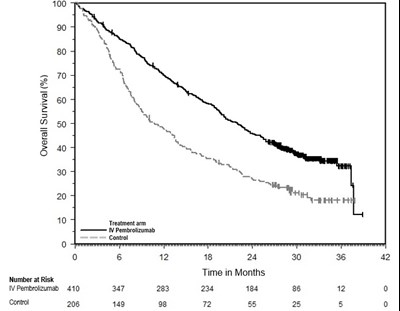 Figure 5 (Keytruda Qlex 05) |
First-line treatment of metastatic squamous NSCLC with carboplatin and either paclitaxel or paclitaxel protein-bound chemotherapy
The efficacy of intravenous pembrolizumab in combination with carboplatin and investigator's choice of either paclitaxel or paclitaxel protein-bound was investigated in KEYNOTE-407 (NCT02775435), a randomized, multi-center, double-blind, placebo-controlled trial conducted in 559 patients with metastatic squamous NSCLC, regardless of PD-L1 tumor expression status, who had not previously received systemic therapy for metastatic disease. Patients with autoimmune disease that required systemic therapy within 2 years of treatment; a medical condition that required immunosuppression; or who had received more than 30 Gy of thoracic radiation within the prior 26 weeks were ineligible. Randomization was stratified by tumor PD-L1 status (TPS <1% [negative] vs. TPS ≥1%), choice of paclitaxel or paclitaxel protein-bound, and geographic region (East Asia vs. non-East Asia). Patients were randomized (1:1) to one of the following treatment arms; all study medications were administered via intravenous infusion:
- Intravenous pembrolizumab 200 mg and carboplatin AUC 6 mg/mL/min on Day 1 of each 21-day cycle for 4 cycles, and paclitaxel 200 mg/m2 on Day 1 of each 21-day cycle for 4 cycles or paclitaxel protein-bound 100 mg/m2 on Days 1, 8 and 15 of each 21-day cycle for 4 cycles, followed by intravenous pembrolizumab 200 mg every 3 weeks.
- Placebo and carboplatin AUC 6 mg/mL/min on Day 1 of each 21-day cycle for 4 cycles and paclitaxel 200 mg/m2 on Day 1 of each 21-day cycle for 4 cycles or paclitaxel protein-bound 100 mg/m2 on Days 1, 8 and 15 of each 21-day cycle for 4 cycles, followed by placebo every 3 weeks.
Treatment with intravenous pembrolizumab and chemotherapy or placebo and chemotherapy continued until RECIST v1.1 (modified to follow a maximum of 10 target lesions and a maximum of 5 target lesions per organ)-defined progression of disease as determined by BICR, unacceptable toxicity, or a maximum of 24 months. Administration of intravenous pembrolizumab was permitted beyond RECIST-defined disease progression if the patient was clinically stable and deriving clinical benefit as determined by the investigator. Patients randomized to the placebo and chemotherapy arm were offered intravenous pembrolizumab as a single agent at the time of disease progression. Assessment of tumor status was performed every 6 weeks through Week 18, every 9 weeks through Week 45 and every 12 weeks thereafter. The main efficacy outcome measures were PFS and ORR as assessed by BICR using RECIST v1.1, modified to follow a maximum of 10 target lesions and a maximum of 5 target lesions per organ, and OS. An additional efficacy outcome measure was DoR as assessed by BICR according to RECIST v1.1, modified to follow a maximum of 10 target lesions and a maximum of 5 target lesions per organ.
The study population characteristics were: median age of 65 years (range: 29 to 88), 55% age 65 or older; 81% male; 77% White; 71% ECOG PS of 1; and 8% with a history of brain metastases. Thirty-five percent had tumor PD-L1 expression TPS <1%; 19% were from the East Asian region; and 60% received paclitaxel.
The trial demonstrated a statistically significant improvement in OS, PFS and ORR in patients randomized to intravenous pembrolizumab in combination with carboplatin and either paclitaxel or paclitaxel protein-bound chemotherapy compared with patients randomized to placebo with carboplatin and either paclitaxel or paclitaxel protein-bound chemotherapy. Table 58 and Figure 6 summarize the efficacy results for KEYNOTE-407.
Table 58: Efficacy Results in KEYNOTE-407| Endpoint | Intravenous Pembrolizumab
200 mg every 3 weeks
Carboplatin
Paclitaxel/Paclitaxel protein-bound
n=278 | Placebo
Carboplatin
Paclitaxel/Paclitaxel protein-bound
n=281 |
|---|
| NE = not estimable |
| OS | | |
| Number of events (%) | 85 (31%) | 120 (43%) |
| Median in months (95% CI) | 15.9 (13.2, NE) | 11.3 (9.5, 14.8) |
| Hazard ratio Based on the stratified Cox proportional hazard model (95% CI) | 0.64 (0.49, 0.85) |
| p-Value Based on a stratified log-rank test | 0.0017 |
| PFS | | |
| Number of events (%) | 152 (55%) | 197 (70%) |
| Median in months (95% CI) | 6.4 (6.2, 8.3) | 4.8 (4.2, 5.7) |
| Hazard ratio (95% CI) | 0.56 (0.45, 0.70) |
| p-Value | <0.0001 |
| n=101 | n=103 |
| Objective Response Rate ORR primary analysis and DoR analysis were conducted with the first 204 patients enrolled. | | |
| ORR (95% CI) | 58% (48, 68) | 35% (26, 45) |
| Difference (95% CI) | 23.6% (9.9, 36.4) |
| p-Value Based on a stratified Miettinen-Nurminen test | 0.0008 |
| Duration of Response | | |
| Median duration of response in months (range) | 7.2 (2.4, 12.4+) | 4.9 (2.0, 12.4+) |
At the protocol-specified final OS analysis, the median in the intravenous pembrolizumab in combination with carboplatin and either paclitaxel or paclitaxel protein-bound chemotherapy arm was 17.1 months (95% CI: 14.4, 19.9) compared to 11.6 months (95% CI: 10.1, 13.7) in the placebo with carboplatin and either paclitaxel or paclitaxel protein-bound chemotherapy arm, with an HR of 0.71 (95% CI: 0.58, 0.88).
Figure 6: Kaplan-Meier Curve for Overall Survival in KEYNOTE-407Based on the protocol-specified final OS analysis
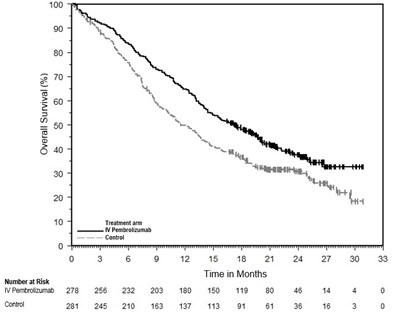 Figure 6 (Keytruda Qlex 06) |
First-line treatment of metastatic NSCLC with PD-L1 expression (TPS ≥1%) as a single agent
KEYNOTE-042
The efficacy of intravenous pembrolizumab was investigated in KEYNOTE-042 (NCT02220894), a randomized, multicenter, open-label, active-controlled trial conducted in 1274 patients with Stage III NSCLC who were not candidates for surgical resection or definitive chemoradiation, or patients with metastatic NSCLC. Only patients whose tumors expressed PD-L1 (TPS ≥1%) by an immunohistochemistry assay using the PD-L1 IHC 22C3 pharmDx kit and who had not received prior systemic treatment for metastatic NSCLC were eligible. Patients with EGFR or ALK genomic tumor aberrations; autoimmune disease that required systemic therapy within 2 years of treatment; a medical condition that required immunosuppression; or who had received more than 30 Gy of radiation in the thoracic region within the prior 26 weeks of initiation of study were ineligible. Randomization was stratified by ECOG PS (0 vs. 1), histology (squamous vs. nonsquamous), geographic region (East Asia vs. non-East Asia), and PD-L1 expression (TPS ≥50% vs. TPS 1 to 49%). Patients were randomized (1:1) to receive intravenous pembrolizumab 200 mg intravenously every 3 weeks or investigator's choice of either of the following platinum-containing chemotherapy regimens:
- Pemetrexed 500 mg/m2 every 3 weeks and carboplatin AUC 5 to 6 mg/mL/min every 3 weeks on Day 1 for a maximum of 6 cycles followed by optional pemetrexed 500 mg/m2 every 3 weeks for patients with nonsquamous histologies;
- Paclitaxel 200 mg/m2 every 3 weeks and carboplatin AUC 5 to 6 mg/mL/min every 3 weeks on Day 1 for a maximum of 6 cycles followed by optional pemetrexed 500 mg/m2 every 3 weeks for patients with nonsquamous histologies.
Treatment with intravenous pembrolizumab continued until RECIST v1.1 (modified to follow a maximum of 10 target lesions and a maximum of 5 target lesions per organ)-defined progression of disease, unacceptable toxicity, or a maximum of 24 months. Administration of intravenous pembrolizumab was permitted beyond RECIST-defined disease progression if the patient was clinically stable and deriving clinical benefit as determined by the investigator. Treatment with intravenous pembrolizumab could be reinitiated at the time of subsequent disease progression and administered for up to 12 months. Assessment of tumor status was performed every 9 weeks. The main efficacy outcome measure was OS in the subgroup of patients with TPS ≥50% NSCLC, the subgroup of patients with TPS ≥20% NSCLC, and the overall population with TPS ≥1% NSCLC. Additional efficacy outcome measures were PFS and ORR in the subgroup of patients with TPS ≥50% NSCLC, the subgroup of patients with TPS ≥20% NSCLC, and the overall population with TPS ≥1% NSCLC as assessed by BICR according to RECIST v1.1, modified to follow a maximum of 10 target lesions and a maximum of 5 target lesions per organ.
The study population characteristics were: median age of 63 years (range: 25 to 90), 45% age 65 or older; 71% male; and 64% White, 30% Asian, and 2% Black. Nineteen percent were Hispanic or Latino. Sixty-nine percent had ECOG PS of 1; 39% with squamous and 61% with nonsquamous histology; 87% had M1 disease and 13% had Stage IIIA (2%) or Stage IIIB (11%) and who were not candidates for surgical resection or definitive chemoradiation per investigator assessment; and 5% with treated brain metastases at baseline. Forty-seven percent of patients had TPS ≥50% NSCLC and 53% had TPS 1 to 49% NSCLC.
The trial demonstrated a statistically significant improvement in OS for patients (PD-L1 TPS ≥50%, TPS ≥20%, TPS ≥1%) randomized to intravenous pembrolizumab as compared with chemotherapy. Table 59 and Figure 7 summarize the efficacy results in the subgroup of patients with TPS ≥50% and in all randomized patients with TPS ≥1%.
Table 59: Efficacy Results of All Randomized Patients (TPS ≥1% and TPS ≥50%) in KEYNOTE-042 | TPS ≥1% | TPS ≥50% |
|---|
| Endpoint | Intravenous Pembrolizumab
200 mg every 3 weeks |
Chemotherapy | Intravenous Pembrolizumab
200 mg every 3 weeks |
Chemotherapy |
|---|
| n=637 | n=637
| n=299 | n=300
|
|---|
| OS | |
| Number of events (%) | 371 (58%) | 438 (69%) | 157 (53%) | 199 (66%) |
| Median in months (95% CI) | 16.7 (13.9, 19.7) | 12.1 (11.3, 13.3) | 20.0 (15.4, 24.9) | 12.2 (10.4, 14.2) |
| Hazard ratio (95% CI) | 0.81 (0.71, 0.93) | 0.69 (0.56, 0.85) |
| p-Value | 0.0036 | 0.0006 |
| PFS | |
| Number of events (%) | 507 (80%) | 506 (79%) | 221 (74%) | 233 (78%) |
| Median in months (95% CI) | 5.4 (4.3, 6.2) | 6.5 (6.3, 7.0) | 6.9 (5.9, 9.0) | 6.4 (6.1, 6.9) |
| Hazard ratio, (95% CI) | 1.07
(0.94, 1.21) | 0.82
(0.68, 0.99) |
| p-Value | - | NS |
| Objective Response Rate | |
| ORR (95% CI) | 27% (24, 31) | 27% (23, 30) | 39% (33.9, 45.3) | 32% (26.8, 37.6) |
| Complete response rate | 0.5% | 0.5% | 0.7% | 0.3% |
| Partial response rate | 27% | 26% | 39% | 32% |
| Duration of Response | |
| % with duration ≥12 months | 47% | 16% | 42% | 17% |
| % with duration ≥18 months | 26% | 6% | 25% | 5% |
The results of all efficacy outcome measures in the subgroup of patients with PD-L1 TPS ≥20% NSCLC were intermediate between the results of those with PD-L1 TPS ≥1% and those with PD-L1 TPS ≥50%. In a pre-specified exploratory subgroup analysis for patients with TPS 1-49% NSCLC, the median OS was 13.4 months (95% CI: 10.7, 18.2) for the pembrolizumab group and 12.1 months (95% CI: 11.0, 14.0) in the chemotherapy group, with an HR of 0.92 (95% CI: 0.77, 1.11).
| Figure 7: Kaplan-Meier Curve for Overall Survival in all Randomized Patients in KEYNOTE-042 (TPS ≥1%) |
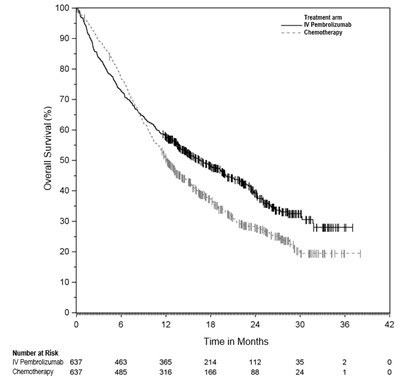 Figure 7 (Keytruda Qlex 07) |
KEYNOTE-024
The efficacy of intravenous pembrolizumab was also investigated in KEYNOTE-024 (NCT02142738), a randomized, multicenter, open-label, active-controlled trial in 305 previously untreated patients with metastatic NSCLC. The study design was similar to that of KEYNOTE-042, except that only patients whose tumors had high PD-L1 expression (TPS of 50% or greater) by an immunohistochemistry assay using the PD-L1 IHC 22C3 pharmDx kit were eligible. Patients were randomized (1:1) to receive intravenous pembrolizumab 200 mg intravenously every 3 weeks or investigator's choice of any of the following platinum-containing chemotherapy regimens:
- Pemetrexed 500 mg/m2 every 3 weeks and carboplatin AUC 5 to 6 mg/mL/min every 3 weeks on Day 1 for 4 to 6 cycles followed by optional pemetrexed 500 mg/m2 every 3 weeks for patients with nonsquamous histologies;
- Pemetrexed 500 mg/m2 every 3 weeks and cisplatin 75 mg/m2 every 3 weeks on Day 1 for 4 to 6 cycles followed by optional pemetrexed 500 mg/m2 every 3 weeks for patients with nonsquamous histologies;
- Gemcitabine 1250 mg/m2 on days 1 and 8 and cisplatin 75 mg/m2 every 3 weeks on Day 1 for 4 to 6 cycles;
- Gemcitabine 1250 mg/m2 on Days 1 and 8 and carboplatin AUC 5 to 6 mg/mL/min every 3 weeks on Day 1 for 4 to 6 cycles;
- Paclitaxel 200 mg/m2 every 3 weeks and carboplatin AUC 5 to 6 mg/mL/min every 3 weeks on Day 1 for 4 to 6 cycles followed by optional pemetrexed maintenance (for nonsquamous histologies).
Patients randomized to chemotherapy were offered intravenous pembrolizumab at the time of disease progression.
The main efficacy outcome measure was PFS as assessed by BICR according to RECIST v1.1, modified to follow a maximum of 10 target lesions and a maximum of 5 target lesions per organ. Additional efficacy outcome measures were OS and ORR as assessed by BICR according to RECIST v1.1, modified to follow a maximum of 10 target lesions and a maximum of 5 target lesions per organ.
The study population characteristics were: median age of 65 years (range: 33 to 90), 54% age 65 or older; 61% male; 82% White and 15% Asian; 65% with ECOG PS of 1; 18% with squamous and 82% with nonsquamous histology and 9% with history of brain metastases. A total of 66 patients in the chemotherapy arm received intravenous pembrolizumab at the time of disease progression.
The trial demonstrated a statistically significant improvement in both PFS and OS for patients randomized to intravenous pembrolizumab as compared with chemotherapy. Table 60 and Figure 8 summarize the efficacy results for KEYNOTE-024.
Table 60: Efficacy Results in KEYNOTE-024| Endpoint | Intravenous Pembrolizumab
200 mg every 3 weeks | Chemotherapy |
|---|
| n=154 | n=151 |
|---|
| NR = not reached |
| PFS | | |
| Number (%) of patients with event | 73 (47%) | 116 (77%) |
| Median in months (95% CI) | 10.3 (6.7, NR) | 6.0 (4.2, 6.2) |
| Hazard ratio Based on the stratified Cox proportional hazard model for the interim analysis (95% CI) | 0.50 (0.37, 0.68) |
| p-Value (stratified log-rank) | <0.001 |
| OS | | |
| Number (%) of patients with event | 44 (29%) | 64 (42%) |
| Median in months (95% CI) Based on the protocol-specified final OS analysis conducted at 169 events, which occurred 14 months after the interim analysis. | 30.0
(18.3, NR) | 14.2
(9.8, 19.0) |
| Hazard ratio (95% CI) | 0.60 (0.41, 0.89) |
| p-Value (stratified log-rank) | 0.005 p-Value is compared with 0.0118 of the allocated alpha for the interim analysis |
| Objective Response Rate | | |
| ORR (95% CI) | 45% (37, 53) | 28% (21, 36) |
| Complete response rate | 4% | 1% |
| Partial response rate | 41% | 27% |
| p-Value (Miettinen-Nurminen) | 0.001 |
| Median duration of response in months (range) | NR
(1.9+, 14.5+) | 6.3
(2.1+, 12.6+) |
Figure 8: Kaplan-Meier Curve for Overall Survival in KEYNOTE-024 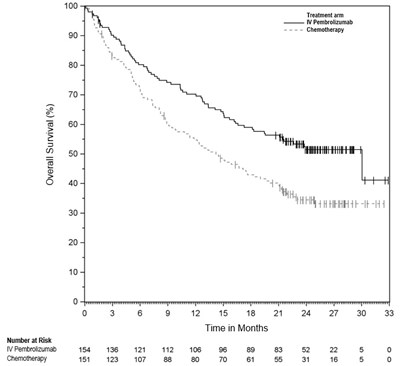 Figure 8 (Keytruda Qlex 08) |
Previously treated NSCLC with PD-L1 expression (TPS ≥1%)
The efficacy of intravenous pembrolizumab was investigated in KEYNOTE-010 (NCT01905657), a randomized, multicenter, open-label, active-controlled trial conducted in 1033 patients with metastatic NSCLC that had progressed following platinum-containing chemotherapy, and if appropriate, targeted therapy for EGFR or ALK genomic tumor aberrations. Eligible patients had PD-L1 expression TPS of 1% or greater by an immunohistochemistry assay using the PD-L1 IHC 22C3 pharmDx kit. Patients with autoimmune disease; a medical condition that required immunosuppression; or who had received more than 30 Gy of thoracic radiation within the prior 26 weeks were ineligible. Randomization was stratified by tumor PD-L1 expression (PD-L1 expression TPS ≥50% vs. PD-L1 expression TPS=1-49%), ECOG PS (0 vs. 1), and geographic region (East Asia vs. non-East Asia). Patients were randomized (1:1:1) to receive intravenous pembrolizumab 2 mg/kg intravenously every 3 weeks, intravenous pembrolizumab 10 mg/kg intravenously every 3 weeks or docetaxel intravenously 75 mg/m2 every 3 weeks until unacceptable toxicity or disease progression. Patients randomized to intravenous pembrolizumab were permitted to continue until disease progression that was symptomatic, rapidly progressive, required urgent intervention, occurred with a decline in performance status, or confirmation of progression at 4 to 6 weeks with repeat imaging or for up to 24 months without disease progression. Assessment of tumor status was performed every 9 weeks. The main efficacy outcome measures were OS and PFS as assessed by BICR according to RECIST v1.1, modified to follow a maximum of 10 target lesions and a maximum of 5 target lesions per organ, in the subgroup of patients with TPS ≥50% and the overall population with TPS ≥1%. Additional efficacy outcome measures were ORR and DoR in the subgroup of patients with TPS ≥50% and the overall population with TPS ≥1%.
The study population characteristics were: median age of 63 years (range: 20 to 88), 42% age 65 or older; 61% male; 72% White and 21% Asian; 66% ECOG PS of 1; 43% with high PD-L1 tumor expression; 21% with squamous, 70% with nonsquamous, and 8% with mixed, other or unknown histology; 91% metastatic (M1) disease; 15% with history of brain metastases; and 8% and 1% with EGFR and ALK genomic aberrations, respectively. All patients had received prior therapy with a platinum-doublet regimen, 29% received two or more prior therapies for their metastatic disease.
Tables 61 and 62 and Figure 9 summarize efficacy results in the subgroup with TPS ≥50% population and in all patients, respectively.
Table 61: Efficacy Results of the Subgroup of Patients with TPS ≥50% in KEYNOTE-010| Endpoint | Intravenous Pembrolizumab
2 mg/kg every 3 weeks
n=139 | Intravenous Pembrolizumab
10 mg/kg every 3 weeks
n=151 | Docetaxel
75 mg/m2 every 3 weeks
n=152 |
|---|
| NR = not reached |
| OS | | | |
| Deaths (%) | 58 (42%) | 60 (40%) | 86 (57%) |
| Median in months (95% CI) | 14.9 (10.4, NR) | 17.3 (11.8, NR) | 8.2 (6.4, 10.7) |
| Hazard ratio Hazard ratio (intravenous pembrolizumab compared to docetaxel) based on the stratified Cox proportional hazard model (95% CI) | 0.54 (0.38, 0.77) | 0.50 (0.36, 0.70) | --- |
| p-Value (stratified log-rank) | <0.001 | <0.001 | --- |
| PFS | | | |
| Events (%) | 89 (64%) | 97 (64%) | 118 (78%) |
| Median in months (95% CI) | 5.2 (4.0, 6.5) | 5.2 (4.1, 8.1) | 4.1 (3.6, 4.3) |
| Hazard ratio (95% CI) | 0.58 (0.43, 0.77) | 0.59 (0.45, 0.78) | --- |
| p-Value (stratified log-rank) | <0.001 | <0.001 | --- |
| Objective Response Rate | | | |
| ORR All responses were partial responses (95% CI) | 30% (23, 39) | 29% (22, 37) | 8% (4, 13) |
| p-Value (Miettinen-Nurminen) | <0.001 | <0.001 | --- |
| Median duration of response in months (range) | NR
(0.7+, 16.8+) | NR
(2.1+, 17.8+) | 8.1
(2.1+, 8.8+) |
Table 62: Efficacy Results of All Randomized Patients (TPS ≥1%) in KEYNOTE-010| Endpoint | Intravenous Pembrolizumab
2 mg/kg every 3 weeks
n=344 | Intravenous Pembrolizumab
10 mg/kg every 3 weeks
n=346 | Docetaxel
75 mg/m2 every 3 weeks
n=343 |
|---|
| NR = not reached |
| OS | | | |
| Deaths (%) | 172 (50%) | 156 (45%) | 193 (56%) |
| Median in months (95% CI) | 10.4 (9.4, 11.9) | 12.7 (10.0, 17.3) | 8.5 (7.5, 9.8) |
| Hazard ratio Hazard ratio (intravenous pembrolizumab compared to docetaxel) based on the stratified Cox proportional hazard model (95% CI) | 0.71 (0.58, 0.88) | 0.61 (0.49, 0.75) | --- |
| p-Value (stratified log-rank) | <0.001 | <0.001 | --- |
| PFS | | | |
| Events (%) | 266 (77%) | 255 (74%) | 257 (75%) |
| Median in months (95% CI) | 3.9 (3.1, 4.1) | 4.0 (2.6, 4.3) | 4.0 (3.1, 4.2) |
| Hazard ratio (95% CI) | 0.88 (0.73, 1.04) | 0.79 (0.66, 0.94) | --- |
| p-Value (stratified log-rank) | 0.068 | 0.005 | --- |
| Objective Response Rate | | | |
| ORR All responses were partial responses (95% CI) | 18% (14, 23) | 19% (15, 23) | 9% (7, 13) |
| p-Value (Miettinen-Nurminen) | <0.001 | <0.001 | --- |
| Median duration of response in months (range) | NR
(0.7+, 20.1+) | NR
(2.1+, 17.8+) | 6.2
(1.4+, 8.8+) |
Figure 9: Kaplan-Meier Curve for Overall Survival in all Randomized Patients in KEYNOTE-010 (TPS ≥1%) 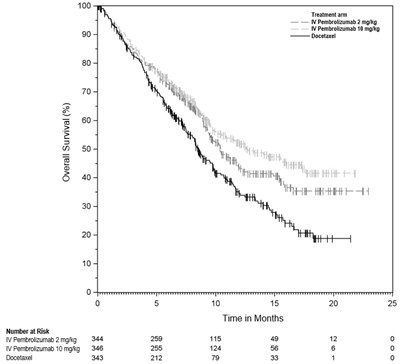 Figure 9 (Keytruda Qlex 09) |
Neoadjuvant and adjuvant treatment of resectable NSCLC
The efficacy of intravenous pembrolizumab in combination with neoadjuvant chemotherapy followed by surgery and continued adjuvant treatment with intravenous pembrolizumab as a single agent was investigated in KEYNOTE-671 (NCT03425643), a multicenter, randomized, double-blind, placebo-controlled trial conducted in 797 patients with previously untreated and resectable Stage II, IIIA, or IIIB (N2) NSCLC by AJCC 8th edition. Patients were enrolled regardless of tumor PD-L1 expression. Patients with active autoimmune disease that required systemic therapy within 2 years of treatment, a medical condition that required immunosuppression, or a history of interstitial lung disease or pneumonitis that required steroids were ineligible. Randomization was stratified by stage (II vs. III), tumor PD-L1 expression (TPS ≥50% or <50%), histology (squamous vs. nonsquamous), and geographic region (East Asia vs. non-East Asia).
Patients were randomized (1:1) to one of the following treatment arms:
- Treatment Arm A: neoadjuvant intravenous pembrolizumab 200 mg on Day 1 in combination with cisplatin 75 mg/m2 and either pemetrexed 500 mg/m2 on Day 1 or gemcitabine 1000 mg/m2 on Days 1 and 8 of each 21-day cycle for up to 4 cycles. Within 4-12 weeks following surgery, intravenous pembrolizumab 200 mg was administered every 3 weeks for up to 13 cycles.
- Treatment Arm B: neoadjuvant placebo on Day 1 in combination with cisplatin 75 mg/m2 and either pemetrexed 500 mg/m2 on Day 1 or gemcitabine 1000 mg/m2 on Days 1 and 8 of each 21-day cycle for up to 4 cycles. Within 4-12 weeks following surgery, placebo was administered every 3 weeks for up to 13 cycles.
All study medications were administered via intravenous infusion. Treatment with intravenous pembrolizumab or placebo continued until completion of the treatment (17 cycles), disease progression that precluded definitive surgery, disease recurrence in the adjuvant phase, disease progression for those who did not undergo surgery or had incomplete resection and entered the adjuvant phase, or unacceptable toxicity. Assessment of tumor status was performed at baseline, Week 7, and Week 13 in the neoadjuvant phase and within 4 weeks prior to the start of the adjuvant phase. Following the start of the adjuvant phase, assessment of tumor status was performed every 16 weeks through the end of Year 3, and then every 6 months thereafter.
The trial was not designed to isolate the effect of intravenous pembrolizumab in each phase (neoadjuvant or adjuvant) of treatment.
The major efficacy outcome measures were OS and investigator-assessed event-free survival (EFS). Additional efficacy outcome measures were pathological complete response (pCR) rate and major pathological response (mPR) rate as assessed by blinded independent pathology review.
The study population characteristics were: median age of 64 years (range: 26 to 83); 45% age 65 or older and 7% age 75 or older; 71% male; 61% White, 31% Asian, 2% Black, 4% race not reported; 9% Hispanic or Latino; 63% ECOG PS of 0 and 37% ECOG PS of 1. Thirty percent had Stage II and 70% had Stage III disease; 33% had TPS ≥50% and 67% had TPS <50%; 43% had tumors with squamous histology and 57% had tumors with non-squamous histology; 31% were from the East Asian region.
Eighty-one percent of patients in the intravenous pembrolizumab in combination with platinum-containing chemotherapy arm received definitive surgery compared to 76% of patients in the placebo in combination with platinum-containing chemotherapy arm.
The trial demonstrated statistically significant improvements in OS and EFS for patients randomized to intravenous pembrolizumab in combination with platinum-containing chemotherapy followed by intravenous pembrolizumab as a single agent compared with patients randomized to placebo in combination with platinum-containing chemotherapy followed by placebo alone.
Table 63 and Figure 10 summarize the efficacy results for KEYNOTE-671.
Table 63: Efficacy Results in KEYNOTE-671| Endpoint | Intravenous Pembrolizumab
200 mg every 3 weeks
with
chemotherapy/Intravenous Pembrolizumab
n=397 | Placebo with
chemotherapy/Placebo
n=400 |
|---|
| NR = not reached |
| OS | | |
| Number of patients with event (%) | 110 (28%) | 144 (36%) |
| Median in months Based on Kaplan-Meier estimates (95% CI) | NR (NR, NR) | 52.4 (45.7, NR) |
| Hazard ratio Based on Cox regression model with treatment as a covariate stratified by stage, tumor PD-L1 expression, histology, and geographic region (95% CI) | 0.72 (0.56, 0.93) |
| p-Value Based on stratified log-rank test ,Compared to a two-sided p-Value boundary of 0.0109 | 0.0103 |
| EFS | | |
| Number of patients with event (%) | 139 (35%) | 205 (51%) |
| Median in months (95% CI) | NR (34.1, NR) | 17.0 (14.3, 22.0) |
| Hazard ratio (95% CI) | 0.58 (0.46, 0.72) |
| p-Value, Compared to a two-sided p-Value boundary of 0.0092 | <0.0001 |
Figure 10: Kaplan-Meier Curve for Overall Survival in KEYNOTE-671 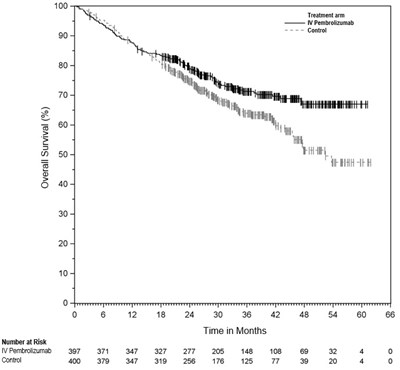 Figure 10 (Keytruda Qlex 10) |
The trial demonstrated a statistically significant difference in pCR rate (18.1% vs. 4.0%; p<0.0001) and mPR rate (30.2% vs. 11.0%; p<0.0001).
Adjuvant treatment of resected NSCLC
The efficacy of intravenous pembrolizumab was investigated in KEYNOTE-091 (NCT02504372), a multicenter, randomized, triple-blind, placebo-controlled trial conducted in 1177 patients with completely resected Stage IB (T2a ≥4 cm), II, or IIIA NSCLC by AJCC 7th edition. Patients had not received neoadjuvant radiotherapy or chemotherapy. Adjuvant chemotherapy up to 4 cycles was optional. Patients were ineligible if they had active autoimmune disease, were on chronic immunosuppressive agents, or had a history of interstitial lung disease or pneumonitis. Randomization was stratified by stage (IB vs. II vs. IIIA), receipt of adjuvant chemotherapy (yes vs. no), PD-L1 status (TPS <1% [negative] vs. TPS 1-49% vs. TPS ≥50%), and geographic region (Western Europe vs. Eastern Europe vs. Asia vs. Rest of World). Patients were randomized (1:1) to receive intravenous pembrolizumab 200 mg or placebo intravenously every 3 weeks.
Treatment continued until RECIST v1.1-defined disease recurrence as determined by the investigator, unacceptable toxicity or up to one year. Tumor assessments were conducted every 12 weeks for the first year, then every 6 months for years 2 to 3, and then annually through year 5. After year 5, imaging was performed as per local standard of care. The major efficacy outcome measure was investigator-assessed disease-free survival (DFS). An additional efficacy outcome measure was OS.
Of 1177 patients randomized, 1010 (86%) received adjuvant platinum-based chemotherapy following resection. Among these 1010 patients, the median age was 64 years (range: 35 to 84), 49% age 65 or older; 68% male; 77% White, 18% Asian; 86% current or former smokers; and 39% with ECOG PS of 1. Eleven percent had Stage IB, 57% had Stage II, and 31% had Stage IIIA disease. Thirty-nine percent had PD-L1 TPS <1% [negative], 33% had TPS 1-49%, and 28% had TPS ≥50%. Fifty-two percent were from Western Europe, 20% from Eastern Europe, 17% from Asia, and 11% from Rest of World.
The trial met its primary endpoint, demonstrating a statistically significant improvement in DFS in the overall population for patients randomized to the intravenous pembrolizumab arm compared to patients randomized to the placebo arm. In an exploratory subgroup analysis of the 167 patients (14%) who did not receive adjuvant chemotherapy, the DFS HR was 1.25 (95% CI: 0.76, 2.05). OS results were not mature with only 42% of pre-specified OS events in the overall population.
Table 64 and Figure 11 summarize the efficacy results for KEYNOTE-091 in patients who received adjuvant chemotherapy.
Table 64: Efficacy Results in KEYNOTE-091 for Patients Who Received Adjuvant Chemotherapy| Endpoint | Intravenous Pembrolizumab
200 mg every 3 weeks
n=506 | Placebo
n=504 |
|---|
| NR = not reached |
| DFS | | |
| Number (%) of patients with event | 177 (35%) | 231 (46%) |
| Median in months (95% CI) | 58.7
(39.2, NR) | 34.9
(28.6, NR) |
| Hazard ratio Based on the unstratified univariate Cox regression model (95% CI) | 0.73 (0.60, 0.89) |
Figure 11: Kaplan-Meier Curve for Disease-Free Survival in KEYNOTE-091 for Patients Who Received Adjuvant Chemotherapy 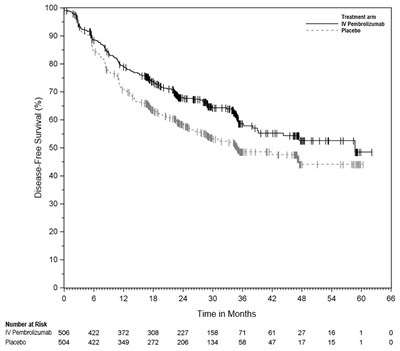 Figure 11 (Keytruda Qlex 11) |
First-line treatment of metastatic or unresectable, recurrent HNSCC
The efficacy of intravenous pembrolizumab was investigated in KEYNOTE-048 (NCT02358031), a randomized, multicenter, open-label, active-controlled trial conducted in 882 patients with metastatic HNSCC who had not previously received systemic therapy for metastatic disease or with recurrent disease who were considered incurable by local therapies. Patients with active autoimmune disease that required systemic therapy within two years of treatment or a medical condition that required immunosuppression were ineligible. Randomization was stratified by tumor PD-L1 expression (TPS ≥50% or <50%) according to the PD-L1 IHC 22C3 pharmDx kit, HPV status according to p16 IHC (positive or negative), and ECOG PS (0 vs. 1). Patients were randomized 1:1:1 to one of the following treatment arms:
- Intravenous pembrolizumab 200 mg intravenously every 3 weeks
- Intravenous pembrolizumab 200 mg intravenously every 3 weeks, carboplatin AUC 5 mg/mL/min intravenously every 3 weeks or cisplatin 100 mg/m2 intravenously every 3 weeks, and FU 1000 mg/m2/day as a continuous intravenous infusion over 96 hours every 3 weeks (maximum of 6 cycles of platinum and FU)
- Cetuximab 400 mg/m2 intravenously as the initial dose then 250 mg/m2 intravenously once weekly, carboplatin AUC 5 mg/mL/min intravenously every 3 weeks or cisplatin 100 mg/m2 intravenously every 3 weeks, and FU 1000 mg/m2/day as a continuous intravenous infusion over 96 hours every 3 weeks (maximum of 6 cycles of platinum and FU)
Treatment with intravenous pembrolizumab continued until RECIST v1.1-defined progression of disease as determined by the investigator, unacceptable toxicity, or a maximum of 24 months. Administration of intravenous pembrolizumab was permitted beyond RECIST-defined disease progression if the patient was clinically stable and considered to be deriving clinical benefit by the investigator. Assessment of tumor status was performed at Week 9 and then every 6 weeks for the first year, followed by every 9 weeks through 24 months. A retrospective re-classification of patients' tumor PD-L1 status according to CPS using the PD-L1 IHC 22C3 pharmDx kit was conducted using the tumor specimens used for randomization.
The main efficacy outcome measures were OS and PFS as assessed by BICR according to RECIST v1.1 (modified to follow a maximum of 10 target lesions and a maximum of 5 target lesions per organ) sequentially tested in the subgroup of patients with CPS ≥20, the subgroup of patients with CPS ≥1, and the overall population.
The study population characteristics were: median age of 61 years (range: 20 to 94), 36% age 65 or older; 83% male; 73% White, 20% Asian and 2.4% Black; 61% had ECOG PS of 1; and 79% were former/current smokers. Twenty-two percent of patients' tumors were HPV-positive, 23% had PD-L1 TPS ≥50%, and 95% had Stage IV disease (Stage IVA 19%, Stage IVB 6%, and Stage IVC 70%). Eighty-five percent of patients' tumors had PD-L1 expression of CPS ≥1 and 43% had CPS ≥20.
The trial demonstrated a statistically significant improvement in OS for patients randomized to intravenous pembrolizumab in combination with chemotherapy compared to those randomized to cetuximab in combination with chemotherapy at a pre-specified interim analysis in the overall population. Table 66 and Figure 13 summarize efficacy results for intravenous pembrolizumab in combination with chemotherapy.
Table 66: Efficacy ResultsResults at a pre-specified interim analysis
for Intravenous Pembrolizumab plus Platinum/Fluorouracil in KEYNOTE-048| Endpoint | Intravenous Pembrolizumab
200 mg every 3 weeks
Platinum
FU | Cetuximab
Platinum
FU |
|---|
| n=281 | n=278 |
|---|
| OS |
| Number (%) of patients with event | 197 (70%) | 223 (80%) |
| Median in months (95% CI) | 13.0 (10.9, 14.7) | 10.7 (9.3, 11.7) |
| Hazard ratio Based on the stratified Cox proportional hazard model (95% CI) | 0.77 (0.63, 0.93) |
| p-Value Based on stratified log-rank test | 0.0067 |
| PFS |
| Number of patients with event (%) | 244 (87%) | 253 (91%) |
| Median in months (95% CI) | 4.9 (4.7, 6.0) | 5.1 (4.9, 6.0) |
| Hazard ratio (95% CI) | 0.92 (0.77, 1.10) |
| p-Value | 0.3394 |
| Objective Response Rate |
| ORR Response: Best objective response as confirmed complete response or partial response (95% CI) | 36% (30.0, 41.5) | 36% (30.7, 42.3) |
| Complete response rate | 6% | 3% |
| Partial response rate | 30% | 33% |
| Duration of Response |
| Median in months (range) | 6.7 (1.6+, 30.4+) | 4.3 (1.2+, 27.9+) |
At the pre-specified final OS analysis for the ITT population, the hazard ratio was 0.72 (95% CI: 0.60, 0.87). In addition, KEYNOTE-048 demonstrated a statistically significant improvement in OS for the subgroups of patients with PD-L1 CPS ≥1 (HR=0.65, 95% CI: 0.53, 0.80) and CPS ≥20 (HR=0.60, 95% CI: 0.45, 0.82).
Figure 13: Kaplan-Meier Curve for Overall Survival for Intravenous Pembrolizumab plus Platinum/Fluorouracil in KEYNOTE-048At the time of the protocol-specified final analysis.
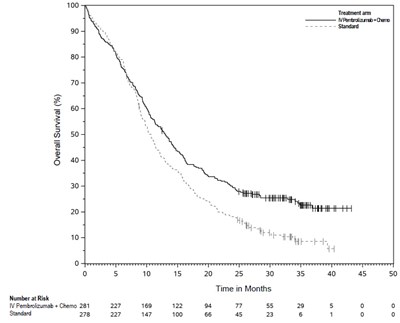 Figure 13 (Keytruda Qlex 14) |
The trial also demonstrated a statistically significant improvement in OS for the subgroup of patients with PD-L1 CPS ≥1 randomized to intravenous pembrolizumab as a single agent compared to those randomized to cetuximab in combination with chemotherapy at a pre-specified interim analysis. At the time of the interim and final analyses, there was no significant difference in OS between the intravenous pembrolizumab single agent arm and the control arm for the overall population.
Table 67 summarizes efficacy results for intravenous pembrolizumab as a single agent in the subgroups of patients with CPS ≥1 HNSCC and CPS ≥20 HNSCC. Figure 14 summarizes the OS results in the subgroup of patients with CPS ≥1 HNSCC.
Table 67: Efficacy ResultsResults at a pre-specified interim analysis
for Intravenous Pembrolizumab as a Single Agent in KEYNOTE-048 (CPS ≥1 and CPS ≥20)| Endpoint | CPS ≥1 | CPS ≥20 |
|---|
Intravenous Pembrolizumab
200 mg every 3 weeks | Cetuximab
Platinum
FU | Intravenous Pembrolizumab
200 mg every 3 weeks | Cetuximab
Platinum
FU |
|---|
| n=257 | n=255 | n=133 | n=122 |
|---|
| OS | |
| Number of events (%) | 177 (69%) | 206 (81%) | 82 (62%) | 95 (78%) |
| Median in months (95% CI) | 12.3 (10.8, 14.9) | 10.3 (9.0, 11.5) | 14.9 (11.6, 21.5) | 10.7 (8.8, 12.8) |
| Hazard ratio Based on the stratified Cox proportional hazard model (95% CI) | 0.78 (0.64, 0.96) | 0.61 (0.45, 0.83) |
| p-Value Based on a stratified log-rank test | 0.0171 | 0.0015 |
| PFS | |
| Number of events (%) | 225 (88%) | 231 (91%) | 113 (85%) | 111 (91%) |
| Median in months (95% CI) | 3.2 (2.2, 3.4) | 5.0 (4.8, 5.8) | 3.4 (3.2, 3.8) | 5.0 (4.8, 6.2) |
| Hazard ratio (95% CI) | 1.15 (0.95, 1.38) | 0.97 (0.74, 1.27) |
| Objective Response Rate | |
| ORR Response: Best objective response as confirmed complete response or partial response (95% CI) | 19% (14.5, 24.4) | 35% (29.1, 41.1) | 23% (16.4, 31.4) | 36% (27.6, 45.3) |
| Complete response rate | 5% | 3% | 8% | 3% |
| Partial response rate | 14% | 32% | 16% | 33% |
| Duration of Response | |
| Median in months (range) | 20.9 (1.5+, 34.8+) | 4.5 (1.2+, 28.6+) | 20.9 (2.7, 34.8+) | 4.2 (1.2+, 22.3+) |
At the pre-specified final OS analysis comparing intravenous pembrolizumab as a single agent to cetuximab in combination with chemotherapy, the hazard ratio for the subgroup of patients with CPS ≥1 was 0.74 (95% CI: 0.61, 0.90) and the hazard ratio for the subgroup of patients with CPS ≥20 was 0.58 (95% CI: 0.44, 0.78).
In an exploratory subgroup analysis for patients with CPS 1-19 HNSCC at the time of the pre-specified final OS analysis, the median OS was 10.8 months (95% CI: 9.0, 12.6) for intravenous pembrolizumab as a single agent and 10.1 months (95% CI: 8.7, 12.1) for cetuximab in combination with chemotherapy, with an HR of 0.86 (95% CI: 0.66, 1.12).
Figure 14: Kaplan-Meier Curve for Overall Survival for Intravenous Pembrolizumab as a Single Agent in KEYNOTE-048 (CPS ≥1)At the time of the protocol-specified final analysis.
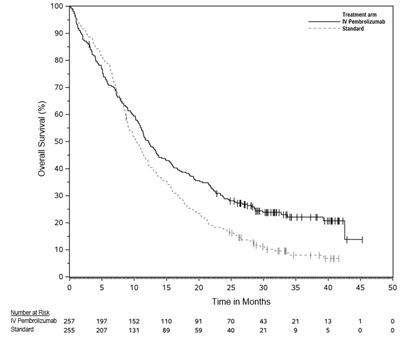 Figure 14 (Keytruda Qlex 15) |
Previously treated recurrent or metastatic HNSCC
The efficacy of intravenous pembrolizumab was investigated in KEYNOTE-012 (NCT01848834), a multicenter, non-randomized, open-label, multi-cohort study that enrolled 174 patients with recurrent or metastatic HNSCC who had disease progression on or after platinum-containing chemotherapy administered for recurrent or metastatic HNSCC or following platinum-containing chemotherapy administered as part of induction, concurrent, or adjuvant therapy. Patients with active autoimmune disease, a medical condition that required immunosuppression, evidence of interstitial lung disease, or ECOG PS ≥2 were ineligible.
Patients received intravenous pembrolizumab 10 mg/kg every 2 weeks (n=53) or 200 mg every 3 weeks (n=121) until unacceptable toxicity or disease progression that was symptomatic, was rapidly progressive, required urgent intervention, occurred with a decline in performance status, or was confirmed at least 4 weeks later with repeat imaging. Patients without disease progression were treated for up to 24 months. Treatment with pembrolizumab could be reinitiated for subsequent disease progression and administered for up to 1 additional year. Assessment of tumor status was performed every 8 weeks. The major efficacy outcome measures were ORR according to RECIST v1.1, modified to follow a maximum of 10 target lesions and a maximum of 5 target lesions per organ, as assessed by BICR, and DoR.
The study population characteristics were median age of 60 years, 32% age 65 or older; 82% male; 75% White, 16% Asian, and 6% Black; 87% had M1 disease; 33% had HPV positive tumors; 63% had prior cetuximab; 29% had an ECOG PS of 0 and 71% had an ECOG PS of 1; and the median number of prior lines of therapy administered for the treatment of HNSCC was 2.
The ORR was 16% (95% CI: 11, 22) with a complete response rate of 5%. The median follow-up time was 8.9 months. Among the 28 responding patients, the median DoR had not been reached (range: 2.4+ to 27.7+ months), with 23 patients having responses of 6 months or longer. The ORR and DoR were similar irrespective of dosage regimen (10 mg/kg every 2 weeks or 200 mg every 3 weeks) or HPV status.
In Combination with Enfortumab Vedotin for the Treatment of Patients with Urothelial Cancer
The efficacy of intravenous pembrolizumab in combination with enfortumab vedotin was evaluated in KEYNOTE-A39 (NCT04223856), an open-label, randomized, multicenter trial that enrolled 886 patients with locally advanced or metastatic urothelial cancer who received no prior systemic therapy for locally advanced or metastatic disease. Patients with active CNS metastases, ongoing sensory or motor neuropathy Grade ≥2, or uncontrolled diabetes defined as hemoglobin A1C (HbA1c) ≥8% or HbA1c ≥7% with associated diabetes symptoms were excluded.
Patients were randomized 1:1 to receive either:
- Intravenous pembrolizumab 200 mg over 30 minutes on Day 1 and enfortumab vedotin 1.25 mg/kg on Days 1 and 8 of each 21-day cycle. Intravenous pembrolizumab was given approximately 30 minutes after enfortumab vedotin. Treatment was continued until disease progression or unacceptable toxicity. In the absence of disease progression or unacceptable toxicity, intravenous pembrolizumab was continued for up to 2 years.
- Gemcitabine 1000 mg/m2 on Days 1 and 8 of a 21-day cycle with cisplatin 70 mg/m2 or carboplatin (AUC = 4.5 or 5) on Day 1 of a 21-day cycle. Treatment was continued until disease progression or unacceptable toxicity for up to 6 cycles.
Randomization was stratified by cisplatin eligibility, PD-L1 expression, and presence of liver metastases.
The median age was 69 years (range: 22 to 91); 77% were male; 67% were White, 22% were Asian, 1% were Black or African American, and 10% were unknown or other; 12% were Hispanic or Latino. Patients had a baseline ECOG performance status of 0 (49%), 1 (47%), or 2 (3%). Forty-seven percent of patients had a documented baseline HbA1c of <5.7%. At baseline, 95% of patients had metastatic urothelial cancer, including 72% with visceral and 22% with liver metastases, and 5% had locally advanced urothelial cancer. Eighty-five percent of patients had urothelial carcinoma (UC) histology including 6% with UC mixed squamous differentiation and 2% with UC mixed other histologic variants. Forty-six percent of patients were considered cisplatin-ineligible and 54% were considered cisplatin-eligible at time of randomization.
The major efficacy outcome measures were OS and PFS as assessed by BICR according to RECIST v1.1. Additional efficacy outcome measures included ORR as assessed by BICR.
The trial demonstrated statistically significant improvements in OS, PFS, and ORR for patients randomized to intravenous pembrolizumab in combination with enfortumab vedotin as compared to platinum-based chemotherapy. Efficacy results were consistent across all stratified patient subgroups.
Table 68 and Figures 15 and 16 summarize the efficacy results for KEYNOTE-A39.
Table 68: Efficacy Results in KEYNOTE-A39| Endpoint | Intravenous Pembrolizumab
200 mg every 3 weeks in combination with Enfortumab Vedotin
n=442 | Cisplatin or Carboplatin with Gemcitabine
n=444 |
|---|
| NR = not reached |
| OS | | |
| Number (%) of patients with event | 133 (30%) | 226 (51%) |
| Median in months (95% CI) | 31.5 (25.4, NR) | 16.1 (13.9, 18.3) |
| Hazard ratio Based on the stratified Cox proportional hazard regression model (95% CI) | 0.47 (0.38, 0.58) |
| p-Value Two-sided p-Value based on stratified log-rank test | <0.0001 |
| PFS | | |
| Number (%) of patients with event | 223 (50%) | 307 (69%) |
| Median in months (95% CI) | 12.5 (10.4, 16.6) | 6.3 (6.2, 6.5) |
| Hazard ratio (95% CI) | 0.45 (0.38, 0.54) |
| p-Value | <0.0001 |
| Confirmed Objective Response Rate Includes only patients with measurable disease at baseline (n=437 for intravenous pembrolizumab in combination with enfortumab vedotin, n=441 for chemotherapy). | | |
| ORR Based on patients with a best overall response as confirmed complete or partial response % (95% CI) | 68% (63, 72) | 44% (40, 49) |
| p-Value Two-sided p-Value based on Cochran-Mantel-Haenszel test stratified by PD-L1 expression, cisplatin eligibility and liver metastases | <0.0001 |
| Complete response | 29% | 12% |
| Partial response | 39% | 32% |
Figure 15: Kaplan-Meier Curve for Overall Survival in KEYNOTE-A39 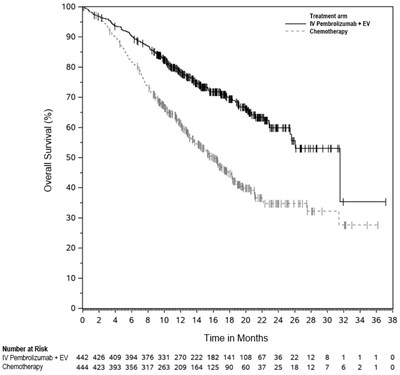 Figure 15 (Keytruda Qlex 16) |
Figure 16: Kaplan-Meier Curve for Progression-Free Survival in KEYNOTE-A39 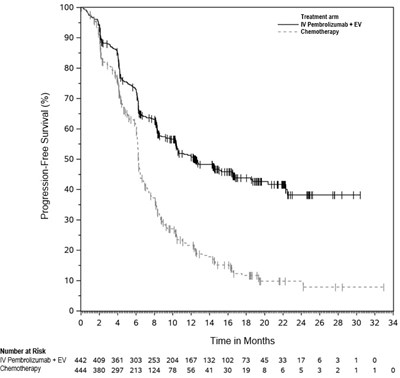 Figure 16 (Keytruda Qlex 17) |
In Combination with Enfortumab Vedotin for the Treatment of Cisplatin-Ineligible Patients with Urothelial Cancer
The efficacy of intravenous pembrolizumab in combination with enfortumab vedotin was evaluated in KEYNOTE-869 (NCT03288545), an open-label, multi-cohort (dose escalation cohort, Cohort A, Cohort K) study in patients with locally advanced or metastatic urothelial cancer who were ineligible for cisplatin-containing chemotherapy and received no prior systemic therapy for locally advanced or metastatic disease. Patients with active CNS metastases, ongoing sensory or motor neuropathy Grade ≥2, or uncontrolled diabetes defined as hemoglobin A1C (HbA1c) ≥8% or HbA1c ≥7% with associated diabetes symptoms were excluded from participating in the study.
Patients in the dose escalation cohort (n=5), Cohort A (n=40), and Cohort K (n=76) received enfortumab vedotin 1.25 mg/kg as an IV infusion over 30 minutes on Days 1 and 8 of a 21-day cycle followed by intravenous pembrolizumab 200 mg as an IV infusion on Day 1 of a 21-day cycle approximately 30 minutes after enfortumab vedotin. Patients were treated until disease progression or unacceptable toxicity.
A total of 121 patients received intravenous pembrolizumab in combination with enfortumab vedotin. The median age was 71 years (range: 51 to 91); 74% were male; 85% were White, 5% were Black, 4% were Asian and 6% were other, unknown or not reported. Ten percent of patients were Hispanic or Latino. Forty-five percent of patients had an ECOG performance status of 1 and 15% had an ECOG performance status of 2. Forty-seven percent of patients had a documented baseline HbA1c of <5.7%. Reasons for cisplatin-ineligibility included: 60% with baseline creatinine clearance of 30-59 mL/min, 10% with ECOG PS of 2, 13% with Grade 2 or greater hearing loss, and 16% with more than one cisplatin-ineligibility criteria.
At baseline, 97.5% of patients had metastatic urothelial cancer and 2.5% of patients had locally advanced urothelial cancer. Thirty-seven percent of patients had upper tract disease. Eighty-four percent of patients had visceral metastasis at baseline, including 22% with liver metastases. Thirty-nine percent of patients had TCC histology; 13% had TCC with squamous differentiation, and 48% had TCC with other histologic variants.
The major efficacy outcome measures were ORR and DoR as assessed by BICR according to RECIST v1.1.
The median follow-up time for the dose escalation cohort + Cohort A was 44.7 months (range 0.7 to 52.4) and for Cohort K was 14.8 months (range: 0.6 to 26.2).
Efficacy results are presented in Table 69 below.
Table 69: Efficacy Results in KEYNOTE-869, Combined Dose Escalation Cohort, Cohort A, and Cohort K| Endpoint | Intravenous Pembrolizumab in combination with Enfortumab Vedotin
n=121 |
|---|
| Confirmed ORR (95% CI) | 68% (58.7, 76.0) |
| Complete response rate | 12% |
| Partial response rate | 55% |
The median duration of response for the dose escalation cohort + Cohort A was 22.1 months (range: 1.0+ to 46.3+) and for Cohort K was not reached (range: 1.2 to 24.1+).
Platinum-Ineligible Patients with Urothelial Carcinoma
The efficacy of intravenous pembrolizumab was investigated in KEYNOTE-052 (NCT02335424), a multicenter, open-label, single-arm trial in 370 patients with locally advanced or metastatic urothelial carcinoma who had one or more comorbidities, including patients who were not eligible for any platinum-containing chemotherapy. The trial excluded patients with autoimmune disease or a medical condition that required immunosuppression. Patients received intravenous pembrolizumab 200 mg every 3 weeks until unacceptable toxicity or disease progression. Patients with initial radiographic disease progression could receive additional doses of treatment during confirmation of progression unless disease progression was symptomatic, was rapidly progressive, required urgent intervention, or occurred with a decline in performance status. Patients without disease progression could be treated for up to 24 months. Tumor response assessments were performed at 9 weeks after the first dose, then every 6 weeks for the first year, and then every 12 weeks thereafter. The major efficacy outcome measures were ORR and DoR as assessed by BICR according to RECIST v1.1, modified to follow a maximum of 10 target lesions and a maximum of 5 target lesions per organ.
The study population characteristics were: median age of 74 years; 77% male; and 89% White. Eighty-seven percent had M1 disease, and 13% had M0 disease. Eighty-one percent had a primary tumor in the lower tract, and 19% of patients had a primary tumor in the upper tract. Eighty-five percent of patients had visceral metastases, including 21% with liver metastases. Fifty percent of patients had baseline creatinine clearance of <60 mL/min, 32% had ECOG PS of 2, 9% had ECOG PS of 2 and baseline creatinine clearance of <60 mL/min, and 9% had one or more of Class III heart failure, Grade 2 or greater peripheral neuropathy, and Grade 2 or greater hearing loss. Ninety percent of patients were treatment naïve, and 10% received prior adjuvant or neoadjuvant platinum-based chemotherapy.
The median follow-up time for 370 patients treated with intravenous pembrolizumab was 11.4 months (range 0.1 to 63.8 months). Efficacy results are summarized in Table 70.
Table 70: Efficacy Results in KEYNOTE-052| Endpoint | Intravenous Pembrolizumab
200 mg every 3 weeks |
|---|
| All Subjects
n=370 |
|---|
| + Denotes ongoing response |
| Objective Response Rate | |
| ORR (95% CI) | 29% (24, 34) |
| Complete response rate | 10% |
| Partial response rate | 20% |
| Duration of Response | |
| Median in months (range) | 33.4
(1.4+, 60.7+) |
Platinum-Eligible Patients with Previously Untreated Urothelial Carcinoma
The efficacy of intravenous pembrolizumab for the first-line treatment of platinum-eligible patients with locally advanced or metastatic urothelial carcinoma was investigated in KEYNOTE-361 (NCT02853305), a multicenter, randomized, open-label, active-controlled study in 1010 previously untreated patients. The safety and efficacy of intravenous pembrolizumab in combination with platinum-based chemotherapy for previously untreated patients with locally advanced or metastatic urothelial carcinoma has not been established.
The study compared intravenous pembrolizumab with or without platinum-based chemotherapy (i.e., cisplatin or carboplatin with gemcitabine) to platinum-based chemotherapy alone. Among the patients receiving intravenous pembrolizumab plus platinum-based chemotherapy, 44% received cisplatin and 56% received carboplatin.
The study did not meet its major efficacy outcome measures of improved PFS or OS in the intravenous pembrolizumab plus chemotherapy arm compared to the chemotherapy-alone arm. Additional efficacy endpoints, including improvement of OS in the intravenous pembrolizumab monotherapy arm, could not be formally tested.
Previously Treated Urothelial Carcinoma
The efficacy of intravenous pembrolizumab was investigated in KEYNOTE-045 (NCT02256436), a multicenter, randomized (1:1), active-controlled trial in 542 patients with locally advanced or metastatic urothelial carcinoma with disease progression on or after platinum-containing chemotherapy. The trial excluded patients with autoimmune disease or a medical condition that required immunosuppression.
Patients were randomized to receive either intravenous pembrolizumab 200 mg every 3 weeks (n=270) or investigator's choice of any of the following chemotherapy regimens all given intravenously every 3 weeks (n=272): paclitaxel 175 mg/m2 (n=90), docetaxel 75 mg/m2 (n=92), or vinflunine 320 mg/m2 (n=90). Treatment continued until unacceptable toxicity or disease progression. Patients with initial radiographic disease progression could receive additional doses of treatment during confirmation of progression unless disease progression was symptomatic, was rapidly progressive, required urgent intervention, or occurred with a decline in performance status. Patients without disease progression could be treated for up to 24 months. Assessment of tumor status was performed at 9 weeks after randomization, then every 6 weeks through the first year, followed by every 12 weeks thereafter. The major efficacy outcomes were OS and PFS as assessed by BICR per RECIST v1.1, modified to follow a maximum of 10 target lesions and a maximum of 5 target lesions per organ. Additional efficacy outcome measures were ORR as assessed by BICR per RECIST v1.1, modified to follow a maximum of 10 target lesions and a maximum of 5 target lesions per organ, and DoR.
The study population characteristics were: median age of 66 years (range: 26 to 88), 58% age 65 or older; 74% male; 72% White and 23% Asian; 42% ECOG PS of 0 and 56% ECOG PS of 1; and 96% M1 disease and 4% M0 disease. Eighty-seven percent of patients had visceral metastases, including 34% with liver metastases. Eighty-six percent had a primary tumor in the lower tract and 14% had a primary tumor in the upper tract. Fifteen percent of patients had disease progression following prior platinum-containing neoadjuvant or adjuvant chemotherapy. Twenty-one percent had received 2 or more prior systemic regimens in the metastatic setting. Seventy-six percent of patients received prior cisplatin, 23% had prior carboplatin, and 1% were treated with other platinum-based regimens.
The study demonstrated statistically significant improvements in OS and ORR for patients randomized to intravenous pembrolizumab as compared to chemotherapy. There was no statistically significant difference between intravenous pembrolizumab and chemotherapy with respect to PFS. The median follow-up time for this trial was 9.0 months (range: 0.2 to 20.8 months). Table 71 and Figure 17 summarize the efficacy results for KEYNOTE-045.
Table 71: Efficacy Results in KEYNOTE-045 | Intravenous Pembrolizumab
200 mg every 3 weeks | Chemotherapy |
|---|
| n=270 | n=272 |
|---|
+ Denotes ongoing response
NR = not reached |
| OS | | |
| Deaths (%) | 155 (57%) | 179 (66%) |
| Median in months (95% CI) | 10.3 (8.0, 11.8) | 7.4 (6.1, 8.3) |
| Hazard ratio Hazard ratio (intravenous pembrolizumab compared to chemotherapy) based on the stratified Cox proportional hazard model (95% CI) | 0.73 (0.59, 0.91) |
| p-Value (stratified log-rank) | 0.004 |
| PFS by BICR | | |
| Events (%) | 218 (81%) | 219 (81%) |
| Median in months (95% CI) | 2.1 (2.0, 2.2) | 3.3 (2.3, 3.5) |
| Hazard ratio (95% CI) | 0.98 (0.81, 1.19) |
| p-Value (stratified log-rank) | 0.833 |
| Objective Response Rate | | |
| ORR (95% CI) | 21% (16, 27) | 11% (8, 16) |
| Complete response rate | 7% | 3% |
| Partial response rate | 14% | 8% |
| p-Value (Miettinen-Nurminen) | 0.002 |
| Median duration of response in months (range) | NR
(1.6+, 15.6+) | 4.3
(1.4+, 15.4+) |
Figure 17: Kaplan-Meier Curve for Overall Survival in KEYNOTE-045 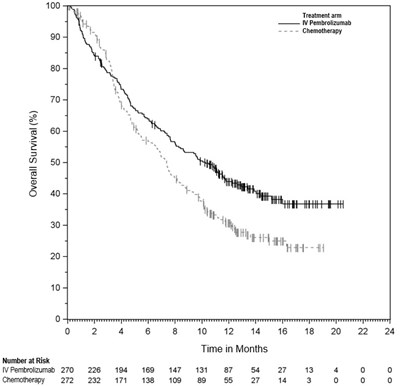 Figure 17 (Keytruda Qlex 18) |
BCG-unresponsive High-Risk Non-Muscle Invasive Bladder Cancer
The efficacy of intravenous pembrolizumab was investigated in KEYNOTE-057 (NCT02625961), a multicenter, open-label, single-arm trial in 96 patients with Bacillus Calmette-Guerin (BCG)-unresponsive, high-risk, non-muscle invasive bladder cancer (NMIBC) with carcinoma in situ (CIS) with or without papillary tumors who are ineligible for or have elected not to undergo cystectomy. BCG-unresponsive high-risk NMIBC was defined as persistent disease despite adequate BCG therapy, disease recurrence after an initial tumor-free state following adequate BCG therapy, or T1 disease following a single induction course of BCG. Adequate BCG therapy was defined as administration of at least five of six doses of an initial induction course plus either of: at least two of three doses of maintenance therapy or at least two of six doses of a second induction course. Prior to treatment, all patients had undergone transurethral resection of bladder tumor (TURBT) to remove all resectable disease (Ta and T1 components). Residual CIS (Tis components) not amenable to complete resection was allowed. The trial excluded patients with muscle invasive (i.e., T2, T3, T4) locally advanced non-resectable or metastatic urothelial carcinoma, concurrent extra-vesical (i.e., urethra, ureter or renal pelvis) non-muscle invasive transitional cell carcinoma of the urothelium, or autoimmune disease or a medical condition that required immunosuppression.
Patients received intravenous pembrolizumab 200 mg every 3 weeks until unacceptable toxicity, persistent or recurrent high-risk NMIBC, or progressive disease. Assessment of tumor status was performed every 12 weeks for two years and then every 24 weeks for three years, and patients without disease progression could be treated for up to 24 months. The major efficacy outcome measures were complete response (as defined by negative results for cystoscopy [with TURBT/biopsies as applicable], urine cytology, and computed tomography urography [CTU] imaging) and duration of response.
The study population characteristics were: median age of 73 years (range: 44 to 92); 44% age ≥75; 84% male; 67% White; and 73% and 27% with an ECOG performance status of 0 or 1, respectively. Tumor pattern at study entry was CIS with T1 (13%), CIS with high grade TA (25%), and CIS (63%). Baseline high-risk NMIBC disease status was 27% persistent and 73% recurrent. The median number of prior instillations of BCG was 12.
The median follow-up time was 28.0 months (range: 4.6 to 40.5 months). Efficacy results are summarized in Table 72.
Table 72: Efficacy Results in KEYNOTE-057| Endpoint | Intravenous Pembrolizumab
200 mg every 3 weeks
n=96 |
|---|
| + Denotes ongoing response |
| Complete Response Rate (95% CI) | 41% (31, 51) |
| Duration of Response Based on patients (n=39) that achieved a complete response; reflects period from the time complete response was achieved | |
| Median in months (range) | 16.2 (0.0+, 30.4+) |
| % (n) with duration ≥12 months | 46% (18) |
First-line Treatment of Locally Advanced Unresectable or Metastatic Esophageal/Gastroesophageal Junction Cancer for Tumors Expressing PD-L1 (CPS ≥1)
KEYNOTE-590
The efficacy of intravenous pembrolizumab was investigated in KEYNOTE-590 (NCT03189719), a multicenter, randomized, placebo-controlled trial that enrolled 749 patients with metastatic or locally advanced esophageal or gastroesophageal junction (tumors with epicenter 1 to 5 centimeters above the GEJ) carcinoma who were not candidates for surgical resection or definitive chemoradiation. PD-L1 status was centrally determined in tumor specimens in all patients using the PD-L1 IHC 22C3 pharmDx kit. Patients with active autoimmune disease, a medical condition that required immunosuppression, or who received prior systemic therapy in the locally advanced or metastatic setting were ineligible. Randomization was stratified by tumor histology (squamous cell carcinoma vs. adenocarcinoma), geographic region (Asia vs. ex-Asia), and ECOG performance status (0 vs. 1).
Patients were randomized (1:1) to one of the following treatment arms; all study medications were administered via intravenous infusion:
- Intravenous pembrolizumab 200 mg on Day 1 of each three-week cycle in combination with cisplatin 80 mg/m2 IV on Day 1 of each three-week cycle for up to six cycles and FU 800 mg/m2 IV per day on Day 1 to Day 5 of each three-week cycle, or per local standard for FU administration, for up to 24 months.
- Placebo on Day 1 of each three-week cycle in combination with cisplatin 80 mg/m2 IV on Day 1 of each three-week cycle for up to six cycles and FU 800 mg/m2 IV per day on Day 1 to Day 5 of each three-week cycle, or per local standard for FU administration, for up to 24 months.
Treatment with intravenous pembrolizumab or chemotherapy continued until unacceptable toxicity or disease progression. Patients could be treated with intravenous pembrolizumab for up to 24 months in the absence of disease progression. The major efficacy outcome measures were OS and PFS as assessed by the investigator according to RECIST v1.1 (modified to follow a maximum of 10 target lesions and a maximum of 5 target lesions per organ). The study pre-specified analyses of OS and PFS based on squamous cell histology, CPS ≥10, and in all patients. Additional efficacy outcome measures were ORR and DoR, according to modified RECIST v1.1, as assessed by the investigator. Additional analyses of efficacy outcome measures were also conducted based on PD-L1 CPS ≥1.
Among 749 patients, 647 (86%) had tumors expressing PD-L1 CPS ≥ 1. The study population characteristics in patients with PD-L1 CPS ≥ 1 expressing tumors were: median age of 63 years (range: 27 to 89), 41% age 65 or older; 83% male; 36% White, 54% Asian, and 1% Black; 40% had an ECOG PS of 0 and 59% had an ECOG PS of 1. Ninety-one percent had M1 disease and 9% had M0 disease. Seventy-four percent had a tumor histology of squamous cell carcinoma, and 26% had adenocarcinoma.
The trial demonstrated a statistically significant improvement in OS and PFS for patients randomized to intravenous pembrolizumab in combination with chemotherapy compared to chemotherapy; however, an exploratory analysis of OS in the PD-L1 CPS <1 population showed an HR of 0.96 (0.59, 1.55), indicating that the improvement in the ITT population was primarily attributed to the results observed in the subgroup of patients with PD-L1 CPS ≥1.
Table 78 and Figures 22 and 23 summarize the efficacy results for KEYNOTE-590 in patients whose tumors expressed PD-L1 CPS ≥1 and CPS ≥10.
Table 78: Efficacy Results in Patients with Locally Advanced Unresectable or Metastatic Esophageal Cancer in KEYNOTE-590| Endpoint | Intravenous Pembrolizumab
200 mg every 3 weeks
Cisplatin
FU
n=320 | Placebo
Cisplatin
FU
n=327 | Intravenous Pembrolizumab
200 mg every 3 weeks
Cisplatin
FU
n=186 | Placebo
Cisplatin
FU
n=197 |
|---|
| CPS ≥1 | CPS ≥10 |
|---|
| OS | | |
| Number (%) of events | 222 (69) | 271 (83) | 124 (67) | 165 (84) |
Median in months
(95% CI) | 12.7
(10.5, 14.4) | 9.8
(8.8, 10.8) | 13.5
(11.1, 15.6) | 9.4
(8.0, 10.7) |
| Hazard ratio Based on the stratified Cox proportional hazard model (95% CI) | 0.71 (0.59, 0.84) | 0.62 (0.49, 0.78) |
| p-Value Based on a stratified log-rank test; p-Value for CPS ≥1 not included (not pre-specified subgroup) | | <0.0001 |
| PFS | | |
| Number of events (%) | 252 (79) | 291 (89) | 140 (75) | 174 (88) |
Median in months
(95% CI) | 6.3
(6.2, 7.1) | 5.7
(4.6, 6.0) | 7.5
(6.2, 8.2) | 5.5
(4.3, 6.0) |
| Hazard ratio (95% CI) | 0.62 (0.52, 0.73) | 0.51 (0.41, 0.65) |
| p-Value | | <0.0001 |
| Objective Response Rate |
| ORR, % Confirmed complete response or partial response
(95% CI) | 45
(40, 51) | 29
(24, 34) | 51
(44, 59) | 27
(21, 34) |
| Number (%) of complete responses | 19 (6) | 9 (2.8) | 11 (6) | 5 (2.5) |
| Number (%) of partial responses | 126 (39) | 85 (26) | 84 (45) | 48 (24) |
| Duration of Response |
Median in months
(range) | 8.6
(1.2+, 31.0+) | 5.8
(1.5+, 25.0+) | 10.4
(1.9+, 28.9+) | 5.6
(1.5+, 25.0+) |
Figure 22: Kaplan-Meier Curve for Overall Survival in KEYNOTE-590 (CPS ≥1) 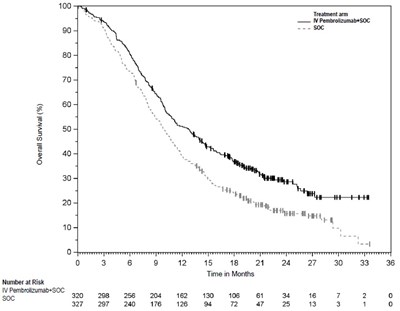 Figure 22 (Keytruda Qlex 23) |
Figure 23: Kaplan-Meier Curve for Overall Survival in KEYNOTE-590 (CPS ≥10) 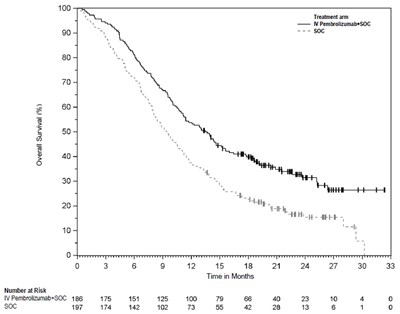 Figure 23 (Keytruda Qlex 24) |
In a pre-specified formal test of OS in patients with PD-L1 CPS ≥10 (n=383), the median was 13.5 months (95% CI: 11.1, 15.6) for the intravenous pembrolizumab arm and 9.4 months (95% CI: 8.0, 10.7) for the placebo arm, with a HR of 0.62 (95% CI: 0.49, 0.78; p-Value < 0.0001). In an exploratory analysis, in patients with PD-L1 CPS <10 (n=347), the median OS was 10.5 months (95% CI: 9.7, 13.5) for the intravenous pembrolizumab arm and 10.6 months (95% CI: 8.8, 12.0) for the placebo arm, with a HR of 0.86 (95% CI: 0.68, 1.10).
Previously Treated Recurrent Locally Advanced or Metastatic Esophageal Cancer for Tumors Expressing PD-L1 (CPS≥ 10)
KEYNOTE-181
The efficacy of intravenous pembrolizumab was investigated in KEYNOTE-181 (NCT02564263), a multicenter, randomized, open-label, active-controlled trial that enrolled 628 patients with recurrent locally advanced or metastatic esophageal cancer who progressed on or after one prior line of systemic treatment for advanced disease. Patients with HER2/neu positive esophageal cancer were required to have received treatment with approved HER2/neu targeted therapy. All patients were required to have tumor specimens for PD-L1 testing at a central laboratory; PD-L1 status was determined using the PD-L1 IHC 22C3 pharmDx kit. Patients with a history of non-infectious pneumonitis that required steroids or current pneumonitis, active autoimmune disease, or a medical condition that required immunosuppression were ineligible.
Patients were randomized (1:1) to receive either intravenous pembrolizumab 200 mg every 3 weeks or investigator's choice of any of the following chemotherapy regimens, all given intravenously: paclitaxel 80-100 mg/m2 on Days 1, 8, and 15 of every 4-week cycle, docetaxel 75 mg/m2 every 3 weeks, or irinotecan 180 mg/m2 every 2 weeks. Randomization was stratified by tumor histology (esophageal squamous cell carcinoma [ESCC] vs. esophageal adenocarcinoma [EAC]/Siewert type I EAC of the gastroesophageal junction [GEJ]), and geographic region (Asia vs. ex-Asia). Treatment with intravenous pembrolizumab or chemotherapy continued until unacceptable toxicity or disease progression. Patients randomized to intravenous pembrolizumab were permitted to continue beyond the first RECIST v1.1 (modified to follow a maximum of 10 target lesions and a maximum of 5 target lesions per organ)-defined disease progression if clinically stable until the first radiographic evidence of disease progression was confirmed at least 4 weeks later with repeat imaging. Patients treated with intravenous pembrolizumab without disease progression could be treated for up to 24 months. Assessment of tumor status was performed every 9 weeks. The major efficacy outcome measure was OS evaluated in the following co-primary populations: patients with ESCC, patients with tumors expressing PD-L1 CPS ≥10, and all randomized patients. Additional efficacy outcome measures were PFS, ORR, and DoR, according to RECIST v1.1, modified to follow a maximum of 10 target lesions and a maximum of 5 target lesions per organ, as assessed by BICR.
A total of 628 patients were enrolled and randomized to intravenous pembrolizumab (n=314) or investigator's treatment of choice (n=314). Of these 628 patients, 167 (27%) had ESCC that expressed PD-L1 with a CPS ≥10. Of these 167 patients, 85 patients were randomized to intravenous pembrolizumab and 82 patients to investigator's treatment of choice [paclitaxel (n=50), docetaxel (n=19), or irinotecan (n=13)]. The baseline characteristics of these 167 patients were: median age of 65 years (range: 33 to 80), 51% age 65 or older; 84% male; 32% White and 68% Asian; 38% had an ECOG PS of 0 and 62% had an ECOG PS of 1. Ninety percent had M1 disease and 10% had M0 disease. Prior to enrollment, 99% of patients had received platinum-based treatment and 84% had also received treatment with a fluoropyrimidine. Thirty-three percent of patients received prior treatment with a taxane.
The observed OS hazard ratio was 0.77 (95% CI: 0.63, 0.96) in patients with ESCC, 0.70 (95% CI: 0.52, 0.94) in patients with tumors expressing PD-L1 CPS ≥10, and 0.89 (95% CI: 0.75, 1.05) in all randomized patients. On further examination in patients whose ESCC tumors expressed PD-L1 (CPS ≥10), an improvement in OS was observed among patients randomized to intravenous pembrolizumab as compared with chemotherapy. Table 79 and Figure 24 summarize the key efficacy measures for KEYNOTE-181 for patients with ESCC CPS ≥10.
Table 79: Efficacy Results in Patients with Recurrent or Metastatic ESCC (CPS ≥10) in KEYNOTE-181| Endpoint | Intravenous Pembrolizumab
200 mg every 3 weeks
n=85 | Chemotherapy
n=82 |
|---|
| OS | | |
| Number (%) of patients with event | 68 (80%) | 72 (88%) |
| Median in months (95% CI) | 10.3 (7.0, 13.5) | 6.7 (4.8, 8.6) |
| Hazard ratio Based on the Cox regression model stratified by geographic region (Asia vs. ex-Asia) (95% CI) | 0.64 (0.46, 0.90) |
| PFS | | |
| Number (%) of patients with event | 76 (89%) | 76 (93%) |
| Median in months (95% CI) | 3.2 (2.1, 4.4) | 2.3 (2.1, 3.4) |
| Hazard ratio (95% CI) | 0.66 (0.48, 0.92) |
| Objective Response Rate | | |
| ORR (95% CI) | 22 (14, 33) | 7 (3, 15) |
| Number (%) of complete responses | 4 (5) | 1 (1) |
| Number (%) of partial responses | 15 (18) | 5 (6) |
| Median duration of response in months (range) | 9.3 (2.1+, 18.8+) | 7.7 (4.3, 16.8+) |
Figure 24: Kaplan-Meier Curve for Overall Survival in KEYNOTE-181 (ESCC CPS ≥10) 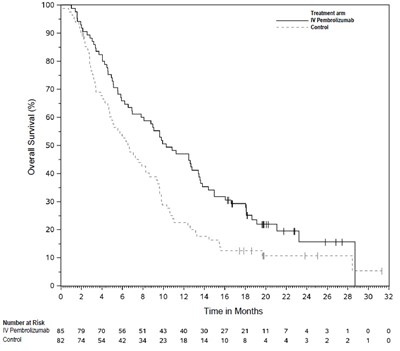 Figure 24 (Keytruda Qlex 25) |
KEYNOTE-180
The efficacy of intravenous pembrolizumab was investigated in KEYNOTE-180 (NCT02559687), a multicenter, non-randomized, open-label trial that enrolled 121 patients with locally advanced or metastatic esophageal cancer who progressed on or after at least 2 prior systemic treatments for advanced disease. With the exception of the number of prior lines of treatment, the eligibility criteria were similar to and the dosage regimen identical to KEYNOTE-181.
The major efficacy outcome measures were ORR and DoR according to RECIST v1.1, modified to follow a maximum of 10 target lesions and a maximum of 5 target lesions per organ, as assessed by BICR.
Among the 121 patients enrolled, 29% (n=35) had ESCC that expressed PD-L1 CPS ≥10. The baseline characteristics of these 35 patients were: median age of 65 years (range: 47 to 81), 51% age 65 or older; 71% male; 26% White and 69% Asian; 40% had an ECOG PS of 0 and 60% had an ECOG PS of 1. One hundred percent had M1 disease.
The ORR in the 35 patients with ESCC expressing PD-L1 was 20% (95% CI: 8, 37). Among the 7 responding patients, the DoR ranged from 4.2 to 25.1+ months, with 5 patients (71%) having responses of 6 months or longer and 3 patients (57%) having responses of 12 months or longer.
Immune-Mediated Adverse Reactions
- Inform patients of the risk of immune-mediated adverse reactions that may be severe or fatal, may occur after discontinuation of treatment, and may require corticosteroid treatment and interruption or discontinuation of KEYTRUDA QLEX. These reactions may include:
- Pneumonitis: Advise patients to contact their healthcare provider immediately for new or worsening cough, chest pain, or shortness of breath [see Warnings and Precautions (5.1)].
- Colitis: Advise patients to contact their healthcare provider immediately for diarrhea or severe abdominal pain [see Warnings and Precautions (5.1)].
- Hepatitis: Advise patients to contact their healthcare provider immediately for jaundice, severe nausea or vomiting, or easy bruising or bleeding [see Warnings and Precautions (5.1)].
- Endocrinopathies: Advise patients to contact their healthcare provider immediately for signs or symptoms of adrenal insufficiency, hypophysitis, hypothyroidism, hyperthyroidism, or Type 1 diabetes mellitus [see Warnings and Precautions (5.1)].
- Nephritis: Advise patients to contact their healthcare provider immediately for signs or symptoms of nephritis [see Warnings and Precautions (5.1)].
- Severe skin reactions: Advise patients to contact their healthcare provider immediately for any signs or symptoms of severe skin reactions, SJS or TEN [see Warnings and Precautions (5.1)].
- Other immune-mediated adverse reactions:
- Advise patients that immune-mediated adverse reactions can occur and may involve any organ system, and to contact their healthcare provider immediately for any new or worsening signs or symptoms [see Warnings and Precautions (5.1)].
- Advise patients of the risk of solid organ transplant rejection and other transplant (including corneal graft) rejection. Advise patients to contact their healthcare provider immediately for signs or symptoms of organ transplant rejection and other transplant (including corneal graft) rejection [see Warnings and Precautions (5.1)].
Hypersensitivity and Administration-Related Reactions