STELLAR
The efficacy of WINREVAIR was evaluated in adult patients with PAH in the STELLAR trial (NCT04576988). STELLAR was a global, double-blind, placebo-controlled, multicenter, parallel-group clinical trial in which 323 patients with PAH (WHO Group 1, FC II or III) were randomized 1:1 to WINREVAIR (target dose 0.7 mg/kg) (n=163) or placebo (n=160) administered subcutaneously once every 3 weeks.
Participants were: 79% female; had a median age of 48 years (range: 18 to 82 years), and median body weight of 68 kg (range: 38 to 141 kg); and 89% White, 2% Black/African American, 2% Asian, 0.3% American Indian or Alaska Native, 0.3% Native Hawaiian or Other Pacific Islander, 6% Missing/Other races. The most common PAH etiologies were idiopathic PAH (59%), heritable PAH (18%), and PAH associated with connective tissue diseases (CTD) (15%). STELLAR excluded patients with human immunodeficiency virus (HIV)-associated PAH, PAH associated with portal hypertension, schistosomiasis-associated PAH, and pulmonary veno-occlusive disease. The mean time from PAH diagnosis to screening was 8.8 years. Most participants were receiving either three (61%) or two (35%) background drugs for PAH, and 40% were receiving prostacyclin infusions. Patients had a WHO FC II (49%) or III (51%) at baseline.
The primary efficacy endpoint was the change from baseline at Week 24 in 6-Minute Walk Distance (6 MWD). In the WINREVAIR group, the placebo-adjusted median increase in 6 MWD was 41 meters (95% CI: 28, 54; p<0.001). Figure 1 displays placebo-adjusted changes in 6 MWD at Week 24 in relevant subgroups.
Figure 1: Change from Baseline in 6-Minute Walk Distance (meters) at Week 24 in Subgroups in STELLAR *Hodges-Lehmann location shift from placebo estimate (median of all paired differences). ASE = asymptotic standard error.
Change from baseline in 6 MWD at Week 24 for subjects who died was imputed to -2000 meters to receive the worst rank. Change from baseline in 6 MWD at Week 24 for subjects who had missing data due to a non-fatal clinical worsening event was imputed to -1000 meters to receive the next-worst rank. |
|
Treatment with WINREVAIR led to an improvement from baseline by at least 1 WHO FC at Week 24 in 29% of patients compared to 14% of patients treated with placebo (p<0.001).
Treatment with WINREVAIR resulted in an 84% reduction in the occurrence of death from any cause or PAH clinical worsening events compared to placebo (see Table 6 and Figure 2). These outcomes were captured until the last patient completed the Week 24 visit (data up to the data cutoff; median duration of exposure 33.6 weeks).
Table 6: Death from Any Cause or PAH Clinical Worsening Events in STELLAR | WINREVAIR
(N=163)
n (%) | Placebo
(N=160)
n (%) | Hazard Ratio
(95% CI) |
|---|
N = number of subjects in the category.
6 MWT = 6-Minute Walking Test |
| Number of subjects who experienced death or at least one clinical worsening event | 9 (5.5) | 42 (26.3) | 0.16 (0.08, 0.35)
p<0.001 |
| Assessment of clinical worsening events A subject can have more than one assessment recorded for their clinical worsening. |
| Death | 2 (1.2) | 7 (4.4) | |
| Worsening-related listing for lung and/or heart transplant | 1 (0.6) | 2 (1.3) |
Need to initiate rescue therapy with an approved PAH therapy or
the need to increase the dose of infusion prostacyclin by 10% or more | 2 (1.2) | 17 (10.6) |
| Need for atrial septostomy There were no events of atrial septostomy. | 0 (0.0) | 0 (0.0) |
| PAH-specific hospitalization (≥24 hours) | 0 (0.0) | 8 (5.0) |
| Deterioration of PAH Deterioration of PAH is defined by both of the following events occurring at any time, even if they began at different times, as compared to their baseline values: (a) Worsened WHO functional class (II to III, III to IV, II to IV, etc.); and (b) Decrease in 6 MWD by ≥15% (confirmed by two 6 MWTs at least 4 hours apart but no more than one week). | 4 (2.5) | 15 (9.4) |
Figure 2: Time to Death from Any Cause or First Occurrence of PAH Clinical Worsening Event Kaplan-Meier Plot in STELLAR |
ZENITH
The efficacy of WINREVAIR was evaluated in adult PAH patients with WHO FC III or IV at high risk of mortality in the ZENITH trial (NCT04896008). ZENITH was a global, double-blind, placebo-controlled, multicenter, parallel-group clinical trial in which 172 patients were randomized 1:1 to WINREVAIR (target dose 0.7 mg/kg) (n=86) or placebo (n=86) administered subcutaneously once every 3 weeks. Efficacy was evaluated at the pre-specified interim analysis which occurred when 61 patients experienced a primary endpoint event and median patient time on study was 273 days.
The demographic and baseline clinical characteristics were similar between the WINREVAIR and placebo groups. Participants were: 77% female; had a median age of 58 years (range: 18 to 75 years); and 87% White, 5% Black/African American, 4% Asian, 1% American Indian or Alaska Native, 3% Missing/Other race, 74% were FC III and 26% were FC IV. The most common PAH etiologies were idiopathic PAH (50%), PAH associated with connective tissue diseases (CTD) (28%), and heritable PAH (11%). The mean time since PAH diagnosis to screening was 8 years. Participants were on background PAH treatment, 72% on triple therapy, 28% on double therapy, and 59% on prostacyclin infusion therapy. The REVEAL Lite 2 risk score was <9 for 2% of participants, 9 to 10 for 67% of participants, and ≥11 for 30% of participants. The ZENITH trial excluded patients diagnosed with human immunodeficiency virus (HIV)-associated PAH, PAH associated with portal hypertension, pulmonary veno-occlusive disease, or pulmonary capillary hemangiomatosis or overt signs of capillary and/or venous involvement.
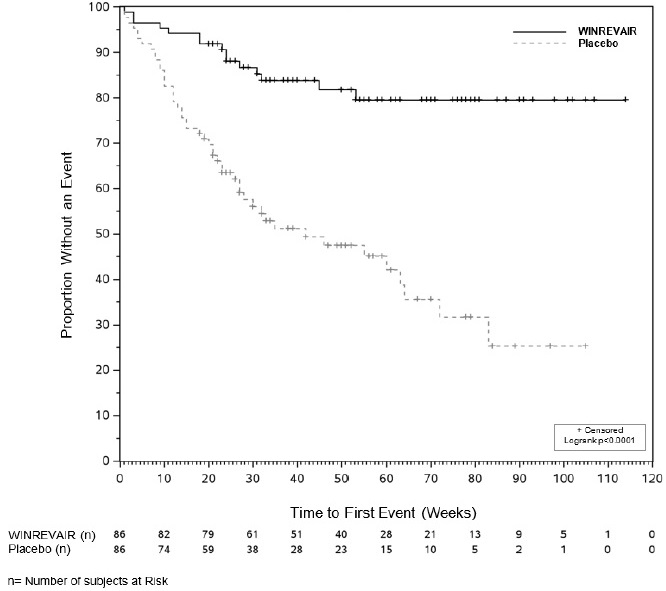
The primary efficacy endpoint was time to first event of all-cause death, lung transplantation, or PAH worsening-related hospitalization of ≥24 hours. In the WINREVAIR treatment group, the risk of a first event of all-cause death, lung transplantation, or PAH worsening-related hospitalization of ≥24 hours was 76% lower compared with the placebo group (HR: 0.24; 95% CI: 0.13, 0.43; p<0.0001) (see Table 7 and Figure 3). Fewer participants in the WINREVAIR group (15 [17%]) than in the placebo group (47 [55%]) had a primary endpoint event as of the data cutoff. Based on the primary endpoint result, the study was stopped for favorable efficacy at the interim analysis.
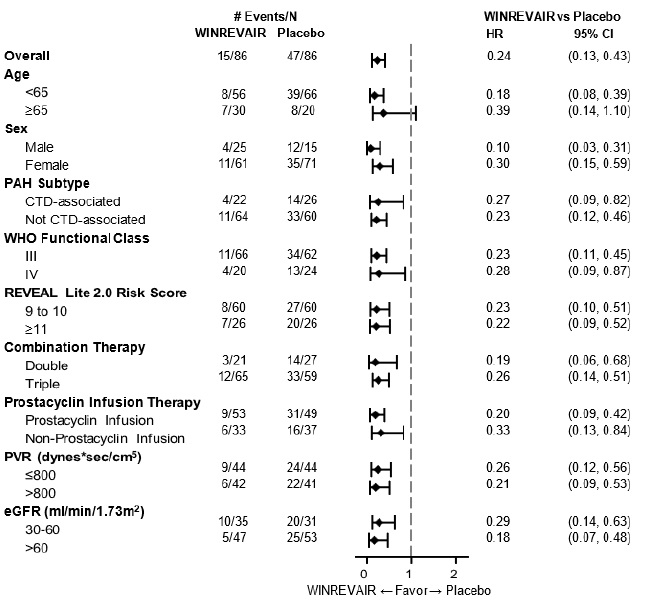
The treatment effect of WINREVAIR was consistent across the prespecified subgroups (see Figure 4).
Table 7: Primary Endpoint Results in ZENITH | WINREVAIR
(N=86)
n (%) | Placebo
(N=86)
n (%) | Hazard Ratio
(95% CI)
p-value |
|---|
| Number of participants with at least 1 primary event The primary composite endpoint analysis includes the first occurrence of an adjudicated morbidity-mortality event up to the data cutoff. All deaths up to the data cutoff are included, regardless of adjudication and regardless of whether they occurred during or post-ZENITH, except for those occurring after lung transplantation or enrollment in SOTERIA. | 15 (17.4) | 47 (54.7) | 0.24 (0.13, 0.43)
<0.0001 |
| Components of primary endpoint Shows each component of the composite primary endpoint as a standalone outcome. A participant is included in more than one row if multiple events meeting primary endpoint definition were observed. | |
| All-cause death | 7 (8.1) | 13 (15.1) |
| Lung transplantation | 1 (1.2) | 6 (7.0) |
| PAH worsening-related to hospitalization (≥24 hours) | 8 (9.3) | 43 (50.0) |
Figure 3: Time to First Event in ZENITH of All-cause Death, Lung Transplantation, or PAH Worsening-related Hospitalization of ≥ 24 Hours Kaplan-Meier Plot 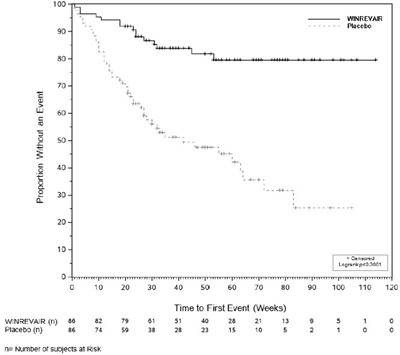 Figure 138 (Winrevair 138) |
Figure 4: Hazard Ratio for the Primary Endpoint in Subgroups in ZENITHSubgroup analyses were not displayed if the number of participants in subgroup category was less than 10% of FAS.
For participants with REVEAL Lite 2.0 risk score <9 at screening, they were grouped under “9 to 10” for the analyses. |
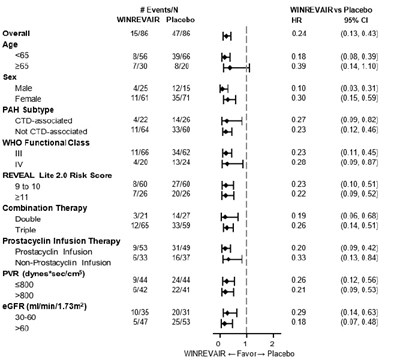 Figure 139 (Winrevair 139) |
The secondary endpoint of overall survival (OS) included all deaths up to the data cutoff, except for those occurring after lung transplantation or enrollment in a long-term follow-up study. Twenty OS events were observed (7 deaths in the WINREVAIR treatment group and 13 deaths in the placebo group). The point estimate for the OS HR favored the WINREVAIR treatment group over the placebo group.
Subsequent secondary endpoints were not eligible to be tested due to the hierarchical testing strategy.
HYPERION
The efficacy of WINREVAIR was evaluated in adults with newly diagnosed PAH (WHO FC II or III, diagnosis within 12 months of study screening) at intermediate to high risk of disease progression in the HYPERION trial (NCT04811092). HYPERION was a global, double-blind, placebo-controlled clinical trial in which 320 patients were randomized 1:1 to WINREVAIR (target dose 0.7 mg/kg) (n=160) or placebo (n=160) administered subcutaneously once every 3 weeks. HYPERION was stopped early based on the positive results from the pre-specified interim analysis of the ZENITH trial and a review of the totality of data from the WINREVAIR clinical program.
The demographic and baseline clinical characteristics were similar between the WINREVAIR and placebo groups. Participants were 73% female, had a median age of 60 years (range: 18 to 88 years), 21% were FC II and 79% were FC III. The most common PAH etiologies were idiopathic PAH (59%) and PAH associated with connective tissue diseases (CTD) (30%). The mean time since PAH diagnosis was 7.2 months (range: 0.1 to 14.5 months). Participants were on background PAH treatment, with 72% on double therapy, 28% on triple therapy, and 17% on prostacyclin infusion therapy. REVEAL Lite 2 risk scores were <6 in 21%, 6-7 in 51%, and ≥8 in 28% of participants, respectively. COMPERA 2 risk scores were low in 2%, intermediate-low in 64%, intermediate-high in 32%, high in 2%, and missing in 0.3% of participants, respectively.
The primary efficacy endpoint was time to clinical worsening (TTCW), defined as the time to death or the first confirmed morbidity event (Table 8). HYPERION was stopped early prior to reaching the pre-specified number of events for the final analysis (121 events planned, 76 events observed). In the WINREVAIR treatment group, the risk of experiencing a first clinical worsening event was 76% lower compared with the placebo group (HR: 0.24; 95% CI: 0.14, 0.41; p<0.0001) (see Table 8). The treatment effect of WINREVAIR was consistent across the prespecified subgroups: age, sex, PAH subtype (idiopathic PAH, CTD-associated PAH), double versus triple background PAH therapy, WHO FC, prostacyclin infusion versus non prostacyclin infusion therapy, PVR, eGFR, REVEAL Lite 2 score, intermediate-low versus intermediate-high COMPERA 2 risk score.
Table 8: Primary Endpoint Results in HYPERIONHYPERION was stopped early. The final analysis was performed on all available data at the time of database lock (320 randomized participants; 76 primary endpoint events), compared to the 121 events required for the pre-specified final analysis.
| WINREVAIR
(N=160)
n (%) | Placebo
(N=160)
n (%) | Hazard Ratio
(95% CI)
p-value |
|---|
Number of participants with:
at least 1 primary eventThe primary composite endpoint analysis includes the first occurrence of an adjudicated morbidity-mortality event up to the data cutoff. All deaths are included, regardless of adjudication and regardless of whether they occurred during the study or during the survival sweep conducted at the time of last patient last visit (LPLV), except for those occurring after lung transplantation or enrollment in SOTERIA. | 17 (10.6) | 59 (36.9) | 0.24 (0.14, 0.41)
<0.0001 |
| Components of primary endpoint Shows each component of the composite primary endpoint as a standalone outcome. A participant is included in more than one row if multiple events meeting primary endpoint definition were observed. | |
| All-cause death | 7 (4.4) | 6 (3.8) |
| Non-planned PAH-related hospitalization of ≥24 hours | 3 (1.9) | 14 (8.8) |
| Atrial septostomy | 0 | 0 |
| Lung transplantation | 0 | 0 |
| Deterioration in performance due to PAH Defined as a decrease in 6MWD from the average of the screening on 2 consecutive tests (which must be at least 4 hours apart) and at least 1 of the following: worsening of WHO FC, signs/symptoms of increased right heart failure; or addition/change of a background PAH therapy. | 8 (5.0) | 46 (28.8) |
The first secondary endpoint, multicomponent improvement (MCI) was measured by the proportion of participants achieving all of the following at Week 24 relative to baseline: improvement in 6MWD (increase ≥30 m), improvement in NT-proBNP (decrease in NT-proBNP ≥30% or maintenance/achievement of NT-proBNP level <300 ng/L), and improvement in WHO FC or maintenance of WHO FC II. The proportion of participants who met all three MCI criteria was significantly greater in the WINREVAIR group (29.4%) than in the placebo group (14.6%) (p=0.003).