Before you can prepare and inject WINREVAIR, you must first be trained and determined to be capable of independent administration of WINREVAIR by a healthcare provider.
- - Mixed vial of medicine
- - Items from the Bottom Tray (needle, dosing syringe for injection, and alcohol wipes).
14 Clean top of vial adapter
With a new alcohol wipe from the bottom tray, clean the top of the vial adapter.
|
15 Remove empty dosing syringe from its package
Find the empty dosing syringe in the bottom tray and remove it from its package.
You will use this dosing syringe to measure out the medicine you need (based on your prescribed dose).
| |
16 Pull air into the dosing syringe
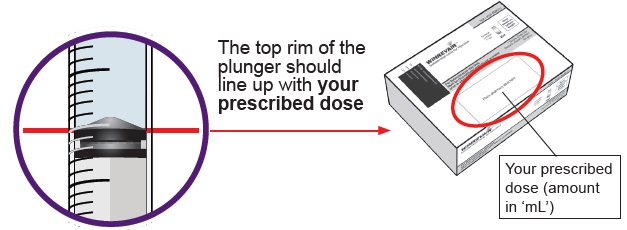
You must do this to make sure pressure in the vial is even and you get an accurate dose.Hold the dosing syringe upright and pull down the plunger to draw air into the dosing syringe. Stop when top rim of plunger is at the amount in ‘mL’ that matches your prescribed dose. Your prescribed dose is on the prescription label on your kit.
|
17 Connect dosing syringe to the vial
While holding the vial adapter, push then twist the dosing syringe onto the vial adapter until it stops.
|
18 Push air into vial, then flip vial upside down
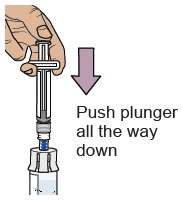
Push the plunger all the way down to transfer all the air into the vial.
Then hold the plunger in place with your thumb and flip the vial upside down.
|
19 Pull plunger back to withdraw your prescribed dose
With the vial and dosing syringe upside down, slowly pull the plunger back.
Stop when you get to the amount in ‘mL’ that matches your prescribed dose.
|
20 Check for large air bubbles and air pockets
Check to see if there are large air bubbles or an air pocket in the syringe. You will remove extra air in the next steps.
|
21 Remove air bubbles and air pockets from syringe
If you see large air bubbles or an air pocket, tap the side of the dosing syringe to move the air to the top. Slowly push the plunger up to remove extra air.
|
22 Compare amount to prescribed dose
After removing all extra air, compare the amount in your syringe to your prescribed dose.
If you do not have your prescribed dose in your syringe, slowly pull the plunger back again to withdraw more medicine from the vial.
Repeat Steps 19 to 21 until you get your prescribed dose and no large bubbles or air pockets remain. | |
23 Confirm your prescribed dose
Before you continue, check to make sure you have the prescribed dose in the dosing syringe.
If the amount does not match your prescribed dose, repeat Steps 19 to 22. |
24 Remove the dosing syringe from the vial and set dosing syringe aside
| Hold the plunger in place with one hand. With the other hand, hold the vial adapter and unscrew the filled dosing syringe from the vial. Throw away the used vial into the sharps container. |
| Place the filled dosing syringe on a clean, flat surface.
Do not touch the dosing syringe tip or let it to touch any surfaces. |
25 Attach injection needle
Find the needle in the bottom tray and open its package. |
With the needle still in the package, grip the base of the needle and twist on the dosing syringe until it stops. Remove the needle package.
|
Move the safety shield away from the needle and toward the syringe. Place the dosing syringe on a clean, flat surface.
Do not uncap the needle. |
26 Choose and clean your injection site
| Select an injection site on your stomach (abdomen) or your upper thigh. If injecting on your stomach, avoid a 2-inch area around your belly button.
Choose a different site every time you inject.
Do not inject into skin that is damaged, sore, tender, bruised, or has red patches.
Do not inject through clothes. |
| Clean the injection site with a new alcohol wipe.
Do not touch the cleaned injection site again. |
Now, you are ready to inject the medicine.
Inject your medicine
27 Inject your medicine
Pull the cap straight off the needle.
Throw away the cap.
Do not touch the plunger until ready to inject so you do not lose any medicine.
|
Gently pinch and hold a fold of skin where you will inject. Insert the needle with a dartlike motion at a 45° to 90° angle.
|
Push the plunger with slow, steady pressure all the way down until the dosing syringe is empty. Confirm all the medicine has been injected. You can let go of the skin fold now.
|
| Keep your fingers away from the needle at all times. |
While keeping the plunger pushed in, remove the needle from your skin at the same angle you inserted it.
|
To reapply the safety shield, push the shield against a flat surface until you hear a “click” and see that the needle is covered.
|
Throw away the dosing syringe and used items in a sharps disposal container.
Do not remove the needle from the dosing syringe. |
How to throw away WINREVAIR- Throw away any used vials (including any remaining WINREVAIR liquid), needle, vial and needle caps, and used syringes in an FDA-cleared sharps disposal container.
- Do not throw away the WINREVAIR vials, syringes, or needle in your household trash.
- Do not reuse any of the supplies. WINREVAIR is for one time use only.
- Important: Always keep the sharps disposal container out of reach of children and pets.
| |
If you do not have an FDA-cleared sharps disposal container, you may use a household container that is: - made of a heavy-duty plastic,
- can be closed with a tight-fitting, puncture-resistant lid, without sharp objects being able to come out,
- upright and stable during use,
- leak resistant, and
- properly labeled to warn of hazardous waste inside the container.
| When your sharps disposal container is almost full, you will need to follow your community guidelines for the right way to throw away your sharps disposal container. There may be state or local laws about how you should throw away used needles, dosing syringes, and prefilled syringes.
For more information about safe sharps disposal, and for specific information about sharps disposal in the state that you live in, go to the FDA’s website at: http://www.fda.gov/safesharpsdisposal.
Do not recycle your used sharps container. |
Frequently asked questions
What should I do if I am bleeding at the injection site?
Place a cotton ball or bandage on your skin right away and apply a small amount of pressure. If the bleeding does not stop, call your healthcare provider right away.
Where can I find my prescribed dose?
Your prescribed dose in ‘mL’ is on your prescription label on your kit. Contact your healthcare provider if you cannot find your prescribed dose.
What should I do if I accidentally get some medicine on my skin or my work surface?
Wash the area thoroughly with soap and water right away.
What should I do if I am not sure I administered my prescribed dose correctly?
Call your pharmacy or healthcare provider.
What should I do if the plunger of my dosing syringe moves automatically when I try to withdraw medicine from the vial?
Do not worry if your plunger moves slightly on its own when you are filling your dosing syringe with medicine.
With one hand, hold the plunger in place to stop the plunger from moving. With the other hand, unscrew the vial from the dosing syringe.
After unscrewed, it is safe to let go of the plunger.
You can avoid this automatic plunger movement by pushing air into the vial before filling your dosing syringe with medicine. Refer to Steps 16 to 23 for detailed instructions.
What should I do if my kit parts are damaged or are discolored, cloudy, or have particles?
Do not use your kit. Call your pharmacy to get a new kit.
What should I do if my medicine does not turn clear after mixing and swirling?
Do not use the medicine if you have swirled the medicine vial for about 2 minutes and let it stand for another 3 minutes but your medicine vial remains cloudy or has clumps, powder, or foreign particles. Call your pharmacy to get a new kit.
What should I do if the sterile water will not come out of the prefilled syringe?
Check that the vial adapter is attached to the vial securely. If not, hold the vial and press the vial adapter down firmly to make sure the vial adapter punctures the vial rubber stopper.
What should I do if I dropped my kit components?
Do not use if any items are damaged. If you are unsure, call your pharmacy to get a new kit.
Can I use my kit that has been left out of the refrigerator?
Store the injection kit in the refrigerator until ready to use it. If the unused injection kit has been out of the refrigerator up to 77°F (25°C) for more than 24 hours, please contact your pharmacy or healthcare provider.
Do I need to use mixed medicine right away?
We recommend you inject the medicine right away after mixing but no later than 4 hours after mixing. If it has been more than 4 hours, throw away unused mixed medicine. If you have questions, please contact your pharmacy or healthcare provider.
How can I get help preparing and giving my injection?
If you have questions about how to give WINREVAIR the correct way or need more information, you can call your pharmacy or healthcare provider.
Call your doctor for advice about side effects.
To report side effects or product quality complaints, please call Merck Sharp & Dohme LLC at 1-800-672-6372. You can also report side effects to FDA at 1-800-FDA-1088.
Manufactured by:
Merck Sharp & Dohme LLC
Rahway, NJ 07065, USA
U.S. License Number 0002
Copyright © 2024 Merck & Co., Inc., Rahway, NJ, USA, and its affiliates.
All rights reserved.
usifu1-mk7962-i-2403r000
This Instructions for Use has been approved by the U.S. Food and Drug Administration
Approved: March 2024
Important: Read this booklet first | Important |
INSTRUCTIONS FOR USE
|
Mix
|
WINREVAIR™ (WIN-reh-vair)
(sotatercept-csrk)
for injection, for subcutaneous use
How to use your WINREVAIR injection kit
|
Combine
|
For package containing 2 vials | Withdraw |
For subcutaneous injection only (inject directly under the skin)
|
Inject
|
In this booklet:
Important information for patients or caregivers
Before you start
Get to know the parts of your kit
Important information you need to know before injecting WINREVAIR
Storing your injection kit
Get started
Mix powdered medicine into liquid form
Combine medicine from both vialsWithdraw your prescribed dose Inject your medicineHow to throw away WINREVAIR
Frequently asked questions
| Important information for patients or caregivers |
Before you prepare and inject WINREVAIR, you must be:
- trained by a healthcare provider following this Instructions for Use booklet step-by-step, and
- capable of independent administration of WINREVAIR as determined by a healthcare provider
Before using WINREVAIR, make sure you are trained to do the following correctly:
- Reconstitute (mix) the medicine
- Combine medicine from both vials
- Measure the correct amount of medicine according to your prescription
- Select and prepare a proper injection site
- Inject the medicine subcutaneously
Before you start: |
| Read this booklet
Read this Instructions for Use from start to finish before using WINREVAIR and each time you get a refill. There may be new information. |
| Start with your healthcare provider
Do not use WINREVAIR until your healthcare provider has shown you or your caregiver the right way to prepare and inject it. Your healthcare provider should show you how to inject WINREVAIR before you use it for the first time. |
| Questions?
If you have questions about how to give WINREVAIR the right way or need more information, call your pharmacy or healthcare provider.
For general product information visit www.WINREVAIR.com or call Merck Sharp & Dohme LLC at 1-800-672-6372. |
How to use WINREVAIR
Before injecting WINREVAIR, make sure you read the full instructions in this booklet to get your prescribed dose.
Mix medicine in vial 1
Mix medicine in vial 2
Combine medicine mixture from vial 1 to vial 2Withdraw your prescribed dose from vial 2 Then, inject your medicineProceed to the next pages for step-by-step directions.
Get to know the parts of your kit
Top Tray | Use to mix the medicine |
| 2 Vials of WINREVAIR medicine powder |
2 Prefilled syringes with sterile water for injection to mix medicine powder into liquid form |
2 Vial adapters to connect the vial and syringe |
Bottom Tray | Use to inject the medicine |
|
Needle for injection
|
Empty dosing syringe to measure, withdraw, and inject your medicine
|
Important information you need to know before injecting WINREVAIR
- You must mix WINREVAIR before using it. Make sure the medicine powder in the vial is completely dissolved before you inject.
- Check your prescribed dose (amount in ‘mL’) each time you use WINREVAIR. Your prescribed dose may change. Your prescribed dose is on the prescription label on your kit.
- Use only the supplies that are in the kit to prepare your prescribed dose.
- Do not open the package or mix the medicine until you are ready to use it.
- Do not reuse any of the supplies. After your injection, throw away the used vials with any remaining WINREVAIR medicine, needle, caps, and syringes in a sharps container. See pages 38-39 for more information.
| |
Storing your injection kit |
| Store WINREVAIR injection kit in the refrigerator at 36°F to 46°F (2°C to 8°C). Do not freeze. |
| Store in the original carton to protect from light. |
| Keep injection kit out of the reach of children and pets. |
Get started
| Before you can prepare and inject WINREVAIR, you must first be trained and determined to be capable of independent administration of WINREVAIR by a healthcare provider. |
1 Check WINREVAIR injection kit and expiration date
| Remove the WINREVAIR injection kit from the refrigerator. |
| Check the expiration date and look for any signs of damage on the kit or on the supplies.
If expired or damaged, do not use.
Call your pharmacy to get a new kit. |
| Check that you have the medicine that your healthcare provider prescribed. |
2 Let your kit come to room temperature, gather supplies, and wash your hands
Wait 15 minutes to allow your kit to warm to room temperature.
Cold medicine is more painful to inject.
| Along with your kit, gather these items and find a clean, flat surface where you will prepare and inject your dose. Sharps disposal containerGauze, cotton ball, or bandage | Wash your hands with soap and water.
|
Mix powdered medicine into liquid form
Start with the Top Tray
3 Remove medicine vial 1, prefilled syringe with sterile water for injection 1, alcohol wipes, and vial adapter 1 from the kit.
4a Check medicine vial
Check the vial label to confirm the medicine is not expired. Inspect the medicine powder.
It should be white to off-white. Do not use if expired, damaged, discolored, or you can see particles in it. |
4b Remove plastic cap and clean vial
Flip off the plastic cap and clean the rubber stopper on top of the vial with an alcohol wipe. Do not use if vial cap is missing. Do not touch the cleaned rubber stopper.Set vial aside on a clean, flat surface. |
5a Align vial adapter to vial
Peel open the vial adapter package and remove vial adapter from its package.
|
Hold the blue neck of the vial adapter and align the vial adapter on top of the vial.
Do not touch the inside of the vial adapter. |
5b Attach vial adapter to vial
Hold the vial with one hand. Push down firmly so it snaps in place (you may feel some resistance). |
5c Clean vial adapter
Clean the top of the vial adapter with an alcohol wipe. |
6 Check prefilled syringe
Confirm the sterile water inside the prefilled syringe is clear and the product is not expired or leaking.
Do not use if you see any clumps, particles, discoloration, or product is expired. You might see air bubbles. This is okay. |
7 Snap off prefilled syringe white cap
Snap off the prefilled syringe cap along the perforation.
|
8 Connect prefilled syringe to vial adapter
Pick up the vial with the vial adapter attached.
Align the prefilled syringe tip on the blue circle of the vial adapter.
Push then twist the prefilled syringe onto the vial adapter until you cannot turn further. While twisting, be sure to hold onto the vial adapter.
|
9 Transfer sterile water from prefilled syringe to vial
| |
Slowly push the plunger all the way down to transfer all the sterile
water into the vial (the plunger will move up; this is normal). | Leave the prefilled syringe attached to the vial and set aside on a flat surface. |
10 Prepare vial 2, prefilled syringe 2, and vial adapter 2
| Stop and check to make sure you have both vial 1 and vial 2 prepared. |
| You need both vials prepared before you can continue to Step 11. |
11 Swirl to mix medicine
Do not shake the vials.
Hold 1 prefilled syringe in each hand and gently swirl both vials in a circular motion until the powder is fully dissolved. This may take up to 2 minutes. |
When the medicine is mixed well, it should be clear. If not, repeat this step until it is clear. |
For each vial, press the plunger down to make sure all the liquid is in the vial (the plunger will move up; this is normal). |
12 Wait for large bubbles in the vials to go away
It is okay to have slight foam around edges of the vials | Set both vials aside for large bubbles to go away.
This may take up to 3 minutes.
|
13 Prepare vials by removing extra air
| Start with either vial. With the vial standing upright, gently pull the plunger upwards to the top of the barrel. Do not pull the plunger out of the syringe. Note: Pulling extra air out of the vials will help to make sure you have the right dose. |
|
14 Remove prefilled syringes from vials
Hold the vial adapters and unscrew both prefilled syringes from the vials.
Throw away both prefilled syringes in the sharps container.
|
You should have 2 vials of medicine prepared and ready to be combined in the next steps. |
Combine medicine from both vials
For the next steps, you will need:
- - Mixed vial 1 and vial 2
- - Items from the Bottom Tray (needle, dosing syringe for injection, and alcohol wipes).
15 Clean top of both vial adapters
With 2 alcohol wipes from the bottom tray, clean the top of the vial adapters. Use a new wipe for each vial adapter.
|
16 Remove empty dosing syringe from its package
Find the empty dosing syringe in the bottom tray and remove it from its package.
You will use this dosing syringe to combine medicine from both vials and measure out the medicine you need (based on your prescribed dose).
| |
17 Pull air into the dosing syringe
You must do this to make sure pressure in the vial is even and you get an accurate dose.Hold the dosing syringe upright and pull down the plunger to draw in 1.5 mL of air.
|
18 Connect dosing syringe to one of the vials
While holding the vial adapter, push then twist the dosing syringe onto the vial adapter until it stops.
|
19 Push air into vial, then flip upside down
Push the plunger all the way down to transfer all the air into the vial.
Then hold the plunger in place with your thumb and flip the vial upside down.
|
20 Withdraw all the medicine from 1st vial
With the vial and dosing syringe upside down, slowly pull the plunger back. Stop at 1.5 mL.
This will make sure all the medicine from the vial is in the dosing syringe.
|
21 Remove 1st vial from the dosing syringe
Hold the vial adapter and unscrew the filled dosing syringe from the vial.
Throw away the empty vial into the sharps container.
|
22 Connect the dosing syringe to the 2nd vial
While holding the vial adapter of the 2nd vial, push then twist the partially filled dosing syringe onto the vial adapter until it stops.
|
23 Push all the medicine into the 2nd vial, then flip vial upside down
Slowly push the plunger all the way down to transfer all of the medicine into the vial. This combines the medicine from both vials.
Hold the plunger in place with your thumb and flip the vial upside down.
|
Withdraw your prescribed dose
24 Pull plunger back to withdraw your prescribed dose
With the vial and dosing syringe upside down, slowly pull the plunger back.
Stop when you get to the amount in ‘mL’ that matches your prescribed dose.
|
25 Check for large bubbles and air pockets
Check to see if there are large air bubbles or an air pocket in the syringe. You will remove extra air in the next steps.
|
26 Remove air bubbles and air pockets from syringe
If you see large air bubbles or an air pocket, tap the side of the dosing syringe to move the air to the top.
Slowly push the plunger up to remove extra air.
|
27 Compare amount to prescribed dose
After removing all extra air, compare the amount in your syringe to your prescribed dose.
If you do not have your prescribed dose in your syringe, slowly pull the plunger back again to withdraw more medicine from the vial.
Repeat Steps 24 to 26 until you get your prescribed dose and no large bubbles or air pockets are visible. | |
28 Confirm your prescribed dose
Before you continue, check to make sure you have the prescribed dose in the dosing syringe.
If the amount does not match your prescribed dose, repeat Steps 24 to 27. |
29 Remove the dosing syringe from the vial and set dosing syringe aside
| Hold the plunger in place with one hand. With the other hand, hold the vial adapter and unscrew the filled dosing syringe from the vial.
Throw away the used vial into the sharps container. |
| Place the filled dosing syringe on a clean, flat surface.
Do not touch the dosing syringe tip or let it to touch any surfaces. |
30 Attach injection needle to dosing syringe
Find the needle in the bottom tray and open its package. |
With the needle still in the package, grip the base of the needle and twist on the dosing syringe until it stops. Remove the needle package. |
Move the safety shield away from the needle and toward the syringe. Place the dosing syringe on a clean, flat surface.
Do not uncap the needle. |
31 Choose and clean your injection site
| Select an injection site on your stomach (abdomen) or your upper thigh. If injecting on your stomach, avoid a 2-inch area around your belly button.
Choose a different site every time you inject.
Do not inject into skin that is damaged, sore, tender, bruised, or has red patches.
Do not inject through clothes. |
| Clean the injection site with a new alcohol wipe.
Do not touch the cleaned injection site again. |
Now, you are ready to inject the medicine.
Inject your medicine
32 Inject your medicine
Pull the cap straight off the needle.
Throw away the cap.
Do not touch the plunger until ready to inject so you do not lose any medicine.
|
Gently pinch and hold a fold of skin where you will inject. Insert the needle with a dartlike motion at a 45° to 90° angle. |
Push the plunger with slow, steady pressure all the way down until the dosing syringe is empty.
Confirm all the medicine has been injected.
You can let go of the skin fold now. |
| Keep your fingers away from the needle at all times. |
While keeping the plunger pushed in, remove the needle from your skin at the same angle you inserted it. |
To reapply the safety shield, push the shield against a flat surface until you hear a “click” and see that the needle is covered. |
Throw away the dosing syringe and used items in a sharps container.
Do not remove the needle from the dosing syringe. |
How to throw away WINREVAIR- Throw away any used vials (including any remaining WINREVAIR liquid), needle, vial and needle caps, and used syringes in an FDA-cleared sharps disposal container.
- Do not throw away the WINREVAIR vials, syringes, or needle in your household trash.
- Do not reuse any of the supplies.
WINREVAIR is for one time use only. - Important: Always keep the sharps disposal container out of reach of children and pets.
| |
If you do not have an FDA-cleared sharps disposal container, you may use a household container that is: - made of a heavy-duty plastic,
- can be closed with a tight-fitting, puncture-resistant lid, without sharp objects being able to come out,
- upright and stable during use,
- leak resistant, and
- properly labeled to warn of hazardous waste inside the container.
| When your sharps disposal container is almost full, you will need to follow your community guidelines for the right way to throw away your sharps container. There may be state or local laws about how you should throw away used needles, dosing syringes, and prefilled syringes. For more information about safe sharps disposal, and for specific information about sharps disposal in the state that you live in, go to the FDA’s website at: http://www.fda.gov/safesharpsdisposal.
Do not recycle your used sharps container. |
Frequently asked questions
What should I do if I am bleeding at the injection site?
Place a cotton ball or bandage on your skin right away and apply a small amount of pressure. If the bleeding does not stop, call your healthcare provider right away.
Where can I find my prescribed dose?
Your prescribed dose in ‘mL’ is on your prescription label on your kit. Contact your healthcare provider if you cannot find your prescribed dose.
What should I do if I accidentally get some medicine on my skin or my work surface?
Wash the area thoroughly with soap and water right away.
What should I do if I am not sure I administered my prescribed dose correctly?
Call your pharmacy or healthcare provider.
What should I do if the plunger of my dosing syringe moves automatically when I try to withdraw medicine from the vial?
Do not worry if your plunger moves slightly on its own when you are filling your dosing syringe with medicine.
With one hand, hold the plunger in place to stop the plunger from moving. With the other hand, unscrew the vial from the dosing syringe.
After unscrewed, it is safe to let go of the plunger.
You can avoid this automatic plunger movement by pushing air into the vial before filling your dosing syringe with medicine. Refer to Steps 17 to 28 for detailed instructions.
What should I do if my kit parts are damaged or are discolored, cloudy, or have particles?
Do not use your kit. Call your pharmacy to get a new kit.
What should I do if my medicine does not turn clear after mixing and swirling?
Do not use the medicine if you have swirled the medicine vial for about 2 minutes and let it stand for another 3 minutes but your medicine vial remains cloudy or has clumps, powder, or foreign particles. Call your pharmacy to get a new kit.
What should I do if the sterile water will not come out of the prefilled syringe?
Check that the vial adapter is attached to the vial securely. If not, hold the vial and press the vial adapter down firmly to make sure the vial adapter punctures the vial rubber stopper.
What should I do if I dropped my kit components?
Do not use if any items are damaged. If you are unsure, call your pharmacy to get a new kit.
Can I use my kit that has been left out of the refrigerator?
Store the injection kit in the refrigerator until ready to use it. If the unused injection kit has been out of the refrigerator up to 77°F (25°C) for more than 24 hours, please contact your pharmacy or healthcare provider.
Do I need to use mixed medicine right away?
We recommend you inject the medicine right away after mixing but no later than 4 hours after mixing. If it has been more than 4 hours, throw away unused mixed medicine. If you have questions, please contact your pharmacy or healthcare provider.
How can I get help preparing and giving my injection?
If you have questions about how to give WINREVAIR the correct way or need more information, you can call your pharmacy or healthcare provider.
Call your doctor for advice about side effects.
To report side effects or product quality complaints, please call Merck Sharp & Dohme LLC at 1-800-672-6372. You can also report side effects to FDA at 1-800-FDA-1088.
Manufactured by:
Merck Sharp & Dohme LLC
Rahway, NJ 07065, USA
U.S. License Number 0002
Copyright © 2024 Merck & Co., Inc., Rahway, NJ, USA, and its affiliates.
All rights reserved.
usifu2-mk7962-i-2403r000
This Instructions for Use has been approved by the U.S. Food and Drug Administration
Approved: March 2024