1 Indications And Usage
VUITY is indicated for the treatment of presbyopia in adults.
The following Structured Product Label (SPL) was submitted to the FDA by Abbvie Inc. for the product Vuity (NDC 0074-7098). This document serves as the official prescribing information, containing essential scientific data and clinical materials required for healthcare providers and patients.
This specific version of the label includes detailed information regarding 1 indications and usage, 2 dosage and administration, 3 dosage forms and strengths, 4 contraindications, 5.1 poor illumination, 5.2 risk of retinal detachment, 5.3 iritis, 5.4 use with contact lenses, and other regulatory disclosures. Use the navigation below to review specific sections of the FDA submission.
VUITY is indicated for the treatment of presbyopia in adults.
The recommended dosage of VUITY is one drop in each eye once daily.
If more than one topical ophthalmic product is being used, the products should be administered at least 5 minutes apart.
VUITY (pilocarpine hydrochloride ophthalmic solution) is provided as a 1.25% solution (12.5 mg/mL).
VUITY is contraindicated in patients with known hypersensitivity to the active ingredient or to any of the excipients.
Patients should be advised to exercise caution in night driving and other hazardous occupations in poor illumination. In addition, miotics may cause accommodative spasm. Patients should be advised not to drive or use machinery if vision is not clear.
Rare cases of retinal detachment have been reported with other miotics when used in susceptible individuals and those with pre-existing retinal disease. Patients should be advised to seek immediate medical care with sudden onset of vision loss.
VUITY is not recommended to be used when iritis is present because adhesions (synechiae) may form between the iris and the lens.
Contact lens wearers should be advised to remove their lenses prior to the instillation of VUITY and to wait 10 minutes after dosing before reinserting their contact lenses.
To prevent eye injury or contamination, care should be taken to avoid touching the dispensing bottle to the eye or to any other surface.
The following clinically significant adverse reactions are described elsewhere in labeling:
Because clinical trials are conducted under widely varying conditions, adverse reaction rates observed in the clinical trials of a drug cannot be directly compared to rates in the clinical trials of another drug and may not reflect the rates observed in practice.
VUITY was evaluated in 375 patients with presbyopia in two randomized, double-masked, vehicle-controlled studies (GEMINI 1 and GEMINI 2) of 30 days duration. The most common adverse reactions reported in >5% of patients were headache and conjunctival hyperemia. Ocular adverse reactions reported in 1-5% of patients were blurred vision, eye pain, visual impairment, eye irritation, and increased lacrimation.
Risk Summary
There are no adequate and well-controlled studies of VUITY administration in pregnant women to inform a drug-associated risk. Oral administration of pilocarpine to pregnant rats throughout organogenesis and lactation did not produce adverse effects at clinically relevant doses.
Data
Human Data
No adequate and well-controlled trials of VUITY have been conducted in pregnant women. In a retrospective case series of 15 women with glaucoma, 4 patients used ophthalmic pilocarpine either pre-pregnancy, during pregnancy or postpartum. There were no adverse effects observed in patients or in their infants.
Animal Data
In embryofetal development studies, oral administration of pilocarpine to pregnant rats throughout organogenesis produced maternal toxicity, skeletal anomalies and reduction in fetal body weight at 90 mg/kg/day (approximately 970-fold higher than the maximum recommended human ophthalmic dose [MRHOD] of 0.015 mg/kg/day, on a mg/m2 basis).
In a peri-/postnatal study in rats, oral administration of pilocarpine during late gestation through lactation increased stillbirths at a dose of 36 mg/kg/day (approximately 390-fold higher than the MRHOD). Decreased neonatal survival and reduced mean body weight of pups were observed at ≥18 mg/kg/day (approximately 200 times the recommended human daily dose of VUITY).
Risk Summary
There is no information regarding the presence of pilocarpine in human milk, the effects on the breastfed infants, or the effects on milk production to inform risk of VUITY to an infant during lactation.
Pilocarpine and/or its metabolites are excreted in the milk of lactating rats. Systemic levels of pilocarpine following topical ocular administration are low [see Clinical Pharmacology (12.3)], and it is not known whether measurable levels of pilocarpine would be present in maternal milk following topical ocular administration.
The developmental and health benefits of breastfeeding should be considered along with the mother’s clinical need for VUITY and any potential adverse effects on the breastfed child from VUITY.
Data
Animal Data
Following a single oral administration of 14C-pilocarpine to lactating rats, the radioactivity concentrations in milk were similar to those in plasma.
Presbyopia does not occur in the pediatric population.
Clinical studies of VUITY did not include subjects aged 65 and over to determine whether they respond differently from younger subjects. Other reported clinical experience with ophthalmic pilocarpine solutions have not identified overall differences in safety between elderly and younger patients.
Systemic toxicity following topical ocular administration of pilocarpine is rare, but occasionally patients who are sensitive may develop sweating and gastrointestinal overactivity. Accidental ingestion can produce sweating, salivation, nausea, tremors and slowing of the pulse and a decrease in blood pressure. In moderate overdosage, spontaneous recovery is to be expected and is aided by intravenous fluids to compensate for dehydration. For patients demonstrating severe poisoning, atropine, the pharmacologic antagonist to pilocarpine, should be used.
VUITY (pilocarpine hydrochloride ophthalmic solution) 1.25% is a cholinergic muscarinic receptor agonist prepared as an isotonic, colorless, sterile ophthalmic solution containing 1.25% of pilocarpine hydrochloride. The chemical name for pilocarpine hydrochloride is (3S,4R)-3-ethyl-4-[(1-methyl-1H-imidazol-5-yl)methyl]oxolan-2-one hydrochloride. Its molecular weight is 244.72 and its molecular formula is C11H16N2O2 · HCl. Its structural formula is:
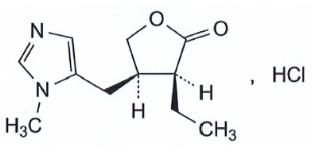
Structural Formula (Vuity 01)
Each mL of VUITY contains pilocarpine hydrochloride 1.25% (12.5 mg) as the active ingredient, equivalent to 1.06% (10.6 mg) pilocarpine free-base. Preservative is: benzalkonium chloride 0.0075%. Inactive ingredients in the ophthalmic solution are: boric acid, sodium citrate dihydrate, sodium chloride, purified water, and may also include hydrochloric acid and/or sodium hydroxide for pH adjustment to between 3.5 and 5.5, if necessary.
Pilocarpine hydrochloride is a cholinergic muscarinic agonist which activates muscarinic receptors located at smooth muscles such as the iris sphincter muscle and ciliary muscle. VUITY contracts the iris sphincter muscle, constricting the pupil to improve near and intermediate visual acuity while maintaining some pupillary response to light. VUITY also contracts the ciliary muscle and may shift the eye to a more myopic state.
Systemic exposure to pilocarpine was evaluated in 22 participants with presbyopia who were administered 1 drop of VUITY in each eye once daily for 30 days. The mean Cmax and AUC0-t,ss values on Day 30 were 1.95 ng/mL and 4.14 ng·hr/mL, respectively. The median Tmax value on Day 30 was 0.3 hours postdose with a range from 0.2 to 0.5 hours postdose.
Carcinogenesis
Pilocarpine did not induce tumors in mice at any dosage level studied (up to 30 mg/kg/day; approximately 160-times the MRHOD). In rats, an oral dose of 18 mg/kg/day (approximately 200 times the MRHOD), resulted in a statistically significant increase in the incidence of benign pheochromocytomas in both male and female rats, and a statistically significant increase in the incidence of hepatocellular adenomas in female rats.
Mutagenesis
Pilocarpine did not show any potential to cause genetic toxicity in a series of studies that included: 1) bacterial assays (Salmonella and E. coli) for reverse gene mutations; 2) an in vitro chromosome aberration assay in a Chinese hamster ovary cell line; 3) an in vivo chromosome aberration assay (micronucleus test) in mice; and 4) a primary DNA damage assay (unscheduled DNA synthesis) in rat hepatocyte primary cultures.
Impairment of Fertility
Pilocarpine oral administration to male and female rats at a dosage of 18 mg/kg/day (200 times the recommended human daily dose) resulted in impaired reproductive function, including reduced fertility, decreased sperm motility, and morphologic evidence of abnormal sperm. It is unclear whether the reduction in fertility was due to effects on males, females, or both. In dogs, exposure to pilocarpine at a dosage of 3 mg/kg/day for 6 months resulted in evidence of impaired spermatogenesis (approximately 110 times the recommended human daily dose).
The efficacy of VUITY for the treatment of presbyopia was demonstrated in two 30‐Day Phase 3, randomized, double‐masked, vehicle‐controlled studies, namely GEMINI 1 (NCT03804268) and GEMINI 2 (NCT03857542). A total of 750 participants aged 40 to 55 years old with presbyopia were randomized (375 to VUITY group) in two studies and participants were instructed to administer one drop of VUITY or vehicle once daily in each eye.
In both studies, the proportion of participants gaining 3 lines or more in mesopic, high contrast, binocular distance corrected near visual acuity (DCNVA), without losing more than 1 line (5 letters) of corrected distance visual acuity (CDVA) with the same refractive correction was statistically significantly greater in the VUITY group compared to the vehicle group at Day 30, Hour 3 (see Table 1).
| GEMINI 1 | GEMINI 2 | |||||
| VUITY N=163 | Vehicle N=160 | p-value | VUITY N=212 | Vehicle N=215 | p-value | |
| Proportion of participants gaining 3-lines or more in mesopic DCNVA, without losing more than 1 line (5 letters) of CDVA at Day 30, Hour 3 | 31% | 8% | p<0.01 | 26% | 11% | p<0.01 |
Figures 1 and 2 present the proportion of participants who gained 3-lines or more in mesopic DCNVA at Day 30.
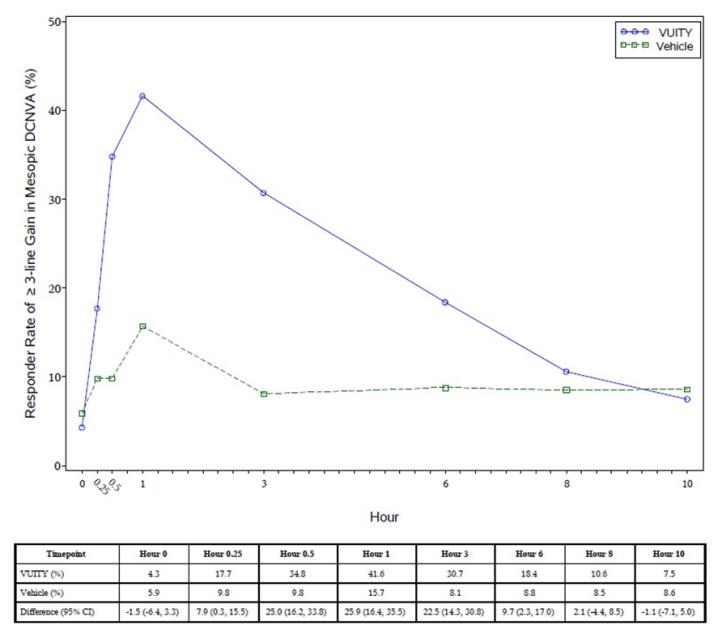
Chart, Line Chartdescription Automatically Generated (Vuity 02)
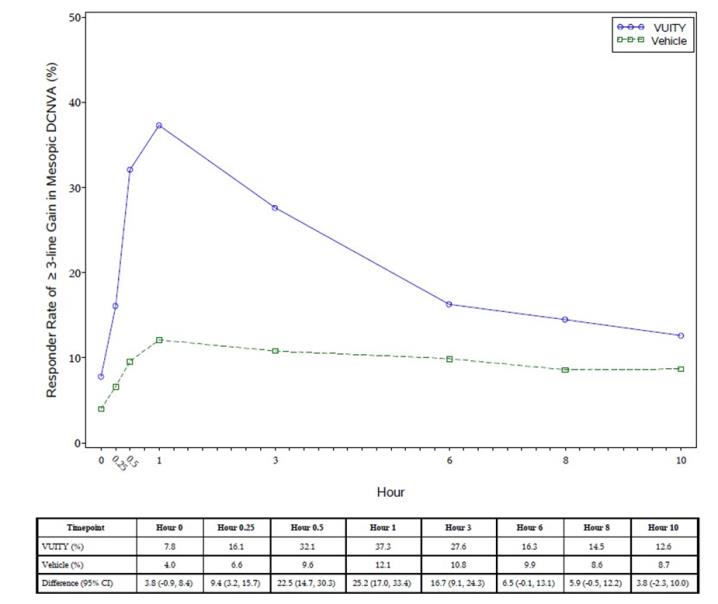
Chart, Line Chartdescription Automatically Generated (Vuity 03)
VUITY is supplied as a sterile ophthalmic solution in colorless low density polyethylene (LDPE) ophthalmic dispenser bottles and tips, with dark green high impact polystyrene caps as follows:
| 2.5 mL fill in 5 mL bottle (Box containing 1 bottle) | NDC 0074-7098-01 |
| 2.5 mL fill in 5 mL bottle (Box containing 3 bottles) | NDC 0074-7098-03 |
| 2.5 mL fill in 5 mL bottle (Carton) | NDC 0074-7098-04 |
Storage
Store at 15°C to 25°C (59°F to 77°F). After opening, VUITY can be used until the expiration date on the bottle.
Night Driving
Caution is advised with night driving and when hazardous activities are undertaken in poor illumination. [see Warnings and Precautions (5.1)]
Accommodative Spasm
Temporary problems when changing focus between near objects and distant objects may occur. Advise patients not to drive or use machinery if vision is not clear. [see Warnings and Precautions (5.1)]
When to Seek Physician Advice
Advise patients to seek immediate medical care with sudden onset of vision loss. [see Warnings and Precautions (5.2)]
Contact Lens Wear
Contact lens should be removed prior to the instillation of VUITY. Wait 10 minutes after dosing before reinserting contact lenses. [see Warnings and Precautions (5.4)]
Avoiding Contamination of the Product
Do not touch dropper tip to any surface, as this may contaminate the contents. [see Warnings and Precautions (5.5)]
Concomitant Topical Ocular Therapy
If more than one topical ophthalmic medication is being used, the medicines must be administered at least 5 minutes apart.

Allergan (Vuity 04)
Distributed by: Allergan, an AbbVie Company
Manufactured for:
AbbVie Inc.
North Chicago, IL 60064 USA
Allergan is an affiliate of AbbVie Inc.
© 2021 Allergan, an AbbVie Company. North Chicago, IL, 60064, USA
Patented.
v1.0USPI7098
NDC 0074-7098-01
Vuity™
(pilocarpine HCI ophthalmic solution) 1.25%
Contains one 2.5 mL bottle
Rx Only
Sterile
For topical application in the eye
1 x 2.5 mL
Allergan™
An AbbVie company

Principal Display Panelndc 0074-7098-01vuity™ (pilocarpine Hci Ophthalmic Solution) 1.25%contains One 2.5 mL Bottlerx Onlysterilefor Topical Application In The Eye1 X 2.5 mLallergan™an Abbvie Company (Vuity 05)
NDC 0074-7098-03
Vuity™
(pilocarpine HCI ophthalmic solution) 1.25%
Contains one 2.5 mL bottle
Rx Only
Sterile
For topical application in the eye
3 x 2.5 mL
Allergan™
An AbbVie company
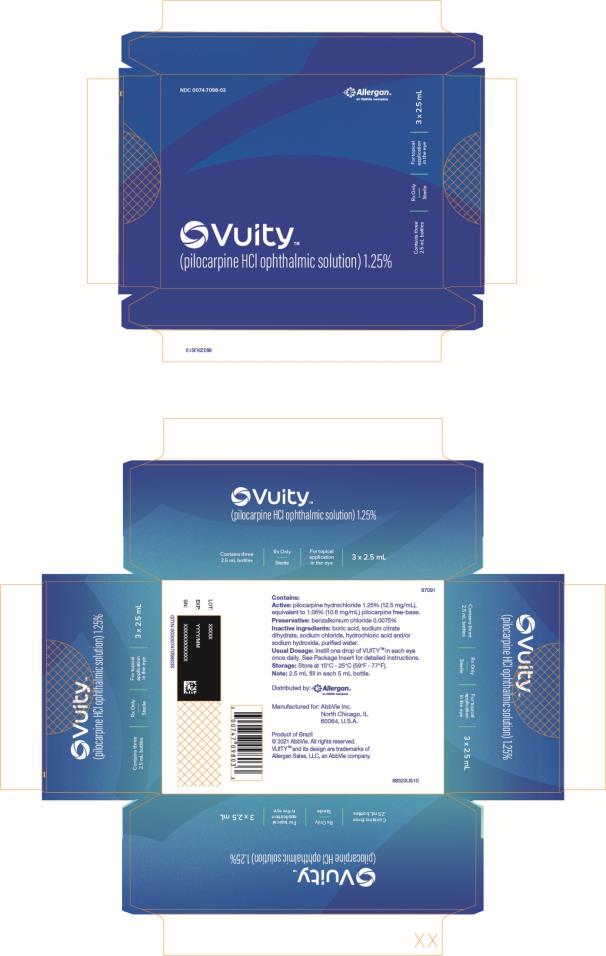
Principal Display Panelinsert Text Ndc 0074-7098-03vuity™ (pilocarpine Hci Ophthalmic Solution) 1.25%contains One 2.5 mL Bottlerx Onlysterilefor Topical Application In The Eye3 X 2.5 mLallergan™an Abbvie Company (Vuity 06)
NDC 0074-7098-04
Vuity™
(pilocarpine HCI ophthalmic solution) 1.25%
Rx Only
Sterile
2.5 mL
For topical Application in the Eye
Allergan™
An AbbVie company
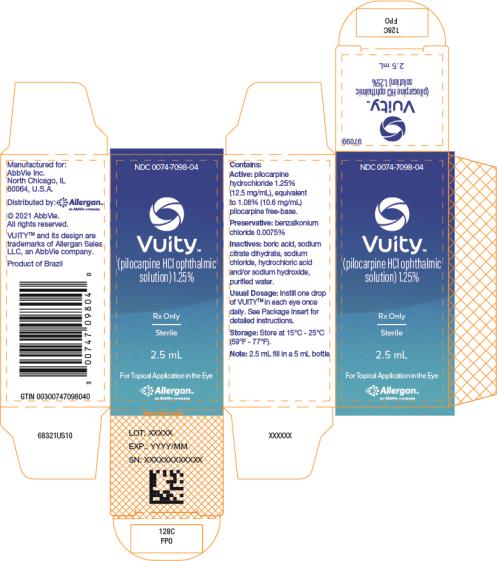
Principal Display Panelndc 0074-7098-04vuity™ (pilocarpine Hci Ophthalmic Solution) 1.25%rx Onlysterile2.5 mLfor Topical Application In The Eyeallergan™an Abbvie Company (Vuity 07)
NDC 0074-7098-05
Professional Sample Not for Resale
Vuity™
(pilocarpine HCI ophthalmic solution) 1.25%
Rx Only
Sterile
1.5 mL
For topical Application in the Eye
Allergan™
An AbbVie company
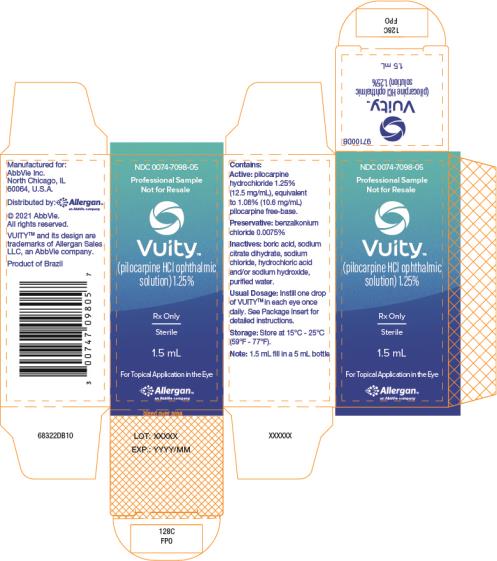
Principal Display Panelndc 0074-7098-05professional Sample Not For Resalevuity™ (pilocarpine Hci Ophthalmic Solution) 1.25%rx Onlysterile1.5 mLfor Topical Application In The Eyeallergan™an Abbvie Company (Vuity 08)
* Please review the disclaimer below.
