Because clinical trials are conducted under widely varying conditions, adverse reaction rates observed in the clinical trials of a drug cannot be directly compared to rates in the clinical trials of another drug and may not reflect the rates observed in practice.
Treatment of Periodic Fever Syndromes: CAPS, TRAPS, HIDS/MKD, and FMF
Treatment of CAPS
The data described herein reflect exposure to ILARIS in 104 adult and pediatric CAPS patients, including 20 FCAS, 72 MWS, 10 MWS/NOMID (Neonatal Onset Multisystem Inflammatory Disorder) overlap, 1 non-FCAS non-MWS, and 1 misdiagnosed in placebo-controlled (35 patients) and uncontrolled trials. Sixty-two patients were exposed to ILARIS for at least 6 months, 56 for at least 1 year, and 4 for at least 3 years. A total of 9 serious adverse reactions were reported for CAPS patients. Among these were vertigo (2 patients), infections (3 patients), including intra-abdominal abscess following appendectomy (1 patient). The most commonly reported adverse reactions associated with ILARIS treatment in greater than 10% of the CAPS patients were nasopharyngitis, diarrhea, influenza, rhinitis, nausea, headache, bronchitis, gastroenteritis, pharyngitis, weight increased, musculoskeletal pain, and vertigo. One patient discontinued treatment due to potential infection.
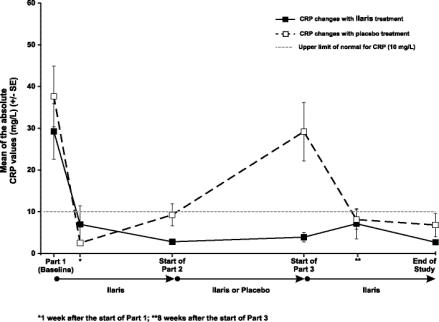
CAPS Study 1 investigated the safety of ILARIS in an 8-week, open-label period (Part 1), followed by a 24-week, randomized withdrawal period (Part 2), followed by a 16-week, open-label period (Part 3). All patients were treated with ILARIS 150 mg subcutaneously or 2 mg/kg if body weight was greater than or equal to 15 kg and less than or equal to 40 kg (see Table 1).
Since all CAPS patients received ILARIS in Part 1, there are no controlled data on adverse events (AEs). Data in Table 1 are for all AEs for all CAPS patients receiving canakinumab. In CAPS Study 1, no pattern was observed for any type or frequency of adverse events throughout the three study periods.
Table 1: Number (%) of Patients with AEs by Preferred Terms, in Greater Than 10% of Patients in Parts 1 to 3 of the Phase 3 Trial for CAPS Patients
Preferred Term | ILARIS
N=35
n (%) |
| n % of Patients with Adverse Events | 35 (100) |
| Nasopharyngitis | 12 (34) |
| Diarrhea | 7 (20) |
| Influenza | 6 (17) |
| Rhinitis | 6 (17) |
| Nausea | 5 (14) |
| Headache | 5 (14) |
| Bronchitis | 4 (11) |
| Gastroenteritis | 4 (11) |
| Pharyngitis | 4 (11) |
| Weight increased | 4 (11) |
| Musculoskeletal pain | 4 (11) |
| Vertigo | 4 (11) |
Vertigo
Vertigo has been reported in 9% to 14% of patients in CAPS studies, exclusively in MWS patients, and reported as a serious adverse event in two cases. All events resolved with continued treatment with ILARIS.
Injection-Site Reactions
In CAPS Study 1, subcutaneous injection-site reactions were observed in 9% of patients in Part 1 with mild tolerability reactions; in Part 2, one patient each (7%) had a mild or a moderate tolerability reaction and, in Part 3, one patient had a mild local tolerability reaction. No severe injection-site reactions were reported and none led to discontinuation of treatment.
Treatment of TRAPS, HIDS/MKD, and FMF
A Phase III trial (TRAPS, HIDS/MKD, and FMF Study 1) investigated the safety of ILARIS in 3 cohorts (TRAPS, HIDS/MKD, and FMF) as follows: a 12-week screening period (Part 1), followed by a 16-week, randomized, double-blind, placebo-controlled parallel-arm treatment period (Part 2), followed by a 24-week randomized withdrawal period (Part 3), followed by a 72-week, open-label treatment period (Part 4). All patients randomized to treatment with ILARIS in Part 2 received 150 mg subcutaneously every 4 weeks if body weight was greater than 40 kg (or 2 mg/kg every 4 weeks if body weight was less than or equal to 40 kg).
In Part 2 of the TRAPS, HIDS/MKD, and FMF Study 1, initially 90 patients were randomized to ILARIS treatment and 91 patients were randomized to placebo. Of patients randomized to ILARIS, 55.6% remained on the initial dose through week 16 with 6.7% receiving an additional ILARIS dose between Day 7 and Day 15. Of the patients randomized to placebo, 9.9% remained on placebo through Week 16 with 28.6% switching to active treatment with ILARIS by Day 15.
Overall, there were 43 TRAPS, 68 HIDS/MKD, and 58 FMF patients in the safety set with a cumulative canakinumab exposure of 47.61 patient-years. The cumulative exposure in the placebo group was 8.03 patient-years.
In Part 2 of the TRAPS, HIDS/MKD, and FMF Study 1, a total of 22 TRAPS patients aged 3 to 76 years of age, 37 HIDS/MKD patients aged 2 to 43 years of age, and 31 FMF patients aged 2 to 60 years of age were initially randomized to treatment with ILARIS 150 mg every four weeks in the placebo-controlled period of the clinical trial. In addition, 4 non-randomized patients (2 FMF patients of age 20 and 29 years with non-exon 10 mutations and 2 HIDS/MKD patients both of 1 year of age) received open-label treatment in Part 2.
The most commonly reported adverse reactions (greater than or equal to 10%) associated with ILARIS treatment in TRAPS, HIDS/MKD, and FMF patients were injection-site reactions and nasopharyngitis. The reported adverse reactions (greater than or equal to 3%) associated with ILARIS treatment in TRAPS, HIDS/MKD, and FMF patients were injection-site reactions (10.1%), and infections including nasopharyngitis (10.7%), upper respiratory tract infection (7.1%), rhinitis (5.3%), gastroenteritis (3.0%), and pharyngitis (3.0%). Serious infections (e.g., conjunctivitis, pneumonia, pharyngitis, pharyngotonsillitis) were observed in approximately 2.4% (0.03 per 100 patient-days) of patients receiving ILARIS in Part 2 of the TRAPS, HIDS/MKD, and FMF Study 1.
In the ILARIS treatment group, 1 TRAPS patient discontinued treatment due to adverse events, 2 HIDS/MKD patients discontinued treatment due to adverse events, and no FMF patients discontinued treatment due to an adverse event.
Injection-Site Reactions
In the TRAPS, HIDS/MKD, and FMF Study 1, subcutaneous injection-site reactions were observed in 10.1% of patients in Part 2 who had a mild or a moderate tolerability reaction. No severe injection-site reactions were reported and none led to discontinuation of treatment.
Treatment of SJIA
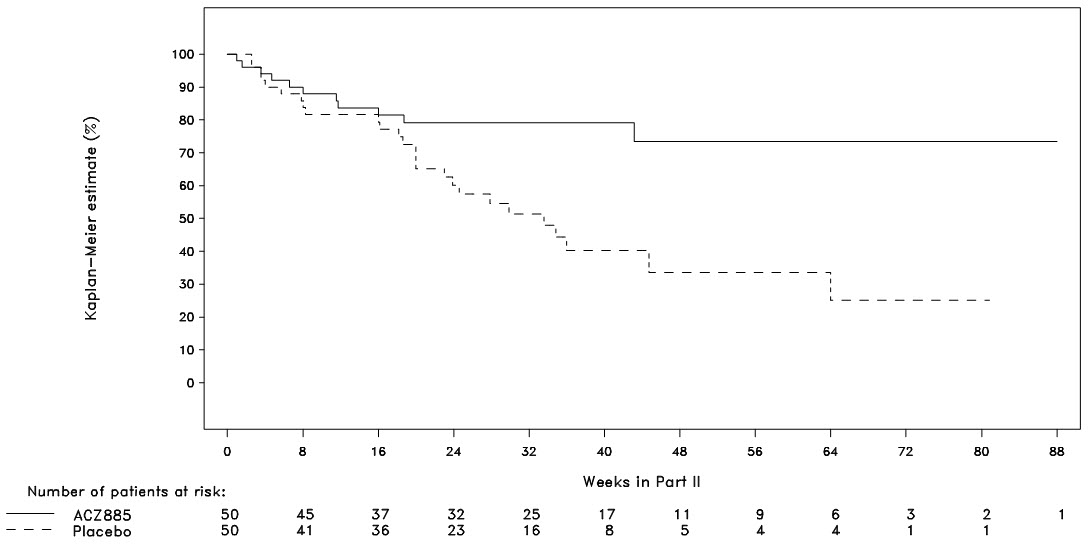
A total of 201 SJIA patients aged 2 to less than 20 years have received ILARIS in clinical trials. The safety of ILARIS compared to placebo was investigated in two phase 3 studies [see Clinical Studies (14.2)]. Patients in SJIA Study 1 received a single dose of ILARIS 4 mg/kg (n=43) or placebo (n=41) via subcutaneous injection and were assessed at Day 15 for the efficacy endpoints and had a safety analysis up to Day 29. SJIA Study 2 was a two-part study with an open-label, single-arm active treatment period (Part I) followed by a randomized, double-blind, placebo-controlled, event-driven withdrawal design (Part II). Overall, 177 patients were enrolled into the study and received ILARIS 4 mg/kg (up to 300 mg maximum) in Part I, and 100 patients received ILARIS 4 mg/kg (up to 300 mg maximum) every 4 weeks or placebo in Part II. Adverse drug reactions listed in Table 2 showed higher rates than placebo from both trials. The adverse drug reactions associated with ILARIS treatment in greater than 10% of SJIA patients were infections, abdominal pain, and injection-site reactions. Serious infections (e.g., pneumonia, varicella, gastroenteritis, measles, sepsis, otitis media, sinusitis, adenovirus, lymph node abscess, pharyngitis) were observed in approximately 4% to 5% (0.02 to 0.17 per 100 patient-days) of patients receiving ILARIS in both studies.
Adverse reactions are listed according to MedDRA version 15.0 system organ class.
Table 2: Tabulated Summary of Adverse Drug Reactions from Pivotal SJIA Clinical Trials | SJIA Study 2 | SJIA Study 1 |
| Part I | Part II | |
| ILARIS
N=177
n (%)
(IR)^ | ILARIS
N=50
n (%)
(IR) | Placebo
N=50
n (%)
(IR) | ILARIS
N=43
n (%)
(IR) | Placebo
N=41
n (%)
(IR) |
| Infections and infestations |
| All Infections (e.g., nasopharyngitis, (viral) upper respiratory tract infection, pneumonia, rhinitis, pharyngitis, tonsillitis, sinusitis, urinary tract infection, gastroenteritis, viral infection) | 97 (54.8%)
(0.91) | 27 (54%)
(0.59) | 19 (38%)
(0.63) | 13 (30.2%)
(1.26) | 5 (12.2%)
(1.37) |
| Gastrointestinal disorders |
| Abdominal pain (upper) | 25 (14.1%)
(0.16) | 8 (16%)
(0.15) | 6 (12%)
(0.08) | 3 (7%)
(0.25) | 1 (2.4%)
(0.23) |
| Skin and subcutaneous tissue disorders |
| Injection-site reaction* | | | | | |
| mild | 19 (10.7%) | 6 (12.0%) | 2 (4.0%) | 0 | 3 (7.3%) |
| moderate | 2 (1.1%) | 1 (2.0%) | 0 | 0 | 0 |
n= number of patients
^IR=Exposure adjusted incidence rate per 100 patient-days
*No injection-site reaction led to study discontinuation