Stop etonogestrel and ethinyl estradiol vaginal ring use if an arterial thrombotic or venous thromboembolic event (VTE) occurs. Stop etonogestrel and ethinyl estradiol vaginal ring use if there is unexplained loss of vision, proptosis, diplopia, papilledema, or retinal vascular lesions. Evaluate for retinal vein thrombosis immediately [see Adverse Reactions (6)].
If feasible, stop etonogestrel and ethinyl estradiol vaginal ring at least four weeks before and through two weeks after major surgery or other surgeries known to have an elevated risk of thromboembolism, and during and following prolonged immobilization.
Start etonogestrel and ethinyl estradiol vaginal ring no earlier than 4 weeks after delivery, in women who are not breastfeeding. The risk of postpartum thromboembolism decreases after the third postpartum week, whereas the risk of ovulation increases after the third postpartum week.
The use of CHCs increases the risk of VTE. Known risk factors for VTE include smoking, obesity, and family history of VTE, in addition to other factors that contraindicate use of CHCs [see Contraindications (4)].
Two epidemiologic studies1, 2, 3 that assessed the risk of VTE associated with the use of etonogestrel and ethinyl estradiol vaginal ring are described below.
In these studies, which were required or sponsored by regulatory agencies, etonogestrel and ethinyl estradiol vaginal ring users had a risk of VTE similar to Combined Oral Contraceptives (COCs) users (see Table 1 for adjusted hazard ratios). A large prospective, observational study, the Transatlantic Active Surveillance on Cardiovascular Safety of etonogestrel and ethinyl estradiol vaginal ring (TASC), investigated the risk of VTE for new users, and women who were switching to or restarting etonogestrel and ethinyl estradiol vaginal ring or COCs in a population that is representative of routine clinical users. The women were followed for 24 to 48 months. The results showed a similar risk of VTE among etonogestrel and ethinyl estradiol vaginal ring users (VTE incidence 8.3 per 10,000 WY) and women using COCs (VTE incidence 9.2 per 10,000 WY). For women using COCs that did not contain the progestins desogestrel (DSG) or gestodene (GSD), VTE incidence was 8.9 per 10,000 WY.
A retrospective cohort study using data from 4 health plans in the US (FDA-funded Study in Kaiser Permanente and Medicaid databases) showed the VTE incidence for new users of etonogestrel and ethinyl estradiol vaginal ring to be 11.4 events per 10,000 WY, for new users of a levonorgestrel (LNG)-containing COC 9.2 events per 10,000 WY, and for users of other COCs available during the course of the study* 8.2 events per 10,000 WY.
_____________________________________
* Includes low-dose COCs containing the following progestins: norgestimate, norethindrone, or levonorgestrel.
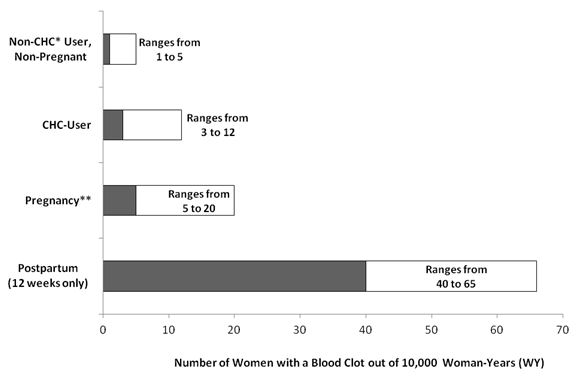
An increased risk of thromboembolic and thrombotic disease associated with the use of CHCs is well-established. Although the absolute VTE rates are increased for users of CHCs compared to nonusers, the rates associated with pregnancy are even greater, especially during the post-partum period (see Figure 1).
The frequency of VTE in women using CHCs has been estimated to be 3 to 12 cases per 10,000 women-years.
The risk of VTE is highest during the first year of CHC use and after restarting a CHC following a break of at least four weeks. The risk of VTE due to CHCs gradually disappears after use is discontinued.
Figure 1 shows the risk of developing a VTE for women who are not pregnant and do not use CHCs, for women who use CHCs, for pregnant women, and for women in the postpartum period. To put the risk of developing a VTE into perspective: If 10,000 women who are not pregnant and do not use CHCs are followed for one year, between 1 and 5 of these women will develop a VTE.
Table 1: Estimates (Hazard Ratios) of Venous Thromboembolism Risk in Users of Etonogestrel and Ethinyl Estradiol Vaginal Ring Compared to Users of Combined Oral Contraceptives (COCs)Epidemiologic Study
(Author, Year of Publication) Population Studied | Comparator Product(s) | Hazard Ratios (HR)
(95% CI) |
TASC | | |
(Dinger, 2012) | | |
Initiators, including new users, switchers and restarters | All COCs available during the course of the study * | HR†: 0.8
(0.5 to 1.5) |
| COCs available excluding DSG- or GSD -containing OCs | HR†: 0.8
(0.4 to 1.7) |
FDA-funded Study in Kaiser Permanente and Medicaid databases (Sidney, 2011) | | |
First use of a combined hormonal contraceptive (CHC) during the study period | COCs available during the course of the study‡ | HR§: 1.1
(0.6 to 2.2) |
| LNG/0.03 mg ethinyl estradiol | HR§: 1.0
(0.5 to 2.0) |
* Includes low-dose COCs containing the following progestins: chlormadinone acetate, cyproterone acetate, desogestrel, dienogest, drospirenone, ethynodiol diacetate, gestodene, levonorgestrel, norethindrone, norgestimate, or norgestrel |
† Adjusted for age, BMI, duration of use, VTE history |
‡ Includes low-dose COCs containing the following progestins: norgestimate, norethindrone, or levonorgestrel |
§ Adjusted for age, site, year of entry into study |
Figure 1: Likelihood of Developing a VTE
*CHC=combination hormonal contraception
**Pregnancy data based on actual duration of pregnancy in the reference studies. Based on a model assumption that pregnancy duration is nine months, the rate is 7 to 27 per 10,000 WY.
Several epidemiology studies indicate that third generation oral contraceptives, including those containing desogestrel (etonogestrel, the progestin in etonogestrel and ethinyl estradiol vaginal ring, is the biologically active metabolite of desogestrel), may be associated with a higher risk of VTE than oral contraceptives containing other progestins. Some of these studies indicate an approximate two-fold increased risk. However, data from other studies have not shown this two-fold increase in risk.
Use of CHCs also increases the risk of arterial thromboses such as strokes and myocardial infarctions, especially in women with other risk factors for these events. CHCs have been shown to increase both the relative and attributable risks of cerebrovascular events (thrombotic and hemorrhagic strokes). In general, the risk is greatest among older (>35 years of age), hypertensive women who also smoke.
Use etonogestrel and ethinyl estradiol vaginal ring with caution in women with cardiovascular disease risk factors.