The asthma development program for NUCALA included 3 double-blind, randomized, placebo‑controlled trials: 1 dose-ranging and exacerbation trial (Trial 1, NCT #01000506) and 2 confirmatory trials (Trial 2, NCT #01691521 and Trial 3, NCT #01691508). Mepolizumab was administered every 4 weeks in all 3 trials as add-on to background treatment. All subjects continued their background asthma therapy throughout the duration of the trials.
Dose-Ranging and Exacerbation Trial
Trial 1 was a 52-week dose-ranging and exacerbation-reduction trial in subjects with asthma with a history of 2 or more exacerbations in the previous year despite regular use of high-dose ICS plus additional controller(s) with or without OCS. Subjects enrolled in this trial were required to have at least 1 of the following 4 pre-specified criteria in the previous 12 months: blood eosinophil count ≥300 cells/mcL, sputum eosinophil count ≥3%, exhaled nitric oxide concentration ≥50 ppb, or deterioration of asthma control after ≤25% reduction in regular maintenance ICS/OCS. Three IV dosages of mepolizumab (75, 250, and 750 mg) administered once every 4 weeks were evaluated compared with placebo. Results from this trial and the pharmacodynamic study supported the evaluation of mepolizumab 75 mg IV and 100 mg SC in the subsequent trials [see Clinical Pharmacology (12.2)]. NUCALA is not indicated for IV use and should only be administered by the SC route.
Confirmatory Trials
A total of 711 subjects with asthma were studied in the 2 confirmatory trials (Trials 2 and 3). In these 2 trials subjects were required to have blood eosinophils of ≥150 cells/mcL at screening (within 6 weeks of dosing) or blood eosinophils of ≥300 cells/mcL within 12 months of enrollment. The screening blood eosinophils of ≥150 cells/mcL criterion was derived from exploratory analyses of data from Trial 1. Trial 2 was a 32-week placebo- and active-controlled trial in subjects with asthma with a history of 2 or more exacerbations in the previous year despite regular use of high-dose ICS plus additional controller(s) with or without OCS. Subjects received mepolizumab 75 mg IV (n = 191), NUCALA 100 mg (n = 194), or placebo (n = 191) once every 4 weeks for 32 weeks.
Trial 3 was a 24-week OCS-reduction trial in subjects with asthma who required daily OCS in addition to regular use of high-dose ICS plus additional controller(s) to maintain asthma control. Subjects in Trial 3 were not required to have a history of exacerbations in the previous year. Subjects received NUCALA 100 mg (n = 69) or placebo (n = 66) once every 4 weeks for 24 weeks. The baseline mean OCS use was similar in the 2 treatment groups: 13.2 mg in the placebo group and 12.4 mg in the group receiving NUCALA 100 mg.
The demographics and baseline characteristics of these 3 trials are provided in Table 2.
Table 2. Demographics and Baseline Characteristics of Asthma Trials
| Trial 1 (N = 616) | Trial 2 (N = 576) | Trial 3 (N = 135) |
Mean age (y) | 49 | 50 | 50 |
Female, n (%) | 387 (63) | 328 (57) | 74 (55) |
White, n (%) | 554 (90) | 450 (78) | 128 (95) |
Duration of asthma, mean (y) | 19 | 20 | 19 |
Never smoked, n (%) | 483 (78) | 417 (72) | 82 (61) |
Baseline FEV1, L | 1.88 | 1.82 | 1.95 |
Baseline % predicted FEV1 | 60 | 61 | 59 |
Baseline % reversibility | 25 | 27 | 26 |
Baseline post-SABA FEV1/FVC | 0.67 | 0.66 | 0.66 |
Geometric mean eosinophil count at baseline, cells/mcL | 250 | 290 | 240 |
Mean number of exacerbations in previous year | 3.6 | 3.6 | 3.1 |
FEV1 = forced expiratory volume in 1 second, SABA = short-acting beta2-agonist, FVC = forced vital capacity.
Exacerbations
The primary endpoint for Trials 1 and 2 was the frequency of exacerbations defined as worsening of asthma requiring use of oral/systemic corticosteroids and/or hospitalization and/or emergency department visits. For subjects on maintenance OCS, an exacerbation requiring OCS was defined as the use of oral/systemic corticosteroids at least double the existing dose for at least 3 days. Compared with placebo, subjects receiving NUCALA 100 mg or mepolizumab 75 mg IV experienced significantly fewer exacerbations. Additionally, compared with placebo, there were fewer exacerbations requiring hospitalization and/or emergency department visits and exacerbations requiring only in-patient hospitalization with NUCALA 100 mg (Table 3).
Table 3. Rate of Exacerbations in Asthma Trials 1 and 2 (Intent-to-Treat Population)
Trial | Treatment | Exacerbations per Year |
Rate | Difference | Rate Ratio (95% CI) |
All exacerbations |
Trial 1 | Placebo (n = 155) | 2.40 | | |
Mepolizumab 75 mg IV (n = 153) | 1.24 | 1.16 | 0.52 (0.39, 0.69) |
Trial 2 | Placebo (n = 191) | 1.74 | | |
Mepolizumab 75 mg IV (n = 191) | 0.93 | 0.81 | 0.53 (0.40, 0.72) |
NUCALA 100 mg SC (n = 194) | 0.83 | 0.91 | 0.47 (0.35, 0.64) |
Exacerbations requiring hospitalization/emergency room visit |
Trial 1 | Placebo (n = 155) | 0.43 | | |
Mepolizumab 75 mg IV (n = 153) | 0.17 | 0.26 | 0.40 (0.19, 0.81) |
Trial 2 | Placebo (n = 191) | 0.20 | | |
Mepolizumab 75 mg IV (n = 191) | 0.14 | 0.06 | 0.68 (0.33, 1.41) |
NUCALA 100 mg SC (n = 194) | 0.08 | 0.12 | 0.39 (0.18, 0.83) |
Exacerbations requiring hospitalization |
Trial 1 | Placebo (n = 155) | 0.18 | | |
Mepolizumab 75 mg IV (n = 153) | 0.11 | 0.07 | 0.61 (0.28, 1.33) |
Trial 2 | Placebo (n = 191) | 0.10 | | |
Mepolizumab 75 mg IV (n = 191) | 0.06 | 0.04 | 0.61 (0.23, 1.66) |
NUCALA 100 mg SC (n = 194) | 0.03 | 0.07 | 0.31 (0.11, 0.91) |
IV = intravenous, SC = subcutaneous.
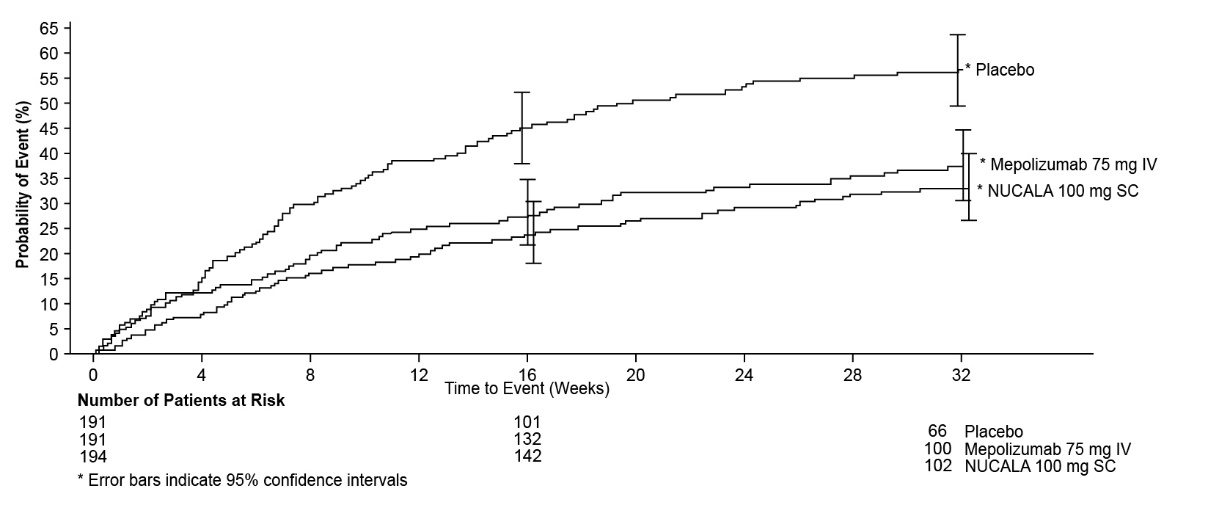
The time to first exacerbation was longer for the groups receiving NUCALA 100 mg and mepolizumab 75 mg IV compared with placebo in Trial 2 (Figure 1).
Figure 1. Kaplan-Meier Cumulative Incidence Curve for Time to First Exacerbation (Asthma Trial 2)

Figure 1. Kaplan-meier Cumulative Incidence Curve For Time To First Exacerbation (trial 2) (Nucala Spl Graphic 01)
Trial 1 data were explored to determine criteria that could identify subjects likely to benefit from treatment with NUCALA. The exploratory analysis suggested that baseline blood eosinophil count of ≥150 cells/mcL was a potential predictor of treatment benefit. Exploratory analysis of Trial 2 data also suggested that baseline blood eosinophil count (obtained within 6 weeks of initiation of dosing) of ≥150 cells/mcL was a potential predictor of efficacy and showed a trend of greater exacerbation benefit with increasing blood eosinophil count. In Trial 2, subjects enrolled solely on the basis of the historical blood eosinophil count of ≥300 cells/mcL in the previous 12 months, but who had a baseline blood eosinophil count <150 cells/mcL, had virtually no exacerbation benefit following treatment with NUCALA 100 mg compared with placebo.
The Asthma Control Questionnaire-5 (ACQ-5) was assessed in Trials 1 and 2, and the St. George’s Respiratory Questionnaire (SGRQ) was assessed in Trial 2. In Trial 1, the ACQ-5 responder rate (defined as a decrease in score of 0.5 or more as threshold) for the 75-mg IV mepolizumab arm was 47% compared with 50% for placebo with an odds ratio (OR) of 1.1 (95% CI: 0.7, 1.7). In Trial 2, the ACQ-5 responder rate for the treatment arm for NUCALA 100 mg was 57% compared with 45% for placebo with an OR of 1.8 (95% CI: 1.2, 2.8). In Trial 2, the SGRQ responder rate (defined as a decrease in score of 4 or more as threshold) for the treatment arm for NUCALA 100 mg was 71% compared with 55% for placebo with an OR of 2.1 (95% CI: 1.3, 3.2).
Oral Corticosteroid Reduction
Trial 3 evaluated the effect of NUCALA 100 mg on reducing the use of maintenance OCS. The primary endpoint was the percent reduction of OCS dose during Weeks 20 to 24 compared with baseline dose, while maintaining asthma control. Subjects were classified according to their change in OCS use during the trial with the following categories: 90% to 100% decrease, 75% to <90% decrease, 50% to <75% decrease, >0% to <50% decrease, and no improvement (i.e., no change or any increase or lack of asthma control or withdrawal of treatment). Compared with placebo, subjects receiving NUCALA 100 mg achieved greater reductions in daily maintenance OCS dose, while maintaining asthma control. Sixteen (23%) subjects in the group receiving NUCALA 100 mg versus 7 (11%) in the placebo group had a 90% to 100% reduction in their OCS dose. Twenty-five (36%) subjects in the group receiving NUCALA 100 mg versus 37 (56%) in the placebo group were classified as having no improvement for OCS dose. Additionally, 54% of subjects receiving NUCALA 100 mg achieved at least a 50% reduction in the daily prednisone dose compared with 33% of subjects receiving placebo (95% CI for difference: 4%, 37%). An exploratory analysis was also performed on the subgroup of 29 subjects in Trial 3 who had an average baseline and screening blood eosinophil count <150 cells/mcL. Five (29%) subjects in the group receiving NUCALA 100 mg versus 0 (0%) in the placebo group had a 90% to 100% reduction in their dose. Four (24%) subjects in the group receiving NUCALA 100 mg versus 8 (67%) in the placebo group were classified as having no improvement for OCS dose. The ACQ and SGRQ were also assessed in Trial 3 and showed results similar to those in Trial 2.
Lung Function
Change from baseline in mean forced expiratory volume in 1 second (FEV1) was measured in all 3 trials and is presented in Table 4. Compared with placebo, NUCALA 100 mg did not provide consistent improvements in mean change from baseline in FEV1.
Table 4. Change from Baseline in FEV1 (mL) in Asthma Trials
Trial | Difference from Placebo in Mean Change from
Baseline FEV1 (mL) (95% CI) |
Week 12 | Week 24 | Weeks 32/52 |
1a | 10 (-87, 108) | 5 (-98, 108) | 61 (-39, 161)b |
2c | 52 (-30, 134) | 76 (-6, 159) | 98 (11, 184)d |
3c | 56 (-91, 203) | 114 (-42, 271) | NA |
a Dose = 75 mg intravenous.
b Forced expiratory volume in 1 second (FEV1) at Week 52.
c Dose = 100 mg subcutaneous.
d FEV1 at Week 32.
The effect of mepolizumab on lung function was also studied in a 12-week, placebo-controlled trial enrolling patients with asthma on a moderate dose of ICS with evidence of symptoms and lung function impairment. Enrollment was not dependent on a history of exacerbations or a pre-specified eosinophil count. Change from baseline in FEV1 at Week 12 was numerically lower in the mepolizumab treatment groups than the placebo group.