Where dose modification is necessary for the treatment of cervical dystonia, uncontrolled open-label studies suggest that dose adjustment can be made in 250 Unit steps according to the individual patient's response, with re-treatment every 12 weeks or longer, as necessary, based on return of clinical symptoms. Uncontrolled open-label studies also suggest that the total dose administered in a single treatment should be between 250 Units and 1000 Units. Re-treatment, if needed, should not occur in intervals of less than 12 weeks. Doses above 1000 Units have not been systematically evaluated.
The starting dose of 500 Units recommended for cervical dystonia is applicable to adults of all ages [see Use in Specific Populations (8.5)].
DYSPORT® is supplied as a single-use vial. Only use sterile preservative-free 0.9% Sodium Chloride Injection, USP for reconstitution of DYSPORT®. Each 500 Unit vial of DYSPORT® is to be reconstituted with 1 mL of preservative- free 0.9% Sodium Chloride Injection USP to yield a solution of 50 Units per 0.1 mL or reconstituted with 2 mL of preservative-free 0.9% Sodium Chloride Injection USP to yield a solution of 25 Units per 0.1 mL. Each 300 Unit vial of DYSPORT ® is to be reconstituted with 0.6 mL of preservative-free 0.9% Sodium Chloride Injection USP to yield a solution equivalent to 50 Units per 0.1 mL.
Using an appropriately sized sterile syringe, needle and aseptic technique, draw up 2 mL or 1 mL of sterile, preservative- free 0.9% Sodium Chloride Injection USP for 500 Unit vial or 0.6 mL of sterile, preservative-free 0.9% sodium Chloride Injection USP for the 300 Unit vial. Insert the needle into the DYSPORT® vial. The partial vacuum will begin to pull the saline into the vial. Any remaining required saline should be expressed into the vial manually. Do not use the vial if no vacuum is observed. Swirl gently to dissolve. Parenteral drug products should be inspected visually for particulate matter and discoloration prior to administration. Reconstituted DYSPORT® should be a clear, colorless solution, free of particulate matter, otherwise it should not be injected.
Expel any air bubbles in the syringe barrel. Remove the needle used to reconstitute the product and attach an appropriately sized new sterile needle.
Discard the vial and needle in accordance with local regulations.
Using an appropriately sized sterile syringe, needle and aseptic technique, draw up 2.5 mL or 1.5 mL of preservative- free 0.9% Sodium Chloride Injection USP Insert the needle into the DYSPORT® vial. The partial vacuum will begin to pull the saline into the vial. Any remaining required saline should be expressed into the vial manually. Do not use the vial if no vacuum is observed. Swirl gently to dissolve. Parenteral drug products should be inspected visually for particulate matter and discoloration prior to administration. Reconstituted DYSPORT® should be a clear, colorless solution, free of particulate matter otherwise it should not be injected.
Discard the vial and needle in accordance with local regulations.
Glabellar facial lines arise from the activity of the lateral corrugator and vertical procerus muscles. These can be readily identified by palpating the tensed muscle mass while having the patient frown. The corrugator depresses the skin creating a "furrowed" vertical line surrounded by tensed muscle (i.e., frown lines). The location, size, and use of the muscles vary markedly among individuals. Physicians administering DYSPORT® must understand the relevant neuromuscular and/or orbital anatomy of the area involved and any alterations to the anatomy due to prior surgical procedures.
Risk of ptosis can be mitigated by careful examination of the upper lid for separation or weakness of the levator palpebrae muscle (true ptosis), identification of lash ptosis, and evaluation of the range of lid excursion while manually depressing the frontalis to assess compensation.
In order to reduce the complication of ptosis, the following steps should be taken:
- Avoid injection near the levator palpebrae superioris, particularly in patients with larger brow depressor complexes.
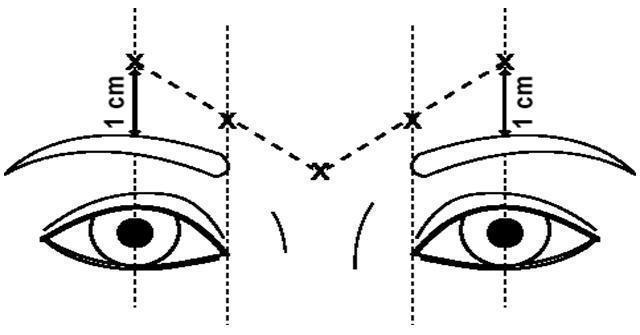
- Medial corrugator injections should be placed at least 1 centimeter above the bony supraorbital ridge.
- Ensure the injected volume/dose is accurate and where feasible kept to a minimum.
- Do not inject toxin closer than 1 centimeter above the central eyebrow.
To inject DYSPORT®, advance the needle through the skin into the underlying muscle while applying finger pressure on the superior medial orbital rim. Inject patients with a total of 50 Units in five equally divided aliquots. Using a 30 gauge needle, inject 10 Units of DYSPORT® into each of five sites, two in each corrugator muscle, and one in the procerus muscle (see Figure 1).
Figure 1
Dosing in initial and subsequent treatment sessions should be tailored to the individual based on the size, number and location of muscles involved, severity of spasticity, the presence of local muscle weakness, the patient's response to previous treatment, and/or adverse event history with botulinum toxins.
No more than 1 mL should generally be administered at any single injection site. The maximum recommended total dose (upper and lower limb combined) of DYSPORT® for the treatment of spasticity in adults is 1500 Units.
Although actual location of the injection sites can be determined by palpation, the use of injection guiding technique e.g., electromyography, electrical stimulation is recommended to target the injection sites.
Upper Limb Spasticity
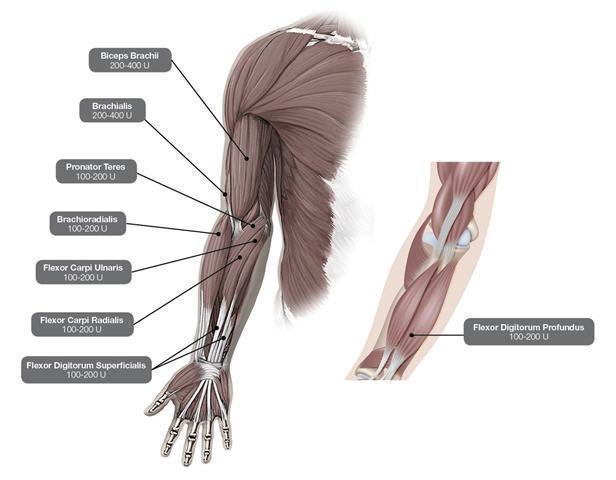
In the clinical trial that assessed the efficacy and safety of DYSPORT® for treatment of upper limb spasticity in adults [see Clinical studies (14.3)], doses of 500 Units and 1000 Units were divided among selected muscles at a given treatment session (seeTable 2 and Figure 2).
Table 2: DYSPORT® Dosing by Muscle for Upper Limb Spasticity in Adult Patients| Muscles Injected | Recommended Dose
DYSPORT® | Recommended Number of
Injection(s) per Muscle |
Flexor carpi radialis (FCR)
Flexor carpi ulnaris (FCU) | 100 Units to 200 Units 100 Units to 200 Units
| 1 to 2 1 to 2 |
Flexor digitorum profundus (FDP) Flexor digitorum superficialis (FDS) | 100 Units to 200 Units 100 Units to 200 Units | 1 to 2 1 to 2 |
Brachialis Brachioradialis Biceps Brachii (BB) Pronator Teres | 200 Units to 400 Units 100 Units to 200 Units 200 Units to 400 Units 100 Units to 200 Units | 1 to 2 1 to 2 1 to 2 1 |
Figure 2: Muscles for Injection for Upper Limb Spasticity in Adults
Repeat DYSPORT® treatment should be administered when the effect of a previous injection has diminished, but no sooner than 12 weeks after the previous injection. A majority of patients in clinical studies were retreated between 12-16 weeks; however some patients had a longer duration of response, i.e. 20 weeks. The degree and pattern of muscle spasticity at the time of re-injection may necessitate alterations in the dose of DYSPORT® and muscles to be injected. Clinical improvement may be expected one week after administration of DYSPORT®.
Lower Limb Spasticity
In the clinical trial that assessed the efficacy and safety of DYSPORT® for treatment of lower limb spasticity in adults [see Clinical Studies (14.3)], doses of 1000 Units and 1500 Units were divided among selected muscles at a given treatment session (see Table 3 and Figure 3).
Table 3: DYSPORT® Dosing by Muscle for Lower Limb Spasticity in Adults| Muscles Injected | Recommended Dysport Dose | Recommended Number of Injection Sites per Muscle |
| Distal Muscles | |
| Gastrocnemius | | |
| Medial head | 100 Units to 150 Units | 1 |
| Lateral head | 100 Units to 150 Units | 1 |
| Soleus | 330 Units to 500 Units | 3 |
| Tibialis posterior | 200 Units to 300 Units | 2 |
| Flexor digitorum longus | 130 Units to 200 Units | 1 to 2 |
| Flexor halluces longus | 70 Units to 200 Units | 1 |
Figure 3: Muscle for Injection for Lower Limb Spasticity in Adults
Repeat DYSPORT® treatment should be administered when the effect of a previous injection has diminished, but no sooner than 12 weeks after the previous injection. A majority of patients in clinical studies were retreated between 12-16 weeks. The degree and pattern of muscle spasticity at the time of re-injection may necessitate alterations in the dose of DYSPORT® and muscles to be injected.
Instructions for Preparation and Administration for the Treatment of Spasticity in Adults
DYSPORT® is supplied as a single-use vial. Only use sterile preservative-free 0.9% Sodium Chloride Injection, USP for reconstitution of DYSPORT®. The recommended concentration is 100 Units/mL or 200 Units/mL with preservative-free 0.9% Sodium Chloride Injection USP) (see Table 1).
Using an appropriately sized sterile syringe, needle and aseptic technique, draw up the required volume (Table 1) of preservative-free 0.9% Sodium Chloride Injection USP.
Insert the needle into the DYSPORT® vial. The partial vacuum will begin to pull the saline into the vial. No more than 2.5 mL of saline should be introduced into the vial (see footnote in Table 1 ). Do not use the vial if a vacuum is absent. Gently swirl to dissolve. Parenteral drug products should be inspected visually for particulate matter and discoloration prior to administration. Reconstituted DYSPORT® should be a clear, colorless solution, free of particulate matter; otherwise it should not be injected.
Expel any air bubbles in the syringe barrel. Remove the needle used to reconstitute the product and attach an appropriately sized new sterile needle.
Discard the vial and needle in accordance with local regulations.
Cervical Dystonia
The data described below reflect exposure to DYSPORT® in 446 cervical dystonia patients in 7 studies. Of these, two studies were randomized, double-blind, single treatment, placebo-controlled studies with subsequent optional open-label treatment in which dose optimization (250 to 1000 Units per treatment) over the course of 5 treatment cycles was allowed.
The population was almost entirely Caucasian (99%) with a median age of 51 years (range 18–82 years). Most patients (87%) were less than 65 years of age; 58.4% were women.
Common Adverse Reactions
The most commonly reported adverse reactions (occurring in 5% or more of patients who received 500 Units of DYSPORT® in the placebo-controlled clinical trials) in cervical dystonia patients were: muscular weakness, dysphagia, dry mouth, injection site discomfort, fatigue, headache, musculoskeletal pain, dysphonia, injection site pain and eye disorders (consisting of blurred vision, diplopia, and reduced visual acuity and accommodation). Other than injection site reactions, most adverse reactions became noticeable about one week after treatment and lasted several weeks.
The rates of adverse reactions were higher in the combined controlled and open-label experience than in the placebo-controlled trials.
During the clinical studies, two patients (<1%) experienced adverse reactions leading to withdrawal. One patient experienced disturbance in attention, eyelid disorder, feeling abnormal and headache, and one patient experienced dysphagia.
Table 5 compares the incidence of the most frequent adverse reactions from a single treatment cycle of 500 Units of DYSPORT® compared to placebo [see Clinical Studies (14.1)].
Table 5: Most Common Adverse Reactions (≥ 5%) and Greater than Placebo in the Pooled, Double-blind, Placebo-Controlled Phase of Clnical Trials in Patients with Cervical Dystonia| Adverse Reaction | DYSPORT® 500 Units
(N=173) | Placebo
(N=182) |
| | % | % |
| Any Adverse Reaction | 61 | 51 |
| General disorders and administration site conditions | 30 | 23 |
| Injection site discomfort | 13 | 8 |
| Fatigue | 12 | 10 |
| Injection site pain | 5 | 4 |
| Musculoskeletal and connective tissue disorders | 30 | 18 |
| Muscular weakness | 16 | 4 |
| Musculoskeletal pain | 7 | 3 |
| Gastrointestinal disorders | 28 | 15 |
| Dysphagia | 15 | 4 |
| Dry Mouth | 13 | 7 |
| Nervous system disorders | 16 | 13 |
| Headache | 11 | 9 |
| Infections and infestations | 13 | 9 |
| Respiratory, thoracic and mediastinal disorders | 12 | 8 |
| Dysphonia | 6 | 2 |
| Eye Disorders The following preferred terms were reported: vision blurred, diplopia, visual acuity reduced, eye pain, eyelid disorder, accommodation disorder, dry eye, eye pruritus. | 7 | 2 |
Dose-response relationships for common adverse reactions in a randomized multiple fixed-dose study in which the total dose was divided between two muscles (the sternocleidomastoid and splenius capitis) are shown in Table 6.
Table 6: Common Adverse Reactions by Dose in Fixed-dose Study in Patients with Cervical Dystonia| Adverse Reactions | DYSPORT® Dose |
| Placebo | 250 Units | 500 Units | 1000 Units |
| Any Adverse Event | 30% | 37% | 65% | 83% |
| Dysphagia | 5% | 21% | 29% | 39% |
| Dry Mouth | 10% | 21% | 18% | 39% |
| Muscular Weakness | 0% | 11% | 12% | 56% |
| Injection Site Discomfort | 10% | 5% | 18% | 22% |
| Dysphonia | 0% | 0% | 18% | 28% |
| Facial Paresis | 0% | 5% | 0% | 11% |
| Eye Disorder The following preferred terms were reported: vision blurred, diplopia, visual acuity reduced, eye pain, eyelid disorder, accommodation disorder, dry eye, eye pruritus. | 0% | 0% | 6% | 17% |
Injection Site Reactions
Injection site discomfort and injection site pain were common adverse reactions following DYSPORT® administration.
Less Common Adverse Reactions
The following adverse reactions were reported less frequently (<5%).
Breathing Difficulty
Breathing difficulties were reported by approximately 3% of patients following DYSPORT® administration and in 1% of placebo patients in clinical trials during the double-blind phase. These consisted mainly of dyspnea. The median time to onset from last dose of DYSPORT® was approximately one week, and the median duration was approximately three weeks.
Other adverse reactions with incidences of less than 5% in the DYSPORT® 500 Units group in the double-blind phase of clinical trials included dizziness in 3.5% of DYSPORT®-treated patients and 1% of placebo-treated patients, and muscle atrophy in 1% of DYSPORT®-treated patients and in none of the placebo-treated patients.
Laboratory Findings
Patients treated with DYSPORT® exhibited a small increase from baseline (0.23 mol/L) in mean blood glucose relative to placebo- treated patients. This was not clinically significant among patients in the development program but could be a factor in patients whose diabetes is difficult to control.
Electrocardiographic Findings
ECG measurements were only recorded in a limited number of patients in an open-label study without a placebo or active control. This study showed a statistically significant reduction in heart rate compared to baseline, averaging about three beats per minute, observed thirty minutes after injection.
Glabellar Lines
In placebo-controlled clinical trials of DYSPORT®, the most common adverse reactions(≥2%) following injection of DYSPORT® were nasopharyngitis, headache, injection site pain, injection site reaction, upper respiratory tract infection, eyelid edema, eyelid ptosis, sinusitis,nausea, and blood present in urine.
Table 7 reflects exposure to DYSPORT® in 398 patients 19 to 75 years of age who were evaluated in the randomized, placebo- controlled clinical studies that assessed the use of DYSPORT® for the temporary improvement in the appearance of glabellar lines [see Clinical Studies (14)]. Adverse reactions of any cause occurred in 48% of the DYSPORT®-treated patients and 33% of the placebo-treated patients.
Table 7: Most Common Adverse Reactions with > 1% Incidence in Pooled, Placebo-Controlled Trials for Glabellar Lines| Adverse Reactions by Body System | DYSPORT®
n=398 (%) Patients who received treatment with placebo and DYSPORT® are counted in both treatment columns. | Placebo
n=496(%) |
| Any Adverse Reaction | 48 | 33 |
Eye Disorders
Eyelid Edema
Eyelid Ptosis
|
2
2 |
0
<1 |
Gastrointestinal Disorders
Nausea |
2 |
1 |
General Disorders and
Administrative Site Conditions
Injection Site Pain
Injection Site Reaction
|
3
3 |
2
< 1 |
Infections and Infestations
Nasopharyngitis
Upper Respiratory Tract Infection
Sinusitis |
10
3
2 |
4
2
1 |
Investigations
Blood Present in Urine |
2 | < 1 |
Nervous System Disorders
Headache |
9 |
5 |
In the overall safety database, where some patients received up to twelve treatments with DYSPORT®, adverse reactions were reported for 57% (1425/2491) of patients. The most frequently reported of these adverse reactions were headache, nasopharyngitis, injection site pain, sinusitis, URI, injection site bruising, and injection site reaction (numbness, discomfort, erythema, tenderness, tingling, itching, stinging, warmth, irritation, tightness, swelling).
Adverse reactions that occurred after repeated injections in 2–3% of the population included bronchitis, influenza, pharyngolaryngeal pain, cough, contact dermatitis, injection site swelling, and injection site discomfort.
The incidence of eyelid ptosis did not increase in the long-term safety studies with multiple re-treatments at intervals ≥ three months. The majority of the reports of eyelid ptosis were mild to moderate in severity and resolved over several weeks. [see Dosage and Administration (2.3)].
Spasticity in Adults
Injection Site Reactions
Injection site reactions (e.g. pain, bruising, haemorrhage, erythema/haematoma etc.) have occurred following administration of DYSPORT® in adults treated for spasticity.
Upper Limb Spasticity in Adults
Table 8 lists the most frequently reported adverse reactions (≥ 2%) in any DYSPORT® dose group and more frequent than placebo in double-blind studies evaluating the treatment of upper limb spasticity in adults with DYSPORT®.
Table 8: Most Common Adverse Reactions Observed in at Least 2% of Patients Treated in Pooled, Double-Blind Trials of Adult Patients with Upper Limb Spasticity Reported More Frequently than with Placebo| Adverse Reaction | DYSPORT® | Placebo |
500 Units
(N=197)
%
| 1000 Units
(N=194)
% |
(N=279)
% |
| Infections and infestations | | | |
| Nasopharyngitis | 4 | 1 | 1 |
| Urinary tract infection | 3 | 1 | 2 |
| Influenza | 1 | 2 | 1 |
| Infection | 1 | 2 | 1 |
| Musculoskeletal and connective tissue disorders | | | |
| Muscular weakness | 2 | 4 | 1 |
| Pain in extremity | 0 | 2 | 1 |
| Musculoskeletal pain | 3 | 2 | 2 |
| Back pain | 1 | 2 | 1 |
| Nervous system disorders | | | |
| Headache | 1 | 2 | 1 |
| Dizziness | 3 | 1 | 1 |
| Convulsion | 2 | 2 | 1 |
| Syncope | 1 | 2 | 0 |
| Hypoaesthesia | 0 | 2 | <1 |
| Partial seizures | 0 | 2 | 0 |
| General disorders and administration site conditions | | | |
| Fatigue | 2 | 2 | 0 |
| Asthenia | 2 | 1 | <1 |
| Injury, poisoning and procedural complications | | | |
| Fall | 2 | 3 | 2 |
| Injury | 2 | 2 | 1 |
| Contusion | 1 | 2 | <1 |
| Gastrointestinal disorders | | | |
| Diarrhea | 1 | 2 | <1 |
| Nausea | 2 | 1 | 1 |
| Constipation | 0 | 2 | 1 |
| Investigation | | | |
| Blood triglycerides increased | 2 | 1 | 0 |
| Respiratory, thoracic and mediastinal disorders | | | |
| Cough | 1 | 2 | 1 |
| Vascular disorders | | | |
| Hypertension | 1 | 2 | <1 |
| Psychiatric disorders | | | |
| Depression | 2 | 3 | 1 |
Less Common Adverse Reactions
In a pooled analysis of clinical studies, adverse reactions with an incidence of less than 2% reported in DYSPORT® treatment groups included dysphagia 0.5%, gait disturbance 0.5%, hypertonia 0.5%, and sensation of heaviness 0.3%.
Lower Limb Spasticity in Adults
The data described below reflect exposure to DYSPORT® in 255 adult patients with lower limb spasticity. Of this population, 89% were Caucasian, 66% male, and the median age was 55 years (range 23-77 years). Table 9 lists the adverse reactions that occurred in ≥ 2% of patients in any DYSPORT® dose group and more frequent than placebo in the double blind study evaluating the treatment of lower limb spasticity in adults. The most common of these adverse reactions (≥ 5%) in any DYSPORT® dose group were falls, muscular weakness, and pain in extremity.
Table 9: Adverse Reactions Observed in at Least 2% of Patients Treated in the Double-Blind Trial of Adult Patients with Lower Limb Spasticity and Reported More Frequently than with Placebo| Adverse Reactions | Dysport
1000 U
(N = 127)
% | Dysport
1500 U
(N = 128)
% | Placebo
(N = 130)
% |
Musculoskeletal and connective tissue disorders
Muscular weakness
Pain in extremity
Arthralgia
Back pain |
2
6
4
3 |
7
6
2
0 |
3
2
1
2 |
Injury, poisoning and procedural complications
Fall
Contusion
Wrist fracture |
9
2
2 |
6
0
0 |
3
0
0 |
Nervous system disorders
Headache
Epilepsy/Convulsion/Partial seizure/Status
Epilepticus |
0
4 |
3
1 |
1
2 |
Infections and infestations
Upper respiratory tract infection |
2 |
1 |
1 |
General disorders and administration site conditions
Fatigue
Asthenia
Influenza-like illness
Edema peripheral |
1
2
2
2 |
4
1
0
0 |
0
1
0
0 |
Investigations
Alanine aminotransferase increase |
2 |
0 |
1 |
Gastrointestinal disorders
Constipation
Dysphagia |
0
2 |
2
1 |
1
1 |
Psychiatric disorders
Depression
Insomnia |
2
0 |
3
2 |
0
0 |
Vascular disorders
Hypertension |
2 |
1 |
1 |
In the efficacy and safety studies of DYSPORT® for the treatment of lower limb spasticity in adults, muscular weakness was reported more frequently in women (10%) treated with 1500 units of DYSPORT® compared to men (5%). Falls were reported more frequently in patients 65 years of age and over. [see Use in Specific Populations (8.5)]
Lower Limb Spasticity in Pediatric Patients
Table 10 reflects exposure to DYSPORT® in 160 patients, 2 to 17 years of age, who were evaluated in the randomized, placebo-controlled clinical study that assessed the use of DYSPORT®for the treatment of unilateral or bilateral lower limb spasticity in pediatric cerebral palsy patients [see Clinical Studies (14.4)]. The most commonly observed adverse reactions (≥ 10% of patients) are: upper respiratory tract infection, nasopharyngitis, influenza, pharyngitis, cough and pryrexia.
Table 10: Adverse Reactions Observed in ≥ 4% of Patients Treated in the Double-Blind Trial of Pediatric Patients with Lower Limb Spasticity and Reported More Frequently than with Placebo| Adverse Reactions | | Unilteral | Bilateral |
Placebo
(n=79)
% | Dysport®
10 Units/kg
(n=43)
% | Dysport®
15 Units/kg
(n=50)
% | Dysport®
20 Units/kg
(n=37)
% | Dysport®
30 Units/kg
(n=30)
% |
| Infections and Infestations |
| Nasopharyngitis | 5 | 9 | 12 | 16 | 10 |
| Upper respiratory tract infection | 13 | 9 | 20 | 5 | 10 |
| Influenza | 8 | 0 | 10 | 14 | 3 |
| Pharyngitis | 8 | 5 | 0 | 11 | 3 |
| Bronchitis | 3 | 0 | 0 | 8 | 7 |
| Rhinitis | 4 | 5 | 0 | 3 | 3 |
| Varicella | 1 | 5 | 0 | 5 | 0 |
| Ear Infection | 3 | 2 | 4 | 0 | 0 |
| Respiratory tract infection viral | 0 | 5 | 2 | 0 | 0 |
| Gastroenteritis viral | 0 | 2 | 4 | 0 | 0 |
| Gastrointestinal disorders |
| Vomiting | 5 | 0 | 6 | 8 | 3 |
| Nausea | 1 | 0 | 2 | 5 | 0 |
| Respiratory, thoracic and mediastinal disorders |
| Cough | 6 | 7 | 6 | 14 | 10 |
| Oropharyngeal pain | 0 | 2 | 4 | 0 | 0 |
| General disorders and administration site conditions |
| Pyrexia | 5 | 7 | 12 | 8 | 7 |
| Musculoskeletal and connective tissue disorders |
| Pain in extremity | 5 | 0 | 2 | 5 | 7 |
| Muscular weakness | 1 | 5 | 0 | 0 | 0 |
| Nervous system disorders |
| Convulsion/Epilepsy | 0 | 7 | 4 | 0 | 7 |
Cervical Dystonia
About 3% of subjects developed antibodies (binding or neutralizing) over time with DYSPORT® treatment.
Glabellar Lines
Testing for antibodies to DYSPORT® was performed for 1554 subjects who had up to nine cycles of treatment. Two subjects (0.13%) tested positive for binding antibodies at baseline. Three additional subjects tested positive for binding antibodies after receiving DYSPORT® treatment. None of the subjects tested positive for neutralizing antibodies.
Spasticity in Adults
Upper Limb Spasticity
From 230 subjects treated with DYSPORT® and tested for the presence of binding antibodies, 5 subjects were positive at baseline and 17 developed antibodies after treatment. Among those 17 subjects, 10 subjects developed neutralizing antibodies. An additional 51 subjects from a separate repeat-dose study were tested for the presence of neutralizing antibodies only. None of the subjects tested positive.
In total, from the 281 subjects treated in the long-term studies and tested for the presence of neutralizing antibodies, 3.6% developed neutralizing antibodies after treatment. In the presence of binding and neutralizing antibodies to DYSPORT® some patients continue to experience clinical benefit.
Lower Limb Spasticity
From 367 subjects treated with DYSPORT® and tested for the presence of binding antibodies, 4 subjects were positive at baseline and 2 developed binding antibodies after treatment. No subjects developed neutralizing antibodies. An additional 85 subjects from two separate studies were tested for the presence of neutralizing antibodies only. One subject tested positive for the presence of neutralizing antibodies.
In total, from the 452 subjects treated in with DYSORT® and tested for the presence of neutralizing antibodies, 0.2% developed neutralizing antibodies after treatment.
Lower Limb Spasticity in Pediatric Patients
From 226 subjects treated with DYSPORT® and tested for the presence of binding antibodies, 5 subjects previously receiving botulinum toxins were positive at baseline and 9 patients developed binding antibodies after injections. Among those 9 subjects, 3 subjects developed neutralizing antibodies, while one subject developed neutralizing antibodies from the 5 subjects testing positive for binding antibodies at baseline who previously received botulinum toxin injections.
From a separate repeat-dose study, 203 subjects were tested for the presence of neutralizing antibodies. Two subjects were positive for neutralizing antibodies at baseline and 5 subjects developed neutralizing antibodies after treatments. In total, from the 429 patients tested for the presence of neutralizing antibodies, 2.1% developed neutralizing antibodies after treatment. In the presence of binding and neutralizing antibodies to DYSPORT® , some patients continued to experience clinical benefit.
Infertility
In rats, DYSPORT® produced adverse effects on mating behavior and fertility [see Nonclinical Toxicology (13.1)].
Cervical Dystonia
Safety and effectiveness in pediatric patients have not been established [see Warnings and Precautions (5.2)].
Glabellar Lines
DYSPORT® is not recommended for use in pediatric patients less than 18 years of age.
Upper Limb Spasticity
Safety and effectiveness in pediatric patients have not been established [see Warnings and Precautions (5.2)].
Lower Limb Spasticity in Pediatric Patients
The safety and effectiveness of DYSPORT® injected into proximal muscles of the lower limb for the treatment of spasticity in pediatric patients has not been established [see Warnings and Precautions (5.2) and Adverse Reactions (6.1)].
Safety and effectiveness in pediatric patients with lower limb spasticity below 2 years of age have not been evaluated [see Warnings and Precautions (5.2)].
Juvenile Animal Data
In a study in which juvenile rats received a single intramuscular injection of DYSPORT® (1, 3 or 10 Units/animal) on postnatal day 21, decreased growth and bone length (injected and contralateral limbs), delayed sexual maturation, and decreased fertility were observed at the highest dose tested, which was associated with excessive toxicity during the first week after dosing.
In a study in which juvenile rats received weekly intramuscular injections of DYSPORT® (0.1, 0.3, or 1.0 Units/animal) from postnatal day 21 to 13 weeks of age, decreases in bone mineral content in the injected limb, associated with atrophy of injected and adjacent muscles, were observed at the highest dose tested. No adverse effects were observed on neurobehavioral development. However, dose levels were not adjusted for growth of the pups. On a body weight basis, the doses at the end of the dosing period were approximately 15% of those at initiation of dosing. Therefore, the effects of DYSPORT® throughout postnatal development were not adequately evaluated.
Study GL-1
Study GL-1 was a single dose, double-blind, multi-center, randomized, placebo-controlled study in which 158 previously untreated subjects received either placebo or 50 Units of DYSPORT®, administered in five aliquots of 10 Units (see Figure 1). Subjects were followed for 180 days. The mean age was 43 years; most of the subjects were women (85%), and predominantly Caucasian (49%) or Hispanic (47%). At Day 30, 55% of DYSPORT®-treated subjects achieved treatment success: a composite 2 grade improvement of glabellar line severity at maximum frown (Table 13).
In study GL-1, the reduction of glabellar line severity at maximum frown was greater at Day 30 in the DYSPORT® group compared to the placebo group as assessed by both Investigators and subjects (Table 14).
Table 14: GL-1: Investigator's and Subject's Assessment of Glabellar Line Severity at Maximum Frown Using a 4-point Scale (% and Number of Subjects with Severity of None or Mild)| | Investigator's Assessment | Subject's Assessment |
| Day | DYSPORT®
N=105 | Placebo
N=53 | DYSPORT®
N=105 | Placebo
N=53 |
| 14 | 90%
95 | 17%
9 | 77%
81 | 9%
5 |
| 30 | 88%
92 | 4%
2 | 74%
78 | 9%
5 |
| 60 | 64%
67 | 2%
1 | 60%
63 | 6%
3 |
| 90 | 43%
45 | 6%
3 | 36%
38 | 6%
3 |
| 120 | 23%
24 | 4%
2 | 19%
20 | 6%
3 |
| 150 | 9%
9 | 2%
1 | 8%
8 | 4%
2 |
| 180 | 6%
6 | 0%
0 | 7%
7 | 8%
4 |
Study GL-2
Study GL-2 was a repeat dose, double-blind, multi-center, placebo-controlled, randomized study. The study was initiated with two or three open-label treatment cycles of 50 Units of DYSPORT® administered in five aliquots of 10 Units DYSPORT® (see Figure 1). After the open-label treatments, subjects were randomized to receive either placebo or 50 Units of DYSPORT®. Subjects could have received up to four treatments through the course of the study. Efficacy was assessed in the final randomized treatment cycle. The study enrolled 311 subjects into the first treatment cycle and 142 subjects were randomized into the final treatment cycle. Overall, the mean age was 47 years; most of the subjects were women (86%) and predominantly Caucasian (80%).
At Day 30, 52% of DYSPORT®-treated subjects achieved treatment success: a composite 2 grade improvement of glabellar line severity at maximum frown (see Table 13).
The proportion of responders in the final treatment cycle was comparable to the proportion of responders in all prior treatment cycles.
After the final repeat treatment with DYSPORT®, the reduction of glabellar line severity at maximum frown was greater at Day 30 in the DYSPORT® group compared to the placebo group as assessed by both Investigators and subjects (Table 15).
Table 15: GL-2 Investigator's and Subject's Assessments of Glabellar Line Severity at Maximum Frown Using a 4-point Scale (% and Number of Subjects with Severity of None or Mild)| | Investigator's Assessment | Subject's Assessment |
| Day | DYSPORT® N=71 | Placebo N=71 | DYSPORT® N=71 | Placebo N=71 |
| 30 | 85%
60 | 4%
3 | 79%
56 | 1%
1 |
Study GL-3
Study GL-3 was a single dose, double-blind, multi-center, randomized, placebo-controlled study in which 300 previously untreated subjects received either placebo or 50 Units of DYSPORT®, administered in five aliquots of 10 Units (see Figure 1). Subjects were followed for 150 days. The mean age was 44 years; most of the subjects were women (87%), and predominantly Caucasian (75%) or Hispanic (18%).
At Day 30, 60% of DYSPORT®-treated subjects achieved treatment success: a composite 2 grade improvement of glabellar line severity at maximum frown (see Table 16).
In study GL-3, the reduction of glabellar line severity at maximum frown was greater at Day 30 in the DYSPORT® group compared to the placebo group as assessed by both Investigators and subjects (see Table 16).
Table 16: GL-3 Investigator's and Subject's Assessment of Glabellar Line Severity at Maximum Frown Using a 4-point Scale (% and Number of Subjects with Severity of None or Mild)| | Investigator's Assessment | Subject's Assessment |
| Day | DYSPORT®
N=200 | Placebo
N=100 | DYSPORT®
N=200 | Placebo
N=100 |
| 14 | 83%
166 | 5%
5 | 83%
165 | 2%
2 |
| 30 | 86%
171 | 0%
0 | 82%
163 | 2%
2 |
| 60 | 75%
150 | 1%
1 | 65%
130 | 4%
4 |
| 90 | 51%
102 | 1%
1 | 46%
91 | 2%
2 |
| 120 | 29%
58 | 1%
1 | 31%
61 | 3%
3 |
| 150 | 16%
32 | 1%
1 | 16%
31 | 3%
3 |
Geriatric Subjects
In GL1, GL2, and GL3, there were 8 subjects aged 65 and older who were randomized to DYSPORT® 50 Units in 5 equal aliquots of 10 Units (4) or placebo (4). None of the geriatric DYSPORT® subjects were a treatment success at maximum frown at Day 30.
Cervical Dystonia, Spasticity in Adults, and Lower Limb Spasticity in Pediatric Patients
500 Unit Vial
Each vial contains 500 Units of freeze-dried abobotulinumtoxinA.
Box containing 1 vial—NDC 15054-0500-1
Box containing 2 vials—NDC 15054-0500-2
300 Unit Vial
Each vial contains 300 Units of freeze-dried abobotulinumtoxinA.
Box containing 1 vial—NDC 15054-0530-6
Glabellar Lines
Each vial contains 300 Units of freeze-dried abobotulinumtoxinA.
Box containing 1 vial— NDC 0299-5962-30
Manufactured by:
Ipsen Biopharm Ltd.
Wrexham,LL13 9UF, UK
U.S. License No. 1787
Distributed by:
Ipsen Biopharmaceuticals, Inc.
Basking Ridge, NJ 07920
and
Galderma Laboratories, L.P.
Fort Worth, TX 76177 USA