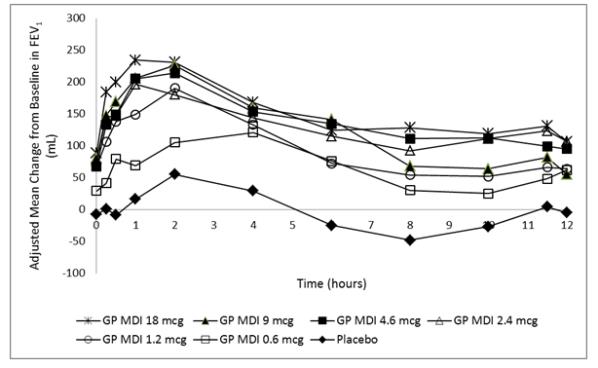
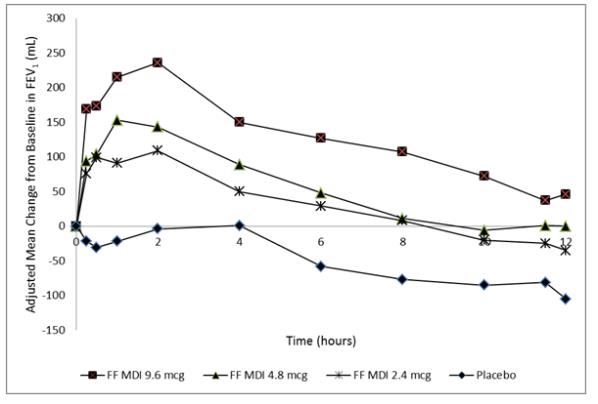
The clinical development program for BEVESPI AEROSPHERE included two (Trial 1 and Trial 2) 24-week, randomized, double-blind, placebo-controlled, parallel-group trials in subjects with moderate to very severe COPD designed to evaluate the efficacy of BEVESPI AEROSPHERE on lung function. The 24-week trials included 3,699 subjects that had a clinical diagnosis of COPD, were between 40 and 80 years of age, had a history of smoking greater than or equal to 10 pack-years, had a post-albuterol FEV1 less than 80% of predicted normal values, and had a ratio of FEV1/FVC of less than 0.7. The majority of patients were male (56%) and Caucasian (91%) with a mean age of 63 years and an average smoking history of 51 pack-years (54% current smokers). During screening, mean post-bronchodilator percent predicted FEV1 was 51% (range: 19% to 82%) and mean percent reversibility was 20% (range: -32% to 135%).
Trial 1 and Trial 2 evaluated BEVESPI AEROSPHERE (glycopyrrolate/formoterol fumarate) 18 mcg/9.6 mcg, glycopyrrolate 18 mcg, formoterol fumarate 9.6 mcg, and placebo administered twice daily (BID). Trial 1 also included an open-label active control. The primary endpoint was change from baseline in trough FEV1 at Week 24 compared with placebo, glycopyrrolate 18 mcg BID, and formoterol fumarate 9.6 mcg BID. The comparison of BEVESPI AEROSPHERE with glycopyrrolate 18 mcg and formoterol fumarate 9.6 mcg was assessed to evaluate the contribution of the individual components to BEVESPI AEROSPHERE. In both trials, BEVESPI AEROSPHERE demonstrated a larger increase in mean change from baseline in trough FEV1 at Week 24 relative to placebo, glycopyrrolate 18 mcg, and formoterol fumarate 9.6 mcg (Table 2).
Table 2 – Least Square (LS) Mean Change from Baseline in Morning Pre-dose Trough
FEV1 (mL) at Week 24 in Trial 1 and Trial 2 (Intent-to-Treat Population)
| | Trough FEV1 (mL) at Week 24 |
| | Difference from |
Treatment | N | Placebo*
LS Mean
(95% CI) | Glycopyrrolate
18 mcg BID*
LS Mean
(95% CI) | Formoterol Fumarate
9.6 mcg BID*
LS Mean
(95% CI) |
Trial 1 |
BEVESPI AEROSPHERE | 429 | N=161
150 mL
(114, 186) | N=344
59 mL
(31, 88) | N=367
64 mL
(36, 92) |
Trial 2 |
BEVESPI
AEROSPHERE | 433 | N=170
103 mL
(67, 140) | N=367
54 mL
(25, 83) | N=350
56 mL
(27, 85) |
N = Number in the intent to treat population
*The placebo, glycopyrrolate and formoterol fumarate comparators used the same inhaler and excipients as BEVESPI AEROSPHERE. |
With the limited data available, there were consistent improvements in trough FEV1 with respect to age, sex, degree of airflow limitation, GOLD stage, smoking status, or inhaled corticosteroid use.
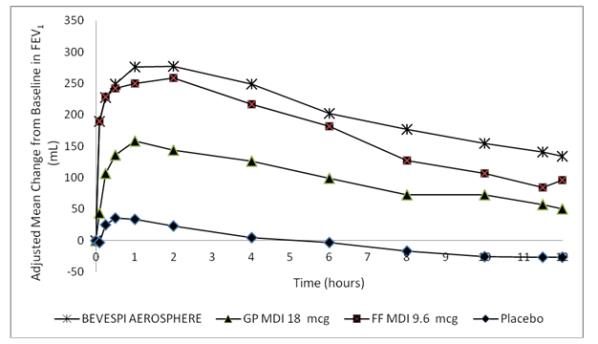
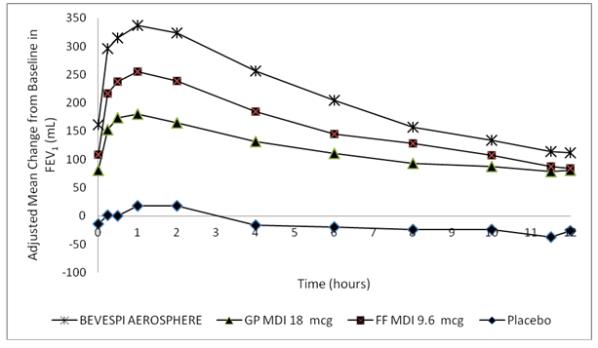
In Trials 1 and 2, serial spirometric evaluations were performed throughout the 12-hour dosing interval in a subset of subjects (n=718 and n=585, respectively) at Day 1 and Week 12. Results from Trial 1 are shown in Figure 3. In Trial 2, the results for BEVESPI AEROSPHERE in FEV1 AUC0-12h were similar to those observed in Trial 1.
Figure 3 - Mean Change from Baseline in FEV1 over Time at Day 1 and Week 12 (Trial 1)
Day 1
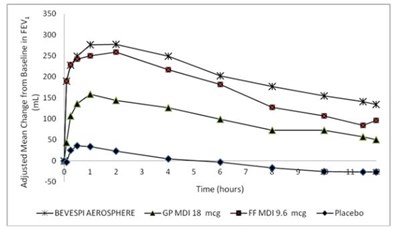
Figure 3 (Mean Change from Baseline in FEV1 over Time at Day 1 and Week 12 (Trial 1) Day 1)
Week 12
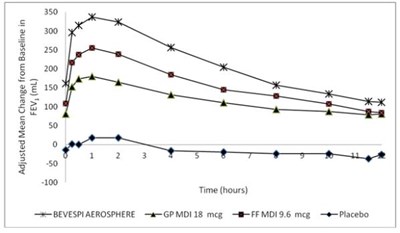
Week 12 (Bevespi Aerosphere 06)
In both trials, peak FEV1 was defined as the maximum FEV1 recorded within 2 hours after the dose of trial medication. The mean peak FEV1 improvement from baseline with BEVESPI AEROSPHERE compared with placebo at Week 24 was 291 mL (95% CI: 252, 331) and 267 mL (95% CI: 226, 308) in Trial 1 and Trial 2, respectively. BEVESPI AEROSPHERE demonstrated an onset of bronchodilatory treatment effect at 5 minutes after the first dose based on a mean increase in FEV1 compared to placebo of 187 mL (95% CI: 168, 205) and 186 mL (95% CI: 164, 207) in Trial 1 and Trial 2, respectively. In both Trial 1 and 2, subjects treated with BEVESPI AEROSPHERE used less daily rescue albuterol compared to subjects treated with placebo.
The St. George’s Respiratory Questionnaire (SGRQ) was assessed in Trials 1 and 2. In Trial 1, the SGRQ responder rate (defined as an improvement in score of 4 or more as threshold) was 37%, 30%, 35%, and 28% for BEVESPI AEROSPHERE, glycopyrrolate, formoterol fumarate, and placebo, respectively, with odds ratios of 1.4 (95% CI: 1.1, 1.8), 1.1 (95% CI: 0.9, 1.5), and 1.5 (95% CI: 1.1, 2.1), for BEVESPI AEROSPHERE vs. glycopyrrolate, BEVESPI AEROSPHERE vs. formoterol fumarate, and BEVESPI AEROSPHERE vs. placebo, respectively. In Trial 2, the trends were similar, with odds ratios of 1.2 (95% CI: 0.9, 1.6), 1.3 (95% CI: 1.0, 1.7), and 1.3 (95% CI: 0.9, 1.8), for BEVESPI AEROSPHERE vs. glycopyrrolate, BEVESPI AEROSPHERE vs. formoterol fumarate, and BEVESPI AEROSPHERE vs. placebo, respectively.