Evidence supporting the effectiveness of glatiramer acetate derives from five placebo-controlled trials, four of which used a glatiramer acetate injection dose of 20 mg per mL per day and one of which used a glatiramer acetate injection dose of 40 mg per mL three times per week.
Glatiramer Acetate Injection 20 mg per mL per day
Study 1 was performed at a single center. Fifty patients were enrolled and randomized to receive daily doses of either glatiramer acetate injection, 20 mg per mL subcutaneously, or placebo (glatiramer acetate injection: n = 25; placebo: n = 25). Patients were diagnosed with RRMS by standard criteria, and had at least 2 exacerbations during the 2 years immediately preceding enrollment. Patients were ambulatory, as evidenced by a score of no more than 6 on the Kurtzke Disability Scale Score (DSS), a standard scale ranging from 0–Normal to 10–Death due to MS. A score of 6 is defined as one at which a patient is still ambulatory with assistance; a score of 7 means the patient must use a wheelchair.
Patients were examined every 3 months for 2 years, as well as within several days of a presumed exacerbation. To confirm an exacerbation, a blinded neurologist had to document objective neurologic signs, as well as document the existence of other criteria (e.g., the persistence of the neurological signs for at least 48 hours).
The protocol-specified primary outcome measure was the proportion of patients in each treatment group who remained exacerbation free for the 2 years of the trial, but two other important outcomes were also specified as endpoints: the frequency of attacks during the trial, and the change in the number of attacks compared with the number which occurred during the previous 2 years.
Table 3 presents the values of the three outcomes described above, as well as several protocol-specified secondary measures. These values are based on the intent-to-treat population (i.e., all patients who received at least 1 dose of treatment and who had at least 1 on-treatment assessment):
Table 3: Study 1 Efficacy Results | Glatiramer Acetate
Injection
20 mg/mL (n = 25) | Placebo
(n = 25) | P-Value |
% Relapse-Free Patients | 14/25 (56%) | 7/25 (28%) | 0.085 |
Mean Relapse Frequency | 0.6/2 years | 2.4/2 years | 0.005 |
Reduction in Relapse Rate Compared to Prestudy | 3.2 | 1.6 | 0.025 |
Median Time to First Relapse (days) | > 700 | 150 | 0.03 |
% of Progression-Free Progression was defined as an increase of at least 1 point on the DSS, persisting for at least 3 consecutive months. Patients | 20/25 (80%) | 13/25 (52%) | 0.07 |
Study 2 was a multicenter trial of similar design which was performed in 11 US centers. A total of 251 patients (glatiramer acetate injection: n = 125; placebo: n = 126) were enrolled. The primary outcome measure was the Mean 2-Year Relapse Rate. Table 4 presents the values of this outcome for the intent-to-treat population, as well as several secondary measures:
Table 4: Study 2 Efficacy Results | Glatiramer Acetate Injection 20 mg/mL (n = 125) | Placebo (n = 126) | P-Value |
Mean No. of Relapses | 1.19/2 years | 1.68/2 years | 0.055 |
% Relapse-Free Patients | 42/125 (34%) | 34/126 (27%) | 0.25 |
Median Time to First Relapse (days) | 287 | 198 | 0.23 |
% of Progression-Free Patients | 98/125 (78%) | 95/126 (75%) | 0.48 |
Mean Change in DSS | -0.05 | +0.21 | 0.023 |
In both studies, glatiramer acetate exhibited a clear beneficial effect on relapse rate, and it is based on this evidence that glatiramer acetate is considered effective.
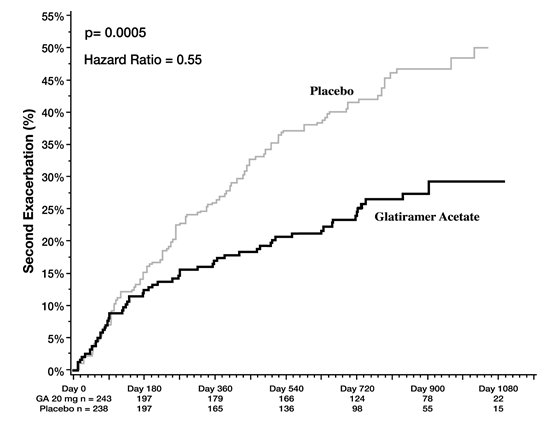
In Study 3, 481 patients who had recently (within 90 days) experienced an isolated demyelinating event and who had lesions typical of multiple sclerosis on brain MRI were randomized to receive either glatiramer acetate injection 20 mg per mL (n = 243) or placebo (n = 238). The primary outcome measure was time to development of a second exacerbation. Patients were followed for up to three years or until they reached the primary endpoint. Secondary outcomes were brain MRI measures, including number of new T2 lesions and T2 lesion volume.
Time to development of a second exacerbation was significantly delayed in patients treated with glatiramer acetate injection compared to placebo (Hazard Ratio = 0.55; 95% confidence interval 0.40 to 0.77; Figure 1). The Kaplan-Meier estimates of the percentage of patients developing a relapse within 36 months were 42.9% in the placebo group and 24.7% in the glatiramer acetate group.

Figure 1: Time To Second Exacerbation (5cd25695 8a5c 48b6 Bd73 86a48de41493 02)
Patients treated with glatiramer acetate injection demonstrated fewer new T2 lesions at the last observation (rate ratio 0.41; confidence interval 0.28 to 0.59; p < 0.0001). Additionally, baseline-adjusted T2 lesion volume at the last observation was lower for patients treated with glatiramer acetate injection (ratio of 0.89; confidence interval 0.84 to 0.94; p = 0.0001).
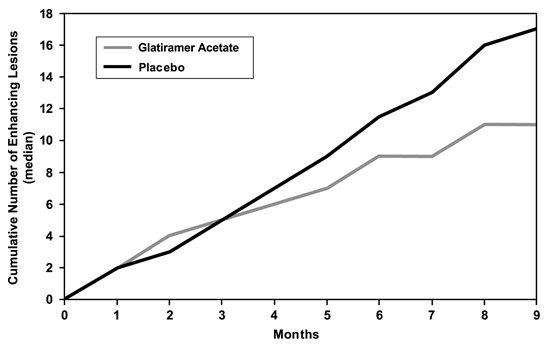
Study 4 was a multinational study in which MRI parameters were used both as primary and secondary endpoints. A total of 239 patients with RRMS (glatiramer acetate injection: n = 119; and placebo: n = 120) were randomized. Inclusion criteria were similar to those in the second study with the additional criterion that patients had to have at least one Gd-enhancing lesion on the screening MRI. The patients were treated in a double-blind manner for nine months, during which they underwent monthly MRI scanning. The primary endpoint for the double-blind phase was the total cumulative number of T1 Gd-enhancing lesions over the nine months. Table 5 summarizes the results for the primary outcome measure monitored during the trial for the intent-to-treat cohort.
Table 5: Study 4 MRI Results | Glatiramer Acetate Injection 20 mg/mL (n = 119) | Placebo (n = 120) | P-Value |
Medians of the Cumulative Number of T1 Gd-Enhancing Lesions | 11 | 17 | 0.0030 |
Figure 2 displays the results of the primary outcome on a monthly basis.

Figure 2: Median Cumulative Number Of Gd-enhancing Lesions (5cd25695 8a5c 48b6 Bd73 86a48de41493 03)
Glatiramer Acetate Injection 40 mg per mL three times per week
Study 5 was a double-blind, placebo-controlled, multinational study with a total of 1404 patients with RRMS randomized in a 2:1 ratio to receive either glatiramer acetate injection 40 mg per mL (n = 943) or placebo (n = 461) three times a week for 12 months. Patients had a median of 2 relapses in the 2 years prior to screening and had not received any interferon-beta for at least 2 months prior to screening. Baseline EDSS scores ranged from 0 to 5.5 with a median of 2.5. Neurological evaluations were performed at baseline, every three months, and at unscheduled visits for suspected relapse or early termination. MRI was performed at baseline, months 6 and 12, or early termination. A total of 91% of those assigned to glatiramer acetate and 93% of those assigned to placebo completed treatment at 12 months.
The primary outcome measure was the total number of confirmed relapses (persistence of neurological symptoms for at least 48 hours confirmed on examination with objective signs). The effect of glatiramer acetate on several magnetic resonance imaging (MRI) variables, including number of new or enlarging T2 lesions and number of enhancing lesions on T1-weighted images, was also measured at months 6 and 12.
Table 6 presents the results for the intent-to-treat population.
Table 6: Study 5 Efficacy and MRI Results | Glatiramer Acetate Injection 40 mg/mL (n = 943) | Placebo (n = 461) | P-Value |
Clinical Endpoints |
Number of confirmed relapses during the 12-month placebo-controlled phase |
Adjusted Mean Estimates Relative risk reduction | 0.331 34% | 0.505 | < 0.0001 |
MRI Endpoints |
Cumulative number of new or enlarging T2 lesions at Months 6 and 12 |
Adjusted Mean Estimates Relative risk reduction | 3.650 35% | 5.592 | < 0.0001 |
Cumulative number of enhancing lesions on T1-weighted images at Months 6 and 12 |
Adjusted Mean Estimates Relative risk reduction | 0.905 45% | 1.639 | < 0.0001 |