In glycemic control trials in adults, liraglutide has been studied as monotherapy and in combination with one or two oral anti-diabetic medications or basal insulin. Liraglutide was also studied in a cardiovascular outcomes trial (LEADER trial).
In each of the placebo controlled trials, treatment with liraglutide produced clinically and statistically significant improvements in hemoglobin A1c and fasting plasma glucose (FPG) compared to placebo.
All liraglutide-treated patients started at 0.6 mg/day. The dose was increased in weekly intervals by 0.6 mg to reach 1.2 mg or 1.8 mg for patients randomized to these higher doses. Liraglutide 0.6 mg is not effective for glycemic control and is intended only as a starting dose to reduce gastrointestinal intolerance [see Dosage and Administration (2)].
Monotherapy
In this 52-week trial, 746 adult patients with type 2 diabetes mellitus were randomized to liraglutide 1.2 mg, liraglutide 1.8 mg, or glimepiride 8 mg. Patients who were randomized to glimepiride were initially treated with 2 mg daily for two weeks, increasing to 4 mg daily for another two weeks, and finally increasing to 8 mg daily. Treatment with liraglutide 1.8 mg and 1.2 mg resulted in a statistically significant reduction in HbA1c compared to glimepiride (Table 3). The percentage of patients who discontinued due to ineffective therapy was 3.6% in the liraglutide 1.8 mg treatment group, 6.0% in the liraglutide 1.2 mg treatment group, and 10.1% in the glimepiride-treatment group.
The mean age of participants was 53 years, and the mean duration of diabetes was 5 years. Participants were 49.7% male, 77.5% White, 12.6% Black or African American and 35.0% of Hispanic or Latino ethnicity. The mean BMI was 33.1 kg/m2.
Table 3. Results of a 52-week Monotherapy Trial in Adults with Type 2 Diabetes Mellitusa
a Intent-to-treat population using last observation on study
b Least squares mean adjusted for baseline value
* p-value <0.05
** p-value <0.0001 |
| Liraglutide 1.8 mg | Liraglutide 1.2 mg | Glimepiride 8 mg |
Intent-to-Treat Population (N) | 246 | 251 | 248 |
HbA1c (%) (Mean) | | | |
Baseline | 8.2 | 8.2 | 8.2 |
Change from baseline (adjusted mean)b | -1.1 | -0.8 | -0.5 |
- Difference from glimepiride arm (adjusted mean)b
95% Confidence Interval
| -0.6** (-0.8; -0.4) | -0.3* (-0.5; -0.1) | |
Percentage of patients achieving HbA1c <7% | 51 | 43 | 28 |
Fasting Plasma Glucose (mg/dL) (Mean) | | | |
Baseline | 172 | 168 | 172 |
Change from baseline (adjusted mean)b | -26 | -15 | -5 |
- Difference from glimepiride arm (adjusted mean)b
95% Confidence Interval
| -20** (-29; -12) | -10* (-19; -1) | |
Body Weight (kg) (Mean) | | | |
Baseline | 92.6 | 92.1 | 93.3 |
Change from baseline (adjusted mean)b | -2.5 | -2.1 | +1.1 |
- Difference from glimepiride arm (adjusted mean)b
95% Confidence Interval
| -3.6** (-4.3; -2.9) | -3.2** (-3.9; -2.5) | |
*p-value = 0.0014 for liraglutide 1.2 mg compared to glimepiride.
†p-value <0.0001 for liraglutide 1.8 mg compared to glimepiride.
P values derived from change from baseline ANCOVA model.
Figure 3. Mean HbA1c for Adult Patients with Type 2 Diabetes Mellitus who Completed the 52-week Trial and for the Last Observation Carried Forward (LOCF, intent-to-treat) Data at Week 52 (Monotherapy)
Combination Therapy
Add-on to Metformin
In this 26-week trial, 1,091 adult patients with type 2 diabetes mellitus were randomized to liraglutide 0.6 mg, liraglutide 1.2 mg, liraglutide 1.8 mg, placebo, or glimepiride 4 mg (one-half of the maximal approved dose in the United States), all as add-on to metformin. Randomization occurred after a 6-week run-in period consisting of a 3-week initial forced metformin titration period followed by a maintenance period of another 3 weeks. During the titration period, doses of metformin were increased up to 2000 mg/day. Treatment with liraglutide 1.2 mg and 1.8 mg as add-on to metformin resulted in a significant mean HbA1c reduction relative to placebo add-on to metformin and resulted in a similar mean HbA1c reduction relative to glimepiride 4 mg add-on to metformin (Table 4). The percentage of patients who discontinued due to ineffective therapy was 5.4% in the liraglutide 1.8 mg + metformin treatment group, 3.3% in the liraglutide 1.2 mg + metformin treatment group, 23.8% in the placebo + metformin treatment group, and 3.7% in the glimepiride + metformin treated group.
The mean age of participants was 57 years, and the mean duration of diabetes was 7 years. Participants were 58.2% male, 87.1% White and 2.4% Black or African American. The mean BMI was 31.0 kg/m2.
Table 4. Results of a 26-week Trial of Liraglutide as Add-on to Metformin in Adults with Type 2 Diabetes Mellitusa
a Intent-to-treat population using last observation on study
b Least squares mean adjusted for baseline value
† For glimepiride, one-half of the maximal approved United States dose.
* p-value <0.05
** p-value <0.0001 |
| Liraglutide 1.8 mg + Metformin | Liraglutide 1.2 mg + Metformin | Placebo + Metformin | Glimepiride 4 mg† + Metformin |
Intent-to-Treat Population (N) | 242 | 240 | 121 | 242 |
HbA1c (%) (Mean) | | | | |
Baseline | 8.4 | 8.3 | 8.4 | 8.4 |
Change from baseline (adjusted mean)b | -1.0 | -1.0 | +0.1 | -1.0 |
- Difference from placebo + metformin arm (adjusted mean)b
95% Confidence Interval - Difference from glimepiride + metformin arm (adjusted mean)b
95% Confidence Interval
| -1.1** (-1.3; -0.9) 0.0 (-0.2; 0.2) | -1.1** (-1.3; -0.9) 0.0 (-0.2; 0.2) | | |
Percentage of patients achieving HbA1c <7% | 42 | 35 | 11 | 36 |
Fasting Plasma Glucose (mg/dL) (Mean) | | | | |
Baseline | 181 | 179 | 182 | 180 |
Change from baseline (adjusted mean)b | -30 | -30 | +7 | -24 |
- Difference from placebo + metformin arm (adjusted mean)b
| -38** | -37** | | |
- 95% Confidence Interval
- Difference from glimepiride + metformin arm (adjusted mean)b
95% Confidence Interval
| (-48; -27) -7 (-16; 2) | (-47; -26) -6 (-15; 3) | | |
Body Weight (kg) (Mean) | | | | |
Baseline | 88.0 | 88.5 | 91.0 | 89.0 |
Change from baseline (adjusted mean)b | -2.8 | -2.6 | -1.5 | +1.0 |
- Difference from placebo + metformin arm (adjusted mean)b
95% Confidence Interval - Difference from glimepiride + metformin arm (adjusted mean)b
95% Confidence Interval
| -1.3* (-2.2; -0.4) -3.8** (-4.5; -3.0) | -1.1* (-2.0; -0.2) -3.5** (-4.3; -2.8) | | |
Liraglutide Compared to Sitagliptin, Both as Add-on to Metformin
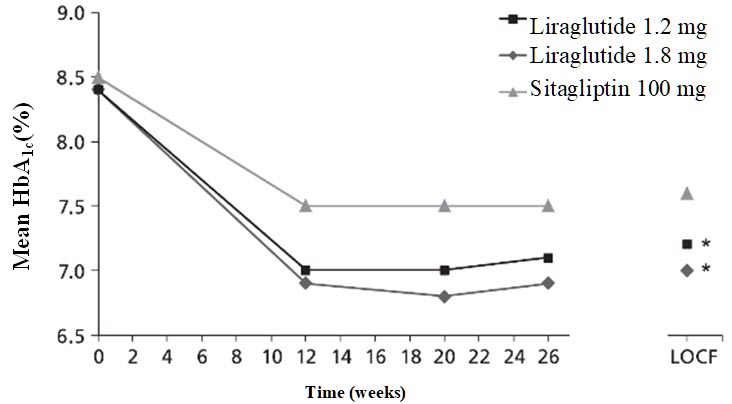
In this 26-week, open-label trial, 665 adult patients with type 2 diabetes mellitus on a background of metformin ≥1,500 mg per day were randomized to liraglutide 1.2 mg once daily, liraglutide 1.8 mg once daily or sitagliptin 100 mg once daily, all dosed according to approved labeling. Patients were to continue their current treatment on metformin at a stable, pre-trial dose level and dosing frequency.
The mean age of participants was 56 years, and the mean duration of diabetes was 6 years. Participants were 52.9% male, 86.6% White, 7.2% Black or African American and 16.2% of Hispanic or Latino ethnicity. The mean BMI was 32.8 kg/m2.
The primary endpoint was the change in HbA1c from baseline to Week 26. Treatment with liraglutide 1.2 mg and liraglutide 1.8 mg resulted in statistically significant reductions in HbA1c relative to sitagliptin 100 mg (Table 5). The percentage of patients who discontinued due to ineffective therapy was 3.1% in the liraglutide 1.2 mg group, 0.5% in the liraglutide 1.8 mg treatment group, and 4.1% in the sitagliptin 100 mg treatment group. From a mean baseline body weight of 94 kg, there was a mean reduction of 2.7 kg for liraglutide 1.2 mg, 3.3 kg for liraglutide 1.8 mg, and 0.8 kg for sitagliptin 100 mg.
Table 5. Results of a 26-week Open-label Trial of Liraglutide Compared to Sitagliptin (both in combination with metformin) in Adults with Type 2 Diabetes Mellitusa
| Liraglutide 1.8 mg + Metformin | Liraglutide 1.2 mg + Metformin | Sitagliptin 100 mg + Metformin |
Intent-to-Treat Population (N) | 218 | 221 | 219 |
HbA1c (%) (Mean) | | | |
Baseline | 8.4 | 8.4 | 8.5 |
Change from baseline (adjusted mean) | -1.5 | -1.2 | -0.9 |
Difference from sitagliptin arm (adjusted mean)b 95% Confidence Interval | -0.6** (-0.8; -0.4) | -0.3** (-0.5; -0.2) | |
Percentage of patients achieving HbA1c <7% | 56 | 44 | 22 |
Fasting Plasma Glucose (mg/dL) (Mean) | | | |
Baseline | 179 | 182 | 180 |
Change from baseline (adjusted mean) | -39 | -34 | -15 |
Difference from sitagliptin arm (adjusted mean)b 95% Confidence Interval | -24** (-31; -16) | -19** (-26; -12) | |
a Intent-to-treat population using last observation on study b Least squares mean adjusted for baseline value ** p-value <0.0001 |
*p-value <0.0001 for liraglutide compared to sitagliptin.
P values derived from change from baseline ANCOVA model.
Figure 4. Mean HbA1c for Adult Patients with Type 2 Diabetes Mellitus who Completed the 26-week Trial and for the Last Observation Carried Forward (LOCF, intent-to-treat) Data at Week 26
Combination Therapy with Metformin and Insulin
This 26-week open-label trial enrolled 988 adult patients with type 2 diabetes mellitus with inadequate glycemic control (HbA1c 7 to 10%) on metformin (≥1,500 mg/day) alone or inadequate glycemic control (HbA1c 7 to 8.5%) on metformin (≥1500 mg/day) and a sulfonylurea. Patients who were on metformin and a sulfonylurea discontinued the sulfonylurea then all patients entered a 12-week run-in period during which they received add-on therapy with liraglutide titrated to 1.8 mg once-daily. At the end of the run-in period, 498 patients (50%) achieved HbA1c <7% with liraglutide 1.8 mg and metformin and continued treatment in a non-randomized, observational arm. Another 167 patients (17%) withdrew from the trial during the run-in period with approximately one-half of these patients doing so because of gastrointestinal adverse reactions [see Adverse Reactions (6.1)]. The remaining 323 patients with HbA1c ≥7% (33% of those who entered the run-in period) were randomized to 26 weeks of once-daily insulin detemir administered in the evening as add-on therapy (N=162) or to continued, unchanged treatment with liraglutide 1.8 mg and metformin (N=161). The starting dose of insulin detemir was 10 units/day and the mean dose at the end of the 26-week randomized period was 39 units/day. During the 26-week randomized treatment period, the percentage of patients who discontinued due to ineffective therapy was 11.2% in the group randomized to continued treatment with liraglutide 1.8 mg and metformin and 1.2% in the group randomized to add-on therapy with insulin detemir.
The mean age of participants was 57 years, and the mean duration of diabetes was 8 years. Participants were 55.7% male, 91.3% White, 5.6% Black or African American and 12.5% of Hispanic or Latino ethnicity. The mean BMI was 34.0 kg/m2.
Treatment with insulin detemir as add-on to liraglutide 1.8 mg + metformin resulted in statistically significant reductions in HbA1c and FPG compared to continued, unchanged treatment with liraglutide 1.8 mg + metformin alone (Table 6). From a mean baseline body weight of 96 kg after randomization, there was a mean reduction of 0.3 kg in the patients who received insulin detemir add-on therapy compared to a mean reduction of 1.1 kg in the patients who continued on unchanged treatment with liraglutide 1.8 mg + metformin alone.
Table 6. Results of a 26-week Open-label Trial of Insulin Detemir as add on to Liraglutide + Metformin Compared to Continued Treatment with Liraglutide + Metformin alone in Adult Patients with Type 2 Diabetes Mellitus not Achieving HbA1c <7% after 12 Weeks of Metformin and Liraglutidea
a Intent-to-treat population using last observation on study
b Least squares mean adjusted for baseline value
** p-value <0.0001 |
| Insulin detemir + Liraglutide + Metformin | Liraglutide + Metformin |
Intent-to-Treat Population (N) | 162 | 157 |
HbA1c (%) (Mean) | | |
Baseline (week 0) | 7.6 | 7.6 |
Change from baseline (adjusted mean) | -0.5 | 0 |
Difference from liraglutide + metformin arm (LS mean)b 95% Confidence Interval | -0.5**
(-0.7; -0.4) | |
Percentage of patients achieving HbA1c <7% | 43 | 17 |
Fasting Plasma Glucose (mg/dL) (Mean) | | |
Baseline (week 0) | 166 | 159 |
Change from baseline (adjusted mean) | -39 | -7 |
Difference from liraglutide + metformin arm (LS mean)b 95% Confidence Interval | -31**
(-39; -23) | |
Add-on to Sulfonylurea
In this 26-week trial, 1,041 adult patients with type 2 diabetes mellitus were randomized to liraglutide 0.6 mg, liraglutide 1.2 mg, liraglutide 1.8 mg, placebo, or rosiglitazone 4 mg (one-half of the maximal approved dose in the United States), all as add-on to glimepiride. Randomization occurred after a 4-week run-in period consisting of an initial, 2-week, forced-glimepiride titration period followed by a maintenance period of another 2 weeks. During the titration period, doses of glimepiride were increased to 4 mg/day. The doses of glimepiride could be reduced (at the discretion of the investigator) from 4 mg/day to 3 mg/day or 2 mg/day (minimum) after randomization, in the event of unacceptable hypoglycemia or other adverse events.
The mean age of participants was 56 years, and the mean duration of diabetes was 8 years. Participants were 49.4% male, 64.4% White and 2.8% Black or African American. The mean BMI was 29.9 kg/m2.
Treatment with liraglutide 1.2 mg and 1.8 mg as add-on to glimepiride resulted in a statistically significant reduction in mean HbA1c compared to placebo add-on to glimepiride (Table 7). The percentage of patients who discontinued due to ineffective therapy was 3.0% in the liraglutide 1.8 mg + glimepiride treatment group, 3.5% in the liraglutide 1.2 mg + glimepiride treatment group, 17.5% in the placebo + glimepiride treatment group, and 6.9% in the rosiglitazone + glimepiride treatment group.
Table 7. Results of a 26-week Trial of Liraglutide as add-on to Sulfonylurea in Adult Patients with Type 2 Diabetes Mellitusa
a Intent-to-treat population using last observation on study
b Least squares mean adjusted for baseline value
† For rosiglitazone, one-half of the maximal approved United States dose.
** p-value <0.0001 |
| Liraglutide 1.8 mg + Glimepiride | Liraglutide 1.2 mg + Glimepiride | Placebo + Glimepiride | Rosiglitazone 4 mg† + Glimepiride |
Intent-to-Treat Population (N) | 234 | 228 | 114 | 231 |
HbA1c (%) (Mean) | | | | |
Baseline | 8.5 | 8.5 | 8.4 | 8.4 |
Change from baseline (adjusted mean)b | -1.1 | -1.1 | +0.2 | -0.4 |
- Difference from placebo + glimepiride arm (adjusted mean)b
95% Confidence Interval
| -1.4** (-1.6; -1.1) | -1.3** (-1.5; -1.1) | | |
Percentage of patients achieving HbA1c <7% | 42 | 35 | 7 | 22 |
Fasting Plasma Glucose (mg/dL) (Mean) | | | | |
Baseline | 174 | 177 | 171 | 179 |
Change from baseline (adjusted mean)b | -29 | -28 | +18 | -16 |
- Difference from placebo + glimepiride arm (adjusted mean)b
95% Confidence Interval
| -47** (-58; -35) | -46** (-58; -35) | | |
Body Weight (kg) (Mean) | | | | |
Baseline | 83.0 | 80.0 | 81.9 | 80.6 |
Change from baseline (adjusted mean)b | -0.2 | +0.3 | -0.1 | +2.1 |
- Difference from placebo + glimepiride arm (adjusted mean)b
95% Confidence Interval
| -0.1 (-0.9; 0.6) | 0.4 (-0.4; 1.2) | | |
Add-on to Metformin and Sulfonylurea
In this 26-week trial, 581 adult patients with type 2 diabetes mellitus were randomized to liraglutide 1.8 mg, placebo, or insulin glargine, all as add-on to metformin and glimepiride. Randomization took place after a 6-week run-in period consisting of a 3-week forced metformin and glimepiride titration period followed by a maintenance period of another 3 weeks. During the titration period, doses of metformin and glimepiride were to be increased up to 2,000 mg/day and 4 mg/day, respectively. After randomization, patients randomized to liraglutide 1.8 mg underwent a 2-week period of titration with liraglutide. During the trial, the liraglutide and metformin doses were fixed, although glimepiride and insulin glargine doses could be adjusted. Patients titrated glargine twice-weekly during the first 8 weeks of treatment based on self-measured fasting plasma glucose on the day of titration. After Week 8, the frequency of insulin glargine titration was left to the discretion of the investigator, but, at a minimum, the glargine dose was to be revised, if necessary, at Weeks 12 and 18. Only 20% of glargine-treated patients achieved the pre-specified target fasting plasma glucose of ≤100 mg/dL. Therefore, optimal titration of the insulin glargine dose was not achieved in most patients.
The mean age of participants was 58 years, and the mean duration of diabetes was 9 years. Participants were 56.5% male, 75.0% White and 3.6% Black or African American. The mean BMI was 30.5 kg/m2.
Treatment with liraglutide as add-on to glimepiride and metformin resulted in a statistically significant mean reduction in HbA1c compared to placebo add-on to glimepiride and metformin (Table 8). The percentage of patients who discontinued due to ineffective therapy was 0.9% in the liraglutide 1.8 mg + metformin + glimepiride treatment group, 0.4% in the insulin glargine + metformin + glimepiride treatment group, and 11.3% in the placebo + metformin + glimepiride treatment group.
Table 8. Results of a 26-week Trial of Liraglutide as Add-on to Metformin and Sulfonylurea in Adult Patients with Type 2 Diabetes Mellitusa
a Intent-to-treat population using last observation on study
b Least squares mean adjusted for baseline value
† For insulin glargine, optimal titration regimen was not achieved for 80% of patients.
* p-value <0.05
** p-value <0.0001 |
| Liraglutide 1.8 mg + Metformin + Glimepiride | Placebo + Metformin + Glimepiride | Insulin glargine† + Metformin + Glimepiride |
Intent-to-Treat Population (N) | 230 | 114 | 232 |
HbA1c (%) (Mean) | | | |
Baseline | 8.3 | 8.3 | 8.1 |
Change from baseline (adjusted mean)b | -1.3 | -0.2 | -1.1 |
- Difference from placebo + metformin + glimepiride arm (adjusted mean)b
95% Confidence Interval
| -1.1** (-1.3; -0.9) | | |
Percentage of patients achieving HbA1c <7% | 53 | 15 | 46 |
Fasting Plasma Glucose (mg/dL) (Mean) | | | |
Baseline | 165 | 170 | 164 |
Change from baseline (adjusted mean)b | -28 | +10 | -32 |
- Difference from placebo + metformin + glimepiride arm (adjusted mean)b
95% Confidence Interval
| -38** (-46; -30) | | |
Body Weight (kg) (Mean) | | | |
Baseline | 85.8 | 85.4 | 85.2 |
Change from baseline (adjusted mean)b | -1.8 | -0.4 | 1.6 |
- Difference from placebo + metformin + glimepiride arm (adjusted mean)b
95% Confidence Interval
| -1.4* (-2.1; -0.7) | | |
Liraglutide Compared to Exenatide, Both as Add-on to Metformin and/or Sulfonylurea Therapy
In this 26-week, open-label trial, 464 adult patients with type 2 diabetes mellitus on a background of metformin monotherapy, sulfonylurea monotherapy or a combination of metformin and sulfonylurea were randomized to once daily liraglutide 1.8 mg or exenatide 10 mcg twice daily. Maximally tolerated doses of background therapy were to remain unchanged for the duration of the trial. Patients randomized to exenatide started on a dose of 5 mcg twice-daily for 4 weeks and then were escalated to 10 mcg twice daily.
The mean age of participants was 57 years, and the mean duration of diabetes was 8 years. Participants were 51.9% male, 91.8% White, 5.4% Black or African American and 12.3% of Hispanic or Latino ethnicity. The mean BMI was 32.9 kg/m2.
Treatment with liraglutide 1.8 mg resulted in statistically significant reductions in HbA1c and FPG relative to exenatide (Table 9). The percentage of patients who discontinued for ineffective therapy was 0.4% in the liraglutide treatment group and 0% in the exenatide treatment group. Both treatment groups had a mean decrease from baseline in body weight of approximately 3 kg.
Table 9. Results of a 26-week Open-label Trial of Liraglutide versus Exenatide (both in combination with metformin and/or sulfonylurea) in Adult Patients with Type 2 Diabetes Mellitusa
a Intent-to-treat population using last observation carried forward
b Least squares mean adjusted for baseline value
** p-value <0.0001 |
| Liraglutide 1.8 mg once daily + metformin and/or sulfonylurea | Exenatide 10 mcg twice daily + metformin and/or sulfonylurea |
Intent-to-Treat Population (N) | 233 | 231 |
HbA1c (%) (Mean) | | |
Baseline | 8.2 | 8.1 |
Change from baseline (adjusted mean)b | -1.1 | -0.8 |
Difference from exenatide arm (adjusted mean)b 95% Confidence Interval | -0.3** (-0.5; -0.2) | |
Percentage of patients achieving HbA1c <7% | 54 | 43 |
Fasting Plasma Glucose (mg/dL) (Mean) Baseline
Change from baseline (adjusted mean)b
Difference from exenatide arm (adjusted mean)b
95% Confidence Interval |
176
-29
-18**
(-25; -12)
|
171
-11
|
Add-on to Metformin and Thiazolidinedione
In this 26-week trial, 533 adult patients with type 2 diabetes mellitus were randomized to liraglutide 1.2 mg, liraglutide 1.8 mg or placebo, all as add-on to rosiglitazone (8 mg) plus metformin (2,000 mg). Patients underwent a 9-week run-in period (3-week forced dose escalation followed by a 6-week dose maintenance phase) with rosiglitazone (starting at 4 mg and increasing to 8 mg/day within 2 weeks) and metformin (starting at 500 mg with increasing weekly increments of 500 mg to a final dose of 2,000 mg/day). Only patients who tolerated the final dose of rosiglitazone (8 mg/day) and metformin (2000 mg/day) and completed the 6-week dose maintenance phase were eligible for randomization into the trial.
The mean age of participants was 55 years, and the mean duration of diabetes was 9 years. Participants were 61.6% male, 84.2% White, 10.2% Black or African American and 16.4% of Hispanic or Latino ethnicity. The mean BMI was 33.9 kg/m2.
Treatment with liraglutide as add-on to metformin and rosiglitazone produced a statistically significant reduction in mean HbA1c compared to placebo add-on to metformin and rosiglitazone (Table 10). The percentage of patients who discontinued due to ineffective therapy was 1.7% in the liraglutide 1.8 mg + metformin + rosiglitazone treatment group, 1.7% in the liraglutide 1.2 mg + metformin + rosiglitazone treatment group, and 16.4% in the placebo + metformin + rosiglitazone treatment group.
Table 10. Results of a 26-week Trial of Liraglutide as Add-on to Metformin and Thiazolidinedione in Adult Patients with Type 2 Diabetes Mellitusa
a Intent-to-treat population using last observation on study
b Least squares mean adjusted for baseline value
** p-value <0.0001 |
| Liraglutide 1.8 mg + Metformin + Rosiglitazone | Liraglutide 1.2 mg + Metformin + Rosiglitazone | Placebo + Metformin + Rosiglitazone |
Intent-to-Treat Population (N) | 178 | 177 | 175 |
HbA1c (%) (Mean) | | | |
Baseline | 8.6 | 8.5 | 8.4 |
Change from baseline (adjusted mean)b | -1.5 | -1.5 | -0.5 |
- Difference from placebo + metformin + rosiglitazone arm (adjusted mean)b
95% Confidence Interval
| -0.9** (-1.1; -0.8) | -0.9** (-1.1; -0.8) | |
Percentage of patients achieving HbA1c <7% | 54 | 57 | 28 |
Fasting Plasma Glucose (mg/dL) (Mean) | | | |
Baseline | 185 | 181 | 179 |
Change from baseline (adjusted mean)b | -44 | -40 | -8 |
- Difference from placebo + metformin + rosiglitazone arm (adjusted mean)b
95% Confidence Interval
| -36** (-44; -27) | -32** (-41; -23) | |
Body Weight (kg) (Mean) | | | |
Baseline | 94.9 | 95.3 | 98.5 |
Change from baseline (adjusted mean)b | -2.0 | -1.0 | +0.6 |
- Difference from placebo + metformin + rosiglitazone arm (adjusted mean)b
95% Confidence Interval
| -2.6** (-3.4; -1.8) | -1.6** (-2.4; -1.0) | |
Liraglutide Compared to Placebo Both With or Without Metformin and/or Sulfonylurea and/or Pioglitazone and/or Basal or Premix Insulin in Patients with Type 2 Diabetes Mellitus and Moderate Renal Impairment
In this 26-week, double-blind, randomized, placebo-controlled, parallel-group trial in adult patients with type 2 diabetes mellitus, 279 patients with moderate renal impairment, as per MDRD formula (eGFR 30−59 mL/min/1.73 m2), were randomized to liraglutide or placebo once daily. Liraglutide was added to the patient’s stable pre-trial antidiabetic regimen (insulin therapy and/or metformin, pioglitazone, or sulfonylurea). The dose of liraglutide was escalated according to approved labeling to achieve a dose of 1.8 mg per day. The insulin dose was reduced by 20% at randomization for patients with baseline HbA1c ≤8% and fixed until liraglutide dose escalation was complete. Dose reduction of insulin and SU was allowed in case of hypoglycemia; up titration of insulin was allowed but not beyond the pre-trial dose.
The mean age of participants was 67 years, and the mean duration of diabetes was 15 years. Participants were 50.5% male, 92.3% White, 6.6% Black or African American, and 7.2% of Hispanic or Latino ethnicity. The mean BMI was 33.9 kg/m2. Approximately half of patients had an eGFR between 30 and <45mL/min/1.73 m2.
Treatment with liraglutide resulted in a statistically significant reduction in HbA1c from baseline at Week 26 compared to placebo (see Table 11). 123 patients reached the 1.8 mg dose of liraglutide.
Table 11. Results of a 26-week Trial of Liraglutide Compared to Placebo in Adult Patients with Type 2 Diabetes Mellitus and Moderate Renal Impairmenta
a Intent-to-treat population
b Estimated using a mixed model for repeated measurement with treatment, country, stratification groups as factors and baseline as a covariate, all nested within visit. Multiple imputation method modeled “wash out” of the treatment effect for patients having missing data who discontinued treatment.
c Early treatment discontinuation, before week 26, occurred in 25% and 22% of liraglutide and placebo patients, respectively.
d Based on the known number of subjects achieving HbA1c <7%. When applying the multiple imputation method described in b) above, the estimated percents achieving HbA1c <7% are 47.6% and 24.9% for liraglutide and placebo, respectively.
e Estimated using a mixed model for repeated measurement with treatment, country, stratification groups as factors and baseline as a covariate, all nested within visit.
* p-value <0.0001
** p-value <0.05 |
| Liraglutide 1.8 mg + Insulin and/or OAD | Placebo + Insulin and/or OAD |
Intent to Treat Population (N) | 140 | 137 |
HbA1c (%) | | |
Baseline (mean) | 8.1 | 8.0 |
Change from baseline (estimated mean)b, c | -0.9 | -0.4 |
Difference from placebob, c 95% Confidence Interval | -0.6* (-0.8; -0.3) | |
Proportion achieving HbA1c < 7%d | 39.3 | 19.7 |
FPG (mg/dL) | | |
Baseline (mean) | 171 | 167 |
Change from baseline (estimated mean)e | -22 | -10 |
Difference from placeboe 95% Confidence Interval | -12** (-23; -0.8) | |