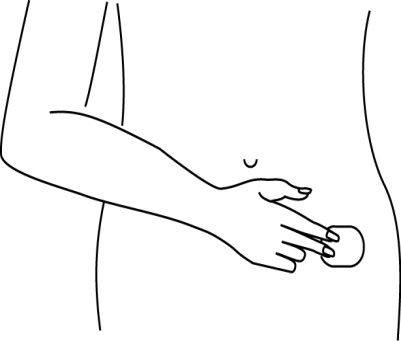
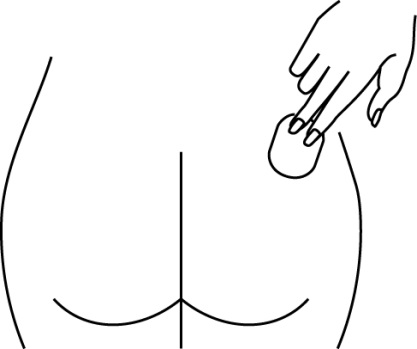
Transdermal administration of the Estradiol Transdermal System produces mean serum concentrations of estradiol comparable to those produced by premenopausal women in the early follicular phase of the ovulatory cycle. The pharmacokinetics of estradiol following application of the Estradiol Transdermal System were investigated in 197 healthy postmenopausal women in six studies. In five of the studies, the Estradiol Transdermal System was applied to the abdomen, and in a sixth study, application to the buttocks and abdomen were compared.
The Estradiol Transdermal System continuously releases estradiol which is transported across intact skin leading to sustained circulating levels of estradiol during a 7-day treatment period. The systemic availability of estradiol after transdermal administration is about 20 times higher than that after oral administration. This difference is due to the absence of first pass metabolism when estradiol is given by the transdermal route.
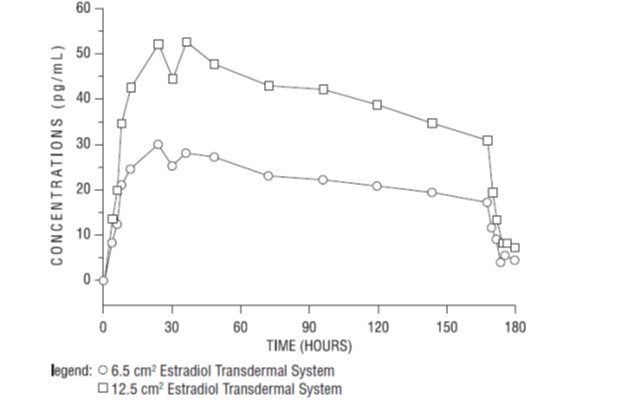
In a bioavailability study, the Estradiol Transdermal System 6.5 cm2 was studied with the Estradiol Transdermal System 12.5 cm2 as reference. The mean estradiol levels in serum from the two sizes are shown in Figure 1.
Figure 1: Mean Serum 17ß -Estradiol Concentrations versus Time Profile following Application of
a 6.5 cm2 Estradiol Transdermal System and Application of a 12.5 cm2 Estradiol Transdermal System
Dose proportionality was demonstrated for the 6.5 cm2 Estradiol Transdermal System as compared to the 12.5 cm2 Estradiol Transdermal System in a 2-week crossover study with a 1-week washout period between the two-transdermal systems in 24 postmenopausal women.
Dose proportionality was also demonstrated for the Estradiol Transdermal System (12.5 cm2 and 25 cm2) in a 1-week study conducted in 54 postmenopausal women. The mean steady state levels (Cavg) of the estradiol during the application of the Estradiol Transdermal System 25 cm2 and 12.5 cm2 on the abdomen were about 80 and 40 pg/mL, respectively.
In a 3-week multiple application study in 24 postmenopausal women, the 25 cm2 Estradiol Transdermal System produced average peak estradiol concentrations (Cmax) of approximately 100 pg/mL. Trough values at the end of each wear interval (Cmin) were approximately 35 pg/mL. Nearly identical serum curves were seen each week, indicating little or no accumulation of estradiol in the body. Serum estrone peak and trough levels were 60 and 40 pg/mL, respectively.
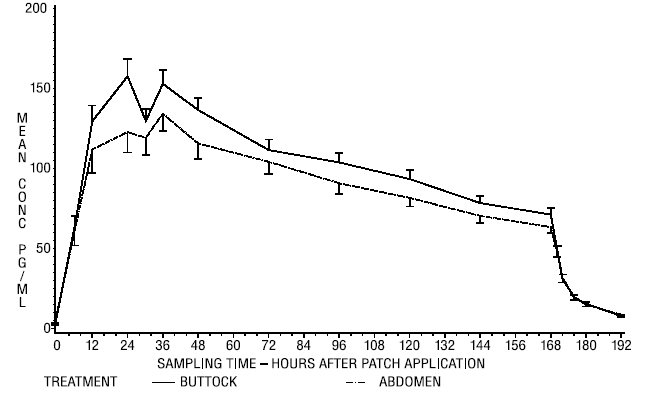
In a single dose, randomized, crossover study conducted to compare the effect of site of application, 38 postmenopausal women wore a single 25 cm2 Estradiol Transdermal System for 1 week on the abdomen and buttocks. The estradiol serum concentration profiles are shown in Figure 2. Values of Cmax and Cavg were, respectively, 25 percent and 17 percent higher with the buttock application than with the abdomen application.
Figure 2: Observed Mean (± SE) Estradiol Serum Concentrations for a One Week Application
of the Estradiol Transdermal System (25 cm2 ) to the Abdomen and Buttocks of 38 Postmenopausal Women
Table 2 provides a summary of estradiol pharmacokinetic parameters determined during evaluation of the Estradiol Transdermal System.
Table 2: Pharmacokinetic Summary (Mean Estradiol Values)
Estradiol Transdermal System Delivery
Rate | Surface
Area
(cm2) | Application
Site | No. of
Subjects | Dosing | Cmax
(pg/mL) | Cmin
(pg/mL) | Cavg
(pg/mL) |
0.025 | 6.5 | Abdomen | 24 | Single | 32 | 17 | 22 |
0.05 | 12.5 | Abdomen | 102 | Single | 71 | 29 | 41 |
0.1 | 25 | Abdomen | 139 | Single | 147 | 60 | 87 |
0.1 | 25 | Buttock | 38 | Single | 174 | 71 | 106 |
The relative standard deviation of each pharmacokinetic parameter after application to the abdomen averaged 50 percent, which is indicative of the considerable intersubject variability associated with transdermal drug delivery. The relative standard deviation of each pharmacokinetic parameter after application to the buttock was lower than that after application to the abdomen (for example, for Cmax 39 percent versus 62 percent, and for Cavg 35 percent versus 48 percent).