CLINICAL STUDIES
The clinical evidence for the efficacy of PLAVIX is derived from
four double-blind trials involving 81,090 patients: the CAPRIE study
(Clopidogrel vs. Aspirin in Patients at Risk of Ischemic Events), a comparison
of PLAVIX to aspirin, and the CURE (Clopidogrel in Unstable Angina to Prevent
Recurrent Ischemic Events), the COMMIT/CCS-2 (Clopidogrel and Metoprolol in
Myocardial Infarction Trial / Second Chinese Cardiac Study) studies comparing
PLAVIX to placebo, both given in combination with aspirin and other standard
therapy and CLARITY-TIMI 28 (Clopidogrel as Adjunctive Reperfusion Therapy –
Thrombolysis in Myocardial Infarction).
Recent Myocardial Infarction (MI), Recent Stroke or
Established Peripheral Arterial Disease
The CAPRIE trial was a 19,185-patient, 304-center, international,
randomized, double-blind, parallel-group study comparing PLAVIX (75 mg daily) to
aspirin (325 mg daily). The patients randomized had: 1) recent histories of
myocardial infarction (within 35 days); 2) recent histories of ischemic stroke
(within 6 months) with at least a week of residual neurological signs; or 3)
objectively established peripheral arterial disease. Patients received
randomized treatment for an average of 1.6 years (maximum of 3 years).
The trial's primary outcome was the time to first occurrence of new ischemic
stroke (fatal or not), new myocardial infarction (fatal or not), or other
vascular death. Deaths not easily attributable to nonvascular causes were all
classified as vascular.
As shown in the table, PLAVIX (clopidogrel bisulfate) was associated with a
lower incidence of outcome events of every kind. The overall risk reduction
(9.8% vs. 10.6%) was 8.7%, P=0.045. Similar results were obtained when all-cause
mortality and all-cause strokes were counted instead of vascular mortality and
ischemic strokes (risk reduction 6.9%). In patients who survived an on-study
stroke or myocardial infarction, the incidence of subsequent events was again
lower in the PLAVIX group.
The curves showing the overall event rate are shown in Figure 1. The event
curves separated early and continued to diverge over the 3-year follow-up
period.
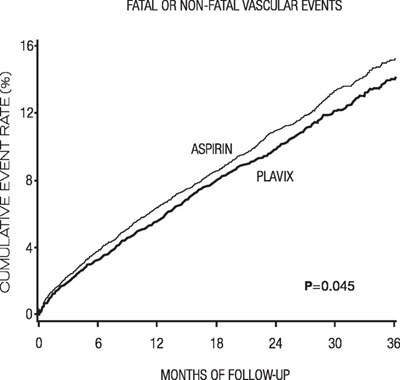
Chart Image (Plavix 75mg Chart)
CHART
Although the statistical significance favoring PLAVIX over aspirin was
marginal (P=0.045), and represents the result of a single trial that has not
been replicated, the comparator drug, aspirin, is itself effective (vs. placebo)
in reducing cardiovascular events in patients with recent myocardial infarction
or stroke. Thus, the difference between PLAVIX and placebo, although not
measured directly, is substantial.
The CAPRIE trial included a population that was randomized on the basis of 3
entry criteria. The efficacy of PLAVIX relative to aspirin was heterogeneous
across these randomized subgroups (P=0.043). It is not clear whether this
difference is real or a chance occurrence. Although the CAPRIE trial was not
designed to evaluate the relative benefit of PLAVIX over aspirin in the
individual patient subgroups, the benefit appeared to be strongest in patients
who were enrolled because of peripheral vascular disease (especially those who
also had a history of myocardial infarction) and weaker in stroke patients. In
patients who were enrolled in the trial on the sole basis of a recent myocardial
infarction, PLAVIX was not numerically superior to aspirin.
In the meta-analyses of studies of aspirin vs. placebo in patients similar to
those in CAPRIE, aspirin was associated with a reduced incidence of thrombotic
events. There was a suggestion of heterogeneity in these studies too, with the
effect strongest in patients with a history of myocardial infarction, weaker in
patients with a history of stroke, and not discernible in patients with a
history of peripheral vascular disease. With respect to the inferred comparison
of PLAVIX to placebo, there is no indication of heterogeneity.
Acute Coronary Syndrome
The CURE study included 12,562 patients with acute coronary
syndrome without ST segment elevation (unstable angina or non-Q-wave myocardial
infarction) and presenting within 24 hours of onset of the most recent episode
of chest pain or symptoms consistent with ischemia. Patients were required to
have either ECG changes compatible with new ischemia (without ST segment
elevation) or elevated cardiac enzymes or troponin I or T to at least twice the
upper limit of normal. The patient population was largely Caucasian (82%) and
included 38% women, and 52% patients ≥65 years of age.
Patients were randomized to receive PLAVIX (300 mg loading dose followed by
75 mg/day) or placebo, and were treated for up to one year. Patients also
received aspirin (75–325 mg once daily) and other standard therapies such as
heparin. The use of GPIIb/IIIa inhibitors was not permitted for three days prior
to randomization.
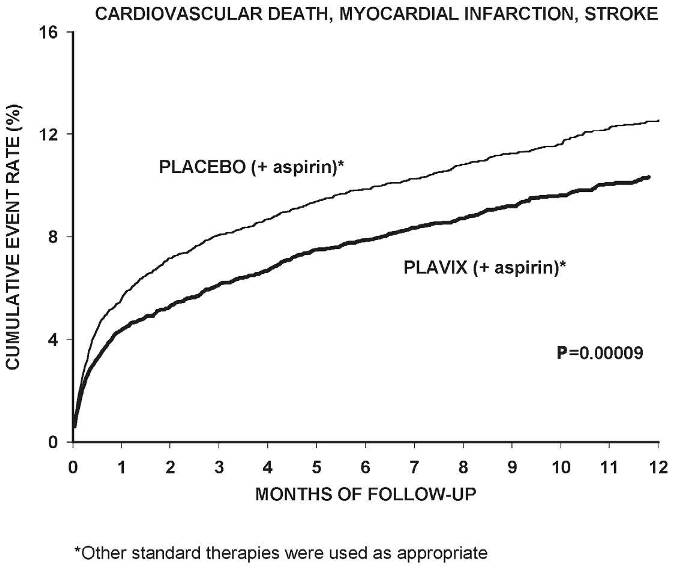
The number of patients experiencing the primary outcome (CV death, MI, or
stroke) was 582 (9.30%) in the PLAVIX-treated group and 719 (11.41%) in the
placebo-treated group, a 20% relative risk reduction (95% CI of 10%–28%;
p=0.00009) for the PLAVIX-treated group (see Table 3).
At the end of 12 months, the number of patients experiencing the co-primary
outcome (CV death, MI, stroke or refractory ischemia) was 1035 (16.54%) in the
PLAVIX-treated group and 1187 (18.83%) in the placebo-treated group, a 14%
relative risk reduction (95% CI of 6%–21%, p=0.0005) for the PLAVIX-treated
group (see Table 3).
In the PLAVIX-treated group, each component of the two primary endpoints (CV
death, MI, stroke, refractory ischemia) occurred less frequently than in the
placebo-treated group.
The benefits of PLAVIX (clopidogrel bisulfate) were maintained throughout the
course of the trial (up to 12 months).

Chart Image 2 (Plavix 75mg Chart2)
CHART 2
In CURE, the use of PLAVIX was associated with a lower incidence of CV death,
MI or stroke in patient populations with different characteristics, as shown in
Figure 3. The benefits associated with PLAVIX were independent of the use of
other acute and long-term cardiovascular therapies, including heparin/LMWH (low
molecular weight heparin), IV glycoprotein IIb/IIIa (GPIIb/IIIa) inhibitors,
lipid-lowering drugs, beta-blockers, and ACE-inhibitors. The efficacy of PLAVIX
was observed independently of the dose of aspirin (75–325 mg once daily). The
use of oral anticoagulants, non-study anti-platelet drugs and chronic NSAIDs was
not allowed in CURE.
The use of PLAVIX in CURE was associated with a decrease in the use of
thrombolytic therapy (71 patients [1.1%] in the PLAVIX group, 126 patients
[2.0%] in the placebo group; relative risk reduction of 43%, P=0.0001), and
GPIIb/IIIa inhibitors (369 patients [5.9%] in the PLAVIX group, 454 patients
[7.2%] in the placebo group, relative risk reduction of 18%, P=0.003). The use
of PLAVIX in CURE did not impact the number of patients treated with CABG or PCI
(with or without stenting), (2253 patients [36.0%] in the PLAVIX group, 2324
patients [36.9%] in the placebo group; relative risk reduction of 4.0%,
P=0.1658).
In patients with ST-segment elevation acute myocardial infarction, safety and
efficacy of clopidogrel have been evaluated in two randomized,
placebo-controlled, double-blind studies, COMMIT- a large outcome study
conducted in China - and CLARITY- a supportive study of a surrogate endpoint
conducted internationally.
The randomized, double-blind, placebo-controlled, 2×2 factorial design COMMIT
trial included 45,852 patients presenting within 24 hours of the onset of the
symptoms of suspected myocardial infarction with supporting ECG abnormalities
(i.e., ST elevation, ST depression or left
bundle-branch block). Patients were randomized to receive PLAVIX (75 mg/day) or
placebo, in combination with aspirin (162 mg/day), for 28 days or until hospital
discharge whichever came first.
The co-primary endpoints were death from any cause and the first occurrence
of re-infarction, stroke or death.
The patient population included 28% women, 58% patients ≥60 years (26%
patients ≥70 years) and 55% patients who received thrombolytics, 68% received
ace-inhibitors, and only 3% had percutaneous coronary intervention (PCI).
As shown in Table 4 and Figures 4 and 5 below, PLAVIX significantly reduced
the relative risk of death from any cause by 7% (p = 0.029), and the relative
risk of the combination of re-infarction, stroke or death by 9% (p = 0.002).

Chart Image3 (Plavix 75mg Chart3)
CHART 3
The effect of PLAVIX did not differ significantly in various pre-specified
subgroups as shown in Figure 6. Additionally, the effect was similar in
non-prespecified subgroups including those based on infarct location, Killip
class or prior MI history (see Figure 7). Such subgroup
analyses should be interpreted very cautiously.
The randomized, double-blind, placebo-controlled CLARITY trial included 3,491
patients, 5% U.S., presenting within 12 hours of the onset of a ST elevation
myocardial infarction and planned for thrombolytic therapy. Patients were
randomized to receive PLAVIX (300-mg loading dose, followed by 75 mg/day) or
placebo until angiography, discharge, or Day 8. Patients also received aspirin
(150 to 325 mg as a loading dose, followed by 75 to 162 mg/day), a fibrinolytic
agent and, when appropriate, heparin for 48 hours. The patients were followed
for 30 days.
The primary endpoint was the occurrence of the composite of an occluded
infarct-related artery (defined as TIMI Flow Grade 0 or 1) on the predischarge
angiogram, or death or recurrent myocardial infarction by the time of the start
of coronary angiography.
The patient population was mostly Caucasian (89.5%) and included 19.7% women
and 29.2% patients ≥65 years. A total of 99.7% of patients received
fibrinolytics (fibrin specific: 68.7%, non-fibrin specific: 31.1%), 89.5%
heparin, 78.7% beta-blockers, 54.7% ACE inhibitors and 63% statins.
The number of patients who reached the primary endpoint was 262 (15.0%) in
the PLAVIX-treated group and 377 (21.7%) in the placebo group, but most of the
events related to the surrogate endpoint of vessel patency.